博客

  • Matthew Welcomes Home Team Antigua and Barbuda After Strong CARIFTA Aquatics Performance

    Matthew Welcomes Home Team Antigua and Barbuda After Strong CARIFTA Aquatics Performance

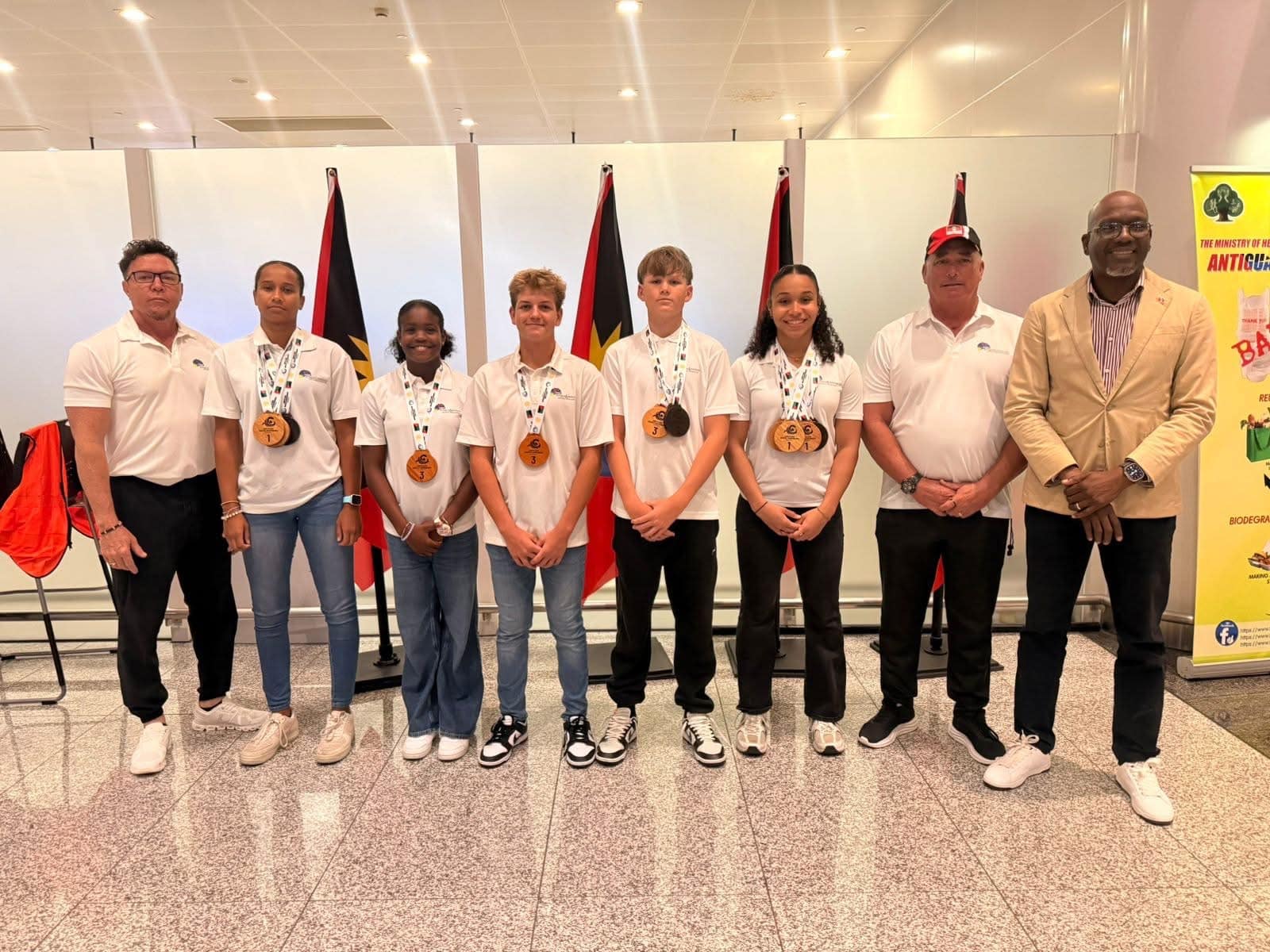
    After delivering an outstanding showing at the 39th CARIFTA Aquatics Championships, Antigua and Barbuda’s national swimming squad has returned to a hero’s welcome in St. John’s, with the nation’s Sports Minister Daryll Matthew hailing the team’s efforts as a landmark moment for the country’s aquatic sports development.

    In an official statement released following the team’s arrival, Matthew shared that he felt profound excitement to greet the young athletes back on home soil after their run at one of the Caribbean’s most prestigious regional age-group swimming competitions. Throughout the five-day meet, Matthew noted, every member of the delegation brought unwavering consistency and a high level of competitive excellence to every race they entered, exceeding pre-event expectations.

    Leading the team’s historic medal haul was 16-year-old swimmer Anya DeGannes, who earned special recognition from the minister for her multi-gold performance and a series of new age-group records set at the championships. DeGannes was not the only standout, however: Madison MacMillan and Ellie Shaw also stepped onto the top of the podium, with MacMillan claiming gold and Shaw taking silver in their competitive divisions, both turning in personal best times to secure their places among the region’s top young swimmers.

    Two male competitors, Jamie Tranter and Alessandro Bazzoni, also earned public praise from Matthew for climbing onto the podium and setting new national and age-group records during their events. The minister did not limit his commendations to medal-winners alone, highlighting the grit, dedication, and team-first spirit of Kaylee Warner, Alyssa Watkins, Christopher Walter, and Selah Wiltshire, whose consistent strong performances contributed directly to the squad’s overall successful showing.

    Beyond the impressive collection of medals, Matthew emphasized that the team’s achievements extended to a range of other milestones. Multiple new national and age-group records were broken over the course of the competition, and nearly every swimmer representing Antigua and Barbuda walked away with a new personal best time, a result that underscores the steady growth of the sport across the country.

    The minister also stressed that the team’s success would not have been possible without the hard work of the national coaching staff. He pointed to the staff’s months of rigorous preparation and long-term commitment to athlete development as core factors that allowed the young swimmers to perform at their best when it mattered most on the regional stage.

    Looking ahead, Matthew framed the team’s performance at the 2024 CARIFTA Aquatics Championships as clear evidence that swimming in Antigua and Barbuda is moving in the right direction, with a new generation of talented young athletes proving they can compete with the best in the Caribbean. The result, he said, offers exciting promise for the future of the sport and the nation’s upcoming competitors in regional and international events.

  • Matthews strengthens SVG’s NY consulate’s engagement with NYPD

    Matthews strengthens SVG’s NY consulate’s engagement with NYPD

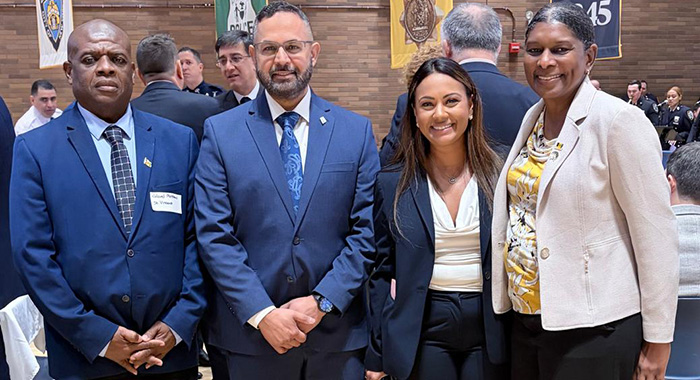
    In a major diplomatic and security gathering hosted by the New York City Police Department, the Consulate General of St. Vincent and the Grenadines (SVG) in New York, headed by Consul General Roland U.C. Matthews, took part in a high-level engagement that brought together top diplomatic representatives from more than 70 nations across the globe.

    This convening created a one-of-a-kind collaborative space, designed to open lines of dialogue, build new working partnerships, and strengthen existing ties between foreign consular bodies and one of the world’s most prominent law enforcement agencies. Over the course of the event, senior leaders from three key NYPD divisions — the Intelligence and Counterterrorism Bureau, the Community Affairs Bureau, and the Public Security Section — delivered detailed presentations showcasing the department’s far-reaching expertise across three core areas: proactive crime prevention, cross-agency intelligence sharing, and community-centered policing strategies.

    Attendees also received an exclusive look into the NYPD’s advanced Joint Operations Center, where officials walk through the department’s data-driven, strategic framework for upholding public safety in New York City, a global metropolis known for its constant dynamism and diverse population.

    For SVG, a small island developing state, the participation marked a pivotal step forward in deepening bilateral security and law enforcement cooperation with U.S. law enforcement. The gathering allowed delegations to continue discussions first initiated in earlier talks, laying solid groundwork for expanded future collaboration — most notably, the development of specialized close protection training for officers of the Royal St. Vincent and the Grenadines Police Force (RSVGPF).

    In comments following the engagement, Consul General Matthews underscored the immense value of these cross-border law enforcement dialogues. “This event provided an invaluable opportunity to connect with fellow consuls general, all of whom share a common objective to ensure that our nationals continue to receive the support they need while abroad, and to foster meaningful dialogue that benefits both our home countries and our host nation,” Matthews said.

    He added that as a small island developing state, SVG actively prioritizes and seeks out capacity-building opportunities like this high-level meeting. “Today, we have started an important conversation, and I am confident that what has begun here will bear fruit in the not-too-distant future,” Matthews noted.

    Widely regarded as one of the most well-resourced and technologically advanced metropolitan police departments in the world, the NYPD used the event to highlight its longstanding track record of effective crime reduction, innovative public safety solutions, and sustained engagement with diverse community groups, including foreign national populations residing in New York.

    Looking ahead, follow-up sessions between SVG consular officials and senior NYPD leadership are scheduled to take place in the coming weeks. These upcoming meetings will focus on locking in concrete, actionable areas of partnership that can be implemented in the near term. Officials project that the final outcomes of this collaboration will deliver tangible, long-lasting benefits to the RSVGPF, ultimately contributing to improved national safety and security across St. Vincent and the Grenadines.

  • Notice of Appointment of Returning Officers

    Notice of Appointment of Returning Officers

    A formal official notice has been issued to confirm the appointment of returning officers, a key step in preparing for upcoming electoral processes.

    Returning officers hold a critical responsibility in the smooth execution of any democratic election: they oversee all on-the-ground logistics for voting stations, validate the eligibility of candidates on the local level, manage polling day operations, and ultimately announce the final results for their respective electoral districts. Their work forms the backbone of transparent, orderly electoral proceedings, ensuring that every vote is counted correctly and the entire process adheres to established legal and regulatory frameworks.

    This appointment notice comes as election organizers advance through pre-election planning milestones. The appointments are the result of a rigorous screening process that evaluated candidates’ administrative experience, impartiality, and ability to manage complex, high-stakes logistical operations under strict deadlines. All appointees have confirmed their acceptance of the roles and are scheduled to complete mandatory pre-election training covering updates to electoral law, new voting technology protocols, and procedures for handling potential disruptions or disputes on polling day.

    Election commission officials have emphasized that the appointment of returning officers is a core requirement to keep the electoral timeline on track, and that all selected individuals have committed to upholding the principles of neutrality and transparency throughout the electoral cycle. Further announcements detailing the specific electoral districts assigned to each returning officer are expected to be released to the public in the coming weeks.

  • Dion Kiethly Massiah Wins Jermaine Kentish Birthday Shootout for Third Straight Year

    Dion Kiethly Massiah Wins Jermaine Kentish Birthday Shootout for Third Straight Year

    In an extraordinary display of consistent dominance in competitive shooting, Dion Kiethly Massiah has etched his name into the history books of the Jermaine Kentish Birthday Shootout, securing the tournament title for the third year running. The annual competition, organized to mark the birthday of the sport’s beloved community figure Jermaine Kentish, has grown into one of the most anticipated local shooting tournaments of the year, drawing dozens of top competitors from across the region each December.

    This year’s event, held at the host shooting range over the weekend, saw Massiah outperform a field of 42 skilled sharpshooters through a series of grueling elimination rounds. From the opening qualifying stages, Massiah established his edge, posting the highest aggregate score across the first three rounds to secure the top seed heading into the knockout bracket. He maintained this momentum through each subsequent match, delivering near-flawless performances in pressure situations that pushed several of his opponents to their limits.

    In the final head-to-head showdown, Massiah faced off against rising young shooter Marcus Green, who had pulled off two major upsets to reach the championship round. Despite a strong challenge from Green, who narrowed the score gap to just two points in the final five shots, Massiah held his nerve, sinking three consecutive bullseyes to seal the win with a final score of 147 out of a possible 160. Speaking after the victory, Massiah credited his consistent training routine and the supportive community around the Jermaine Kentish Shootout for his three-peat success.

    Tournament organizers noted that the event has grown significantly since its founding, both in participation numbers and community engagement, with proceeds from this year’s competition going toward supporting youth shooting sports programs in the area. Jermaine Kentish, the namesake of the tournament, praised Massiah’s achievement, calling his three consecutive wins a testament to his skill, discipline, and love for the sport.

  • Bepalen onderwijsagenda is een Surinaams voorrecht

    Bepalen onderwijsagenda is een Surinaams voorrecht

    For decades, Suriname’s education system has grappled with the same persistent set of challenges: burned-out, underpaid teachers, unmotivated students, stagnant literacy and numeracy skills, and slow adaptation to the demands of modern society. When compared to how little core work has changed for professions like auto mechanics and technicians, it becomes clear that systemic transformation in education has lagged far behind where it needs to be. Even as the public widely recognizes that education is the single most future-defining investment a nation can make, there remains a widespread, long-held sense that Suriname is not unlocking the full potential of its young people.

    In an era marked by cultural pessimism, widespread distrust of governance, and a tendency to frame public frustration as unconstructive outrage, one core fact stands out: Suriname currently lacks a sufficient pool of qualified education experts to drive the urgently needed systemic overhaul the sector requires. As the nation prepares for a wave of new development in coming years, this transformation could not be more critical. Drawing on decades of firsthand experience in education reform in Suriname since returning to the country in 2000, the author argues that lifting the education system to new heights requires targeted, structured policy, a clear policy framework with actionable tools, institutional strengthening, sustainable financing, ongoing dialogue with frontline education workers, and most importantly, broad buy-in from teachers, parents, and other key stakeholders. Successful reform, he emphasizes, must follow a bottom-up approach rooted in local needs.

    Innovating education is a specialized craft, not a problem that can be solved with a quick fix or silver bullet. Even the most promising policy ideas can fail without careful, thoughtful implementation. Despite these challenges, the author remains optimistic about the future of Suriname’s education sector. Having seen both the tangible successes and unintended setbacks of reform efforts over more than two decades, he argues that moving forward with a clear, locally defined, Suriname-owned reform agenda is non-negotiable.

    A core priority of this agenda is raising public education investment to at least 20% of the national budget and 10% of the country’s gross domestic product. The author acknowledges that increased funding alone is not a panacea for all systemic ills, and recognizes the extraordinary economic pressures the current cabinet faces amid an ongoing national crisis, which has created widespread financial uncertainty. Even so, he argues that strategic investment in education and a knowledge-based economy is a foundational requirement for long-term economic recovery, making a structural increase in education and research spending unavoidable.

    Currently, per-student education spending in neighboring countries is growing far faster than in Suriname, even as the challenges facing Suriname’s education system continue to grow. To address this gap, reform leaders are developing evidence-based calculations for the structural and additional investment the sector will need for future growth. Only through sustained, broad-based investment can Suriname enable earlier education access, extend learning opportunities, remove unnecessary barriers to participation, keep teaching careers attractive, unlock the full potential of every student, and support world-class research and innovation. Clear direction and intentional future-focused policy choices are essential to achieving these goals.

    The 13-pillar roadmap laid out for Suriname’s publicly funded education and research sector aims to bring the system to regional top-tier status, with undisputed quality and up-to-date curricular content anchored by evidence-based policy that draws on ongoing research into the impact of implemented reforms. The core pillars of this plan are: 1. Universal access to education and equal opportunity for all students to maximize their unique talents through intentional talent management; 2. Investment in institutional strengthening for a National Curriculum Institute to lead curriculum development, testing, and assessment; 3. Reorienting education to motivate students to reach their potential, with a balanced focus on motivation, student well-being, and academic performance by strengthening mental skill development in curricula; 4. Ensuring students at all levels receive proper recognition for both practical and theoretical skills, aligned with labor market needs and national capacity building; 5. Normalizing lifelong learning, allowing adults to access retraining and upskilling opportunities through public education providers; 6. Making education careers attractive through competitive working conditions and dedicated opportunities for professional growth for education professionals; 7. Developing knowledge networks to position Suriname as an attractive partner for international and domestic research and innovation collaboration; 8. Expanding early childhood education and care for children aged 0–4, as a strong foundational base for lifelong learning; 9. Evaluating and updating learning outcomes with continuous learning pathways across primary, secondary, vocational, and special education; 10. Building a broad, strong culture of lifelong learning across all sectors of society; 11. Driving cultural change among education professionals to build a more collaborative sector with more attractive working conditions; 12. Developing a national science policy to support world-standard research and innovation; 13. Launching a national school renovation and construction program to bring all school facilities up to top functional condition.

    This opinion piece is written by Prof. dr. Henry R. Ori.

  • Oil and gas mission to Caracas

    Oil and gas mission to Caracas

    Trinidad and Tobago Prime Minister Kamla Persad-Bissessar has announced that a diplomatic delegation bound for Venezuela will depart the twin-island nation in the near future, with the core goal of securing what the government describes as the country’s rightful share of jointly owned oil and gas resources held via the state-run National Gas Company (NGC).

    Persad-Bissessar made the announcement during a public event on Wednesday, where she oversaw the official commissioning of six new fire tenders at the Penal Fire Station. She framed the upcoming diplomatic mission as part of her administration’s broader work to safeguard national security both in public safety and in the critical economic domain.

    “Whilst we bring help and promote safety and security with these fire tenders, I just want to tell you that we’ve been working really hard with the government of the United States and other governments, and that shortly, a diplomatic delegation will depart Trinidad and Tobago to go to Venezuela to ensure we get our just share of the oil and gas that we partly own through the NGC,” Persad-Bissessar told attendees at the ceremony. She added, “So, while we look to safety and security in this sense, we are looking for your safety and security in the economic space, which is very important. We have not forgotten.”

    When pressed by reporters on whether she would personally join the traveling delegation, the Prime Minister described the travel plans as still “a work in progress” with no final details confirmed.

    The planned mission comes against the backdrop of months of tense diplomatic and energy relations between the two neighboring Caribbean and South American nations, and recent progress in securing US regulatory approval for energy cooperation. Back in October 2025, Trinidad and Tobago received an official OFAC (Office of Foreign Assets Control) license from the US Treasury Department, clearing the way for the country to advance work on the joint Dragon gas development project with Venezuela. This license marked a key milestone for the initiative, as sweeping US sanctions on Venezuela’s energy sector have long restricted cross-border energy projects involving the country.

    Persad-Bissessar previously noted that the OFAC license was the outcome of extensive behind-the-scenes diplomatic work, and represented a new opening for ongoing negotiations. She credited progress to a recent productive meeting with US Secretary of State Marco Rubio in Washington D.C., where the two sides discussed deepening bilateral cooperation and advancing shared strategic and economic interests.

    Weeks before the license was granted, however, bilateral relations hit a major low. In October 2025, then-Venezuelan Vice President Delcy Rodriguez announced that Caracas would immediately suspend all gas cooperation agreements with Trinidad and Tobago, a decision that was approved by Venezuelan President Nicolas Maduro following a proposal from the board of state-owned oil giant PDVSA (Petroleos de Venezuela).

    The suspension was triggered by Venezuelan anger over a port call by the US warship USS Gravely to Port of Spain on October 26, 2025. Caracas accused Trinidad and Tobago of collaborating with the US on what it claimed was a planned false-flag operation hostile to the Venezuelan government, with Rodriguez stating that the warship’s presence amounted to an act of aggression against Venezuela.

    The terminated 2015 Framework Agreement on Energy Cooperation covered a wide range of joint initiatives, including shared gas field development, cross-border energy infrastructure, hydrocarbon exploration, and coordinated development of shared natural resources. The agreement was originally set for a 10-year term, and had been automatically renewed for an additional five years just months before the suspension, in February 2026. Rodriguez noted at the time that the agreement’s Article 13, Paragraph 3 granted either party the unilateral right to terminate the deal, justifying Caracas’s action. Following the suspension, Venezuela’s National Assembly voted to declare Persad-Bissessar persona non grata.

    This is not the first round of diplomatic outreach to Caracas on energy issues under the current administration. The upcoming mission follows more than a dozen trips to Venezuela by former Trinidadian Energy Minister Stuart Young between August 2022 and June 2024, totaling 34 days of on-the-ground negotiations. Prior to the 2025 Dragon project license, OFAC issued a separate license in 2024 clearing the way for development of the cross-border Manakin-Cocuina gas field, which is set to be operated by British energy major BP. Both licenses are required to comply with longstanding US sanctions targeting Venezuela’s energy sector.

    Despite the past months of tensions, Persad-Bissessar has pushed back on claims of a permanent rupture, confirming that formal diplomatic relations between Trinidad and Tobago and Venezuela remain intact.

  • It’s time to wake up

    It’s time to wake up

    Five months into the tenure of the New Democratic Party (NDP) administration led by Prime Minister Godwin Friday, a prominent regional lawyer, journalist and social commentator Jomo Thomas has sounded a public alarm: the new government is in dire need of a skilled professional communications strategist to reverse eroding public credibility.

    For weeks, widespread dissatisfaction with the NDP’s disjointed public messaging has bubbled under the surface of political discourse in St. Vincent and the Grenadines, but until now few have voiced the criticism openly. Thomas argues that the era of polite, behind-the-scenes feedback is over, and hard truths must be shared before the government loses what remaining public trust it holds.

    In just 20 weeks in office, the administration has accumulated a growing trail of missteps: contradictory statements from different cabinet members, uncoordinated policy announcements, overreaching executive actions, and confirmed instances of public misinformation. While individual incidents may appear trivial on their own, Thomas notes that taken together, they reveal a dangerous pattern of disorganization that the post-election goodwill from the party’s November 2025 decisive electoral victory can no longer obscure.

    As the administration approaches its six-month milestone, a clear majority of Vincentians still cannot articulate the government’s core policy priorities or long-term national direction. Even for loyal NDP supporters who may take offense to this assessment, the reality is unavoidable: for many ordinary citizens, the current government feels indistinguishable from the previous Unity Labour Party administration it defeated, carrying over the same policy approaches, leadership styles, and bureaucratic habits. This lack of visible change has left many voters openly questioning what purpose their landslide election win actually served.

    From the earliest days of the NDP’s term, political observers warned that while the party ran a vigorous, effective campaign, it entered office unprepared for the day-to-day demands of governing. Supporters of the new administration pushed back at the time, arguing that all new governments face an expected learning period. But Thomas points out that a productive learning curve depends on three key traits: humility to accept gaps in knowledge, discipline to implement structural changes, and willingness to act on feedback – traits he says the current administration has so far lacked, instead leaning into stubbornness and complacency.

    Too many incoming cabinet members and political appointees have entered office assuming they already possess the skills needed to govern, Thomas says, rejecting outside guidance or professional support. The outcomes of this overconfidence are already visible to the public.

    Persistent public speculation has emerged that Deputy Prime Minister St. Clair Leacock functions as the de facto head of government, even as many dismiss these rumors as unfounded. Notably, the administration’s own poor communication strategy has done nothing to counter this growing public perception. Increasingly, voters only see Prime Minister Friday at low-stakes, image-focused events: school openings, local sports competitions, and other photo-ready public appearances. Thomas stresses that the Office of the Prime Minister is not a prop for social media content; it requires consistent, serious public visibility and clear demonstration of national leadership.

    Thomas adds that the current press secretary, while widely recognized as a hardworking contributor during the election campaign, lacks the specialized training and high-level experience required to manage national government communications. This is not a personal criticism, he clarifies, but an objective observation of a critical professional gap that needs addressing. Running communications for an election campaign and coordinating national public messaging for a sitting government are entirely different roles requiring vastly different skill sets.

    Voters often criticized former Prime Minister Ralph Gonsalves for his overwhelming, omnipresent public profile, Thomas acknowledges, but one clear benefit of that leadership style was that the public always knew exactly where the administration stood on key issues. There was no question who the national leader was, and the entire cabinet aligned behind consistent messaging. Thomas emphasizes that no one is calling for a return to Gonsalves’ authoritarian-style leadership, but effective governance by any administration requires clear, consistent messaging. If Friday is doing the work of leading effectively behind closed doors, that work is completely invisible to the public – and in politics, public perception shapes reality.

    The urgent need for a professional communications strategist extends far beyond optimizing social media content, Thomas explains. The new hire would be tasked with coordinating consistent messaging across all government-owned and aligned platforms, including the Agency for Public Information, NBC Radio, VC3 Television, and other state media outlets. Without this coordinated leadership, Thomas warns the NDP administration will continue to be seen as unfocused, reactive to events rather than proactive, and internally divided.

    The initial public excitement that followed the NDP’s early policy moves – including the popular VAT-free shopping day and the partial reinstatement of public servants dismissed by the previous administration – has already worn off. Five months in, voters are increasingly asking: what tangible, meaningful change has the government delivered since those opening moves? What is the administration’s long-term plan for the country? Who is actually in charge of setting the national agenda?

    Thomas urges the NDP leadership to wake up to a core political reality: governance and political communication cannot be separated. The party’s chances of winning re-election at the end of the term will not depend solely on delivering policy outcomes. It will depend on how well it communicates its vision, how consistently it demonstrates leadership, and how effectively it manages public perception of its work.

    It is past time for the NDP to get serious about fixing this critical gap, Thomas says. It is past time for the administration to act. If the party fails to address its communication failures soon, it risks fulfilling the current fears of many political observers: becoming a one-term administration that squandered its electoral mandate before it had a chance to deliver on its promises.

    By S. Smith
    *This is an opinion piece. The views expressed are those of the author and do not represent the official editorial position of iWitness News.*
  • 11 shells, two guns, self defence claimed

    11 shells, two guns, self defence claimed

    A fatal shooting has shaken the quiet community of Vistabella in San Fernando, Trinidad, claiming the life of a well-known local construction businessman and leaving investigators untangling the circumstances of a deadly confrontation between the victim and an unidentified woman early yesterday morning.

    Thirty-seven-year-old Steve Ghany, a married father of two with 11 years of marriage, was deeply embedded in his family’s multi-project construction business and was also a prominent figure in the local jet-ski community. According to initial police accounts, the conflict erupted shortly after 8:30 a.m. inside Ghany’s residential property, when a verbal argument between Ghany and the woman escalated rapidly into a physical altercation.

    After several minutes of back-and-forth struggle, law enforcement reports indicate Ghany retrieved a firearm and fired shots toward the woman, who emerged from that exchange unharmed. Investigators were later told by a Ghany family relative that the woman then seized a second weapon and returned fire, striking Ghany multiple times. He succumbed to his injuries at the scene before emergency responders could intervene.

    Crime scene processing teams recovered two functional firearms and 11 spent bullet casings from the property as key evidence. The woman involved was taken into custody at the home immediately after the shooting; she was transported to receive mandatory medical assessment before being moved to a holding facility at the Southern Division police station.

    Multiple law enforcement units, including Region Three Homicide Detectives, the Southern Division Task Force, and the San Fernando Criminal Investigations Department, have launched a full probe to map out the full sequence of events and identify what motive sparked the deadly confrontation. Attorney Prakash Ramadhar, who visited the Ghany residence to meet with family members and law enforcement shortly after the incident, declined to comment on the case when contacted by local outlet Express. “It is too early at this time to make a statement on behalf of the family,” Ramadhar said via phone.

    A Ghany family employee, who spoke to reporters on condition of anonymity, described the chaotic moments after he arrived for work yesterday. The worker said he first heard a series of loud bangs around 9:15 a.m. but did not immediately recognize the sounds as gunfire. “I went to check the work we were supposed to do today on the house, when we heard a few noises like ‘Bang! Bang! Bang! Bang! Bang!’ My son asked me if that noise was galvanise pounding. About five minutes later, a policeman came into the yard and asked me what was happening. I told him I didn’t know what was going on. It was a while after I realised that something had happened,” the employee recalled.

    The worker spoke warmly of Ghany, describing him as a fair, approachable employer who treated his staff like family. “Steve treated all of his workers very good, and he was understanding. He would call those fellas on the phone and talk to them normal. He said we were part of his family, and he trusted us, his workers,” the employee said.

    The shooting comes just months after a separate high-profile gun violence incident that rocked the Ghany family. In December 2024, Ghany’s stepmother Monica Ghany was killed in a targeted ambush, and his brother Matthew was wounded. The attack unfolded as Monica and Matthew left San Fernando General Hospital, driving along a major commuter route near the water taxi ferry terminal on their way back to the family’s San Fernando home. Gunmen in an oncoming vehicle pulled alongside and opened fire on the driver’s side of their Nissan Tiida, striking Monica multiple times in the upper body. She was pronounced dead at the scene, while Matthew survived a gunshot wound to his right hand. The attackers fled the area, and the killing remains an open, unsolved case. Monica Ghany’s husband — also named Steve Ghany — died just a few months after the ambush.

    Speaking to reporters yesterday at the formal handing-over ceremony for the new Penal Fire Station, Minister of Homeland Security Roger Alexander offered public condolences to the Ghany family, noting he had met with Steve Ghany just over the weekend during a visit to a local rifle range. “I hope the good Lord bless his soul, and that the family will be able to live again after this incident,” Alexander said, confirming that investigators are still working to piece together all details of yesterday’s shooting.

  • Girl dies after struck by jet ski at Pigeon Point

    Girl dies after struck by jet ski at Pigeon Point

    A senseless tragedy has cut short the life of a young primary school student at one of Tobago’s most popular coastal destinations, leaving a family shattered and prompting local authorities to promise sweeping safety reviews for public beach operations.

    Seven-year-old Angelica Sadie Jogie, a resident of Barrackpore and student at San Fernando TML Primary School, was swimming with her family inside the designated bathing perimeter at Pigeon Point Beach on Wednesday when an out-of-control jet ski smashed through the safety rope and struck the group. The incident happened mid-day as the family enjoyed a day out at the Heritage Park, a top tourist and local recreation spot.

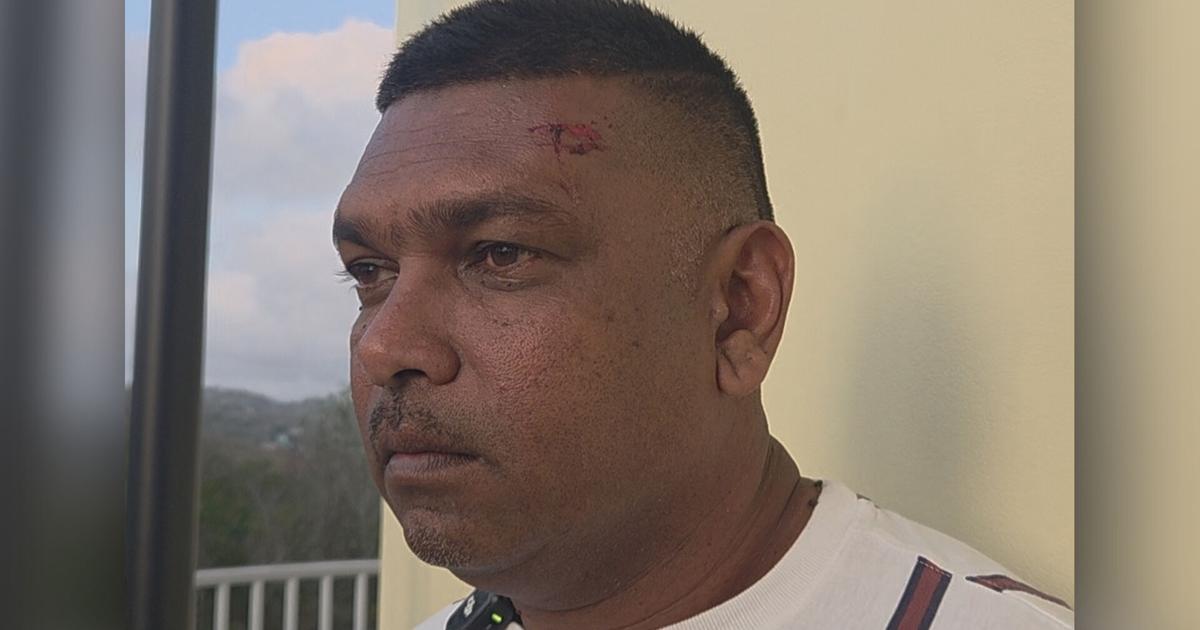
    Darren Jogie, Angelica’s uncle, who was among the group caught in the collision, recalled the chaotic moments after impact in an interview with local media outlet *Express*. “We were bathing inside the roped-off area, not even far from the boundary, and this jet ski just came out of nowhere. It hit me, it hit my brother, and it hit my niece. Two of us were knocked unconscious instantly. Sadie took the full force of the crash — her entire face was mangled,” Jogie described. The uncle himself suffered visible head injuries in the collision.

    Bystanders and family members immediately pulled the injured child from the water and administered emergency cardiopulmonary resuscitation at the scene to try to restart her pulse. She was rushed to Scarborough General Hospital for urgent medical intervention, but despite the best efforts of first responders and hospital care teams, the seven-year-old succumbed to her injuries during treatment.

    In the hours after the crash, Farley Augustine, Chief Secretary of the Tobago House of Assembly (THA), addressed the tragedy during an emergency press briefing, confirming the details of the incident and outlining the ongoing response. Authorities confirmed that immediately after the collision, the jet ski operator fled the Pigeon Point area, leaving the injured group behind. Law enforcement has already seized the abandoned watercraft, and teams from the Trinidad and Tobago Police Service (TTPS) are conducting a full manhunt to locate the operator.

    Augustine described the young girl’s death as a profoundly unfortunate incident, noting that conversations about improving safety management at Pigeon Point Heritage Park have been ongoing for years, with a stated goal of prioritizing visitor safety above all other concerns. “This collision happened in a zone explicitly cordoned off for swimmers. The jet ski breached the perimeter and hit a mother, father, and uncle, and we lost a little girl as a result,” Augustine said, extending official condolences to Angelica’s parents Arnold and Salisha Jogie and the entire extended family.

    The THA Chief Secretary added that parallel investigations are underway beyond the TTPS’s criminal probe. The local governing body is reviewing whether park staff and licensed jet ski operators adhered to mandatory safety protocols, and whether post-incident emergency response aligned with established operational standards. Augustine confirmed the Executive Council will move forward to implement stricter safety oversight for all activities at the park to prevent similar tragedies in the future.

    Shortly after the incident, THA Tourism Secretary Zorisha Hackett, Assistant Secretary Nikita Percy, and other senior local officials traveled to Scarborough General Hospital to meet with the grieving Jogie family and offer official sympathies and support on behalf of the Tobago House of Assembly. As of Thursday morning, the family remains in shock, struggling to process the sudden loss of the young girl, with no update on when the operator will be taken into custody.

  • Ameen: $1b debt at corporations

    Ameen: $1b debt at corporations

    Trinidad and Tobago’s new Minister of Rural Development and Local Government, Khadijah Ameen, has uncovered a massive accumulated debt crisis across the country’s regional corporations, with total liabilities expected to exceed one billion dollars. The revelation came following a collaborative meeting held Wednesday with municipal mayors, chairs, and senior administrative leaders of all regional corporations, convened as part of pre-budget planning ahead of the government’s upcoming mid-year fiscal review.