A controversial police-involved killing that sparked widespread public anger across Jamaica has prompted Prime Minister Dr Andrew Holness to call for urgent systemic changes to how the Jamaica Constabulary Force (JCF) handles injured and deceased individuals at crime scenes. The incident, which took place on Sunday, May 17, saw 36-year-old Latoya ‘Buju’ Bulgin shot dead by a JCF officer in Granville, St James, with graphic closed-circuit television footage of her body being roughly loaded into the bed of a police pickup truck fueling national outrage.
According to local reports, Bulgin had been transporting passengers to a protest against the recent fatal police shooting of 17-year-old Tjey Edwards in the same area when she was stopped by officers in the community’s central square. CCTV footage shows the officer opened fire on Bulgin while she remained seated behind the steering wheel of her Toyota Voxy. A post-shooting police statement claims Bulgin had threatened to drive over the officer who fired the fatal shots. What ignited the strongest public backlash, however, was footage showing the injured woman dragged from her vehicle legs-first, left on the ground, then unceremoniously hauled into the back of a police pickup by two officers, who struggled to close the vehicle’s tailgate after loading her.
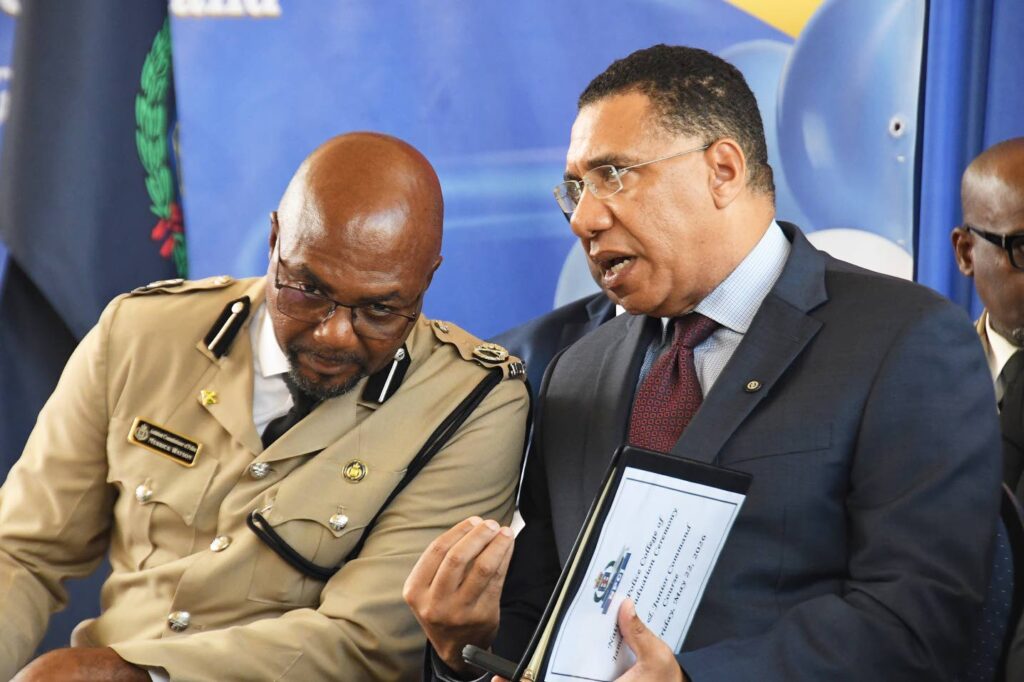
By the following day, furious residents of Granville responded by blocking key intersections with fallen trees, discarded appliances and other debris, and setting open fires in public areas to protest the treatment of Bulgin. As public condemnation of the incident grew across the island, the JCF high command acted swiftly to place the involved officer on administrative interdiction, with independent probes launched by both the Independent Commission of Investigations and the Inspectorate and Professional Standards Oversight Bureau. It was against this heated backdrop that Holness announced his directive for reform during an address to graduating recruits of the JCF’s 91st Staff & Junior Command Courses at the National Police College of Jamaica in Twickenham Park, St Catherine on Friday.
Opening his remarks, Holness extended formal condolences to Bulgin’s family, friends, and community, acknowledging the profound pain, anger, and concern the incident has sparked across the nation. He praised the JCF high command for its quick action to suspend the involved officer pending investigation, while emphasizing that the core issue at hand centers on basic human dignity. Addressing the call for procedural change, Holness noted that while Jamaica’s limited immediate access to emergency medical services creates operational complexities, the gaps in current protocols demand urgent, careful review. The prime minister confirmed that the proposed reforms would be brought before the National Security Council for formal discussion, with the goal of establishing clear, mandatory government policy for handling injured people and deceased remains at crime scenes.
Holness framed the reform push as a critical component of the JCF’s ongoing organizational transformation, arguing that a society’s treatment of its most vulnerable members and the deceased reflects the values of its civilization. ‘We are trying to build an economy and a society, but more importantly we are building a civilisation,’ Holness told the graduating officers. ‘How we treat our injured, most vulnerable, weakest amongst us, how we treat the remains of the deceased, tells us a lot about the kind of civilisation we are. And so, if the JCF is transforming, then that must be part of the transformation.’
The prime minister acknowledged that modern policing in Jamaica often requires split-second decision-making in high-stress, dangerous environments, noting that hyper-vigilance can be a critical survival tool for officers on patrol. But he stressed that this reality does not excuse misconduct, unlawful action, or lack of discipline, and that the difficult operating environment makes strong training, clear oversight, institutional accountability, and sound command culture even more necessary. Holness also reminded officers that their core statutory mandate above all else is the preservation and protection of human life.
In his address, Holness highlighted significant progress the JCF has made in reducing violent crime across the island, noting that as of May 19 this year, the national murder count stood at 204, down 24 percent from 268 recorded over the same period in 2024. He credited this reduction in large part to the growing trust and cooperation between local communities and law enforcement, and warned that any violation of public trust could jeopardize these hard-won gains. ‘As we become more effective in dispatching criminals, we must always remember that our actions require the support of the public,’ Holness said. ‘It is the dignity and the integrity, the compassion that you exercise your duty that distinguishes you and gives value to the uniform that you wear.’