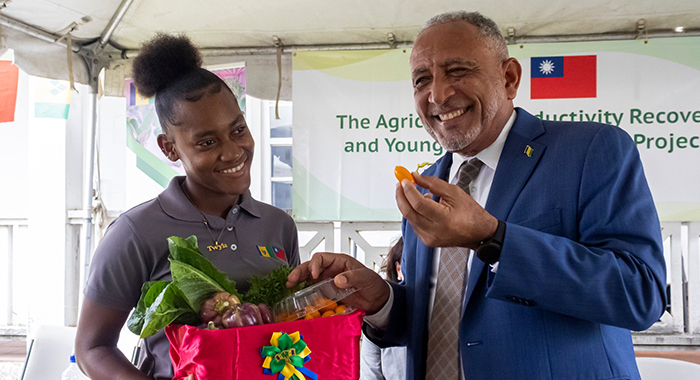
Against a backdrop of cascading challenges ranging from climate-driven natural disasters to global economic volatility, Prime Minister Godwin Friday has made reviving St. Vincent and the Grenadines (SVG)’s agricultural sector a core priority of his administration, launching a transformative three-year initiative to train the next generation of young farmers.
Speaking at the official launch of the Agricultural Productivity Recovery and Young Farmers Training Project hosted at the Orange Hill Agricultural Biotechnology Centre, Friday emphasized that agriculture remains the foundational backbone of SVG’s national identity and long-term economic stability. “Anybody who thinks of St. Vincent and the Grenadines without agriculture, without a thriving agricultural backbone, doesn’t quite understand who we are as a people,” he told the assembled audience of trainee participants, established farmers, government officials and local hospitality industry representatives.
Jointly implemented by SVG’s Ministry of Agriculture and the Taiwan Technical Mission, the program targets multiple pressing crises facing the island nation’s farming sector. After widespread devastation from Hurricane Beryl and a string of other climate shocks, the initiative aims to boost overall agricultural output by 10% through modernized production techniques and intensive skills training for 75 young new farmers.
Friday framed the launch as a turning point after a prolonged period of struggle for SVG’s agricultural communities. “We continue to recover from the effects of repeated natural disasters, most recently Hurricane Beryl… The farmers of this country have been through hell, and they are still struggling to survive.” Beyond domestic climate impacts, the island nation also grapples with cascading external pressures stemming from geopolitical conflicts in the Gulf region and Ukraine, which have sent global prices for food, fuel and fertilizer soaring, disrupted critical supply chains, and amplified uncertainty across the global economy. “As a small island developing state, we are particularly vulnerable to these shocks,” Friday noted, adding that “boosting our agricultural sector, diversifying our agricultural production are so important for us at this time.”
One of the most urgent challenges the initiative aims to address is the rapidly ageing farming workforce, a trend that threatens the long-term viability of SVG’s agriculture. “Those who currently work in this sector are getting older, and no matter how passionate they are about it, we know that we cannot sustain a vibrant agricultural sector if we have an ageing farming population,” the prime minister explained.
By centering the program on youth engagement, digital and biotechnological innovation, and modern business skills, the project directly solves two key problems at once: it addresses the systemic gaps threatening the sector while creating new economic opportunities for young people. Friday added that the initiative reverses decades of job loss in agriculture, noting that a growing number of veteran farmers have abandoned their lands to take low-wage security positions in Kingstown, even when they would prefer to continue farming.
“This initiative encourages our people to return to the land by offering a positive outlook for farmers, and especially because it creates meaningful opportunities for you, young people,” he said. Friday pointed out that young people make rational choices about their careers, and will choose to stay in agriculture if the sector offers them sustainable, competitive incomes: “That is reasonable. That is rational. It is for us to help them to realise that objective.”
The prime minister stressed that the modern agriculture his administration is promoting is not a return to outdated, traditional farming practices. “This is not our father’s farming. This is not our grandparents’ farming. This is a new way of doing it to make it more productive,” he said. Investments in skills training, smart agricultural technologies, and new demonstration hubs in Orange Hill and Dumbarton are designed to drive this industry-wide shift.
“We must combine farming with new technology and modern business practices. This will ensure that our agriculture remains sustainable, that our farmers become highly productive, and that farming will be attractive to young people, thereby creating the next generation of farmers,” Friday explained. He also drew a key distinction between expanding total production volume and improving productivity, arguing that efficiency is the key to competing with imported agricultural goods. “We talk about increasing production — that means you increase the quantum, the amount of stuff that we do — but the critical thing is improving productivity, that is to say, how efficiently we produce what we produce,” he said. For example, improving the quality and efficiency of local tomato production can convince local hotels to source locally instead of purchasing cheaper, lower-quality imported produce.
Friday concluded by emphasizing that modern farmers must adopt an entrepreneurial mindset, just like any other business leader. “It comes from an approach by the farmer, in the same way that a business person will do… always looking for the next best thing to be able to increase the efficiency at what you do, and your competitiveness against other producers, whether they be from here or abroad.”