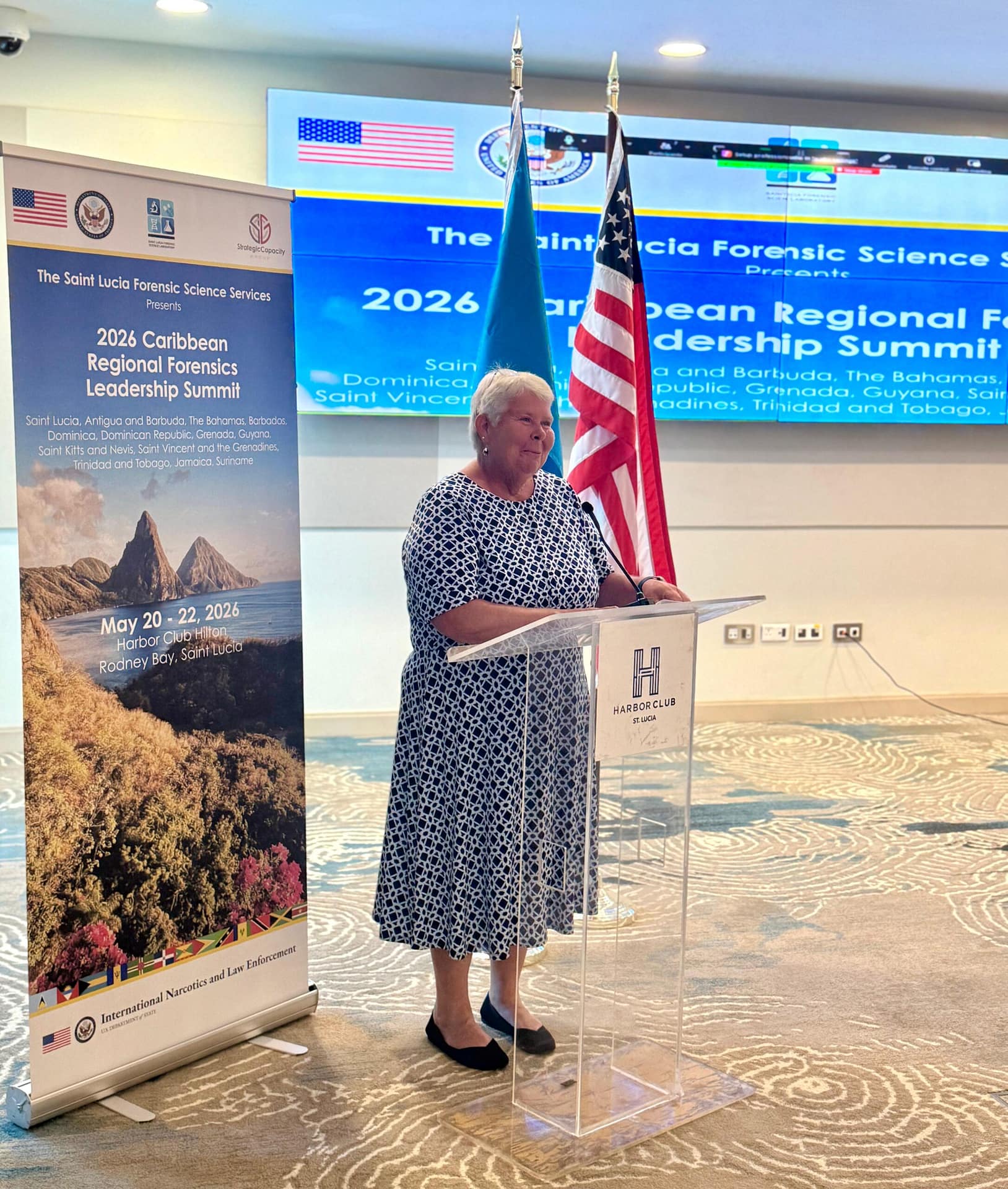
Against a growing backdrop of transnational synthetic drug trafficking threatening Caribbean regional security, the United States has announced an $8 million investment to boost forensic capabilities across the region, unveiled during the second Caribbean Regional Forensic Leadership Summit held in Saint Lucia from May 20 to 22.
Hosted jointly by the Saint Lucia Forensic Science Laboratory and the U.S. Department of State under the long-running Caribbean Basin Security Initiative (CBSI), the summit brought together forensic experts, prosecution officials and security leaders from 14 Caribbean nations, including delegations from Antigua and Barbuda’s Forensic Services and Office of the Director of Public Prosecutions. The gathering also included representatives from the Caribbean Regional Security System and CARICOM Implementation Agency for Crime and Security (CARICOM IMPACS), aligning regional stakeholders around a shared goal of countering cross-border criminal networks.
The new U.S. funding will be directed toward three key priorities: delivering cutting-edge synthetic drug detection equipment, providing specialized technical training for local forensic staff, and deepening collaborative ties with the U.S. Drug Enforcement Administration (DEA). The primary objectives of the investment are to enhance regional capacity to detect fentanyl and other dangerous synthetic opioids, cut through persistent backlogs in regional forensic laboratories, and strengthen the credibility of forensic evidence to meet court admissibility standards for prosecuting transnational organized crime cases.
A landmark outcome of this year’s summit was the official launch of the Caribbean Forensic Scientific Working Group, the first region-wide coordinated platform designed to connect Caribbean forensic practitioners directly with U.S. subject-matter experts. The new body will work to standardize forensic protocols, improve reporting practices across national jurisdictions, and streamline cross-border cooperation on criminal investigations. Additionally, the summit marked a key milestone for the DEA’s Global Uniformity for Analytical Reporting and Drug Seizures (GUARDS) program, with Saint Lucia and Guyana becoming the first Caribbean nations to adopt the framework for standardized analysis and reporting of drug-related evidence.
“This ongoing partnership between the United States and Caribbean nations reflects our shared commitment to dismantling transnational criminal networks and addressing the rapidly evolving threat of synthetic drugs across the region,” said U.S. Chargé d’Affaires Sarah Nelson during the summit.
The CBSI has served as the foundation for U.S.-Caribbean security cooperation for more than a decade. Since the initiative launched in 2010, Antigua and Barbuda and dozens of other Caribbean states have collaborated with the U.S. to shore up regional security infrastructure, crack down on drug trafficking routes, and dismantle transnational criminal organizations operating in the region, with this new forensic investment marking a major expansion of that shared work.