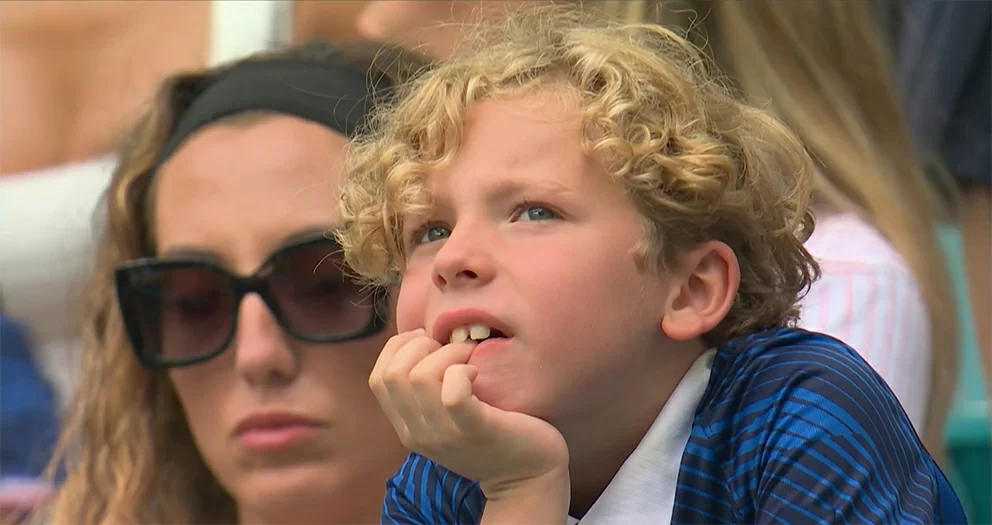
The 2026 FIFA World Cup third-place playoff delivered a historic, high-scoring spectacle at Miami Stadium in Florida that far exceeded every fan’s expectation, capping off a thrilling tournament with a match that will be remembered for decades. What was billed as a consolation match turned into a rollercoaster of goals, comebacks, and record-breaking performances that kept spectators on the edge of their seats from the opening whistle to the final minute.
标签: Suriname
苏里南
-
Dodental door aardbevingen in Venezuela stijgt tot boven 5.000
Nearly one month after two powerful back-to-back earthquakes shook Venezuela, local authorities announced on Friday evening that the confirmed death toll from the disaster has climbed to 5,069. The interim government led by President Delcy Rodriguez shared in an official statement that the number of injured people has remained steady at 16,740, a figure that has not changed for 11 consecutive days.
The ongoing upward adjustment of the death toll comes as rescue teams and cleanup crews continue their work sifting through collapsed structures across affected regions. The coastal state of La Guaira, located along the Caribbean coast and the hardest-hit area by the seismic event, has been the primary focus of recovery operations. As of Friday, seismologists have recorded a total of 1,331 aftershocks following the initial two major quakes, which registered magnitudes of 7.2 and 7.5 respectively when they struck on June 24.
Official damage assessments released by the Venezuelan government show that 856 buildings across the country have sustained damage, with 190 structures fully collapsing. In addition to residential and public buildings, hundreds of critical infrastructure assets including bridges and major roadways have also suffered extensive damage that complicates recovery and access to hard-hit communities.
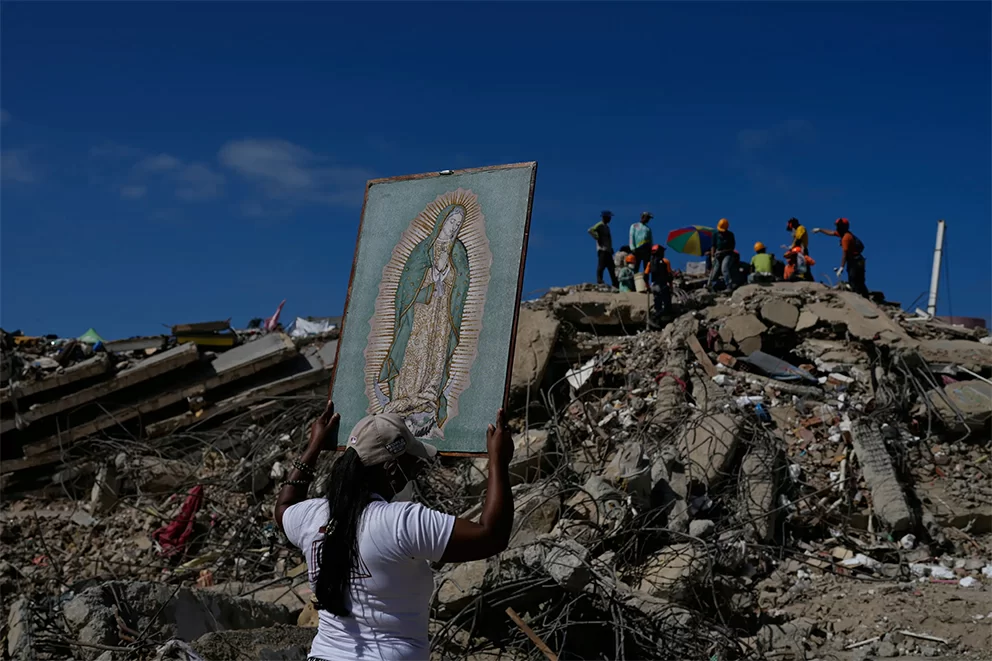
Local authorities confirm that the humanitarian situation across affected regions remains critical, and emergency response teams are continuing their full-scale efforts to locate remaining victims trapped in rubble and begin preliminary repairs to damaged infrastructure to support long-term recovery. In the hardest-hit La Guaira region, community and religious leaders have also joined recovery efforts, supporting families searching for the remains of their loved ones amid the wreckage of fallen residential buildings.
-

Telesur moderniseert kernnetwerk om groei dataverkeer op te vangen
Suriname’s leading state-owned telecommunications firm Telesur is embarking on a two-year large-scale initiative to modernize its core IP and transmission network, responding to exponential surges in domestic and international data traffic that have strained existing infrastructure over the past five years.
The official launch of the project took place this Thursday at a Strategic Stakeholder Session and Project Kick-off Ceremony, where Telesur formalized its partnership with three global technology leaders: Openlink, Cisco, and Ciena. At the event, all parties signed a binding Statement of Commitment, cementing their shared responsibilities for delivering the network upgrade on schedule. Armando Guevara, General Manager of Openlink, and Doric Ramlakhan, Chief Executive Officer of Telesur, led the ceremonial signing.
According to official data shared by Telesur, the urgent need for this investment stems from staggering growth in data usage across the country. Between 2020 and 2025, the company recorded a 419% jump in international data traffic on its network, soaring from roughly 35 gigabits per second (Gbps) to 172 Gbps. Domestic data traffic has also expanded rapidly, driven by the ongoing rollout of fiber-optic connections across Suriname and accelerating digital transformation across households, private enterprises, and public government services.
The IP Core and transmission network acts as the digital backbone of all of Telesur’s operations, handling all data routing within Suriname as well as international connectivity to global networks. Completing the modernization will not only boost the network’s ability to accommodate current and future demand but also prepare the infrastructure to support emerging digital applications that are expected to enter the market in coming years.
For end customers, the upgrade will deliver tangible long-term benefits: expanded network capacity, more consistent and stable internet connections, and a flexible infrastructure that can accommodate future technological advances. Most construction and upgrades will be carried out on backend infrastructure, meaning the project will cause minimal direct disruption to everyday user services during implementation.
Telesur CEO Doric Ramlakhan emphasized that the investment is a proactive measure to prevent growing data demand from eroding the quality of the company’s service offerings. More broadly, Ramlakhan noted that the modernization project lays a critical foundational framework for sustained digital advancement, innovation, and inclusive economic growth across Suriname in the years ahead.
-
Bouva ziet grotere rol voor IICA bij ontwikkeling landbouw
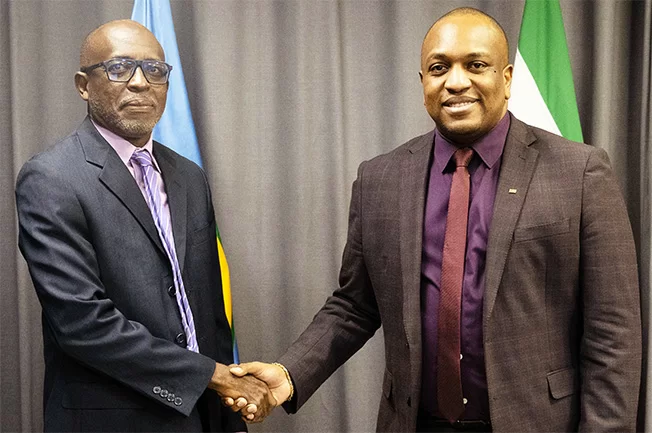
Suriname’s government has formally announced its plan to strengthen long-standing cooperative ties with the Inter-American Institute for Cooperation on Agriculture (IICA), outlining the central role of agriculture in the country’s economic growth strategy alongside its booming oil and gas sector. The announcement came during a introductory meeting between Foreign Affairs, International Trade and Cooperation Minister Melvin Bouva and newly appointed IICA representative for Suriname, Michael Dalton.
During the discussions, both parties focused on how IICA’s technical support can advance the sustainability and modernization of Suriname’s agricultural industry, a core priority for the government that aims to position the country as a regional food hub. Minister Bouva highlighted the ongoing partnership between the Ministry of Agriculture, Animal Husbandry and Fisheries (LVV) and the Dominican Republic-based Rizek Group to expand the nation’s cocoa sector, noting that IICA’s specialized technical expertise would add significant value to this and other key strategic agricultural projects across the country.
For his part, Dalton provided a comprehensive update on the organization’s active work in Suriname. Current initiatives include two major agricultural projects funded by the Inter-American Development Bank (IDB), preparations for the Caribbean Beekeepers Congress scheduled to take place in Paramaribo from November 6 to 8, and the development of a $25 million rice program proposal to be submitted to the Green Climate Fund. IICA is also working on a national exhibition to promote local Surinamese honey, and is finalizing a new four-year medium-term work plan that includes a tailored regional strategy for Caribbean nations, designed to address the unique agricultural challenges and development priorities across the region.
Suriname and IICA first established their formal cooperation partnership in 1981. Over the past four decades, the institute has worked alongside the Ministry of LVV and other local Surinamese stakeholders to deliver dozens of projects focused on agricultural expansion, knowledge sharing, and institutional capacity building. Minister Bouva expressed public appreciation for the decades of productive collaboration, emphasizing that international partnerships are critical to advancing the country’s national development goals. He extended his well wishes to Dalton in his new role, saying he is confident that the partnership between Suriname and IICA will see significant expansion and progress in the coming years.
-

Derde helft WK 2026: Gebroken en teleurgesteld: Frankrijk en Engeland in troostfinale
A day before the 2026 FIFA World Cup final, two fallen semi-final heavyweights France and England will take the pitch on Saturday to contest the tournament’s third-place bronze medal, a match neither side envisioned themselves playing after their recent crushing knockout stage exits.
Both nations entered the North American World Cup with title ambitions, but saw their championship dreams dashed in the semi-final round. France, widely tipped as favorites to claim a third world crown, were outclassed in a clear defeat by Spain. For England, the loss stung even deeper: a late, heart-breaking defeat to Argentina extended their six-decade-long wait for a major international trophy. Now, with the final out of reach, both sides will look to end their campaigns on a rare positive note at Miami Stadium in Florida.
While third-place matches are often written off as low-stakes, uninspired affairs, Saturday’s clash carries extra significance for France. This will be the final international match in charge for head coach Didier Deschamps, who steps down after 14 years at the helm of Les Bleus. Deschamps, who suffered the personal loss of his mother during the group stage, leaves a legendary legacy: he guided France to the 2018 World Cup title, a runners-up finish at the 2022 tournament, and another deep run to the semi-finals in 2026. Under his leadership, France emerged as one of the most consistently dominant top national teams in global soccer. A third-place finish would serve as a fitting send-off for the departing coach.
Beyond Deschamps’ farewell, the match also carries a historic individual milestone for French superstar Kylian Mbappé. Entering the clash with eight tournament goals, Mbappé is level with Argentina’s Lionel Messi atop the Golden Boot race, with Messi holding a narrow lead on assists. He is also just one goal away from equaling or breaking the all-time record for most World Cup career goals, which currently stands at 21. If Mbappé holds onto his lead to claim the Golden Boot, he will make history as the first player ever to win the award twice.
For both footballing powerhouses, however, the third-place match remains an unwanted fixture. Unlike third-place podiums in individual sports, the bronze medal match of the World Cup often leaves players with a hollow feeling: a reminder of how close they came to a shot at the title, only to fall short. “None of our players, and none of France’s players, want to play this game,” England head coach Thomas Tuchel said after his side’s semi-final defeat to Argentina. “They want to be playing in the final. We gave everything to get there. Everyone competes to win the World Cup, but this is where we are now.”
Deschamps echoed that sentiment, acknowledging the disappointment hanging over his side: “We are not where we wanted to be. The disappointment matches our ambitions, but we have to accept it.”
Entering the clash, France hold clear recent form against England. This will be the fourth World Cup meeting between the two nations: England claimed wins in their first two encounters (2-0 in 1966, 3-1 in 1982), but France grabbed a 2-1 quarter-final win over England in the 2022 World Cup. Overall, England have won just once in their last nine matches against France, a 2-0 friendly win back in November 2015.
In team news, France will be without defender William Saliba (back injury) and goalkeeper Brice Samba (calf injury), while England are missing midfielder Jordan Henderson (wrist fracture) and face a late fitness test for full-back Reece James (muscle injury). With the title out of reach, both sides are expected to make sweeping changes to their starting lineups, giving minutes to squad players who have seen limited game time throughout the tournament. The exception is Mbappé, who is all but guaranteed to start as he chases the Golden Boot and the all-time scoring record. For England, Harry Kane and Jude Bellingham, both on six goals for the tournament, are also expected to start to make a late push for the individual award.
The 2026 World Cup third-place match between France and England kicks off at 16:00 local time at Miami Stadium, Miami, Florida.
-

MIA roept hulp samenleving in bij opsporing Burke en ontsnapte Colombiaan
On July 18, the Meldpunt Informatie Anoniem (MIA), Suriname’s anonymous crime reporting hotline, issued urgent Red Alerts for two high-priority fugitives linked to large-scale organized criminal activity, warning the public of the risks they pose and calling for community assistance to locate them. The first fugitive, Gene Juliano Joël Burke, is a person of interest connected to one of the largest drug seizures in recent Surinamese history, which intercepted more than 1,800 kilograms of cocaine. Authorities have charged Burke with three key offenses: participation in a transnational criminal organization, violating Suriname’s Opium Act, and breaking national firearms regulations. Most critically, MIA has publicly classified Burke as armed and dangerous, emphasizing that he poses a direct threat to public safety if confronted by civilians. While multiple suspects have already been taken into custody in connection with the cocaine seizure, the investigation remains active as law enforcement continues to hunt for all remaining fugitives linked to the smuggling operation.
The second Red Alert targets 58-year-old Colombian national Jorge Eliecer Ariza Ortega, who escaped from the holding cell block at the Keizerstraat police station under still-unexplained circumstances. Ariza Ortega was being held in pretrial detention as a suspect in a major organized crime and drug trafficking investigation, facing identical charges to Burke: membership in a criminal syndicate, large-scale drug trafficking, and illegal firearms possession. As of the Red Alert’s issuance, law enforcement has no solid leads on Ariza Ortega’s whereabouts. In response to the escape, three police personnel – one full-duty officer and two trainee officers who were assigned to the night shift when the escape occurred – have been placed on administrative leave pending an internal investigation into how the breakout was possible.
Ariza Ortega is no stranger to high-profile drug investigations: he was among the suspects arrested in February’s so-called “semi-submarine case”, an operation targeting a major smuggling ring that used a custom-built semi-submersible vessel to move cocaine across regional waters. When law enforcement raided the ring’s operations, officers seized the homemade semi-submarine, multiple illegal firearms, and eight 200-liter barrels of aircraft fuel – supplies believed to be intended for smuggling operations. Several suspects fled during that initial raid, and law enforcement has conducted multiple arrests over the intervening months, but Ariza Ortega’s escape has marked a major setback to the years-long investigation.
To accelerate the manhunt, MIA is calling on all members of the public to share any information they may have about the two fugitives’ current locations. Anonymous tips can be submitted via telephone at (+597) 84-70223 or by email to report@meldpunt.sr. The organization stressed that public cooperation is a critical component of successful fugitive operations, noting that community input not only helps law enforcement take dangerous suspects off the street but also upholds broader public safety across the country.
-
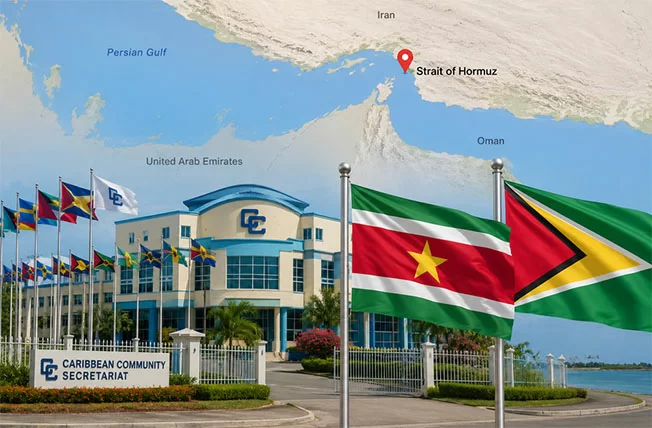
Midden-Oostenconflict kan Caribische economieën treffen; Suriname mogelijk in uitzonderingspositie
Growing geopolitical friction in the Middle East is emerging as a dual threat: not only does it risk further destabilizing already jittered global energy markets, but it also carries far-reaching economic repercussions for small island nations across the Caribbean, leading regional economists have warned.
New concerns have been triggered by a fresh uptick in international crude oil prices and growing instability around transit through the Strait of Hormuz, one of the world’s most critical energy chokepoints. Roughly 20% of the global oil supply passes through this narrow strategic waterway on a yearly basis. In a dedicated analysis of the Middle East conflict’s spillover effects on global energy markets and the world economy, the International Energy Agency (IEA) has emphasized that prolonged disruption to shipping through the strait poses a major risk to global energy security. The agency’s report details how even limited disruptions in this corridor can ripple out to push energy prices higher, stoke renewed inflationary pressures, and erode energy affordability for households and businesses across every region of the world.
For most Caribbean countries, a sustained jump in oil prices would trigger immediate, direct economic harm. The vast majority of regional economies are heavily reliant on imported fossil fuels to power electricity generation, public and private transport, and industrial production. As a result, higher energy costs pass through almost instantly to rising household living expenses, pushing up food prices and transport fares for everyday consumers.
Beyond broader cost-of-living pressures, the region’s core economic engine — tourism — also faces significant downside risk. More expensive fuel increases operating costs for international airlines and cruise lines, which typically pass these extra expenses on to consumers in the form of higher ticket prices. That makes travel to Caribbean destinations less affordable for international visitors, which can ultimately dampen tourist arrivals and cut into the billions of dollars in annual revenue the sector generates for local economies.
The outlook is more nuanced for two regional outliers: Suriname and Guyana. While Suriname will still face higher prices for imported goods and transport services if tensions worsen, it ranks alongside Guyana as one of the Caribbean’s emerging oil producing nations. A prolonged period of elevated global oil prices could, over the longer term, boost expected revenue from Suriname’s developing offshore oil production projects. Guyana, which has rapidly grown to become a major net oil exporter over the past several years, is already reaping the benefits of current high crude prices.
Earlier reporting from Reuters confirms that recent Middle East tensions stand to further increase Guyana’s oil export revenue, even as the surge in production creates new challenges for sustainable economic development and management of its fast-expanding petroleum sector. For Suriname, where first commercial offshore oil production is still being prepared for launch over the coming years, the current global situation underscores how critical it is for policymakers to plan for prudent management of future oil revenues. At the same time, until domestic production scales up, Suriname remains highly vulnerable to rising import costs and fuel price spikes.
Economists stress that while higher global oil prices will eventually deliver extra revenue for producing nations in the region, these benefits will only materialize once full-scale production is operational. In the interim, if the Middle East conflict continues to escalate, Suriname’s households and businesses will overwhelmingly feel the negative impacts of higher transport and import costs. The unfolding crisis makes clear just how interconnected global markets are: events thousands of kilometers away can quickly translate into tangible economic shifts across the Caribbean’s small, open economies.
-
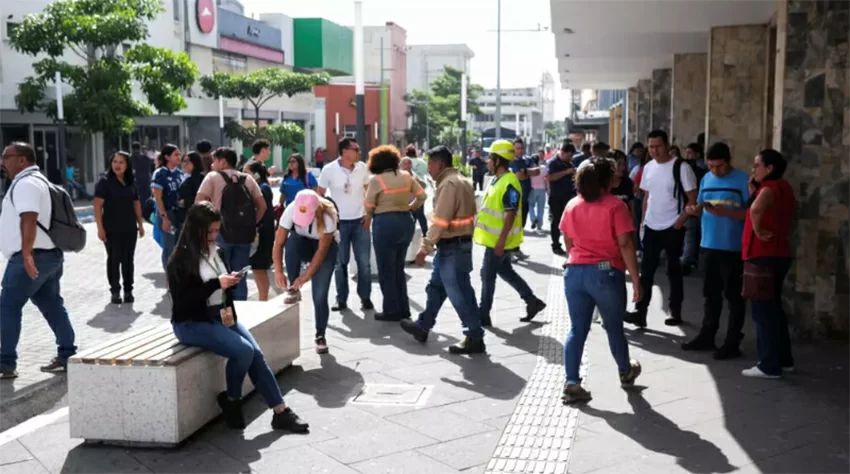
Zware aardbeving van magnitude 7,3 treft Mexicaanse kust nabij Guatemala
On July 17, 2026, a powerful 7.3-magnitude earthquake jolted the southern Pacific coast of Mexico near the Guatemala border, sending panic spreading across three countries and forcing thousands of residents to rush out of buildings for safety.
The U.S. Geological Survey (USGS) confirmed the quake’s epicenter was located roughly 48 kilometers off the coast of the small Mexican town Aquiles Serdan, at a shallow depth of 18 kilometers – a positioning that amplifies shaking felt across nearby populated areas. In the hours after the main tremor, Mexico’s national seismological institute recorded more than 30 aftershocks, with the strongest reaching a magnitude of 6.8, prolonging anxiety for local communities.
Strong shaking was reported across wide swathes of southern Mexico, including the states of Chiapas and Oaxaca, as well as neighboring Guatemala and El Salvador. In Tuxtla Gutierrez, the capital of Chiapas, high-rise structures swayed violently, sparking widespread panic. Araceli Sanchez, a local government employee who was working in a 15-story office building when the quake hit, described the experience as “terrifying.” She recalled that residents cried as they fled down emergency stairwells to evacuate, many still shaken by the unexpected intensity of the tremor.
In the immediate aftermath of the quake, the U.S. Tsunami Warning System issued a brief tsunami advisory for the Pacific coastlines of Mexico and Guatemala, but the warning was canceled within a short window after assessment confirmed no remaining tsunami risk.
Mexican President Claudia Sheinbaum held emergency coordination calls with the governors of the affected regions shortly after the quake, while Secretary of the Navy Raymundo Morales released an initial statement confirming no reports of serious damage had been recorded as of early reports. Even in Mexico City, which sits more than 800 kilometers from the epicenter and is still remembered for the devastating 1985 and 2017 earthquakes that killed thousands, some residents reported feeling light shaking. As a precautionary measure, several tall buildings in the capital were evacuated as a safety measure.
Across the border in Guatemala, multiple buildings in Guatemala City were cleared out, and classes were canceled in regions near the Mexican border. Many local residents described the sudden, intense shaking as triggering traumatic flashbacks to a pair of major quakes that hit Venezuela just weeks earlier. On June 24, back-to-back quakes of magnitude 7.2 and 7.5 struck Venezuela less than a minute apart, leaving extensive damage across Caracas and surrounding areas and triggering weeks of rescue and relief operations.
Geographically, Mexico and Central America sit along the boundary of multiple shifting tectonic plates, making the region one of the most seismically active zones on Earth. This geological reality means major quakes are a recurring risk for communities across the area.
As of the latest update, there are still no official reports of casualties or major damage to critical infrastructure. Inspection teams have already been deployed to the affected regions to survey for hidden structural damage, while emergency response services remain on standby to respond to any developing crises. Though the tsunami threat has passed, aftershocks continue to rumble through the region, keeping local populations on edge. Local authorities have urged residents to remain alert for additional tremors and to follow official guidance as the situation continues to develop.
-
Toen spreken belangrijker werd dan luisteren
One of the most striking paradoxes of the modern era stands out starkly today: humanity has never communicated more frequently across more platforms than it does now, yet we have never seemed to listen to one another less. Debate and dialogue play out everywhere from legislative chambers and live television broadcasts to global policy conferences, corporate boardrooms and social media feeds. Every person holds an opinion, every voice craves to persuade and every speaker demands to be heard. But amid this constant cacophony of expression, a foundational question grows harder to ignore: when did speaking become more important than listening?
There was likely never a single defining moment when this shift occurred. Instead, it has been a gradual evolution unfolding over centuries, driven by a growing desire to be proven right that has outpaced the willingness to collaborate in search of shared truth and collective solutions.
Throughout human history, rhetoric has played an indispensable role in the advancement of civilizations. Great leaders, philosophers and statesmen have long used the power of words to inspire masses, unite fractured societies and drive meaningful, lasting change. Without a clear vision and the ability to communicate that vision convincingly, societies struggle to mobilize toward common goals. Yet the greatest thinkers of antiquity understood that persuasive power only holds real meaning when it is rooted in genuine understanding.
In ancient Greece, two distinct approaches to public debate emerged. Socrates framed dialogue as a collaborative journey to uncover shared truth, while the Sophists prioritized the art of persuasion above all else. Both frameworks carry inherent value, but when the desire to persuade overrides the commitment to understand, rhetoric loses its moral and practical foundation.
Far from being opposing skills, rhetoric and active listening are complementary pillars of effective leadership. Every major societal shift begins with a unifying vision that inspires, persuades and gives direction to communities. But as that vision moves from concept to implementation, the role of leadership shifts. At that stage, listening becomes just as critical as speaking, because sustainable solutions can only emerge when diverse perspectives, lived experiences and competing interests are brought together to inform decision-making. Inspirational leadership moves people to action; attentive leadership keeps them united through the challenges of implementation.
This core principle is not a new concept, and it is deeply reflected in traditional governance practices in Suriname. For generations, many Indigenous and Maroon communities in Suriname’s interior have made major collective decisions only after extended, inclusive deliberation. The traditional krutu gathering is a well-known example: attendees first share their individual insights and perspectives openly, before the group works together to reach a collective decision that accounts for all voices.
This balance between speaking and listening is particularly urgent as Suriname enters a new phase of national development. A clear, unifying vision remains indispensable, but as the country’s policy challenges grow more complex, the need to integrate diverse knowledge, experience and interests grows alongside it. Even so, there remains a widespread perception that strong leadership is measured first by the power of a speech or the sharpness of a debater’s rhetoric. It is true that persuasive skill and clear argumentation are essential to a democratic constitutional state. But the true quality of a leader, public administrator or parliamentarian is ultimately measured not just by the words they speak, but by their ability to genuinely hear what others have to say.
For years, I have argued that Suriname does not suffer from a lack of expertise. The country is home to experienced professionals, enterprising citizens, a strong engaged diaspora and young talented people eager to contribute to the nation’s future. On top of that, Suriname is blessed with rich natural resources that many other nations lack. Our greatest shortfall, therefore, is not a lack of knowledge or opportunity—it is a failure to bring together the knowledge and talent that already exists within the country. After all, the best ideas rarely emerge from a single mind; they grow from the collision and combination of diverse experiences, interests and perspectives.
No one understood this truth better than Nelson Mandela. In his autobiography *Long Walk to Freedom*, Mandela recounts the lesson he learned as a young man: a good leader does not speak first at gatherings, they speak last. The process is simple: listen to every voice first, only then offer direction. For Mandela, this practice was not a sign of hesitation—it was the very essence of unifying, effective leadership.
It is no coincidence that the Bible has preserved this timeless principle for millennia: “There is a time to be silent, and a time to speak” (Ecclesiastes 3:7). Wise leadership does not demand choosing between speaking and listening; it lies in knowing when to provide clear direction and when to make space for the insights of others.
Today, Suriname stands on the cusp of unprecedented economic and social development. This moment demands leaders who can inspire when direction is needed, and listen when collaboration is required. Because sustainable development does not grow from one voice dominating all others—it emerges when diverse voices lift each other up.
Perhaps, then, Suriname’s sustainable future does not begin with a better speech. It begins with a better conversation.