标签: Suriname

苏里南

  • Hogere goudprijs stuwt staatsinkomsten en internationale reserves

    Hogere goudprijs stuwt staatsinkomsten en internationale reserves

    Suriname’s Finance and Planning Minister Adelien Wijnerman announced Friday that soaring global gold prices have generated substantial revenue gains for the nation throughout 2025 and early 2026. The mineral-rich South American country has experienced measurable improvements in both mining sector revenues and international reserve levels, marking a significant turnaround in fiscal stability.

    Minister Wijnerman detailed that beyond conventional tax revenues, non-tax receipts have shown particular strength—primarily royalties and dividends from the mining industry. The international gold market’s robust performance has directly translated into increased sectoral income, contributing to a stronger governmental financial position compared to 2024. While final 2025 figures remain under processing, the minister characterized these developments as “positively transformative” for national finances.

    By January 2026, Suriname’s international reserves climbed to approximately $1.8 billion, providing import coverage for 7.8 months. This reserve accumulation stems largely from enhanced mining revenues, particularly gold exports. Minister Wijnerman emphasized that fortified reserves play crucial roles in exchange rate stabilization, meeting foreign debt obligations, and buffering against external economic shocks.

    Despite these fiscal improvements, inflation persists as a pressing concern. Annual inflation reached 11.4% in 2025, exceeding 2024’s 10% rate. The minister attributed persistent price pressures to elevated utility tariffs, rising food costs, and broader economic expense developments.

    During questioning, Minister Wijnerman corrected previous communications regarding gold royalty rates, confirming the current 5.5% levy remains effective. While a potential reduction to 4.5% remains under discussion, earlier references to 3.5% were acknowledged as erroneous.

    The minister cautioned that while elevated gold prices provide immediate fiscal breathing room, Suriname’s economy remains heavily dependent on mining revenues. She stressed that economic diversification remains imperative to reduce vulnerability to commodity price fluctuations and build sustainable long-term resilience.

  • Fietsboom in Havana door Amerikaanse brandstofblokkade

    Fietsboom in Havana door Amerikaanse brandstofblokkade

    Havana’s streets are witnessing an unprecedented transportation transformation as Cubans increasingly turn to bicycles amid a severe fuel shortage crisis. The shift comes as direct consequences of tightened U.S. sanctions that have disrupted oil supplies from Venezuela and other traditional sources.

    The current situation stems from January 2026 when the United States arrested Venezuelan leader Nicolás Maduro, effectively cutting off Cuba’s primary oil supply that had sustained the island nation for over a quarter-century. Subsequent American threats against oil-exporting nations have further constrained deliveries from Mexico and other potential suppliers.

    This energy crisis has forced Havana residents to adopt innovative survival strategies. Across the city, people are retrieving long-stored bicycles from storage, repairing worn tires, and even learning to ride for the first time. The movement represents both practical adaptation and symbolic resistance to economic pressures that have made traditional transportation increasingly unaffordable.

    Transportation costs have tripled in recent months, compelling citizens like 23-year-old Gabriela Barbon to embrace cycling. ‘Cycling is no longer a hobby, it’s a necessity,’ she remarked during a training session with local organization Citykleta. Their ‘Learn to Pedal’ campaign has seen overwhelming response, attracting nearly four times the expected participants.

    The trend has created parallel economic opportunities and challenges. Bicycle repair shops like that of Pedro Carrillo report an ‘explosion’ in business, though they simultaneously face shortages of replacement parts. ‘Sometimes I don’t have what people need—those supplies are nowhere to be found,’ Carrillo noted from his sidewalk workshop.

    Meanwhile, the Cuban government is implementing emergency measures including investments in solar energy and other renewable sources. International aid organizations attempt to provide humanitarian assistance, though political tensions and the ongoing embargo continue to limit their effectiveness.

    According to United Nations reports, food security remains critically compromised while energy supplies stay unreliable. The six-decade American embargo, recently intensified under the Trump administration, continues to weigh heavily on Cuba’s economic stability.

    Despite these challenges, the bicycle phenomenon demonstrates Cuban resilience. As resident Yoandris Herrera explains while preparing to transport his children to school: ‘Fuel is now so expensive, cycling is simply more practical.’ This two-wheeled revolution represents both immediate practical solution and powerful symbol of adaptation in difficult times.

  • Inflatie in januari licht gestegen; jaarinflatie op 11%

    Inflatie in januari licht gestegen; jaarinflatie op 11%

    January 2026 witnessed a continued upward trajectory in consumer prices, with official data revealing a 0.3% month-over-month increase from December 2025. The more striking figure emerges from the annual comparison, showing prices have surged by 11% compared to January of the previous year, indicating persistent inflationary pressures within the economy.

    The Consumer Price Index (CPI), a crucial gauge of inflation, climbed to 934.3 points in January from 931.4 the preceding month. This incremental monthly rise masks the substantial year-on-year price growth that continues to affect consumers’ purchasing power.

    Analysis of spending categories reveals uneven price movements across different sectors. The most significant increases were recorded in housing and utilities, alongside alcohol and tobacco products. Conversely, the transportation sector experienced a slight reprieve with modest price decreases, providing some relief to consumers in this category.

    The overall inflation rate, while appearing relatively moderate in monthly terms, conceals considerable volatility at the product level. Certain goods and services have actually become more affordable, while others have undergone substantial price hikes, creating a mixed experience for consumers depending on their spending patterns.

    These inflation metrics are derived from comprehensive monthly price collections covering a wide basket of goods and services across seven districts. Notably, the regions of Marowijne, Brokopondo and Sipaliwini are excluded from these measurements, areas where prices are reportedly significantly higher, suggesting the reported inflation figures may not fully capture the economic reality across all demographic and geographic segments.

  • US$ 180 miljoen uit obligatie-uitbreiding voor sociale en economische projecten

    US$ 180 miljoen uit obligatie-uitbreiding voor sociale en economische projecten

    Suriname’s Ministry of Finance has announced that approximately $180 million from its recently expanded $265 million state bond will be directed toward critical social and economic development projects. Finance Minister Adelien Wijnerman detailed the allocation during a press conference on Friday, emphasizing that these funds are specifically earmarked for capital investments rather than operational expenses like salaries or subsidies.

    The 10-year bond extension, maturing in 2035 and carrying an 8.5% interest rate, has already been deposited into a dedicated account. These resources are strictly designated for pre-approved initiatives across several key sectors:

    – Healthcare: Strengthening hospital infrastructure, enhancing primary care services, and improving access to essential medicines
    – Education: Renovating school facilities, upgrading sanitation systems, and implementing digital learning support
    – Government Digitalization: Modernizing public services while increasing transparency and revenue collection capabilities
    – Agriculture and Food Security: Boosting agro-processing capabilities and reinforcing local production systems
    – SME and Youth Programs: Creating financing opportunities for emerging entrepreneurs
    – Energy and Basic Utilities: Supporting improved energy and drinking water infrastructure for schools and healthcare institutions

    While exact sectoral distributions remain under discussion, Minister Wijnerman confirmed that project specifications are being finalized in collaboration with relevant ministries.

    A portion of the total bond amount will address outstanding commercial debts, allowing the government to further reduce previous obligations. The bond’s semi-annual interest payments amount to approximately $11.3 million, with the first payment scheduled for May 2026. Notably, interest payments for the initial 2.5 years have been incorporated into the borrowed amount, meaning they will be drawn from the reserved special account rather than impacting the current operational budget.

    Minister Wijnerman defended the strategic timing of these investments, stating they are essential for strengthening social infrastructure ahead of anticipated oil revenues expected from 2028 onward. Although the bond expansion increases the national debt burden, the minister emphasized that previous refinancing operations and extended repayment terms have created additional fiscal space for these development priorities.

  • Sint Maarten wint van Suriname U-20

    Sint Maarten wint van Suriname U-20

    In a hard-fought Under-20 football encounter, Sint Maarten emerged victorious with a 2-1 win over Natio on February 27th, marking their first triumph after suffering two consecutive defeats in previous matches.

    The match remained scoreless until the 40th minute when Sint Maarten’s forward Yan Gonzaque broke through Natio’s defensive line and skillfully placed the ball into the net, establishing a 1-0 lead that persisted through halftime.

    Following the interval, the game maintained equilibrium with Natio controlling slightly more possession. Despite this advantage, Sint Maarten extended their lead in the 74th minute as Gonzaque secured his second goal of the evening, demonstrating clinical finishing ability.

    Natio responded swiftly with top scorer Xavi Dors reducing the deficit to 2-1 just two minutes later. The match intensified dramatically when a contentious situation erupted involving players from both sides. The altercation began when Sint Maarten players attempted to delay the restart while Natio players sought to quickly return the ball to midfield. The confrontation resulted in disciplinary action with one Sint Maarten player receiving a red card and a Natio player being shown yellow.

    During the final minutes, Natio intensified pressure in search of an equalizer but ultimately failed to convert opportunities, allowing Sint Maarten to secure their first victory of the tournament.

  • Korps Penitentiaire Ambtenaren versterkt met 197 nieuwe functionarissen

    Korps Penitentiaire Ambtenaren versterkt met 197 nieuwe functionarissen

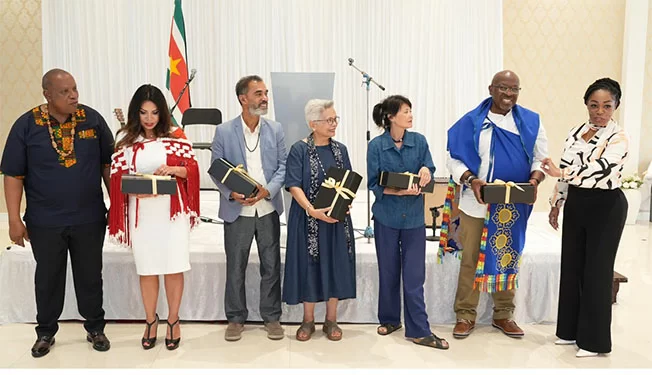
    In a significant move to strengthen its correctional system, Suriname has formally sworn in 197 new penitentiary officers during an official ceremony held on Friday. The recruits were appointed as ‘fourth-class penitentiary officers’ and simultaneously sworn in as special police officers, marking one of the largest single expansions of personnel in the country’s prison system.

    The ceremony was attended by Justice and Police Minister Harish Monorath and Attorney General Garcia Paragsingh, who presided over the oath-taking ritual. According to official statements, this substantial personnel infusion aligns with the government’s strategic policy to enhance security, maintain order, and strengthen legal certainty within Suriname’s correctional facilities.

    KPA Corps Chief Joyce Pané-Alfaisi emphasized during her address that integrity, duty consciousness, collaboration, and confidentiality represent indispensable core values within penitentiary institutions and detention centers. She explicitly stated that violations of these professional standards would not be tolerated under any circumstances.

    Attorney General Paragsingh underscored that the sworn oath constitutes more than mere formality—it represents a substantial responsibility within the criminal justice process. She noted that the professional conduct of correctional officers directly influences public confidence in both the corps and the rule of law.

    Gideon Wielingen, Chairman of the Suriname Penitentiary Officers Union, revealed that the new officers completed an intensive eighteen-month training program. He urged the newly appointed personnel to execute their duties with dedication and a strong sense of responsibility.

    Minister Monorath characterized the ceremony as a ‘harvest festival,’ indicating that the rigorous training had instilled discipline, justice, and duty consciousness—qualities that society would now benefit from. The minister emphasized that this expansion resulted from targeted investments in human capital and ongoing professionalization within the prison system.

    The government continues to invest in reducing understaffing and workload pressure within the KPA, with parallel plans developing for a new headquarters facility in Paramaribo. Following a collective prayer moment, the recruits officially took their oaths, with the top three training graduates receiving special recognition from ministry officials.

    This massive injection of nearly two hundred officers provides Suriname’s correctional system with substantial operational reinforcement, potentially transforming institutional capacity and service delivery within the nation’s law enforcement infrastructure.

  • Taxichauffeur krijgt 26 maanden straf voor handel in cocaïne

    Taxichauffeur krijgt 26 maanden straf voor handel in cocaïne

    A Surinamese court has delivered a stern verdict in a significant drug trafficking case, sentencing a taxi driver to 26 months of unconditional imprisonment after police discovered 2.37 kilograms of cocaine concealed in his vehicle during a routine inspection at Stolkertsijver.

    Presiding Magistrate Maureen Dayala handed down the sentence alongside a substantial fine of SRD 12,000 (approximately $320 USD), with a stipulation that failure to pay would result in an additional two months of detention. The judgment came after the defendant pleaded for leniency based on his financial responsibilities as a family provider.

    During court proceedings, the accused revealed he had accumulated thousands of euros in debt while in French Guiana and had attempted to resolve his financial crisis by profitably selling the illicit substances. This plan unraveled dramatically when law enforcement officials intercepted his vehicle during a standard traffic control operation.

    Notably, two other passengers present in the car at the time of interception were cleared of any criminal charges after investigations confirmed they had no knowledge of the concealed narcotics.

    The public prosecutor emphasized throughout the hearing that personal circumstances cannot justify criminal activities. Magistrate Dayala echoed this position in her ruling, stating the defendant had consciously endangered others—including potential children—by engaging in cocaine distribution, thus warranting the full weight of the judicial sentence in accordance with the Public Prosecutor’s demands.

  • Buscontroleurs in actie: veiligheid niet gegarandeerd, 12 punten sinds vorig jaar bij minister

    Buscontroleurs in actie: veiligheid niet gegarandeerd, 12 punten sinds vorig jaar bij minister

    Hundreds of bus controllers across the Netherlands are preparing for industrial action following failed negotiations with transport authorities over critical workplace safety and employment conditions. The General Union of TCT Personnel announced this decision after an emergency general assembly held on Monday, citing systemic neglect of their longstanding grievances.

    The labor dispute stems from a comprehensive list of twelve unresolved issues formally presented to Transport, Communication, and Tourism Minister Raymond Landveld last year. Union President Patricia Molgo’s detailed correspondence highlighted demands for permanent appointments, promotion opportunities, gratuity payments, transparent appointment procedures, reliable staff transportation, facility renovations, professional training programs, adequate work uniforms, and improved communication channels with management.

    Approximately 300 controllers nationwide report escalating safety threats during fare inspection duties. Union Secretary Eugene Daniël revealed disturbing patterns of aggression from bus drivers, with two serious incidents occurring within February alone. ‘Controllers are being physically assaulted by drivers, and in one recent case, no arrests were made due to inadequate response from bus service leadership,’ Daniël stated. ‘We have exhausted all diplomatic avenues and now have no alternative but to take action.’

    The union has scheduled a follow-up assembly to coordinate the specific nature and timing of the impending measures. This development signals growing tensions within the Dutch public transportation sector regarding worker protection protocols and employment security.

  • CELOS identificeert oorzaak cassaveziekte: schimmel bedreigt voedselteelt

    CELOS identificeert oorzaak cassaveziekte: schimmel bedreigt voedselteelt

    The Center for Agricultural Research in Suriname (CELOS) has conclusively identified the causative agent behind the cassava disease that has been affecting agricultural regions since late 2025. Through comprehensive laboratory analysis, researchers have confirmed that the pathogen responsible is the fungus Ceratobasidium theobromae, internationally associated with Cassava Witches’ Broom Disease (CWBD).

    This plant disease severely impacts cassava crops, leading to significant growth retardation and substantial yield losses. Symptoms observed since November last year include broom-like branching patterns, deformed shoots, and noticeable plant stunting across multiple cassava fields.

    The scientific confirmation came through molecular laboratory testing directed by biologist Krishna Gopie, utilizing field samples collected by CELOS scientist Rudi Nelom in collaboration with the Ministries of Agriculture, Animal Husbandry and Fisheries (LVV) and Regional Development (RO). DNA analysis successfully detected genetic material from the fungal pathogen, with tests conducted using international reference materials and control samples to ensure result reliability.

    This breakthrough is considered critical for Suriname’s agricultural sector, where cassava serves as both a staple food source and primary income generator for farmers. Accurate diagnosis enables targeted monitoring and control measures while helping prevent further spread through contaminated planting materials.

    CELOS emphasizes that this discovery underscores the vital importance of local scientific research in protecting national agricultural interests. The institute will collaborate with LVV and RO to conduct follow-up studies on disease distribution and potential impacts. Additionally, educational programs will be implemented to inform farmers about symptom recognition and responsible use of planting materials.

    CELOS Director Jairam has urged cassava growers to remain vigilant for signs including excessive branching, abnormal shoot development, and growth retardation. Suspicious plants can be reported to the Plant Pathology Department for further investigation. The research center stresses that close cooperation between scientists and agricultural producers is essential to minimize further damage to cassava cultivation and protect food security.

  • Wetsvoorstel moet belangenverstrengeling bij staatsbedrijven voorkomen

    Wetsvoorstel moet belangenverstrengeling bij staatsbedrijven voorkomen

    In a significant move to combat systemic corruption, National Democratic Party (NDP) assembly members Silvana Afonsoewa and Rossellie Cotino have introduced groundbreaking legislation titled the ‘Law on Incompatibility of Functions in State Companies and Government Institutions’. This proposed statute represents one of the most comprehensive anti-corruption measures in recent parliamentary history.

    The legislation establishes an absolute prohibition against public officials within state-owned enterprises and government institutions from simultaneously holding paid positions, consultancy contracts, or advisory roles in other public entities. The ban extends to all legal constructions, effectively closing loopholes that might allow indirect financial benefits through corporate vehicles or third-party arrangements.

    Enforcement mechanisms under the proposal are notably stringent. Violations trigger mandatory and cumulative sanctions including immediate contract termination, full restitution of improperly received compensation, and dismissal from all conflicting positions. The law explicitly eliminates any possibility of discretionary exceptions or negotiated settlements.

    Existing arrangements are granted a transitional period not exceeding two years, during which affected individuals must either terminate their additional contracts or resign from one of their positions. Following this grace period, no continuation of incompatible functions will be permitted under any circumstances.

    The legislative initiative targets multiple governance objectives: preventing actual and perceived conflicts of interest, safeguarding the independence and integrity of public officials, eliminating the accumulation of public incomes, promoting transparency in the allocation of state resources, and ultimately restoring public trust in governmental institutions.

    The proposal emphasizes that state companies and government institutions manage public funds and execute public duties, thus requiring officials to exercise their functions with uncompromised independence. Contrary to potential criticisms, the legislation is projected to have no adverse financial impact on the State. Instead, it is expected to contribute to more efficient public spending and enhanced integrity within the governance framework.