标签: Suriname

苏里南

  • Nerkust draagt leiding FOLS over aan Barron: Het is tijd voor de jonge generatie

    Nerkust draagt leiding FOLS over aan Barron: Het is tijd voor de jonge generatie

    Paramaribo, Suriname – April 16, 2026 – A historic leadership transition has taken place at the Federation of Organizations of Teachers in Suriname (FOLS), where long-serving president Marcellino Nerkust has officially handed over the gavel to newly elected leader Bernice Barron following the organization’s annual board election.

    Nerkust announced his decision not to seek re-election after more than two decades at the helm of the country’s leading teachers’ advocacy group, choosing to make way for a new generation of leadership after guiding FOLS since August 2005. His tenure officially concluded on April 15, 2026, with the election held at the COB training and conference center. Barron defeated a small field of other candidates to win a three-year term as FOLS president, serving through 2029.

    Though Nerkust had already been officially retired for five years, he said his choice to step down now comes as he has reached full pensionable age and completed what he considers a full contribution to Suriname’s teachers and education sector. “It is time now for the young generation to take the lead,” Nerkust said in remarks after the election.

    The leadership election proceeded smoothly, aligned with updated organizational bylaws that came into force earlier this year. Those bylaws, which were formally published in the Official Gazette of the Republic of Suriname on February 7, 2025, outline direct in-office election of the FOLS presidency, a framework that guided this week’s vote.

    Looking back on his 21-year tenure, Nerkust reflected on a period marked by persistent challenges, but also counted a series of landmark wins for Suriname’s teaching community. During his leadership, FOLS secured the introduction of the FISO 1 and 2 salary adjustment schemes under the Venetiaan administration, and won a formal, legally recognized education allowance for teachers in December 2008. Under the Bouterse government, FOLS led successful advocacy for the revaluation of teachers’ professional status and pay.

    More recently, during the Santokhi administration, Nerkust guided FOLS through the formal publication of its updated organizational statutes, secured a new clothing allowance for all teachers, and led bargaining through the Ravaksur-PLUS collective negotiation framework that delivered tangible purchasing power improvements for education workers. Just before his departure, Nerkust also oversaw the delivery of a new priority policy wishlist to current Suriname President Jennifer Simons.

    Nerkust closed his remarks by saying he leaves the organization with his head held high, and expressed full confidence in FOLS’ future under Barron’s new leadership.

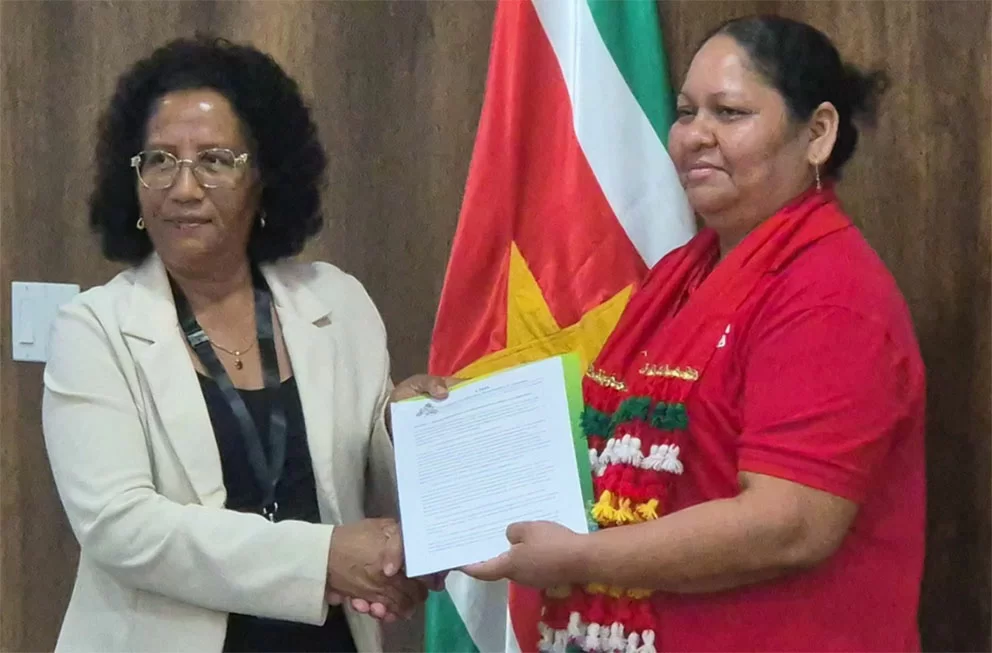
  • Doorbraak in gronddossier Mariënburg: uitvoering eindelijk in zicht

    Doorbraak in gronddossier Mariënburg: uitvoering eindelijk in zicht

    A new round of high-level talks has been launched in Suriname to finally deliver a structural, long-term solution to the long-running land rights crisis that has left hundreds of Mariënburg residents without formal legal ownership of their properties for decades.
    The meeting, held April 15, brought together Stanley Soeropawiro, Minister of Land and Forest Management, his senior staff, Bronto Somohardjo, chair of the Permanent Committee on Land Affairs of the National Assembly, and Carlo Jadnanansing, liquidator of Surinaamse Cultuur Maatschappij B.V. and a former notary. The core focus of the discussion was crafting a tangible resolution for local residents who have never held official land titles for their plots, a gap that has left them without basic legal security for their homes and property.
    Under the newly proposed roadmap, the first phase of the resolution process will see eligible residents issued a statement of willingness (bereidverklaring, BV), which will be followed by formal land lease allocation. Officials say this step-by-step process is designed to eventually deliver full, legally binding land rights security for affected residents.
    Talks are set to resume next week, with full implementation of the plan scheduled to begin by the end of May, following Jadnanansing’s return from travel.
    Somohardjo emphasized that the Mariënburg land crisis has dragged on for years, with residents repeatedly forced to advocate for action from authorities. As recently as April 2025, residents publicly raised alarms over their ongoing lack of legal land security, prompting officials to promise a new round of solutions. Just one month later, in May 2025, authorities announced the problem had been resolved and distributed documents to residents claiming to resolve the issue.
    “But let’s be honest: to this day, nothing has been solved. People were once again fooled with a worthless piece of paper,” Somohardjo said in blunt remarks following the new talks. He acknowledged that years of broken promises have eroded public trust, saying “I completely understand the frustration of the people. For many, faith that a real solution will ever come has all but disappeared. That is exactly why we want to show that things can be different: no more empty promises, no more meaningless paperwork, just a permanent, lasting solution that actually works.”

  • Paus Leo roept Kameroen op tot strijd tegen corruptie en vrede in conflictgebieden

    Paus Leo roept Kameroen op tot strijd tegen corruptie en vrede in conflictgebieden

    On a 10-day apostolic tour across four African nations, Pope Leo XIV landed in Cameroon on Wednesday, delivering a forceful, unflinching address to the country’s long-ruling leadership that put urgent global and national issues front and center. Speaking directly to President Paul Biya – who has held presidential power since 1982 – Prime Minister Joseph Dion Ngute, and other top government officials shortly after arriving from Algeria, the Pope demanded urgent action to root out systemic corruption and resolve the decade-long separatist conflict plaguing Cameroon’s English-speaking regions.

  • RK-bisdom vraagt btw-vrijstelling  voor restauratie historisch Paramaribo

    RK-bisdom vraagt btw-vrijstelling voor restauratie historisch Paramaribo

    On April 15, Bishop Karel Choennie held a high-stakes meeting with Suriname President Jennifer Simons focused squarely on protecting and preserving the iconic monumental buildings that define Paramaribo’s historic city center. At the core of the discussion was the urgent need for targeted financial assistance to make critical restoration work possible, with Choennie pushing for concrete policy changes including full value-added tax exemptions and relief from other levies for property owners.

    The talks covered both the specific ongoing restoration of the Poortgebouw located on Monseigneur Wulfinghstraat and the broader systemic challenges facing the upkeep of the nation’s irreplaceable cultural heritage. Choennie emphasized that preserving these historic landmarks is far more than a cultural mission — it is a significant financial burden that private owners cannot be expected to bear alone. As the leader of the Roman Catholic Church, which ranks as one of the largest private owners of historic real estate in Suriname, Choennie brought firsthand experience of these costs to the meeting.

    According to communications officials from the Suriname government, the bishop formally requested that the presidency implement immediate tax relief for active restoration projects. In response, President Simons confirmed that her administration is already developing a comprehensive master plan for the revitalization of Paramaribo’s downtown district. She noted that a special presidential commission tasked with evaluating policy solutions is expected to deliver its final findings within a two-week window. The commission’s recommendations will ultimately form the basis for new legislation or a presidential executive order that will formalize financial support structures for monumental property owners.

    Choennie reiterated that these historic buildings are the backbone of Paramaribo’s downtown identity, shaping the unique cultural character that draws residents and visitors alike. “If the government requires owners to keep these buildings in their original historic state, it must match that requirement with meaningful financial support,” the bishop stated during the meeting.

    The president’s proposed framework already includes two key support mechanisms: interest-free loans specifically for exterior facade repairs, and low-interest loans for more extensive interior and structural renovations. Choennie expressed clear support for this targeted approach, arguing that it creates tangible opportunities to make Paramaribo’s downtown a more attractive and welcoming public space. “A more beautiful, well-preserved city draws more visitors and investment,” he noted. “Our goal should be to turn the downtown core into a space where residents are eager to gather, walk, and relax.”

    Even as the plan moves forward, Choennie drew attention to the unique practical and financial hurdles that come with maintaining A-status monuments — the most historically significant and at-risk properties. The iconic wooden cathedral of Paramaribo, for example, faces exorbitant upkeep costs that far outstrip any potential revenue from commercial use. Structural constraints, elevated fire risk, and limited nearby parking all make it difficult to repurpose these historic spaces for profitable commercial activities.

    “The traditional wooden construction and original floor plans make it extremely challenging to install modern infrastructure that businesses require,” Choennie explained. “That inherently limits the revenue potential for owners, even when the building is structurally sound.”

    The bishop also highlighted the important work of private-sector and grassroots urban renewal initiatives, which have already purchased and restored dozens of at-risk historic properties across the downtown. Moving forward, he argued, sustained structural collaboration between the national government and private owners is the only way to stop further deterioration of Paramaribo’s historic core and secure its future for coming generations.

  • Rusland belooft verdere olievoorzieningen aan Cuba na eerste levering

    Rusland belooft verdere olievoorzieningen aan Cuba na eerste levering

    Two weeks after dispatching a 700,000-barrel crude oil tanker to the Caribbean island nation, Russian Foreign Minister Sergey Lavrov has publicly reaffirmed Moscow’s long-term commitment to delivering critical energy support to Cuba, a longstanding ally. The announcement, made Wednesday at the conclusion of Lavrov’s two-day visit to China, comes as Cuba grapples with a severe energy crisis triggered by shifts in regional oil supply chains and escalating U.S. pressure.

    The crisis unfolded in early January, when U.S. authorities arrested Venezuelan President Nicolás Maduro during an international visit, prompting Washington to cut off all oil exports from Venezuela – Cuba’s most important traditional energy supplier. With domestic production covering less than one-third of the island’s 11 million residents’ energy needs, Cuba immediately plunged into acute fuel shortages that threatened critical public services and daily life.

    The Trump administration has ramped up pressure on third-party countries to halt oil shipments to Cuba, threatening steep punitive tariffs on any nation that defies U.S. sanctions. Earlier this year, the U.S. granted a one-off exemption for Russian oil deliveries to Cuba on humanitarian grounds, but even that limited exception pushed other major suppliers to cut ties: Mexico, once a key oil provider to the island, has already suspended all shipments to avoid U.S. retaliation.

    Lavrov confirmed that the first Russian tanker, carrying 100,000 metric tons of crude oil equal to approximately 700,000 barrels, has already arrived at Cuba’s Matanzas Bay, with cargo volumes projected to meet Cuba’s energy needs for roughly two months. “I have no doubt that we will continue this assistance, and I also expect China will maintain its participation in this cooperation,” Lavrov told reporters, declining to comment on whether the U.S. would approve future Russian shipments on a case-by-case basis, as the Trump administration has announced it will do.

    In a sharp rebuke of Washington’s regional policy, Lavrov also expressed hope that the U.S. would abandon its current hardline approach in the Caribbean, which he compared to the era of historical colonial intervention. “We hope the U.S. will not return to the times of colonial wars,” he said, highlighting growing pushback against unilateral U.S. sanctions among Russia and other global powers that maintain ties with Havana.

  • Overheid en traditionele leiders in gesprek over bosbeheer en klimaatgelden

    Overheid en traditionele leiders in gesprek over bosbeheer en klimaatgelden

    On April 15, the government of Suriname kicked off a landmark two-day dialogue with leaders of Indigenous and Tribal Peoples, centered on advancing sustainable forest management, inclusive community participation, and expanded access to global climate finance. The gathering, called the Gran Krutu, marks a defining milestone in integrating local Indigenous communities into national conservation and development policy shaping, a move that recognizes the critical role these communities play as stewards of Suriname’s globally significant forest ecosystems.

    Hosted jointly by Suriname’s Ministry of Oil, Gas and Environment (OGM) and the Ministry of Regional Development, the dialogue is structured around two core goals: first, to share clear, accessible information aligned with the lived realities of Indigenous and Tribal communities, and second, to co-develop foundational policy frameworks that are both fully participatory and respectful of Indigenous cultural traditions.

    Suriname holds a unique global position as a High Forest Low Deforestation nation, meaning it retains nearly all of its old-growth forest cover while maintaining extremely low rates of deforestation. This status positions the country to access significant international climate finance, including results-based payments for forest conservation — a key priority highlighted throughout the dialogue. The opening ceremony of the gathering was led by Suriname’s Vice President Gregory Rusland.

    Speaking at the event, Minister of Regional Development Miquella Huur emphasized the urgent need to support local communities, particularly smallholder farmers, in aligning three interconnected goals: strengthening national food security, advancing long-term environmental sustainability, and protecting Suriname’s forest landscapes. “Full participation and genuine ownership by Indigenous and Tribal Peoples is non-negotiable for sustainable development across their traditional territories,” Huur noted.

    For his part, OGM Minister Patrick Brunings reinforced the critical importance of responsible forest stewardship and the active inclusion of Indigenous communities at every stage of policy development. Brunings also confirmed that a portion of revenues generated from Suriname’s oil and gas sector will be allocated to advance sustainable development initiatives aligned with the national development roadmap, known as the Suriname 3.0 vision.

    The first day of the dialogue featured technical presentations on a range of key topics, including the structure of global climate finance, the UN-backed REDD+ (Reducing Emissions from Deforestation and Forest Degradation) framework, and the mechanics of results-based conservation payments. Organizers also set aside dedicated time for traditional Indigenous leaders to share their on-the-ground insights, traditional knowledge, and priority concerns directly with government representatives.

    The two-day gathering is backed by a coalition of international partners, including the Food and Agriculture Organization of the United Nations (FAO) and the Green Climate Fund, with additional technical and financial support from the Suriname Foundation for Forest Management and Forest Control. All participation by Indigenous and Tribal Peoples is being carried out in full adherence to the principle of free, prior and informed consent (FPIC), a global standard for ensuring Indigenous communities have full autonomy to engage with or decline government projects and policies affecting their lands.

  • Vakbond EBS vraagt ingrijpen president in conflict met directie

    Vakbond EBS vraagt ingrijpen president in conflict met directie

    On Tuesday, April 15, the Suriname Energy Workers’ Union (Ogem Werknemers Organisatie Suriname, OWOS) — the registered labor body representing employees of state-owned utility N.V. Energiebedrijven Suriname (EBS) — brought its long-running internal conflict with EBS management to the desk of Suriname President Jennifer Simons during a formal meeting at the Presidential Cabinet.

    The labor dispute recently escalated to a temporary work stoppage, making it a pressing priority for the union leadership to escalate the issue to the highest level of national government. OWOS Chairman Marciano Hellings emphasized that the ongoing tensions at the utility have reached a critical stage, demanding rapid intervention to restore stability to the organization, according to official statements from Suriname’s Communication Service.

    In response to the union’s appeal, the Presidential Cabinet has committed to facilitating structured dialogue between the union bargaining team and EBS executive leadership. President Simons announced she will conduct a thorough review of the dispute in the coming days before inviting both parties to sit down for direct negotiations. Her core goal for the mediation process is to de-escalate tensions and ensure the utility can continue its core operations without further disruption.

    Hellings voiced confidence in the president’s ability to mediate a fair resolution to the standoff. He noted that Simons has acknowledged the severity of the unrest at EBS and has given a formal commitment that she will not allow the crisis to drag on unresolved.

    Beyond the immediate labor conflict, Hellings underscored the critical strategic role EBS plays in both Suriname’s social fabric and broader national economy. With major new development projects on the horizon in Suriname’s fast-growing oil and gas sector, Hellings said EBS stands to capture significant new opportunities to expand its operations and contribute more to national growth — but those gains are only achievable with stable internal governance and a clear long-term strategy.

    “Everything hinges on strategic leadership, a transparent shared vision, and a concrete multi-year development plan,” Hellings said. “If that foundational structure is in place and organizational policy receives consistent support from all stakeholders, EBS can get back on a strong positive trajectory.”

  • GranMorgu-project bereikt nieuwe fase met aankomst eerste offshore apparatuur

    GranMorgu-project bereikt nieuwe fase met aankomst eerste offshore apparatuur

    Suriname’s flagship large-scale offshore energy development, the GranMorgu oil project, has officially moved into its active execution phase following the arrival of its first batch of critical subsea equipment, project leaders confirmed in mid-April 2026.

    The specialized components, part of the project’s Long BaseLine (LBL) positioning system, were delivered to Paramaribo’s Dr. Jules Sedney Port by the end of March 2026. The LBL system is an advanced underwater navigation technology that allows work vessels and installation equipment to pinpoint their exact location on the seabed using acoustic signals transmitted between transponders placed on the ocean floor. This precision technology is widely recognized as essential for accurate installation of offshore energy infrastructure, particularly in deepwater operating environments where small positioning errors can lead to costly project delays and safety risks.

    Artur Nunes da Silva, General Manager of TotalEnergies EP Suriname, noted that this delivery marks a clear transition from years of pre-construction planning to tangible offshore construction work. The on-site installation of the LBL equipment is scheduled to begin in June 2026, representing the first official offshore installation phase of the entire GranMorgu project.

    All offshore construction activities are being carried out in partnership with leading international contractors, including major energy infrastructure firm Saipem. Project stakeholders have emphasized that safety and operational efficiency are top priorities throughout all phases of development, with all work aligned to strict global industry safety and environmental standards.

    Located approximately 150 kilometers off Suriname’s coastline, GranMorgu stands as the country’s first large-scale offshore oil development, built on the back of the earlier Sapakara and Krabdagu oil discoveries. The project will center on a floating production storage and offloading (FPSO) unit with a planned production capacity of 220,000 barrels of crude oil per day. Recoverable oil reserves at the GranMorgu field are estimated at more than 750 million barrels.

    Backed by a total investment of roughly $10.5 billion, the GranMorgu project is expected to deliver transformative benefits to Suriname’s national economy, driving new job creation, supporting the growth of local supporting industries, and expanding government revenue streams. First commercial oil production from the project is on track to launch in 2028, according to current development timelines.

  • Peru: Fujimori leidt eerste ronde presidentsverkiezingen terwijl hertelling voortduurt

    Peru: Fujimori leidt eerste ronde presidentsverkiezingen terwijl hertelling voortduurt

    As Peru’s post-general election vote counting stretched into its third day on Tuesday, political tensions have surged across the Andean nation, sparking parliamentary investigations and unsubstantiated claims of widespread electoral fraud. With roughly 80% of ballots now counted, the identity of the candidate that will face conservative frontrunner Keiko Fujimori in the June 7 presidential runoff remains uncertain.

    Fujimori, a former congresswoman and daughter of late former Peruvian president Alberto Fujimori, currently holds a narrow lead in official vote tallies with 16.8% of the vote. No candidate has secured the 50% of support required for an outright first-round victory, meaning Fujimori – who is making her fourth bid for the country’s highest office – is all but guaranteed a spot in the second round of voting.

    A tight and shifting race for second place has unfolded behind the frontrunner, according to data from Peru’s National Office of Electoral Processes (ONPE), the country’s independent electoral authority. Right-wing former Lima mayor Rafael Lopez Aliaga sits in second position with roughly 12% of the vote, just a single percentage point ahead of center-left candidate Jorge Nieto, who holds 11%. Left-wing congressman Roberto Sanchez trails closely in fourth place with just over 10% of counted ballots.

    As the slow counting process drags on, accusations of electoral fraud have grown louder from trailing candidates. Lopez Aliaga has already publicly decried what he calls “brutal fraud”, and he earned public backing from Sanchez on Tuesday, who also raised questions about the integrity of the voting process. Neither candidate has presented concrete evidence to support their fraud claims to date.

    Critics have drawn parallels between the current slow counting process and previous elections in the copper-rich South American nation, recalling that former president Pedro Castillo was not officially confirmed as the winner until eight days after the 2021 second round vote.

    European Union electoral observers, who monitored Sunday’s first round vote, have acknowledged significant logistical issues during the electoral process but found no concrete evidence to support the widespread fraud claims that have circulated since polling opened. “There have been clear problems,” said Annalisa Corrado, head of the EU’s electoral observation mission to Peru. “But we have not found objective elements that support the narrative of fraud.”

    The extended counting period follows major logistical disruptions to ballot distribution on polling day Sunday. The issues forced election officials to extend voting hours into Monday for more than 50,000 eligible voters, concentrated mostly in parts of Lima, the national capital that is home to roughly one-third of Peru’s total electorate.

    ONPE head Piero Corvetto was summoned before Peru’s parliament this week to explain the delays to the vote counting process. He denied that serious irregularities had taken place, framing the distribution issues as an isolated error in the rollout of electoral materials. Corvetto also issued a public apology for the disruptions to voting and counting.

    He emphasized that both the presidential and parliamentary elections presented unprecedented challenges for voters and electoral officials alike, particularly amid years of sustained political unrest that has eroded public trust in national institutions and left many voters disillusioned with the political class.

    Long-running political instability remains one of the most pressing issues facing Peru, regardless of the final election outcome. The country has seen multiple presidents turnover in recent years, creating widespread skepticism that any new administration will be able to complete a full five-year term. Repeat impeachments, high-profile corruption scandals, and fragile legislative coalitions have made it nearly impossible for recent administrations to serve out their full terms.

    The current interim president, José Balcázar, was appointed by parliament in February after legislators removed his predecessor José Dina from office. Dina had served only four months in office before being ousted over a scandal involving secret meetings with a Chinese business executive.

  • Traditionele leiders Marowijne- en Lawagebied vragen betrokkenheid bij grensakkoord

    Traditionele leiders Marowijne- en Lawagebied vragen betrokkenheid bij grensakkoord

    On April 15, traditional leaders from five Indigenous and tribal communities along the Marowijne and Lawa Rivers gathered in Paramaribo, the capital of Suriname, to issue a joint declaration calling for their formal inclusion and full recognition of their inherent rights amid ongoing negotiations to implement the border agreement between Suriname and French Guiana.

    The communities involved — the Kali’na, Lokono, Aluku, Paamaka and Wayana peoples — have inhabited the riverine border lands for multiple generations, making them the first-hand witnesses to the growing cross-border challenges threatening their way of life.

    In their statement, the leaders outlined the daily crises their communities face: unchecked river pollution, rampant illegal gold mining, widespread deforestation and surging transnational criminal activity. These overlapping threats have already eroded their natural habitats, undermined local food security, and put the long-term survival of their villages at risk. “When the rainy season comes, all the waste and pollution washes up onto our riverbanks,” the declaration noted, emphasizing that communities bear the direct brunt of unregulated cross-border activity.

    The leaders clarified that they do not oppose moving forward with the existing border framework reached between Suriname and France, in contrast to a recent petition calling to halt all proceedings on the agreement. They explicitly distanced themselves from that petition, stressing that long-term residents of the border region deserve a seat at the table, not a stoppage of negotiations.

    Instead, the leaders are calling for clear, binding commitments and robust cross-border cooperation between the two nations to restore order, strengthen security, and protect the ecologically and culturally vital border region. Without clear regulations and enforced rule of law, the area will descend into chaos, they warned.

    Beyond security and environmental protection, the declaration underscores three core demands for the further development and implementation of the border agreement: First, the full legal recognition of Indigenous and tribal rights to their traditional territories, their distinct cultures, and their traditional ways of life. Second, guaranteed participation in all decision-making processes that impact their communities. Third, the preservation of cross-border social, cultural and familial ties that have existed for centuries between communities on both sides of the artificial international border.

    As traditional authority figures for the border region, the leaders emphasize that their perspectives, shaped by generations of living on and caring for the land, must be heard and meaningfully integrated into national decision-making on the border issue. In particular, they seek to act as active partners in developing and executing initiatives to maintain security and public order along the border.

    The statement concluded with a reaffirmation of the leaders’ willingness to engage constructively in the process, to advance solutions that protect their traditional homelands, secure long-term stability for the border region, and build a sustainable future for their communities. The declaration was signed by top traditional leaders from all five represented communities, including Granman Ipomadi Pelenapin of the Wayana, Granman Simeon Glunder of the Aluku, and Jona Gunther, chair of the Kali’na and Lokono of Lower Marowijne, among others.