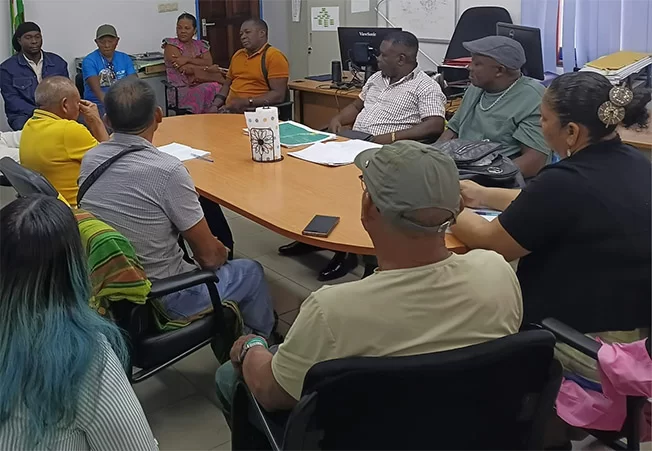
On April 15, traditional leaders from five Indigenous and tribal communities along the Marowijne and Lawa Rivers gathered in Paramaribo, the capital of Suriname, to issue a joint declaration calling for their formal inclusion and full recognition of their inherent rights amid ongoing negotiations to implement the border agreement between Suriname and French Guiana.
The communities involved — the Kali’na, Lokono, Aluku, Paamaka and Wayana peoples — have inhabited the riverine border lands for multiple generations, making them the first-hand witnesses to the growing cross-border challenges threatening their way of life.
In their statement, the leaders outlined the daily crises their communities face: unchecked river pollution, rampant illegal gold mining, widespread deforestation and surging transnational criminal activity. These overlapping threats have already eroded their natural habitats, undermined local food security, and put the long-term survival of their villages at risk. “When the rainy season comes, all the waste and pollution washes up onto our riverbanks,” the declaration noted, emphasizing that communities bear the direct brunt of unregulated cross-border activity.
The leaders clarified that they do not oppose moving forward with the existing border framework reached between Suriname and France, in contrast to a recent petition calling to halt all proceedings on the agreement. They explicitly distanced themselves from that petition, stressing that long-term residents of the border region deserve a seat at the table, not a stoppage of negotiations.
Instead, the leaders are calling for clear, binding commitments and robust cross-border cooperation between the two nations to restore order, strengthen security, and protect the ecologically and culturally vital border region. Without clear regulations and enforced rule of law, the area will descend into chaos, they warned.
Beyond security and environmental protection, the declaration underscores three core demands for the further development and implementation of the border agreement: First, the full legal recognition of Indigenous and tribal rights to their traditional territories, their distinct cultures, and their traditional ways of life. Second, guaranteed participation in all decision-making processes that impact their communities. Third, the preservation of cross-border social, cultural and familial ties that have existed for centuries between communities on both sides of the artificial international border.
As traditional authority figures for the border region, the leaders emphasize that their perspectives, shaped by generations of living on and caring for the land, must be heard and meaningfully integrated into national decision-making on the border issue. In particular, they seek to act as active partners in developing and executing initiatives to maintain security and public order along the border.
The statement concluded with a reaffirmation of the leaders’ willingness to engage constructively in the process, to advance solutions that protect their traditional homelands, secure long-term stability for the border region, and build a sustainable future for their communities. The declaration was signed by top traditional leaders from all five represented communities, including Granman Ipomadi Pelenapin of the Wayana, Granman Simeon Glunder of the Aluku, and Jona Gunther, chair of the Kali’na and Lokono of Lower Marowijne, among others.