On April 15, the government of Suriname kicked off a landmark two-day dialogue with leaders of Indigenous and Tribal Peoples, centered on advancing sustainable forest management, inclusive community participation, and expanded access to global climate finance. The gathering, called the Gran Krutu, marks a defining milestone in integrating local Indigenous communities into national conservation and development policy shaping, a move that recognizes the critical role these communities play as stewards of Suriname’s globally significant forest ecosystems.
Hosted jointly by Suriname’s Ministry of Oil, Gas and Environment (OGM) and the Ministry of Regional Development, the dialogue is structured around two core goals: first, to share clear, accessible information aligned with the lived realities of Indigenous and Tribal communities, and second, to co-develop foundational policy frameworks that are both fully participatory and respectful of Indigenous cultural traditions.
Suriname holds a unique global position as a High Forest Low Deforestation nation, meaning it retains nearly all of its old-growth forest cover while maintaining extremely low rates of deforestation. This status positions the country to access significant international climate finance, including results-based payments for forest conservation — a key priority highlighted throughout the dialogue. The opening ceremony of the gathering was led by Suriname’s Vice President Gregory Rusland.
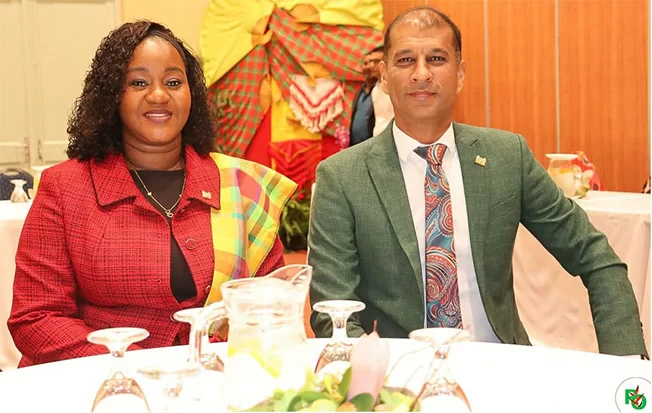
Speaking at the event, Minister of Regional Development Miquella Huur emphasized the urgent need to support local communities, particularly smallholder farmers, in aligning three interconnected goals: strengthening national food security, advancing long-term environmental sustainability, and protecting Suriname’s forest landscapes. “Full participation and genuine ownership by Indigenous and Tribal Peoples is non-negotiable for sustainable development across their traditional territories,” Huur noted.
For his part, OGM Minister Patrick Brunings reinforced the critical importance of responsible forest stewardship and the active inclusion of Indigenous communities at every stage of policy development. Brunings also confirmed that a portion of revenues generated from Suriname’s oil and gas sector will be allocated to advance sustainable development initiatives aligned with the national development roadmap, known as the Suriname 3.0 vision.
The first day of the dialogue featured technical presentations on a range of key topics, including the structure of global climate finance, the UN-backed REDD+ (Reducing Emissions from Deforestation and Forest Degradation) framework, and the mechanics of results-based conservation payments. Organizers also set aside dedicated time for traditional Indigenous leaders to share their on-the-ground insights, traditional knowledge, and priority concerns directly with government representatives.
The two-day gathering is backed by a coalition of international partners, including the Food and Agriculture Organization of the United Nations (FAO) and the Green Climate Fund, with additional technical and financial support from the Suriname Foundation for Forest Management and Forest Control. All participation by Indigenous and Tribal Peoples is being carried out in full adherence to the principle of free, prior and informed consent (FPIC), a global standard for ensuring Indigenous communities have full autonomy to engage with or decline government projects and policies affecting their lands.