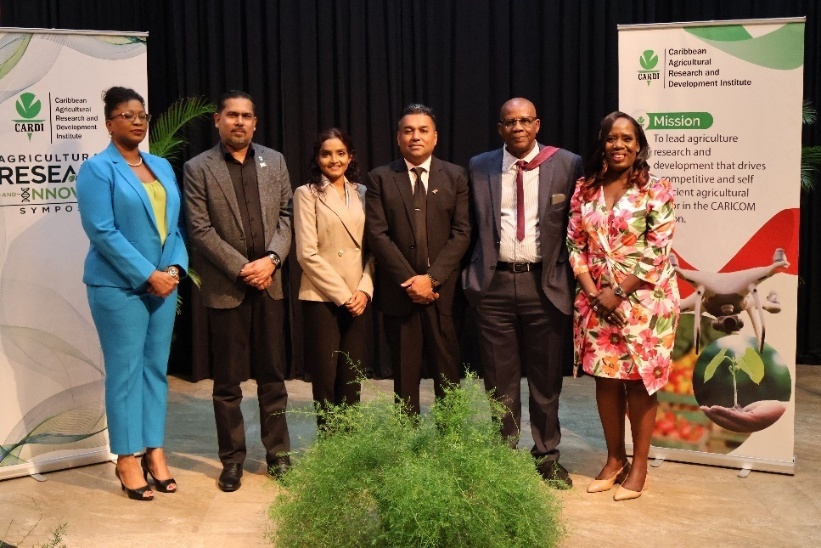
On July 8, 2026, the Caribbean Agricultural Research and Development Institute (CARDI) inaugurated its first-ever Agricultural Research and Innovation Symposium (ARIS) in a landmark event that united a diverse cross-section of regional stakeholders. Researchers, government policymakers, smallholder and commercial farmers, international development partners, and private sector agribusiness representatives gathered from across the Caribbean to explore cutting-edge, science-backed strategies for building a more food-secure and climate-resilient regional agricultural sector.
Organized around the central theme “Advancing Agricultural Innovation for Sustainable and Climate-Resilient Food Systems”, the symposium functions as an annual recurring platform to disseminate CARDI’s latest research outputs and deepen cross-institutional collaboration among groups dedicated to transforming the Caribbean’s aging, vulnerable agricultural landscape.
In his opening address, CARDI Board of Governors Chairman Hon. Lennox Andrews, who also serves as Grenada’s Minister of Agriculture, emphasized that sustained investment in agricultural research and innovation is non-negotiable for the region to tackle its growing set of interconnected agricultural challenges. “Climate change impacts, evolving pest and disease outbreaks, and sudden global market disruptions leave us no choice but to embrace science, innovation, and cross-sector collaboration as core tools to secure the future of Caribbean agriculture,” Andrews stated. “The research showcased at this symposium proves CARDI’s unwavering commitment to developing practical solutions that boost farm productivity, strengthen regional food systems, and lift the livelihoods of smallholder farmers across every island nation.” He added a critical call to action: “If we expect CARDI to continue delivering these life-changing solutions for our region, we must ensure it has the sustained financial resources and policy support required to carry out its mandate.”
CARDI Executive Director Ansari Hosein framed the symposium as a transformative milestone for the 50-plus-year-old regional institution, marking the launch of a new regular tradition of stakeholder engagement. “This symposium brings our research teams from across 14 member states together to share the results of two years of on-the-ground research conducted in our member countries, and most importantly, it creates space for direct dialogue with the farmers, policymakers, development partners and private sector actors that our work serves,” Hosein explained. “Our core goal is to move research beyond the walls of the laboratory and deliver tangible, on-the-ground benefits for food and nutrition security, climate resilience, and agricultural competitiveness across every corner of the Caribbean.” He reaffirmed that CARDI’s ongoing research agenda remains centered on building robust, resilient, innovative, and sustainable agri-food systems that align with the region’s collective food security targets.
Speaking on behalf of Trinidad and Tobago’s Minister of Agriculture and Fisheries, Ministerial Advisor Ravi Pooran Maharaj praised CARDI for establishing the first dedicated regional forum for agricultural scientific collaboration and knowledge exchange. “The Caribbean’s future food security hinges on our collective ability to turn laboratory research into real, on-farm action,” Maharaj noted. “This symposium provides a critical space where researchers, policymakers, innovators, and practicing farmers can exchange ideas, build long-term partnerships, and speed up the adoption of transformative technologies that will reshape agriculture across Trinidad and Tobago and the entire Caribbean.” He emphasized that agricultural innovation is no longer a discretionary investment but an existential necessity, highlighting the outsized role of climate-smart farming techniques, improved drought- and pest-resistant crop varieties, precision agriculture tools, and sustainable land management practices in building food systems that can withstand climate shocks.
Michelle Anne Thomas, Permanent Secretary in Trinidad and Tobago’s Ministry of Agriculture and Fisheries, welcomed the symposium as a key mechanism to strengthen ties between regional research institutions and government bodies. “The complex, interconnected challenges facing Caribbean agriculture cannot be solved by any single group – they demand deep, sustained partnerships between researchers, policymakers, and producers,” Thomas said. “By creating structured opportunities to share actionable knowledge and practical solutions, initiatives like this symposium ensure that scientific evidence informs public policy, strengthens national agricultural programs, and delivers meaningful benefits for both farmers and consumers across the region.”
The three-day symposium featured three technical sessions that highlighted CARDI’s ongoing research across its 14 member states, addressing the region’s most urgent agricultural priorities. Research presentations covered a range of locally focused initiatives, including assessments of the commercial production potential for white potatoes in Grenada and tropical wheat varieties adapted to Belize’s climate. Additional studies outlined innovations in production practices for lettuce, corn, silage, dasheen, and black-eyed peas, all designed to cut the Caribbean’s heavy dependence on imported food and animal feed, a major drain on regional foreign exchange.
The event also put a spotlight on CARDI’s expanding work in digital agricultural innovation. Presentations explored strategies to increase youth participation in commercial agriculture, new digital platforms for optimized livestock feed management, artificial intelligence-powered tools for rapid crop disease diagnosis, and emerging digital technologies that can strengthen agricultural extension services and help farmers make more data-driven on-farm decisions.
Across all sessions, the research presented reinforced CARDI’s core mission: to deliver practical, science-based solutions that advance regional food and nutrition security, improve smallholder farmer livelihoods, and boost the global competitiveness of Caribbean agricultural products. This article was distributed via the CARDI network; NOW Grenada holds no responsibility for contributor opinions, statements, or third-party content included in this report.