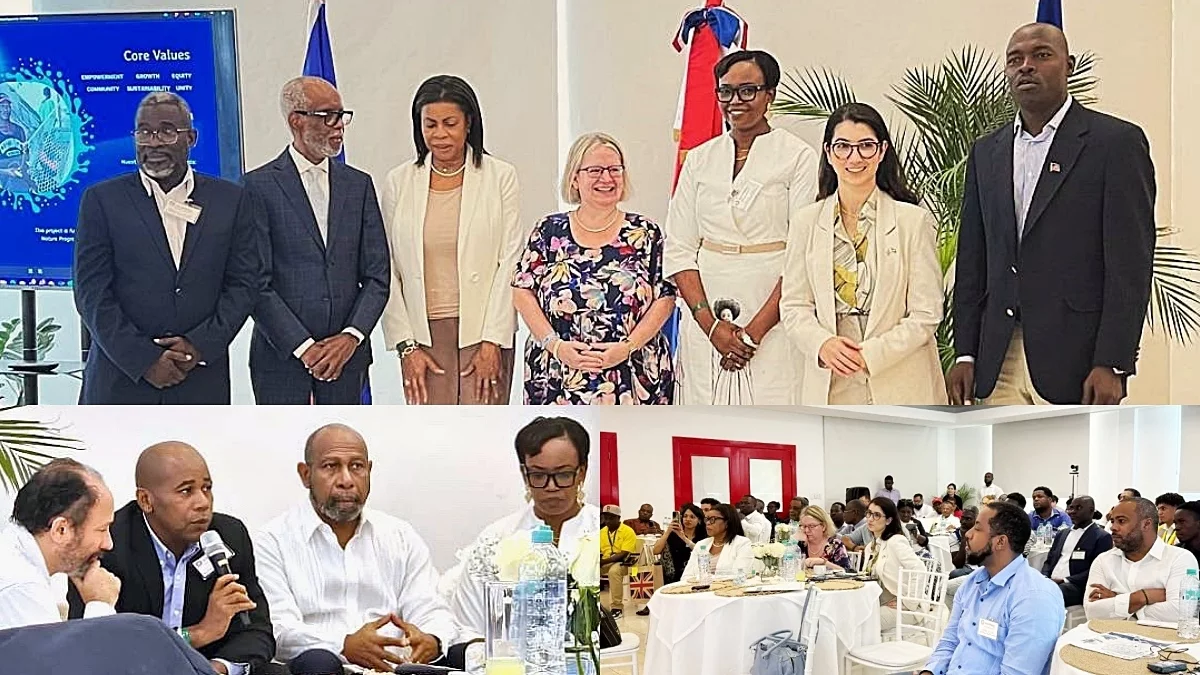
Last week marked a landmark step in cross-border environmental cooperation between Haiti and the Dominican Republic, as the Pan American Development Foundation (PADF) formally launched the three-year binational initiative *Blue Hispaniola*. The official launch ceremony, hosted at the CODEVI free zone in the Haitian border town of Ouanaminthe, drew a broad coalition of stakeholders spanning both nations, including government representatives, senior PADF officials, delegates from the British government, local political leaders, private sector actors, academic experts, artisanal fishing association representatives, civil society partners, community organizers, and prominent Haitian and Dominican figures focused on marine conservation.
Funded entirely through a $4 million UK International Development grant via the Ocean Community Empowerment and Nature (OCEAN) program, the initiative is set to run through March 2029, with work concentrated on the ecologically critical shared north coast of Hispaniola. Designed to address the interconnected challenges of overexploited marine resources and vulnerable coastal livelihoods across the island, the project’s core goals are threefold: advance science-backed sustainable management of shared marine assets, bolster economic stability for communities that rely on coastal and ocean resources, and deepen long-term collaborative ties between the neighboring countries around the blue economy.
A key strength of *Blue Hispaniola* lies in its cross-border, locally led approach: the project has partnered with six community-focused organizations from both countries to build out a transboundary blue economy corridor. This corridor will support sustainable fishing practices, protect threatened coastal habitats, expand market access for small-scale producers, and scale inclusive income-generating activities that benefit local communities rather than external actors.
Four Haitian organizations anchor the project’s work on the Haitian side: Haiti Efficace, the Essence-Elle Foundation, the Peasant Movement for the Development of Paulette, and the Revolted Feminist Group of Haiti. On the Dominican side, the work is led by two respected civil society groups: the NGO AgroFrontera and Fundación Reddom. Together, the partner organizations will deliver targeted capacity-building for local fishing associations, hands-on conservation training for coastal communities, improved connections to fair local and regional markets, and targeted support to amplify women’s leadership across the entire fisheries value chain.
The initiative targets tangible, measurable impact across the island: it is projected to directly support more than 8,350 coastal residents, with at least 50 percent of those beneficiaries being women. It will also improve sustainable management practices across 92,250 hectares of vulnerable marine and coastal ecosystems, a region that supports critical biodiversity and sustains tens of thousands of livelihoods. Project leaders have stated that the initiative is designed to serve as a replicable regional model for cross-border blue economy cooperation, centered on the principles of local governance, sustainable natural resource stewardship, and inclusive economic development that lifts up marginalized coastal communities.
Speaking at the launch, PADF Executive Director Katie Taylor framed the project as a proof of concept for balancing conservation and economic progress. “Blue Hispaniola aims to transform shared waters into shared opportunities,” Taylor said. “When two countries share the same coastline, the wisest investment is one that benefits the communities that depend on it. This project demonstrates that ocean protection and economic development can go hand in hand.”
For Haiti’s Ministry of the Environment, the launch of the initiative reaffirms the government’s commitment to positioning regional cooperation as a core lever for advancing marine biodiversity protection, growing the blue economy, and boosting climate and economic resilience for coastal communities. The ministry issued a call for all relevant stakeholders to join the effort to sustainably protect the shared marine heritage of Hispaniola, emphasizing that collective action today is critical to securing benefits for both current and future generations across the island.