标签: Suriname

苏里南

  • Grote animo voor markoesaproject; LVV houdt extra trainingssessie

    Grote animo voor markoesaproject; LVV houdt extra trainingssessie

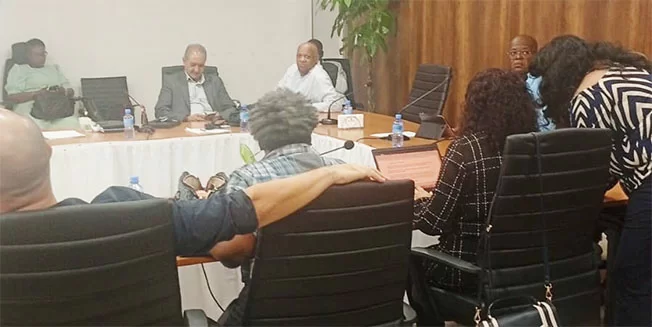
    An initiative aimed at boosting passion fruit cultivation in Suriname has drawn far more interest from prospective growers than organizers initially projected, prompting a last-minute adjustment to training plans. The Suriname Ministry of Agriculture, Livestock and Fisheries (LVV) originally scheduled one training session for participants in the Markoesa Outgrowers Project in Wanica District, but overwhelming application volumes forced the ministry to split the cohort into two separate sessions, each capped at 25 aspiring producers to ensure personalized, hands-on learning.

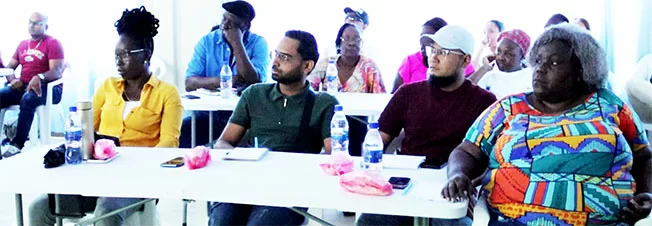
    The first of the two-day training programs launched Tuesday at the training facility of the Wanica District Commissioner’s Office in Lelydorp, marking the official kickoff of the collaborative project. The initiative is a joint effort between LVV and the Presidential Working Group *From Poverty to Welfare through Productive Labor*, which centers on creating inclusive economic opportunities for small-scale producers across the country.

    The curriculum is designed to equip new entrants with all the practical knowledge they need to build successful passion fruit growing operations. Core training modules cover a full range of critical cultivation topics, including routine crop care, integrated disease and pest management, safe handling and application of agricultural protection products, effective weed control strategies, and reliable plant propagation techniques. All training content is tailored to local growing conditions in Suriname to maximize relevance and success for participants.

    LVV officials note that Suriname currently has significant untapped potential to expand commercial passion fruit production. Unlike many niche agricultural crops, passion fruit offers strong dual benefits for the national economy: it has high demand in international export markets, and it also supports growth in the domestic fruit processing sector, creating additional local jobs and economic activity beyond the farm.

    One key feature that sets the Markoesa Outgrowers Project apart from other agricultural development initiatives is that guaranteed market access is already in place before producers begin planting. All harvested passion fruit from participating growers will have an established buyer, with the Melkcentrale’s passion fruit processing facility standing ready to accept and process the full output of the program’s participants. This eliminates the biggest barrier to entry for many new small-scale producers: the uncertainty of selling their crop at a fair price after harvest.

    Ultimately, the core mission of the project aligns with the ministry’s broader agricultural development goals: to stimulate sustainable growth in Suriname’s passion fruit sector while opening up accessible economic development pathways for more Surinamese residents to build long-term careers in commercial agriculture.
  • DNA stemt unaniem in met wijziging Begrafeniswet

    DNA stemt unaniem in met wijziging Begrafeniswet

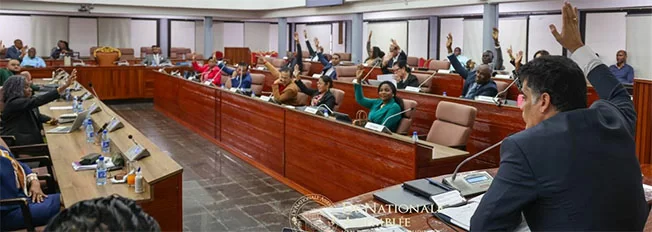
    On Tuesday, Suriname’s legislative body, the Nationale Assemblée (DNA), passed an amendment to the country’s 1959 Burial Act with 33 votes in favor, marking a key interim step toward broader modernization of the nation’s funeral and cemetery regulations. This incremental change is designed to introduce clearer, more up-to-date rules for the handling of deceased persons and the management of burial grounds, while government stakeholders work to complete a full, comprehensive revision of the entire piece of legislation.

    Government officials frame the newly adopted amendment as a critical milestone in bringing Suriname’s funeral sector into line with 21st century needs. By formalizing updated procedures and official guidelines, the reform aims to strengthen guarantees for respectful, orderly, and hygienic management of remains and public cemeteries. The amendment bill was originally tabled before parliament on January 27, 2025.

    During parliamentary debate on the proposal, Minister of Justice and Police Harish Monorath emphasized that the upcoming full review of the Burial Act will align the entire regulatory framework with current social, administrative, and environmental developments. Key areas up for reconsideration during the comprehensive overhaul include regulations for grave reuse, availability of land for new burial grounds, cremation protocols, and standards for alternative end-of-life body disposal methods. Monorath also confirmed that religious groups, cultural organizations, and civil society stakeholders will be actively consulted throughout the full revision process.

    Pre-parliamentary review of the amendment was handled by a special Committee of Rapporteurs led by chair Iona Edwards, with additional members Harriët Ramdien, Ingrid Bouterse-Waldring, Le-Roy Doorson, Marciano Dasai, Dorothy Hoever, and Dinotha Vorswijk.

    Debate revealed widespread cross-party support for the interim amendment. Rabin Parmessar, parliamentary leader of the NDP faction, noted that the changes earned broad backing within the DNA after a period of constructive cross-faction negotiations. He also reiterated the widespread expectation that the government will follow through on its commitment to deliver the promised full overhaul of the act.

    Government coordinator Marinus Bee, speaking on behalf of the administration, confirmed that the comprehensive revised Burial Act will be submitted to the Nationale Assemblée within four months, fulfilling the government’s earlier pledge.

    Asiskumar Gajadien, leader of the VHP faction, noted that parliamentary discussions made clear that a full update of the outdated 1959 legislation is an urgent necessity. Following Bee’s formal commitment to the four-month timeline for full reform, the VHP faction agreed to support the interim amendment.

    With the adoption of this targeted change, Suriname now has an updated temporary legal framework for its funeral industry, as stakeholders prepare for the more extensive legislative reform that will address all unmet needs in the sector.

  • VN waarschuwt voor extreme weersomstandigheden door naderende El Niño

    VN waarschuwt voor extreme weersomstandigheden door naderende El Niño

    The United Nations has issued a urgent global alert, calling on all countries to step up preparations for a projected surge in extreme weather events driven by the developing El Niño climate phenomenon in the coming months. According to the UN’s World Meteorological Organization (WMO), there is an 80% probability that El Niño will develop between June and August 2025, with that probability rising to nearly 90% by the end of November this year.

    El Niño is a naturally occurring climate pattern defined by abnormally elevated sea surface temperatures across the central and eastern equatorial Pacific Ocean. It typically emerges every two to seven years and persists for 9 to 12 months once formed, triggering large-scale shifts in global wind patterns, atmospheric pressure systems and rainfall distribution that reshape weather across every continent.

    The impacts of El Niño vary dramatically by region: it brings above-average rainfall to parts of South America, the southern United States, sections of the Horn of Africa and Central Asia, while driving severe prolonged drought in Australia, Central America, Indonesia, and parts of South Asia. It also fuels more frequent and intense hurricanes across the central and eastern Pacific basin.

    For the Caribbean and Latin America specifically, El Niño brings a complex mix of overlapping climate hazards. Northern and western parts of South America, including the coastal regions of Peru and Ecuador, face a high risk of extreme heavy rainfall that can trigger catastrophic flash floods, destructive mudslides, and widespread damage to public infrastructure and agricultural lands. At the same time, other areas including northern Brazil and large swathes of the Caribbean are projected to face severe drought, leading to acute water scarcity and widespread crop failure. Shifts in ocean and atmospheric currents also disrupt regional fisheries and increase overall vulnerability to natural disasters. While El Niño often suppresses Atlantic hurricane activity, it can still amplify the intensity of storms and hurricanes that do form in the Caribbean. These erratic weather shifts carry severe social and economic consequences, particularly for low-income and vulnerable communities that depend heavily on climate-sensitive sectors like small-scale agriculture and fishing.

    UN Secretary-General António Guterres stressed that the 2025 El Niño event is expected to deliver at least moderate, and potentially severe, global impacts, framing the phenomenon as an urgent wake-up call for global climate action. “The impacts will strike harder, spread faster, and cross borders with devastating speed,” Guterres stated in a video address.

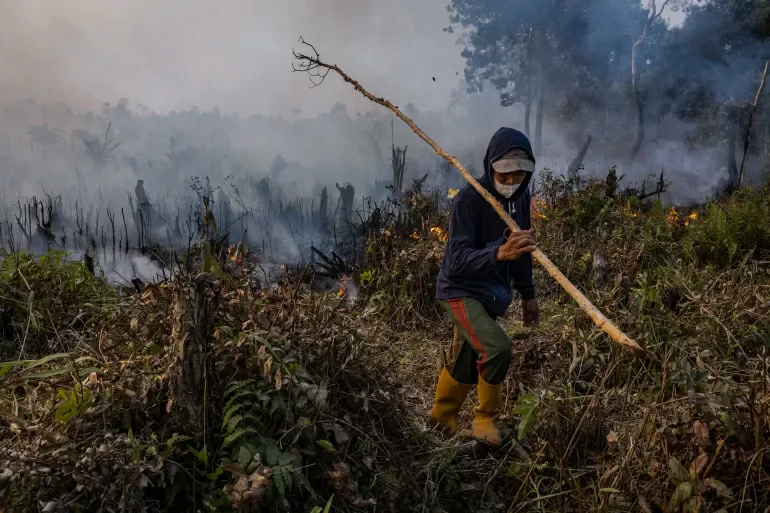
    Researchers from Imperial College London and the World Weather Attribution network have also warned that this year’s El Niño could amplify the risk of extreme, uncontrollable wildfires across vulnerable regions. In response, the European Union has pre-positioned a record number of firefighters and firefighting aircraft across high-risk Mediterranean nations including Cyprus, Greece, Italy, France, Spain and Portugal to prepare for the upcoming wildfire season.

    The previous strong El Niño event, which ran from 2023 to 2024, was a key contributor to 2024 being confirmed as the warmest year ever recorded globally. WMO Secretary-General Celeste Saulo added that the extreme heat tied to El Niño also increases the risk of vector-borne diseases spread by insects, while further straining global food and water supplies. “Already vulnerable communities are being pushed even further to the brink by these impacts,” Saulo noted.

    Global consumers also face the prospect of additional food price increases, with costs already pressured by inflation driven by geopolitical conflict in the Middle East. Hein Schumacher, CEO of Barry Callebaut, one of the world’s largest cocoa processors, warned that cocoa yields in major producing regions including Ecuador and West Africa – which together account for 60% of global cocoa output – are likely to decline this year due to El Niño’s impacts. “We are monitoring the developing situation with extreme caution,” Schumacher said.

  • Simons wil samenwerking met Dominicaanse Republiek verder uitbouwen

    Simons wil samenwerking met Dominicaanse Republiek verder uitbouwen

    On June 3, during an extraordinary session of the Dominican Republic’s National Congress, Suriname’s President Jennifer Simons delivered a landmark address pushing for expanded strategic partnerships between the two Caribbean nations, outlining a multi-sector roadmap for collaboration that spans trade, governance, climate action, and sustainable development.

    Simons’ address to the Dominican legislative body came as part of an official working visit to the country, marking a key moment in diplomatic engagement between the two small developing states. In her remarks, the Surinamese head of state emphasized that the bilateral relationship goes far beyond formal diplomatic ties: both Suriname and the Dominican Republic are democratic nations bound by shared core values, with a collective responsibility to advance inclusive growth across the entire Caribbean region.

    A central pillar of Simons’ speech was a targeted call to strengthen inter-parliamentary cooperation between the two countries. She argued that regular exchanges between elected lawmakers and specialized parliamentary committees would create tangible benefits, including improved domestic governance, greater institutional transparency, and more robust democratic foundations in both nations.

    Beyond parliamentary collaboration, Simons underlined the urgent need for closer alignment between both public sector institutions and private business communities. She noted that the recently signed bilateral cooperation agreements between the two countries are set to unlock new flows of trade and cross-border investment, while also creating opportunities for joint work in high-priority sectors including education, tourism, agriculture, energy, and climate resilience.

    Acknowledging that both nations face shared structural challenges as small developing states, Simons drew specific attention to the disproportionate impacts of climate change that threaten Caribbean communities. To address this and other pressing transnational issues including public safety and sustainable development, she advocated for coordinated regional and international collective action, highlighting that shared challenges require unified response strategies.

    In closing, Simons stressed that deepened bilateral cooperation carries enormous mutual upside: stronger ties will allow both countries to fully leverage their untapped economic potential, driving growth and opportunity across key sectors ranging from tourism and professional services to small and medium enterprise development.

  • DNA eist opheldering over verdwenen 537 kilo kwik bij politiepost

    DNA eist opheldering over verdwenen 537 kilo kwik bij politiepost

    A high-stakes political controversy has erupted in Suriname after 537 kilograms of seized mercury was stolen from a secured storage container located on the grounds of the Geyersvlijt police district, prompting harsh questioning of the country’s Minister of Justice and Police, Harish Monorath, before the National Assembly.

    The stolen mercury was originally seized by authorities on March 14, and stored in a locked container at the local police headquarters pending disposal. Monorath confirmed to lawmakers that all 11 containers holding the contraband, totaling 537kg of the toxic material, had vanished. According to the minister, Suriname currently lacks the specialized infrastructure and regulatory processes required to safely destroy seized mercury, forcing authorities to hold the material in secure police storage long-term.

    Monorath told the assembly he was first notified of the break-in on a Friday afternoon. Investigators have confirmed that while other items were held in the same storage facility, only the mercury was taken by thieves. The case has sparked particular outrage because the Geyersvlijt police compound also hosts the Regional Assistance Team Paramaribo, a specialized law enforcement unit, making a large-scale theft from the site deeply embarrassing for the national police force. Monorath publicly described the incident as “serious, disappointing, reprehensible and condemnable”, adding that the theft on secured police territory is unfathomable to him.

    Lawmakers across party lines have pushed for accountability and a full transparent investigation. Mahinder Jogi, a member of the Assembly from the ruling VHP party, delivered sharp questioning to the minister, demanding to know how such a large theft could occur, who bore responsibility for the site’s security, and whether the minister would accept political consequences for the failure under his portfolio. He closed his questioning with the blunt, widely shared public question: “Where did the mercury go?”

    Rabin Parmessar, leader of the opposition NDP bloc, rejected Monorath’s initial explanation as insufficient, calling for a deep, independent probe that covers all aspects of the incident: the circumstances of the theft, the inadequate security protocols at the site, the functionality of on-site CCTV surveillance, and the performance of local police leadership. Parmessar stressed that the incident is a major stain on the national police institution, which relies on public trust to carry out its core duties.

    Stanley Betterson, an Assembly member from the ABOP party, emphasized the urgent need to address gaps in integrity within the national police corps. While he stopped short of calling for the minister’s immediate resignation as an automatic fix, he said Monorath must implement strict, active oversight to root out corruption and misconduct, and that clear, decisive action must be taken against “bad apples” within the police force responsible for the security failure.

    In response to widespread criticism, Monorath confirmed that a full criminal investigation was launched immediately after the theft was discovered. He noted that he is withholding many details of the ongoing probe to protect investigative integrity, but pledged that every possible resource is being deployed to uncover how the theft was able to happen on police-owned territory, and to recover the stolen mercury.

  • Derde helft WK 2026: Duitsland met jong talent en ervaren kracht klaar voor rentree op wereldtoneel

    Derde helft WK 2026: Duitsland met jong talent en ervaren kracht klaar voor rentree op wereldtoneel

    Four titles, 20 historic appearances, and two straight early group-stage exits: as the 2026 FIFA World Cup approaches, four-time champion Germany enters the tournament seeking to reverse a painful recent trend and rebuild its reputation as one of the global game’s elite forces.

    Germany’s World Cup legacy is unmatched by most nations. Since their first tournament appearance in 1934, the four-time world champions (1954, 1974, 1990, 2014) hold all-time records including Miroslav Klose’s 16 career World Cup goals and Lothar Matthäus’s 25 tournament appearances. But their recent run has been a shock to the football world: the 2014 champions crashed out in the group stage in both 2018 and 2022, a result unthinkable for a country with such deep footballing tradition. Currently ranked 16th in the FIFA World Rankings, Germany enters 2026 with a renewed sense of purpose under head coach Julian Nagelsmann, who took over the national side in September 2023.

    Under Nagelsmann, the Mannschaft has already regained a sense of pride and confidence that was missing in recent tournaments. cruising to qualification with five wins from six qualifying matches. Nagelsmann’s squad strikes a deliberate balance between emerging generational talent and seasoned veteran leadership. Young stars like Bayern Munich’s Jamal Musiala and Liverpool’s Florian Wirtz lead the team’s attacking core, supported by experienced campaigners including Joshua Kimmich, Antonio Rüdiger, and iconic goalkeeper Manuel Neuer.

    The biggest surprise heading into the tournament is Neuer’s return. The 38-year-old shot-stopper announced his international retirement following UEFA Euro 2024, but reversed his decision to earn a spot in the 2026 squad, with Nagelsmann confirming Neuer remains his starting number one and a critical locker room leader. Musiala, one of the standouts of Euro 2024 who is expected to be Germany’s breakout star in 2026, has recently dealt with a serious leg injury that adds a small question mark to his fitness. Wirtz, meanwhile, overcame a rocky start to his Liverpool career to return to form, bringing creative versatility to Germany’s attack. 18-year-old Bayern prospect Lennart Karl, another exciting young talent, has already drawn comparisons to Lionel Messi for his low center of gravity and dynamic dribbling ability.

    Despite the overall strength of the squad, lingering question marks remain. Germany still lacks a world-class starting center forward: Niclas Füllkrug missed out on selection after a underwhelming club season, leaving Kai Havertz (likely to play as a false nine), Nick Woltemade and Deniz Undav as the only available options up top. Analysts also remain uncertain whether the young-heavy squad can handle the pressure of a major tournament and genuinely compete with the tournament’s top favorites. Still, Nagelsmann has made his ambitions clear: his goal for the squad is to lift the World Cup trophy.

    Germany has been drawn into Group E, a relatively favorable grouping that sets the team up well to reach the knockout stage for the first time since their 2014 title win. They kick off their campaign on June 14 in Houston, Texas against Curaçao, the smallest nation ever to qualify for a World Cup. Next, they face Ivory Coast (back at the World Cup after a 12-year absence) in Toronto on June 20, before closing out group play against South American qualifier Ecuador in East Rutherford, New Jersey on June 25.

    The full 2026 German World Cup squad is as follows:
    Goalkeepers: Manuel Neuer (Bayern Munich), Oliver Baumann (1899 Hoffenheim), Alexander Nübel (Stuttgart)
    Defenders: Joshua Kimmich (captain, Bayern Munich), Nico Schlotterbeck (Borussia Dortmund), David Raum (RB Leipzig), Jonathan Tah (Bayern Munich), Waldemar Anton (Borussia Dortmund), Antonio Rüdiger (Real Madrid), Nathaniel Brown (Eintracht Frankfurt), Malick Thiaw (Newcastle United)
    Midfielders: Jamal Musiala (Bayern Munich), Florian Wirtz (Liverpool), Lennart Karl (Bayern Munich), Angelo Stiller (Stuttgart), Aleksandar Pavlović (Bayern Munich), Leon Goretzka (Bayern Munich), Leroy Sané (Galatasaray), Felix Nmecha (Borussia Dortmund), Nadiem Amiri (Mainz 05), Pascal Groß (Brighton & Hove Albion)
    Forwards: Kai Havertz (Arsenal), Deniz Undav (Stuttgart), Jamie Leweling (Stuttgart), Nick Woltemade (Newcastle United), Maximilian Beier (Borussia Dortmund)

  • DNA bepaalt donderdag wijze van stemmen over vordering oud-bewindslieden

    DNA bepaalt donderdag wijze van stemmen over vordering oud-bewindslieden

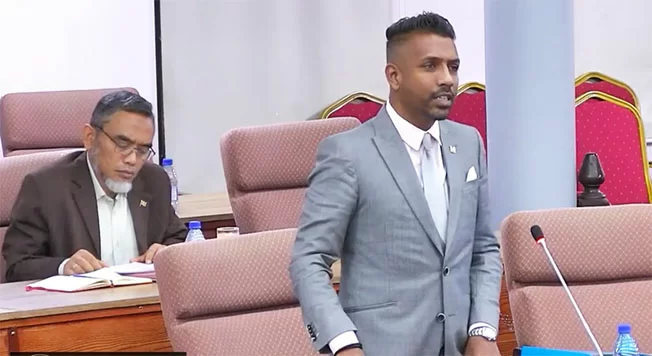
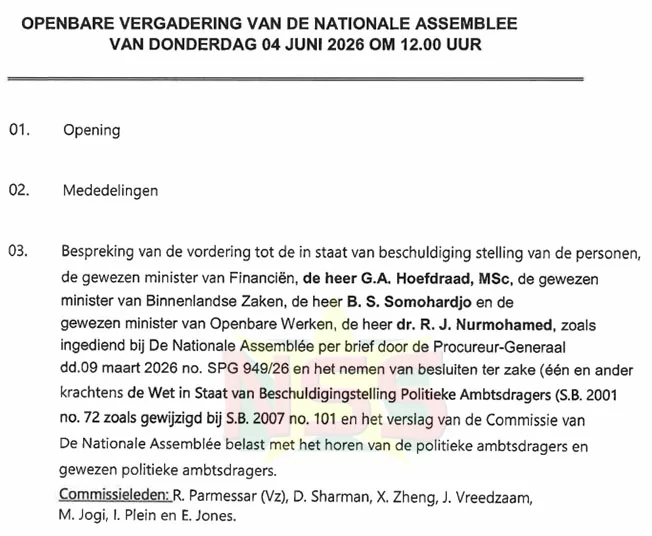
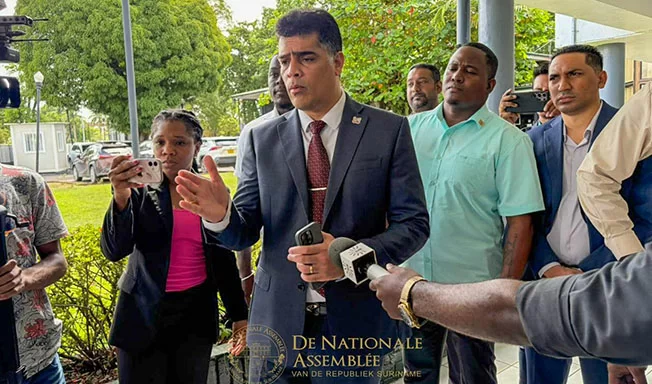
    Suriname’s legislative body, De Nationale Assemblee (DNA), has scheduled a plenary sitting for Thursday to consider impeachment motions against three former cabinet members, bringing a long-running political accountability process to a critical voting stage.

    Before the public portion of the sitting gets underway, lawmakers will first convene a closed internal administrative meeting. During this preliminary session, the special parliamentary committee tasked with questioning current and former elected officials will present its official investigative report on the impeachment case against the three ex-ministers.

    Once the committee’s findings are delivered to the full assembly, legislators will first vote on procedural rules: specifically, whether the final vote on the impeachment motions will be conducted via written secret ballot or through a public show of hands. This procedural decision is widely viewed as consequential for the entire trajectory of the proceedings, as it may shape how lawmakers position themselves ahead of the final vote.

    After settling the voting method, the assembly will move into public session to open debate on the impeachment motions against Gillmore Hoefdraad, the former Minister of Finance, Bronto Somohardjo, ex-Minister of Internal Affairs, and Riad Nurmohamed, former Minister of Public Works. The entire process is grounded in the investigative report compiled by the special committee led by sitting assembly member Rabin Parmessar, which carried out months of hearings and evidence gathering with support from other assembly legislators and independent legal experts.

    Following the procedural vote, the full parliament will deliver its final ruling on the impeachment referral submitted by the Prosecutor General of Suriname, marking a key milestone in efforts to hold former high-level public officials accountable for alleged misconduct in office.

  • DNA vraagt opheldering over sloop Danny’s Villapark; districtscommissaris grijpt in

    DNA vraagt opheldering over sloop Danny’s Villapark; districtscommissaris grijpt in

    A simmering housing rights dispute centered on the Mungra Project, better known locally as Danny’s Villapark, has been brought before Suriname’s National Assembly (DNA) after hundreds of residents submitted a formal petition demanding an end to ongoing evictions and home demolitions. In a swift intervention that has paused immediate action against affected families, Marlon Budike, District Commissioner for Northeast Paramaribo, has ordered an immediate halt to all demolition work in the area, which had previously been carried out under police supervision.

    Prior to the National Assembly’s public plenary session on June 2, residents delivered their petition, calling for a full independent inquiry into the land ownership rights of the plots where they have built their homes. According to the petitioners, dozens of households purchased their parcels in good faith decades ago, and have spent years investing time, labor and savings into constructing their family residences.

    The dispute was opened for debate during the public parliamentary session, where multiple members of the assembly pressed the national government for clarity on how the crisis unfolded. Lawmakers highlighted the urgent need to clarify residents’ legal standing and investigate the circumstances under which demolitions were authorized and carried out.

    In their petition, residents outlined that their claims to the land have been challenged by a private foundation, which asserts full ownership of all property within the Danny’s Villapark project area. Critically, residents say they have never been given an opportunity to be heard in the legal dispute over the land, and have not received any formal notification of court proceedings related to their homes and parcels.

    Residents further allege that heavy machinery has already been used to demolish multiple occupied homes, and that families have been ordered to evacuate their properties immediately. The petition also notes the presence of armed individuals in the residential area, an escalation that has created widespread fear and a pervasive sense of insecurity among the local population.

    Budike’s administrative order has brought a temporary stop to further demolition activity, offering a brief reprieve for affected families. As the National Assembly takes up the issue, residents are calling on lawmakers and the national government to move quickly to resolve the uncertainty surrounding the land’s legal status and formalize protections for the impacted households. Petition organizers estimate that between 50 and 70 families are directly affected by the dispute. Beyond an independent probe into land ownership, residents are calling for the eviction moratorium to remain in place until full clarity is reached on who holds legal title to the land.

  • Honderden kinderen bidden voor vrede, onderwijs en de toekomst van Suriname

    Honderden kinderen bidden voor vrede, onderwijs en de toekomst van Suriname

    On Saturday, more than 300 people — including children, parents, youth leaders and volunteers — came together in Suriname for the annual National Children’s Prayer Day, hosted at the Gods Rainville municipality venue. The gathering centered on intercessory prayer for the nation of Suriname, local families, educational institutions, national and global leaders, and children across the world navigating challenging living conditions.

    This year’s event was jointly organized by three faith-focused groups: the Weid Mijn Lammeren Foundation, the Suriname Bible Society, and the Children’s Evangelization Society. Young participants came from a wide range of Christian denominational backgrounds, including Roman Catholic, Pentecostal, Baptist, and Wesleyan congregations. The day’s program blended a variety of activities, including group singing, dance performances, collective worship, and open prayer sessions.

    Gloria Lie Kwie Sjoe, one of the event’s co-organizers, expressed deep gratitude for the large turnout and the enthusiastic engagement from the young participants. “The sincerity that children bring to their prayers is extraordinary,” she shared in remarks during the gathering. “Their prayers come straight from the heart. It is so important for children to learn that prayer is not difficult or boring — anyone can pray, no matter how old or young you are. God listens to the prayers of children just as he listens to adults. Prayer gives people hope, comfort, and strength when they need it most.”

    One of the most memorable segments of the day was a personal prayer writing activity, where each child jotted down their own private prayers on small notes. These handwritten messages offered an intimate window into what young people across Suriname care about most, and produced many deeply moving moments for everyone in attendance.

    The prayers reflected a wide range of hopes and concerns for both local and global communities: one child prayed that Suriname’s national football team would qualify for the FIFA World Cup, while another wrote that they hoped all conflict and war would end around the world. Many children asked for greater peace within Suriname, improved living conditions for unhoused residents, healing for sick loved ones, and safer public environments for all children.

    Education was also a key focus of the children’s prayers. Many young participants prayed for teachers and fellow students, as well as for improved educational infrastructure and resources across the country. Additional prayers called for safer, cleaner public streets and healthy, prosperous futures for all people living in Suriname.

    In closing remarks, event organizers emphasized that the gathering made clear an important truth: children are not only the future of the nation, they already hold a meaningful and powerful voice in the present. Their simple, unfiltered, sincere prayers came together to form a strong, unified message of hope, faith, and shared connection across all of Suriname.

  • Onderwijsbonden en regering bereiken akkoord; morgen school

    Onderwijsbonden en regering bereiken akkoord; morgen school

    A weeks-long standoff between Suriname’s national government and combined education unions has come to a peaceful resolution, after intensive multi-party negotiations produced a comprehensive agreement to improve working conditions for educators and clear the way for an immediate resumption of regular classes across the country. The national work stoppage, which launched earlier that week, will formally end with the imminent signing of the agreement, which currently only awaits final technical edits before being formalized by all stakeholders.

    Negotiations brought together representatives from the cabinet, the unified education unions, and a specially convened presidential commission to hash out concessions on core demands that triggered the industrial action. The final principle agreement addresses pressing grievances including unpaid back wages, long-overdue benefit adjustments, unpaid overtime, and the establishment of a permanent framework for future dialogue between the two sides.

    Under the terms of the deal, education union leadership will immediately advise all their members to return to full regular teaching duties. Both sides have also committed to protecting the continuity of education going forward, and agreed to resolve future disputes through structured negotiation rather than industrial action wherever possible.

    Among the most concrete commitments is a pledge to clear the backlog of administrative and legal status updates within the Ministry of Education, Science and Culture by a set timeline. The agreement also mandates that all unpaid overtime owed to part-time educators must be paid in full no later than the end of June. Additional concrete terms include new provisions for 20-year service gratifications, guaranteed standard payroll processing for union representatives, and the formal launch of a permanent consultation platform between union leadership and the education ministry.

    A series of substantial benefit increases for active and retired educators make up the centerpiece of the agreement. The annual eyeglass allowance for educators will jump from SRD 2,000 to SRD 7,000 starting June 1, 2026, with a further increase to SRD 9,000 scheduled to take effect on January 1, 2027. Retired educators will also be eligible for this adjusted benefit. The monthly distance education allowance will rise from SRD 350 to SRD 850, while a new 14% of base salary allowance for continuing professional development has been introduced. Starting this August, educators will also receive an annual clothing allowance of SRD 5,000. For instructors teaching in the bachelor’s programs at the Teacher Training Institute (IOL), all future overtime will be compensated in line with the standardized MO-B salary scheme.

    Both sides have acknowledged that this round of negotiations did not resolve every single demand raised by the unions. Remaining outstanding issues will be added to the agenda for future negotiation sessions to prevent renewed disruption to classes. The agreement marks a clear breakthrough in a conflict that had sparked widespread industrial action across the country in the days before the deal. Union leaders had previously stated they would only end the national strike once binding, concrete commitments were put in writing, a condition met by the finalized agreement.