标签: Suriname

苏里南

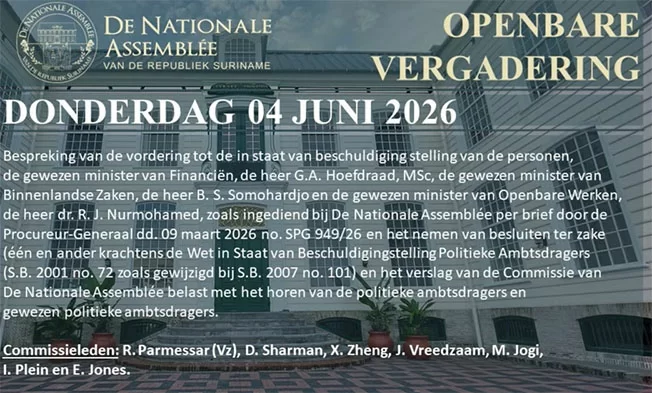
  • DNA vergadert openbaar over vorderingen pg tegen drie voormalige ministers

    DNA vergadert openbaar over vorderingen pg tegen drie voormalige ministers

    After hours of procedural delays, extended adjournments and last-minute negotiations, Suriname’s National Assembly (DNA) has formally approved holding a public plenary session to debate the Prosecutor General’s motions against three former senior political office holders, bringing a days-long parliamentary standoff to a temporary resolution. The green light for the public hearing came only after the parliamentary committee tasked with reviewing the motions finally tabled its final report, a step that was thrown into doubt earlier the same day.

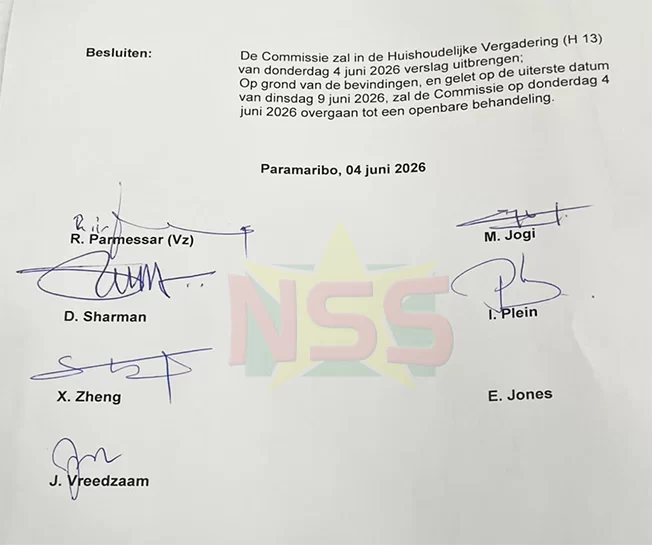
    When the assembly convened for an internal procedural meeting on Wednesday, committee chair Rabin Parmessar initially told lawmakers he could not deliver the committee’s final report. The announcement triggered immediate heated debate across the chamber, with multiple assembly members stressing that the full National Assembly holds the ultimate authority to decide whether to proceed with a public hearing. Following closed-door consultations and a lengthy adjournment, the committee ultimately submitted its report, clearing the way for the assembly to vote to advance the debate to an open public session.

    The Prosecutor General’s motions relate to three former cabinet members: Riad Nurmohamed, ex-Minister of Public Works, Gillmore Hoefdraad, former Minister of Finance, and Bronto Somohardjo, ex-Minister of Home Affairs. The assembly is required to vote on requests connected to a potential impeachment and formal indictment of the three former officials, a process that carries significant weight for Suriname’s ongoing efforts to address alleged past official misconduct.

    Procedural tensions emerged even before the internal meeting got underway, centered on the requirement to establish a quorum to validate proceedings. Initially, the parliamentary factions of the National Democratic Party (NDP) and Pertjajah Luhur (PL) declined to sign the attendance register, a move that put the meeting’s validity at risk. It was only after it was confirmed that a sufficient quorum had already been reached through the attendance of lawmakers from the VHP, NPS, ABOP, BEP and A20 parties that the NDP faction agreed to add their signatures to the register.

    The entire process is playing out against a strict legal deadline that binds the National Assembly to reach a final decision no later than June 9, leaving lawmakers just days to complete their debate and vote on the next steps for the three former ministers.

  • Onzekerheid over openbare DNA-vergadering: commissievoorzitter wil geen eindverslag uitbrengen

    Onzekerheid over openbare DNA-vergadering: commissievoorzitter wil geen eindverslag uitbrengen

    On June 4, political gridlock has thrown the planned public session of Suriname’s National Assembly (DNA) into uncertainty, just days before a legal deadline to rule on the prosecutor general’s request to bring three former senior political officials up on formal charges.

    The session, scheduled to kick off at 12:00 local time, was intended to debate the prosecutor general’s motion to indict former ministers Riad Nurmohamed, Gillmore Hoefdraad, and Bronto Somohardjo. However, as of the preliminary house meeting, no final decision has been reached on whether the public session will proceed as planned.

    Commission chair Rabin Parmessar told attendees of the closed-door preliminary meeting that he cannot deliver a final committee report on the indictment requests, a key document required to move forward with the legislative debate. Sources confirm that only six out of the seven members of the special parliamentary committee have signed the finalized draft report, leaving the document incomplete and creating an immediate procedural impasse.

    The road to scheduling the public session has been fraught with friction from the start. Initially, parliamentary factions from the NDP and Pertjajah Luhur (PL) refused to sign the attendance register to block the session from reaching the required quorum. Only after members from ruling coalition parties VHP, NPS, ABOP, BEP and A20 signed in, securing the necessary quorum, did the NDP faction reverse course and add their signatures to the register.

    Multiple sitting assembly members have emphasized that the full National Assembly, as the country’s highest legislative decision-making body, holds the ultimate authority to decide whether the public session proceeds and how the indictment debate will move forward, regardless of the committee’s deadlock on the final report. The clock is already ticking for the legislature: the legal deadline for DNA to issue a formal decision on the prosecutor general’s request expires on June 9, leaving just days for lawmakers to break the current stalemate.

    As of midday June 4, it remains unclear how the impasse over the unsigned final report will be resolved, and whether the planned public session will still be held as scheduled. Political tensions are running high across the legislature, with deep divisions already evident within the ruling coalition. Earlier on the same day, coalition leaders held a closed coordination meeting with President Jennifer Simons, which failed to bridge internal divides over the proceeding.

  • Lula hekelt nieuwe Amerikaanse tarieven: ‘Wij accepteren deze behandeling niet’

    Lula hekelt nieuwe Amerikaanse tarieven: ‘Wij accepteren deze behandeling niet’

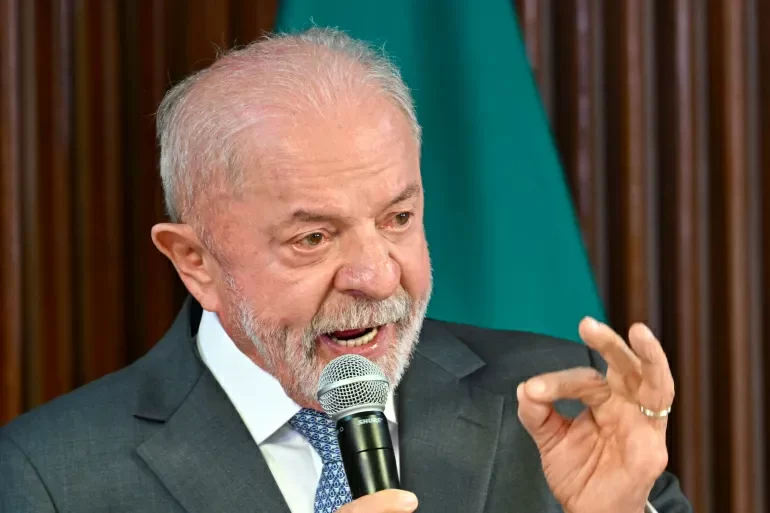
    In a sharp rebuke that has underscored growing frictions between Brasilia and Washington, Brazilian President Luiz Inacio Lula da Silva has publicly condemned the second Trump administration’s recent proposal to impose 25% tariffs on a range of Brazilian imports entering the United States. Lula has labeled the planned trade measure “unacceptable”, expressing deep surprise that the move would come at a time when ties between the two nations were just beginning to show signs of improvement after years of disagreement. The announcement caught many observers off guard, coming just one month after Lula met with U.S. President Donald Trump at the White House, a meeting that left Lula expressing cautious optimism about a potential thaw in bilateral relations. For years, relations between the two countries have been strained over disputes spanning trade policy, human rights disagreements, and competing priorities in regional politics, but the high-profile Washington meeting had been widely interpreted as the start of a new détente between the two governments. The relationship between Trump and Lula has long been complicated and fraught with ideological divides. Since Trump began his second presidential term in January 2025, he has maintained consistent criticism of Lula’s left-leaning administration. Trump has repeatedly spoken out against what he claims is censorship of right-wing political voices in Brazil, and has kept close personal and political ties to former Brazilian president Jair Bolsonaro and his family, leading figures in Brazil’s conservative right-wing movement. Bolsonaro is currently serving a 27-year prison sentence after being convicted of plotting to undermine Brazil’s democratic system following his narrow loss to Lula in the 2022 presidential election. The new U.S. tariffs were introduced following a U.S. investigation into alleged unfair Brazilian trade practices, including claims of illegal Amazon deforestation, restricted access to Brazil’s domestic ethanol market, and inconsistent enforcement of anti-corruption rules. U.S. Trade Representative Jamieson Greer has argued that current trade practices between the two nations are “unreasonable” and create unfair barriers to American commerce, adding that the U.S. faces a large trade deficit with Brazil. However, publicly available official trade data directly contradicts this claim: in March 2026 alone, the U.S. recorded a $420 million trade surplus with Brazil, rather than a deficit. Independent trade analysts say the proposed tariffs are part of a strategic shift by the Trump administration, which lost its broad legal authority to impose global tariffs under the International Emergency Economic Powers Act following a February 2026 ruling by the U.S. Supreme Court. The new levies are instead being enacted under Section 301 of U.S. trade law, a statute that grants the executive branch wide authority to impose trade sanctions when it claims trade agreement violations have occurred. Key Brazilian export sectors have been granted exemptions from the proposed 25% tariffs, including beef, coffee, rare earth elements, industrial metals, energy products, and aircraft components. The tariffs are still in a public consultation period that will conclude in early July 2026, leaving final implementation uncertain for now. The tariff announcement comes at an extraordinarily sensitive political moment for Lula, who is gearing up for a tightly contested general election in November, where his coalition will face off against a ticket led by Flavio Bolsonaro, former president Jair Bolsonaro’s eldest son. Despite his sharp criticism of the new trade measure, Lula has reaffirmed Brazil’s commitment to building stable, institutional relations with the United States. At the same time, he issued a clear warning that Brazil will actively diversify its trade partnerships and turn to other global markets if the tariffs are ultimately implemented.

  • Congres zet rem op Trumps Iran-oorlog

    Congres zet rem op Trumps Iran-oorlog

    In a historic vote that exposed deep partisan rifts and growing pushback against unilateral executive war powers, the U.S. House of Representatives approved a landmark resolution on Wednesday that curbs President Donald Trump’s ability to launch military action against Iran without explicit congressional approval. The measure passed by a razor-thin margin of 215 votes to 208, with four House Republicans breaking ranks to join all voting Democrats in advancing the bill – marking the first successful congressional challenge to Trump’s Iran policy this year.

    The resolution represents an explicit rebuke of Trump’s February 28 decision to launch a large-scale military assault on Iran without prior congressional authorization, a move that ignited an ongoing conflict that will enter its 100th day this coming Saturday. Trump has repeatedly downplayed the scope of the hostilities, dismissing the conflict as a mere “skirmish” or a “short-term operation,” but his consistent pattern of deploying military force without congressional sign-off has fueled mounting frustration across Capitol Hill and among the American public.

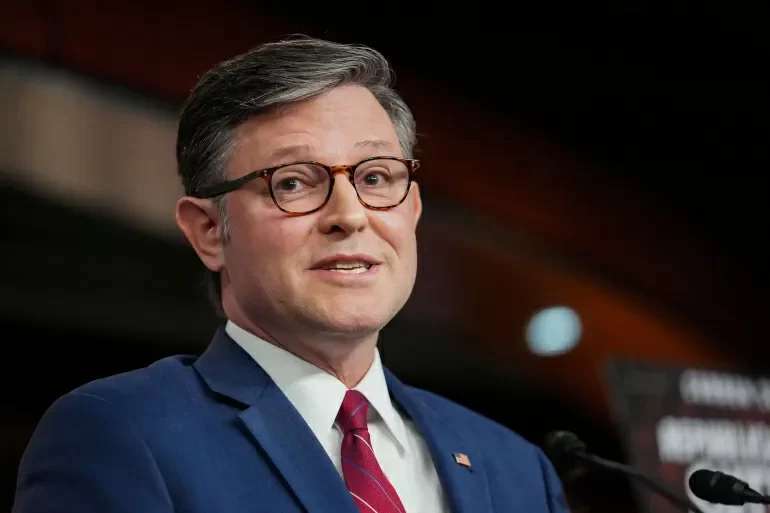
    The vote laid bare intraparty divisions within the Republican caucus. The four GOP defectors – Tom Barrett, Warren Davidson, Brian Fitzpatrick and Thomas Massie – defied House Speaker Mike Johnson, a top Trump ally who rallied party members to oppose the resolution. Massie, who recently lost his Republican primary re-election bid in large part due to opposition from Trump, framed the resolution’s passage as a clear signal that lawmakers are ready to end the open-ended conflict. Barrett echoed constitutional concerns, emphasizing that the U.S. Constitution explicitly grants Congress the sole power to declare war, and that any previous congressional authorization for military action against Iran has long expired.

    House Democrats celebrated the vote as a critical win for the separation of powers and called on the U.S. Senate to quickly take up and pass the same measure. They have drawn attention to the soaring financial cost of the conflict and its ambiguous legal standing. Official Pentagon data puts current U.S. spending on the conflict at roughly $29 billion, but many independent defense analysts estimate the true total cost will run into the hundreds of billions of dollars. Lawmakers and military officials have also raised growing alarms about the depletion of critical U.S. weapons stockpiles, which has left gaps in the country’s own defense preparedness.

    Public discontent with the conflict has surged across the United States in recent months. New public polling shows 60 percent of U.S. adults now disapprove of Trump’s handling of the Iran conflict, a notable increase from earlier surveys. The ongoing hostilities have already driven up global fuel prices, contributing to domestic inflation and widespread economic uncertainty, which has in turn amplified public criticism of the administration’s policy.

    The resolution now moves to the Senate, where a matching bill has already been advanced through procedural steps. But the measure faces an steep uphill battle: Trump has already signaled he will veto any legislation that seeks to limit his military authority against Iran. Overturning a presidential veto requires a two-thirds majority vote in both the House and the Senate, a threshold that supporters are far from reaching at this stage.

    Even so, Wednesday’s House vote marks a significant shift, demonstrating growing willingness among members of both parties to check presidential war-making power, and underscores the persistent political tensions that continue to surround Trump’s approach to the Iran conflict.

  • Column: SML ondersteunen

    Column: SML ondersteunen

    The launch of professional football through the Suriname Major League (SML) has unlocked a key opportunity for Surinamese top clubs to compete at the regional level. Just a short time after its establishment, the league has already cemented its value as a launching pad for Surinamese football, with no one able to deny its early positive impact.

    Under the current structure, both the SML champion and runner-up earn guaranteed spots in regional competitions organized by the Confederation of North, Central America and Caribbean Association Football (Concacaf). This season, SML champion Broki will test its mettle against other top Caribbean sides in the Concacaf Caribbean Cup, while runner-up Robinhood will compete in the Concacaf Club Shield. Importantly, the winner of the Club Shield also earns a subsequent berth to the higher-tier Concacaf Caribbean Cup, extending the opportunity for Surinamese clubs to gain international exposure. While these regional qualifying opportunities are a major win for the local game, the new league still faces critical structural gaps that limit its growth. The most pressing issue is the overall lack of competitive matches across the entire Surinamese football season.

    Currently, too few clubs hold the professional license required to compete in the SML, resulting in a season that is far too short to build fan momentum or improve player quality. It is acknowledged that strict licensing requirements are necessary to maintain professional standards, so unvetted clubs cannot be added to the top flight hastily. At the same time, the absence of a promotion and relegation system between the SML and lower divisions saps the league of much-needed competitive tension, as top-flight clubs face no consequence for poor on-field performance. To address the shallow league structure, lower-division clubs must step up to meet licensing requirements, expanding the number of participants and allowing for a full, competitive season.

    Beyond expanding the core league membership, a second solution to the lack of matches is the introduction of additional knockout cup competitions. The SML steering committee will need to prioritize outreach to the local business community to secure sponsorship for these new tournaments. While large domestic companies can take on full sponsorship individually, smaller firms should also be given the opportunity to pool resources in a consortium to back a cup. Notably, large companies that hold or have historically held monopoly positions in the Surinamese market, which generate substantial annual revenues, could launch and sponsor a cup as a meaningful part of their corporate social responsibility commitments.

    Given the uncertain timeline for more lower-tier clubs to meet professional licensing requirements, local businesses could take inspiration from English football’s structure and add multiple cup competitions alongside the existing league and current domestic cup. Any new cup would need to offer an attractive prize purse to drive full commitment from participating clubs and players. Additionally, introducing performance-based valuations and awards for players and coaches would incentivize higher quality of play, which in turn would draw more fans back to stadiums to watch matches.

    Ultimately, the long-term growth of professional football in Suriname is not the responsibility of the SML alone. The future of the local game depends entirely on the active support of all stakeholders, including the government, local business community and football governance bodies. Financial backing from FIFA will not last indefinitely, so urgent action is needed now to secure alternative funding sources that can not only keep local football operational, but also make it a more engaging, competitive product for fans across the country.

  • Derde helft WK 2026: Team Engeland, kan Tuchel het beste uit Kane en Bellingham halen?

    Derde helft WK 2026: Team Engeland, kan Tuchel het beste uit Kane en Bellingham halen?

    Sixty years have passed since England lifted their only men’s FIFA World Cup title on home soil, and as the 2026 tournament approaches in North America, the Three Lions enter the event as one of the pre-tournament favorites – but not without lingering questions surrounding their squad selection, tactical direction, and big-game form that have left fans and pundits divided.

    England made history during qualifying, becoming the first European nation to secure their World Cup spot with two group matches still remaining, wrapping up their campaign with a perfect eight wins from eight matches and not conceding a single goal along the way. The comfortable qualification run cemented their place among the top contenders, currently sitting 4th in the official FIFA world rankings. That smooth progress, however, has done little to quiet growing concerns: their qualifying group was widely regarded as one of the weakest in the European bracket, and recent friendly results – including back-to-back losses to Senegal and Japan at Wembley Stadium – have sparked public dissatisfaction with the team’s performances against elite opposition.

    At the center of the current debate is German head coach Thomas Tuchel, who took over the national side following the departure of Gareth Southgate. Southgate, despite frequent criticism for his cautious, risk-averse playing style and controversial tactical choices, led England to back-to-back European Championship finals and a World Cup semi-final appearance in 2018. Since taking charge, Tuchel has yet to deliver the dynamic, attacking football many fans expected, with the team often producing slow, hesitant displays. Tactical experiments, including shifts to a false nine system and a double playmaker setup, have failed to yield consistent positive results so far.

    Tuchel’s 26-man squad for the 2026 tournament has triggered major controversy, after he omitted several longstanding regular starters and surprising included a number of uncapped or out-of-form players. Two of England’s most creative attacking talents, Cole Palmer of Chelsea and Phil Foden of Manchester City, were left out after underwhelming club seasons. Veteran defender Trent Alexander-Arnold and former starter Harry Maguire also missed out on selection. In their places, Tuchel gave a spot to Saudi Arabia-based striker Ivan Toney, who has played limited competitive minutes since moving to the Middle East. Other controversial inclusions include Tottenham defender Djed Spence, 35-year-old Brentford midfielder Jordan Henderson, and uncapped Bayer Leverkusen defender Jarell Quansah. Overall, nine of the 26 selected players will be making their debut at a major senior international tournament.

    Tuchel has defended his selection choices, emphasizing team chemistry over individual talent in his approach. “We are not trying to pick the 26 most talented individual players in England,” he explained. “Our goal is to build the best possible team. Tournaments are won by cohesive teams, not collections of stars – everything depends on group chemistry.” Despite early skepticism about a foreign coach leading the national side, Tuchel has made it clear his ambition is to end the nation’s 60-year trophy drought and bring the World Cup title back to England.

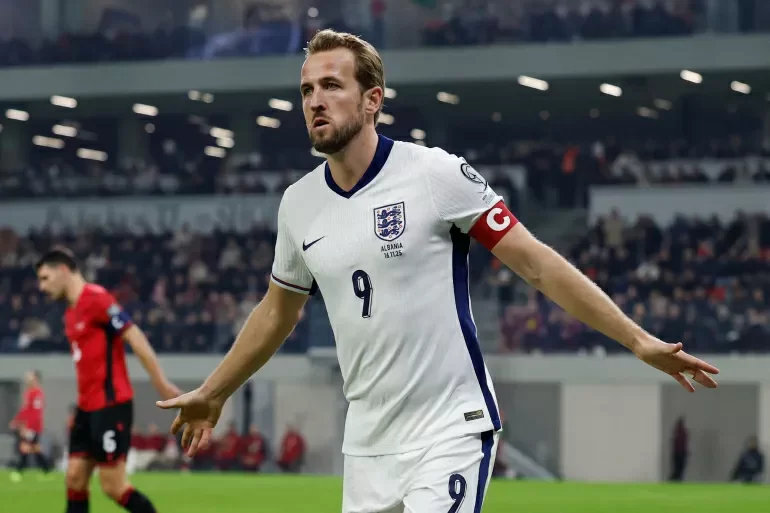
    One of the biggest individual storylines surrounding the side is the form of captain and all-time record goalscorer Harry Kane, who already has 78 international goals to his name heading into the tournament. Kane has a history of failing to hit his best form at major tournaments for England, even after claiming the Golden Boot at the 2018 World Cup, often arriving at the competition fatigued or carrying minor injuries following a long club season. This year, however, Kane comes into the tournament off the back of a career-best club campaign with Bayern Munich, where he scored an incredible 61 goals in 51 matches across all competitions. A fit and in-form Kane is just two goals away from equaling England’s all-time record of 10 World Cup goals set by Gary Lineker, and he will be counted on to lead the line if England is to make a deep run.

    Another key talking point is the position of Real Madrid midfield star Jude Bellingham, one of the most talented young players in European football. Bellingham endured a difficult season at club level, disrupted by injuries and inconsistent form, which has opened the door for Aston Villa’s Morgan Rogers to challenge for a starting spot. Bellingham is capable of playing in a deeper central midfield role, but that position is already widely expected to be filled by established starters Declan Rice and Elliot Anderson, leading to speculation that Bellingham could start the tournament on the bench.

    One bright spot for England is the emergence of 21-year-old Manchester City left-back Nico O’Reilly, who has enjoyed a breakout season. O’Reilly scored seven Premier League goals this term and played a key role in City’s League Cup final victory, and many observers believe he could become the first world-class left-back England has produced since Ashley Cole. While he is still developing his game, he brings elite pace, solid defensive fundamentals, and strong positional awareness to the side.

    England have been drawn into Group L, a challenging group that will test their credentials from the opening match. Their tournament kicks off on June 17 in Arlington, Texas against 11th-ranked Croatia, the same side that knocked England out of the 2018 World Cup at the semi-final stage. They will then face Ghana in Foxborough, Massachusetts on June 23, before wrapping up group play against Panama on June 27 in East Rutherford, New Jersey. While Panama is ranked 33rd in the world, they earned a surprise final spot at the 2025 CONCACAF Nations League after beating the United States, and 74th-ranked Ghana boasts dangerous attacking talent in the form of Antoine Semenyo and Mohammed Kudus, making them a dangerous dark horse in the group.

    Full 2026 England World Cup Squad:
    Goalkeepers: Jordan Pickford (Everton), Dean Henderson (Crystal Palace), James Trafford (Manchester City)
    Defenders: Reece James (Chelsea), Ezri Konsa (Aston Villa), Jarell Quansah (Bayer Leverkusen), John Stones (Manchester City), Marc Guehi (Manchester City), Dan Burn (Newcastle United), Nico O’Reilly (Manchester City), Djed Spence (Tottenham Hotspur), Tino Livramento (Newcastle United)
    Midfielders: Declan Rice (Arsenal), Elliot Anderson (Nottingham Forest), Kobbie Mainoo (Manchester United), Jordan Henderson (Brentford), Morgan Rogers (Aston Villa), Jude Bellingham (Real Madrid), Eberechi Eze (Arsenal)
    Forwards: Harry Kane (Bayern Munich), Ivan Toney (Al-Ahli), Ollie Watkins (Aston Villa), Bukayo Saka (Arsenal), Marcus Rashford (Barcelona), Anthony Gordon (Newcastle United), Noni Madueke (Arsenal)
  • Werkbezoeken president leveren nieuwe afspraken

    Werkbezoeken president leveren nieuwe afspraken

    Suriname’s President Jennifer Simons has returned to the country following a series of official working visits to two Latin American and Caribbean nations – Brazil and the Dominican Republic – that have yielded a broad suite of new bilateral cooperation agreements spanning key sectors from public health to diplomatic engagement. The trip marked a major push by Suriname to deepen its economic and diplomatic ties across the Latin American and Caribbean region, according to official government statements.

    During the first leg of the tour in Brazil, Simons held formal high-level talks with Brazil’s President Luiz Inácio Lula da Silva. The in-depth discussions covered a wide range of shared priorities, and resulted in new cooperation pacts across seven core areas: public health, defense, cybersecurity, agriculture, trade, infrastructure, and energy. The two leaders also used the meeting to exchange views on pressing cross-border issues, including regional integration efforts and global climate action, aligning their positions on shared regional challenges.

    After concluding engagements in Brazil, Simons and her official Surinamese delegation traveled onward to the Dominican Republic for the second phase of the tour. Discussions in Santo Domingo centered on three key priorities: boosting bilateral investment, expanding agricultural collaboration, and growing cross-border tourism. By the end of the visit, the two sides formalized new partnerships by signing a total of six distinct cooperation agreements.

    One of the most significant diplomatic outcomes of the Dominican Republic visit is an agreement to further strengthen bilateral ties between the two countries, including a planned establishment of a Dominican Republic embassy in Paramaribo, Suriname’s capital. That update was officially confirmed by Suriname’s Communication Service in a post-visit statement.

    While in the Dominican Republic, President Simons also delivered an address to the country’s National Congress. In her speech, she touched on a range of critical topics including regional integration, climate change, and collective security. She emphasized that small developing nations face interconnected shared challenges that can only be effectively addressed through coordinated, joint action.

    Suriname’s national government has stated that all agreements reached during both visits are expected to drive substantial expansion of economic and diplomatic cooperation between Suriname and the two host nations, laying a long-term foundation for mutually beneficial growth across multiple sectors.

  • Suriname verliest icoon van de inheemse keramiekkunst

    Suriname verliest icoon van de inheemse keramiekkunst

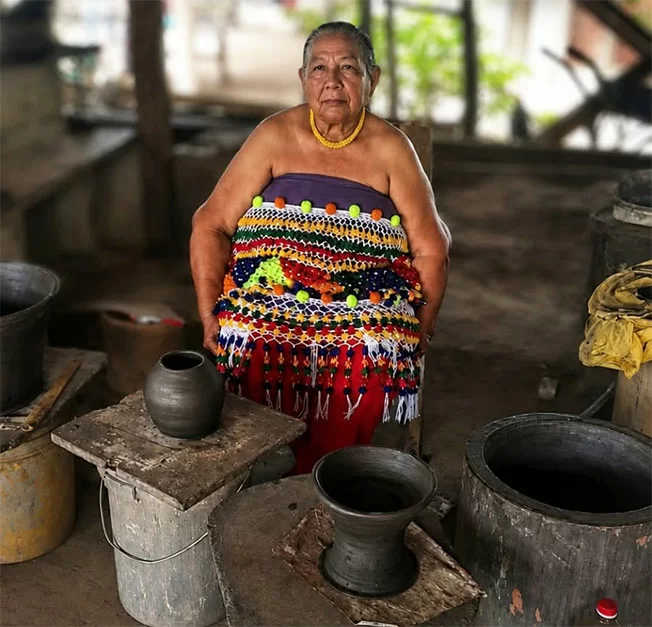
    The Caribbean and Surinamese art world is mourning the loss of one of its most influential Indigenous ceramic voices, Cornelly Aloema, who died at the age of 77 following a brief period of illness. The celebrated ceramist and potter passed away in a local hospital, leaving behind a decades-long legacy that reshaped Surinamese ceramic art and lifted up Indigenous craft traditions.

    Born in the Galibi community in Marowijne district, Aloema built her new life alongside her husband Thomas Sjinga in 1975, when the couple settled at the Onoribo plantation in Para. It was not long before her innate artistic talent caught the eye of Luciël Becker, a prominent local artist and philosopher, who first introduced her work to the wider artistic community through Wild Coast Art Gallery. From that starting point, Aloema carved out a singular artistic path, building on centuries-old Indigenous pottery traditions to evolve into a groundbreaking innovator in the medium. Beyond functional daily ware, she created striking decorative vases and one-of-a-kind art objects that earned her international recognition and a loyal global following.

    Aloema’s work was defined by her unwavering commitment to artisanal, tradition-centered practice. She sourced all her materials directly from natural surroundings: raw clay, plant-based natural pigments, tree bark, and natural resins, and fired every piece using the traditional open-wood fire technique passed down through generations of Indigenous potters. For decades, her creations were regularly featured in exhibitions hosted by Art Gallery Wi Eygi Du, which confirmed her death and shared details of her final arrangements.

    Beyond her individual artistic output, Aloema’s greatest contribution came through her mentorship and inspiration for emerging creators. She mentored and encouraged generations of Indigenous potters across Suriname, helping to strengthen and grow ceramic craft practices within multiple Indigenous communities across the country. Her work earned widespread institutional recognition for her contributions to Surinamese art: she was awarded the Honorary Order of the Palm by former Surinamese president Ronald Venetiaan, and most recently received a distinguished award from the Stichting Grani Fiti Yu Moy Misi in 2023.

    With Aloema’s passing, Suriname has lost one of the most important contemporary representatives of Indigenous art and culture. Art Gallery Wi Eygi Du confirmed that Aloema will be laid to rest on Tuesday, as the art community gathers to honor her life and legacy.

  • Voormalig bisschop Wilhelmus de Bekker overleden

    Voormalig bisschop Wilhelmus de Bekker overleden

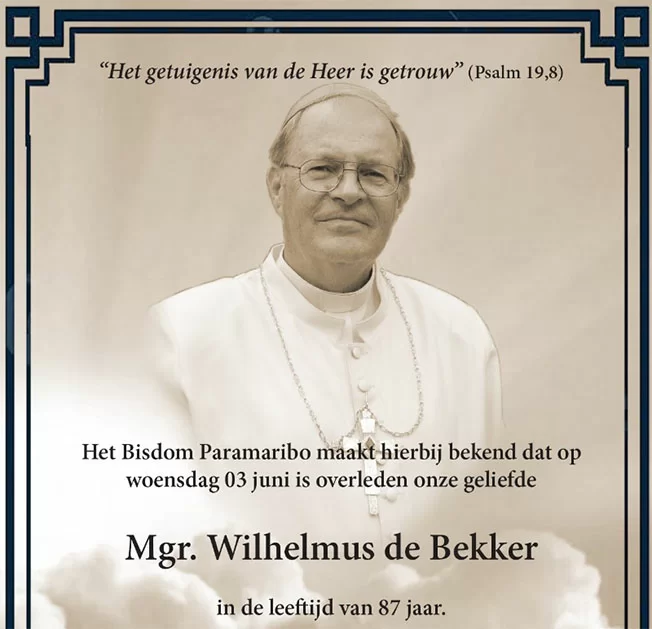
    One of Suriname’s long-serving Roman Catholic spiritual leaders, former Paramaribo Bishop Monseigneur Wilhelmus Adrianus Josephus Maria de Bekker, passed away on Wednesday at the age of 87.

    De Bekker’s journey to the episcopate began decades before his consecration, rooted in educational service and pastoral work within the Surinamese Catholic community. Ordained as a priest on May 25, 1985, by the late Bishop Aloysius Zichem, he had already spent many years working in the Catholic special education system, where he held roles including consultant inspector. He also served as director of the Pater Ahlbrinck Foundation prior to his priestly ordination.

    Following his ordination to the priesthood, De Bekker took on key pastoral and administrative roles: he led the Sint-Alfonsusparochie as parish priest and served as vicar-general of the Diocese of Paramaribo. He was officially consecrated as Bishop of Paramaribo on January 30, 2005, and went on to guide the country’s Roman Catholic community for approximately eight and a half years. In line with canonical regulations, he submitted his resignation from the episcopal office upon reaching the mandatory retirement age of 75, and Pope Francis accepted his departure from active episcopal service on May 31, 2014.

    Even after entering official emeritus status in 2014, De Bekker continued his pastoral service for several more years. He served as parish priest of the Sint-Thaddeusparochie in Groningen, where he dedicated himself to leading the project to construct a new parish church. He spent his final years of life living at the Fatima Oord care home, where he passed away this week.

    Current Bishop Karel Choennie has announced full funeral and memorial arrangements to honor the late prelate. A special mourning vesper service will be held in his memory at Sint-Alfonsus Church on Saturday, June 13, starting at 7:00 PM local time. The official funeral Mass will take place the following day, Sunday, June 14, at the HH. Petrus en Paulus Cathedral, beginning at 1:00 PM. After the service, De Bekker will be interred in the cathedral’s crypt.

    For community members who wish to pay their respects, public viewing and farewell will be open at the cathedral between 10:00 AM and 12:30 PM on June 14. A condolence register will also be available for signing at the cathedral from 10:00 AM to 1:00 PM on Friday, June 12.

    The Surinamese Roman Catholic community is mourning the loss of a figure who dedicated more than six decades of his life to service across the church, education, and broader civil society. With his passing, the community has lost a committed spiritual leader who shaped the life of the church in Suriname for generations.

  • Nieuwe escalaties VS-Iran conflict: Aanval op luchthaven Koeweit en wederzijdse raketaanvallen

    Nieuwe escalaties VS-Iran conflict: Aanval op luchthaven Koeweit en wederzijdse raketaanvallen

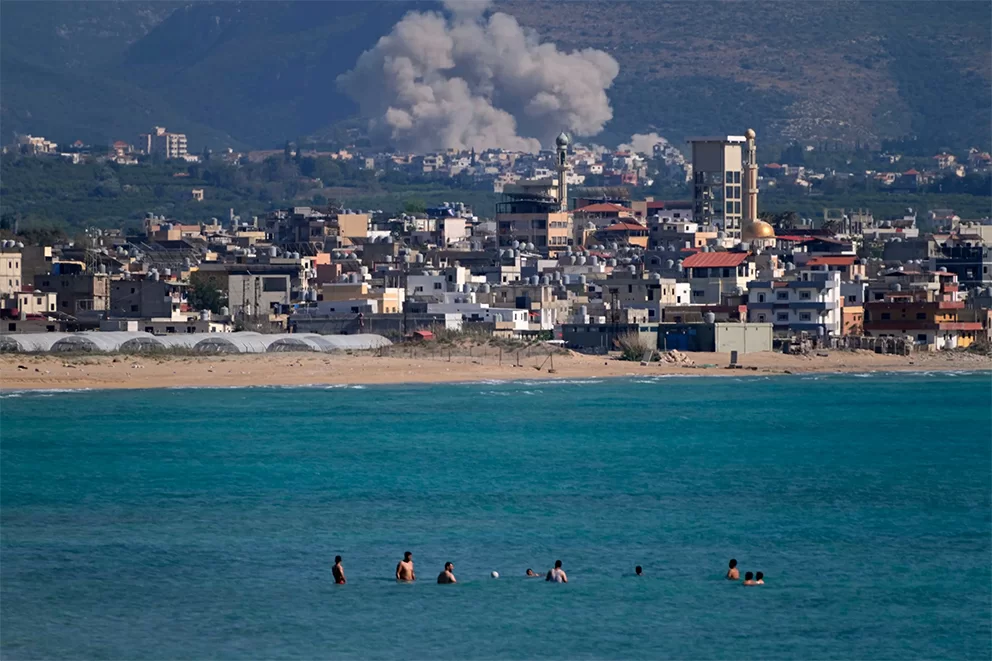
    On June 3, fresh waves of coordinated attacks and rapidly escalating hostilities have thrown the already volatile Middle East into heightened crisis, spreading conflict across multiple states from the Persian Gulf to the Eastern Mediterranean. The most recent major incident unfolded Wednesday, when Kuwait’s international airport came under a simultaneous drone and missile assault that left at least one person dead and 63 others injured. The attack forced immediate authorities to shut down the air hub temporarily and reroute all incoming and outgoing commercial flights. Notably, this assault occurred just hours after a fresh exchange of missile strikes between Iran and the United States that ratcheted up bilateral tensions in the Gulf region.\n\nIn the wake of that cross-fire between Iran and the U.S., American military officials confirmed they had intercepted multiple Iranian ballistic missiles and drones launched toward their positions, before carrying out their own retaliatory air strikes on targets on Qeshm Island, located adjacent to the strategically critical Strait of Hormuz, through which roughly 20% of global oil supplies pass daily. For its part, Iran’s Islamic Revolutionary Guard Corps claimed it had successfully carried out an attack targeting the U.S. Fifth Fleet and an American naval vessel. Amid this back-and-forth, Kuwait has moved swiftly to distance itself from the conflict: the Kuwaiti government issued a firm denial that it had allowed any foreign power to use its territory or airspace to launch attacks against Iran, and ordered two Iranian embassy staff members to leave the country within a 24-hour window.\n\nParallel to the Gulf escalation, political tensions around U.S.-Iran nuclear diplomacy remain tangled. U.S. President Donald Trump stated that diplomatic discussions with Iran are ongoing, and claimed Iran has agreed to abandon its pursuit of a nuclear weapon. Even as talks proceed, however, the Trump administration imposed new economic sanctions on Iran’s Persian Gulf Strait Authority, the body Tehran has tasked with overseeing shipping traffic through the Strait of Hormuz.\n\nThe attack on Kuwait’s main airport drew widespread international condemnation. The Indian government confirmed that one of its citizens was killed in the assault, with several other Indian nationals sustaining injuries, and issued a call for all regional actors to immediately halt all provocative attacks.\n\nTensions have also spiked dramatically along the Israel-Lebanon border, adding another layer of instability to the region. Israeli air strikes across southern Lebanon have left at least nine people dead, the Lebanese side confirmed, including two paramedics responding to earlier incidents. Additional strikes were carried out near the Lebanese capital Beirut. The Israeli military announced it intercepted an “enemy aircraft” over northern Israel, while the Lebanese militant group Hezbollah claimed responsibility for a series of rocket attacks targeting Israeli military positions in the country’s north. These latest exchanges of fire came just after direct peace negotiations between the Israeli government and Lebanese officials got underway in Washington, a meeting that Hezbollah has publicly rejected.\n\nIsraeli officials issued a stark warning: if Hezbollah continues to launch rocket attacks on Israeli communities in northern Israel, the Israeli military will launch full-scale strikes on the southern suburbs of Beirut. Israeli officials added that this position has the full backing of the U.S. government in Washington. Even further inland in Iraq, regional instability is disrupting critical global energy supplies. Iraqi Prime Minister Ali al-Zaidi has ordered a resumption of oil production in Iraq’s Kurdish region, after multiple private energy companies suspended production amid repeated drone attacks on local oil fields. Those production halts have already worsened energy supply disruptions across the Middle East, with knock-on effects for global energy markets.