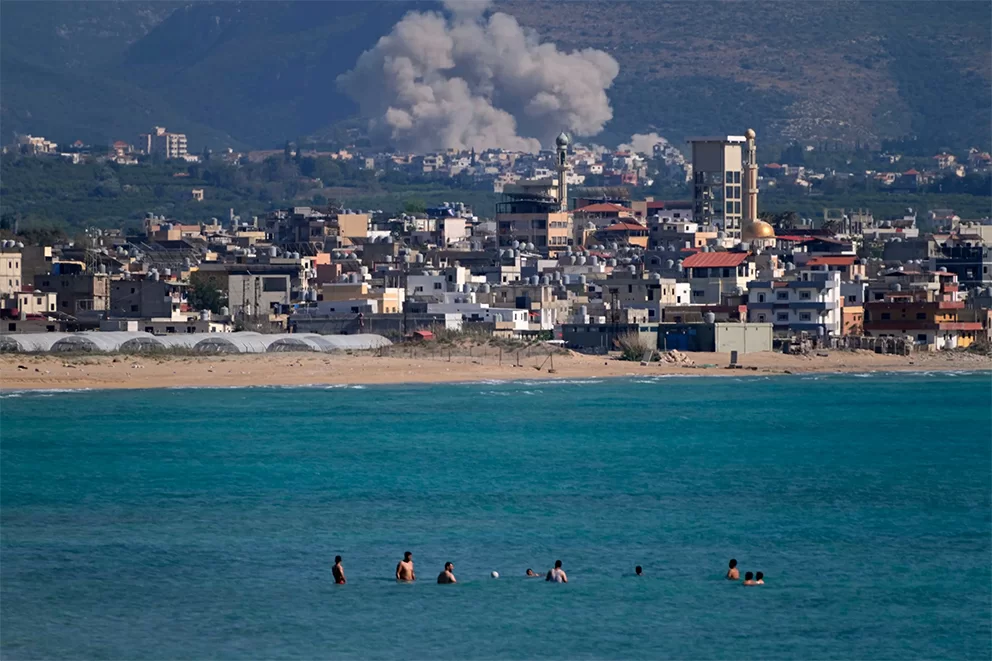
On June 3, fresh waves of coordinated attacks and rapidly escalating hostilities have thrown the already volatile Middle East into heightened crisis, spreading conflict across multiple states from the Persian Gulf to the Eastern Mediterranean. The most recent major incident unfolded Wednesday, when Kuwait’s international airport came under a simultaneous drone and missile assault that left at least one person dead and 63 others injured. The attack forced immediate authorities to shut down the air hub temporarily and reroute all incoming and outgoing commercial flights. Notably, this assault occurred just hours after a fresh exchange of missile strikes between Iran and the United States that ratcheted up bilateral tensions in the Gulf region.\n\nIn the wake of that cross-fire between Iran and the U.S., American military officials confirmed they had intercepted multiple Iranian ballistic missiles and drones launched toward their positions, before carrying out their own retaliatory air strikes on targets on Qeshm Island, located adjacent to the strategically critical Strait of Hormuz, through which roughly 20% of global oil supplies pass daily. For its part, Iran’s Islamic Revolutionary Guard Corps claimed it had successfully carried out an attack targeting the U.S. Fifth Fleet and an American naval vessel. Amid this back-and-forth, Kuwait has moved swiftly to distance itself from the conflict: the Kuwaiti government issued a firm denial that it had allowed any foreign power to use its territory or airspace to launch attacks against Iran, and ordered two Iranian embassy staff members to leave the country within a 24-hour window.\n\nParallel to the Gulf escalation, political tensions around U.S.-Iran nuclear diplomacy remain tangled. U.S. President Donald Trump stated that diplomatic discussions with Iran are ongoing, and claimed Iran has agreed to abandon its pursuit of a nuclear weapon. Even as talks proceed, however, the Trump administration imposed new economic sanctions on Iran’s Persian Gulf Strait Authority, the body Tehran has tasked with overseeing shipping traffic through the Strait of Hormuz.\n\nThe attack on Kuwait’s main airport drew widespread international condemnation. The Indian government confirmed that one of its citizens was killed in the assault, with several other Indian nationals sustaining injuries, and issued a call for all regional actors to immediately halt all provocative attacks.\n\nTensions have also spiked dramatically along the Israel-Lebanon border, adding another layer of instability to the region. Israeli air strikes across southern Lebanon have left at least nine people dead, the Lebanese side confirmed, including two paramedics responding to earlier incidents. Additional strikes were carried out near the Lebanese capital Beirut. The Israeli military announced it intercepted an “enemy aircraft” over northern Israel, while the Lebanese militant group Hezbollah claimed responsibility for a series of rocket attacks targeting Israeli military positions in the country’s north. These latest exchanges of fire came just after direct peace negotiations between the Israeli government and Lebanese officials got underway in Washington, a meeting that Hezbollah has publicly rejected.\n\nIsraeli officials issued a stark warning: if Hezbollah continues to launch rocket attacks on Israeli communities in northern Israel, the Israeli military will launch full-scale strikes on the southern suburbs of Beirut. Israeli officials added that this position has the full backing of the U.S. government in Washington. Even further inland in Iraq, regional instability is disrupting critical global energy supplies. Iraqi Prime Minister Ali al-Zaidi has ordered a resumption of oil production in Iraq’s Kurdish region, after multiple private energy companies suspended production amid repeated drone attacks on local oil fields. Those production halts have already worsened energy supply disruptions across the Middle East, with knock-on effects for global energy markets.
Nieuwe escalaties VS-Iran conflict: Aanval op luchthaven Koeweit en wederzijdse raketaanvallen