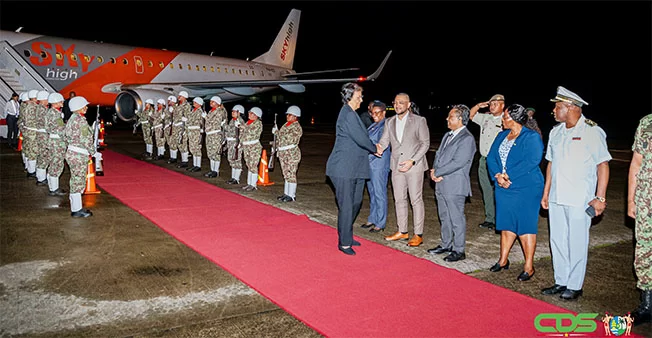
Suriname’s President Jennifer Simons has returned to the country following a series of official working visits to two Latin American and Caribbean nations – Brazil and the Dominican Republic – that have yielded a broad suite of new bilateral cooperation agreements spanning key sectors from public health to diplomatic engagement. The trip marked a major push by Suriname to deepen its economic and diplomatic ties across the Latin American and Caribbean region, according to official government statements.
During the first leg of the tour in Brazil, Simons held formal high-level talks with Brazil’s President Luiz Inácio Lula da Silva. The in-depth discussions covered a wide range of shared priorities, and resulted in new cooperation pacts across seven core areas: public health, defense, cybersecurity, agriculture, trade, infrastructure, and energy. The two leaders also used the meeting to exchange views on pressing cross-border issues, including regional integration efforts and global climate action, aligning their positions on shared regional challenges.
After concluding engagements in Brazil, Simons and her official Surinamese delegation traveled onward to the Dominican Republic for the second phase of the tour. Discussions in Santo Domingo centered on three key priorities: boosting bilateral investment, expanding agricultural collaboration, and growing cross-border tourism. By the end of the visit, the two sides formalized new partnerships by signing a total of six distinct cooperation agreements.
One of the most significant diplomatic outcomes of the Dominican Republic visit is an agreement to further strengthen bilateral ties between the two countries, including a planned establishment of a Dominican Republic embassy in Paramaribo, Suriname’s capital. That update was officially confirmed by Suriname’s Communication Service in a post-visit statement.
While in the Dominican Republic, President Simons also delivered an address to the country’s National Congress. In her speech, she touched on a range of critical topics including regional integration, climate change, and collective security. She emphasized that small developing nations face interconnected shared challenges that can only be effectively addressed through coordinated, joint action.
Suriname’s national government has stated that all agreements reached during both visits are expected to drive substantial expansion of economic and diplomatic cooperation between Suriname and the two host nations, laying a long-term foundation for mutually beneficial growth across multiple sectors.