标签: Belize

伯利兹

  • Stevedores Warn Port Stalemate Could Put Economy at Risk

    Stevedores Warn Port Stalemate Could Put Economy at Risk

    Four months have passed since the Essential Services Arbitration Tribunal brought an end to a years-long labor standoff between the Port of Belize and its stevedore workforce, yet not a single step has been taken to finalize a new collective bargaining agreement (CBA) that would resolve the core issues at the heart of the dispute. The entire arbitration process, which dragged on for more than 12 months, came to an abrupt halt in March when the Christian Workers Union rejected a revised confidentiality agreement, walking away from the negotiating table and leaving the dispute unresolved.

    Today, after the government of Belize assumed formal control of the Port of Belize, stevedores say they are still waiting for the new administration to follow through on its public promise to restart good-faith negotiations. Bruce Diaz, the chief union representative for the stevedores, says workers have maintained extraordinary patience through months of inaction, but issued a stark warning: if government and port officials do not return to negotiations imminently, the entire Belizean economy could face cascading disruption.

    “There is no tribunal left – the process abandoned us back in February,” Diaz explained in an interview. “We have been waiting to coordinate a meeting with Port of Belize leadership ever since, and we have not received any response at all. After the government took control, they confirmed they would sit down with us to finalize the CBA. To date, we have had no meetings, no productive discussions, and we need to move forward. We all know that if stevedores are forced to stop work, every Belizean will feel the impact – and we workers will feel it too. We do not want to take that step, so we have held off in good faith to see if they will meet with us to sort through the current issues.”

    Diaz emphasized that getting a new CBA signed is non-negotiable for the workforce, highlighting the grueling, uncelebrated work stevedores perform to keep the national economy moving. “Stevedores work around the clock, through rain and extreme heat, while executives and directors are at home asleep,” he said. “We work in pouring rain, dry off in the sun, and keep going to keep Belize’s economy flowing. If the Port of Belize stops functioning, basic goods from noodles to chicken sausage will not reach local communities – and prices for all goods will skyrocket. In past negotiations, we have made concessions to keep operations running even when we did not get the terms we needed, and that remains the case today. We are calling on the Port of Belize to meet with our negotiating team and finalize this CBA before the situation escalates.”

    Diaz added that stevedores initially viewed the government’s takeover of the port as a positive turning point, with workers holding out hope that the new administration would bring a more collaborative approach to labor relations. Months later, however, the workforce says it feels ignored, sidelined, and forced to issue a public warning to get the attention of port leadership. This report is a transcribed excerpt from an evening television newscast, with Kriol language statements standardized to written English for clarity.


  • Drone Regulations Delayed Until July Thirtieth

    Drone Regulations Delayed Until July Thirtieth

    The Belize Department of Civil Aviation (BDCA) has announced a one-month extension to its deadline for releasing a revised draft of national unmanned aircraft systems regulations, pushing the date from the originally scheduled June 30 to July 30, 2026. The extension comes in the wake of a public consultation phase that drew far more input than initially anticipated, with dozens of targeted comments and technical recommendations submitted by key stakeholders across both the traditional aviation sector and fast-growing commercial and recreational drone industries. BDCA officials have emphasized that the timeline shift is purely an administrative adjustment to accommodate the review of all submitted feedback, and in no way signals a reduction in the department’s commitment to rolling out clear, effective rules for drone operations in Belizean airspace. Once the revised draft is published next month, the department will open a second public comment window, giving all interested parties another opportunity to review the proposed framework and submit formal feedback before the regulations are finalized. BDCA reaffirmed that its top priority is upholding full transparent regulatory due process, with the end goal of establishing a clear set of standards that allows both manned commercial and private aircraft and unmanned drone systems to operate safely in shared Belizean airspace, mitigating collision risks and supporting the sustainable growth of the burgeoning local drone sector.

  • Belize Strengthens Child-Centered Justice System

    Belize Strengthens Child-Centered Justice System

    BELIZE CITY, July 10, 2026 — When minors become involved with the country’s legal system, every decision carries outsized consequences for their long-term development and well-being. Now, the Central American nation of Belize is taking targeted steps to transform its justice framework to be more responsive, empathetic, and centered on the unique needs of children.

    A two-day specialized training program for judicial professionals wrapped up recently in Belize City, drawing together sitting judges and leading stakeholders from across the country’s justice sector. The curriculum focused on four core priority areas: child-centered justice frameworks, combatting human trafficking, restorative justice practices, and diversion programs that keep children out of traditional punitive court systems when appropriate.

    The initiative was spearheaded by three leading national bodies: Belize’s Ministry of Human Development, the national Anti-Trafficking in Persons Council, and the Child Justice Committee. The Judicial Education Institute provided logistical and technical support to make the training possible.

    Per program organizers, the core objective of the training is to equip judicial officers with the tools and knowledge to more effectively protect vulnerable children and victims of trafficking. The training emphasizes trauma-informed, victim-centered legal practices that prioritize a child’s physical safety, mental health, and overall well-being as the central consideration in every case involving minors.

    This training marks a key milestone in Belize’s ongoing efforts to reform its justice system to align with international standards for child protection, addressing widespread recognition that traditional legal approaches often fail to account for the developmental needs and trauma experienced by children who come into contact with the law.

  • Stevedores’ Warning to Belize: “We Do Not Want to Pull the Plug

    Stevedores’ Warning to Belize: “We Do Not Want to Pull the Plug

    It has been four full months since arbitration talks between the Port of Belize and its stevedore workforce collapsed, and efforts to finalize a new collective bargaining agreement (CBA) are still stuck in gridlock, despite public pledges from Belize’s government to restart productive negotiations. The breakdown traces back to March, when the Essential Services Arbitration Tribunal proceedings were brought to a sudden, premature end after more than a year of deliberations. The Christian Workers Union, which represents the stevedores, rejected a modified confidentiality agreement, walking away from the tribunal and leaving the CBA process in limbo.

    In the months following the arbitration collapse, the Port of Belize has transitioned to government oversight. But union leaders say that even with this shift in control, workers have not received any formal invitation to resume negotiations on a new CBA.

    Bruce Diaz, the chief union representative for the stevedores, noted that workers have held off on taking drastic industrial action to keep the port operational, but warned that prolonged inaction from the government and port leadership could trigger cascading disruptions across Belize’s entire economy. Diaz highlighted the grueling, unsung work that stevedores perform to keep supply chains moving: “We need to get this CBA signed. The stevedores work night and day in the rain while the big executives and all the directors are sleeping comfortably in their beds. We are the ones out in bad weather keeping operations moving. We keep Belize’s economy flowing.”

    Diaz spelled out the direct risks that a port shutdown would create for ordinary Belizean residents: “If the Port of Belize is not functioning, basic goods like noodles, chicken sausage, and all the everyday items communities rely on will not arrive. That will immediately push prices up for everyone across the country.”

    Despite the mounting frustration, Diaz emphasized that workers are committed to waiting for good-faith negotiations before taking disruptive action. “When the stevedores pull the plug, the entire Belizean people feel the impact. We do not want to pull the plug. That is why we are continuing to bear this patience,” he said. Now, four months after the government promised workers a seat at the negotiating table, stevedores are still waiting for officials to follow through on their commitment – before workers’ patience runs out entirely.

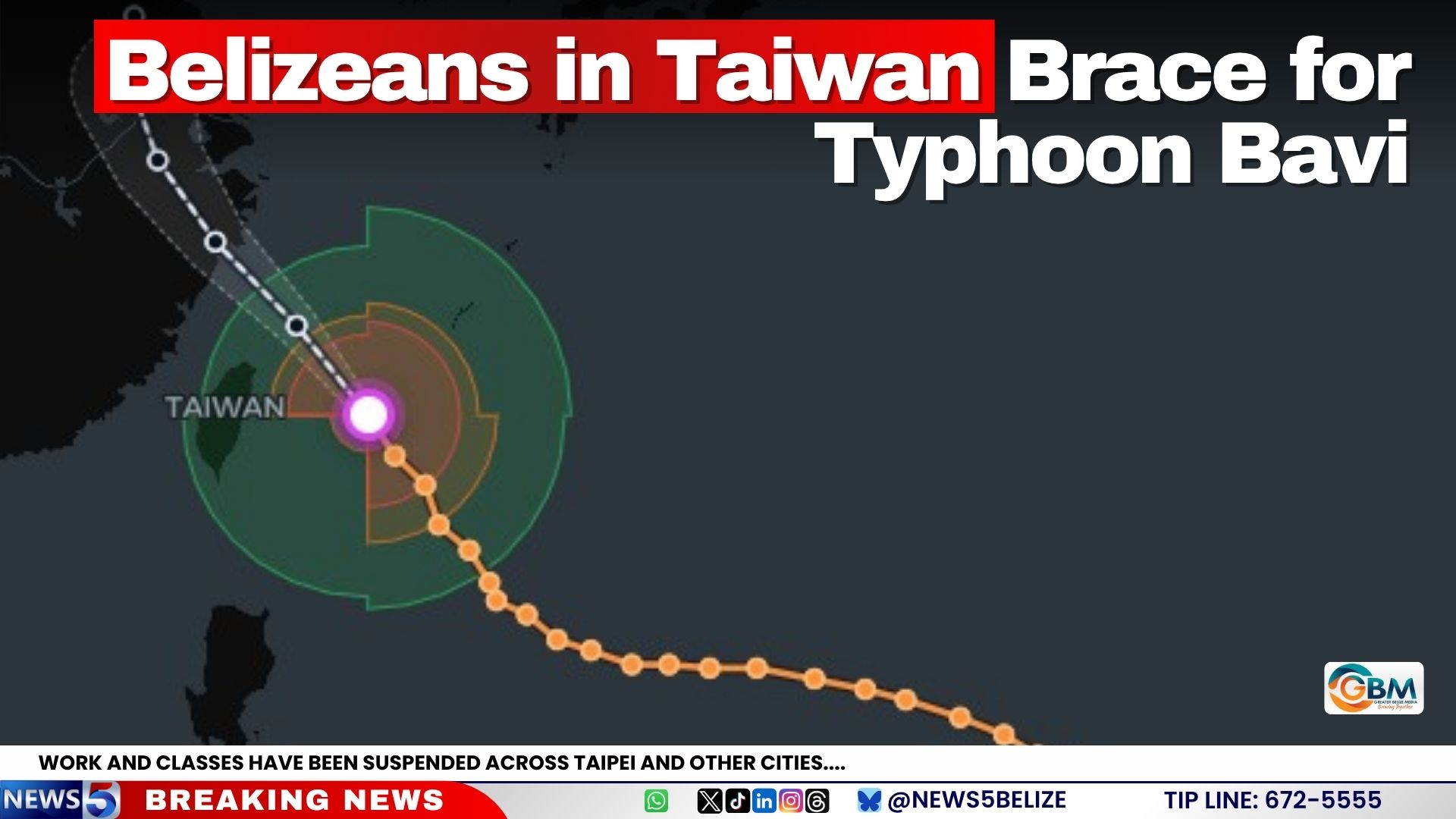
  • Belizeans in Taiwan Brace for Typhoon Bavi

    Belizeans in Taiwan Brace for Typhoon Bavi

    As July 10, 2026 brings a rare large-scale weather event to East Asia, Taiwan is preparing for the arrival of Typhoon Bavi, a massive storm system advancing toward the island at a steady 27 kilometers per hour. Meteorological officials warn the storm could dump up to 700 millimeters of rain across affected regions in just 24 hours, a volume that raises severe flooding risks even in areas with well-established drainage infrastructure.

    While forecasters project Bavi will track through waters just off Taiwan’s northern coast rather than making a direct landfall, the unprecedented size of the storm system means no part of the island will escape its impacts. The Central Weather Administration has confirmed that Bavi is the largest tropical cyclone to approach Taiwan since 1987, a classification that has triggered widespread emergency preparations across the entire island, far beyond the areas expected to face the worst conditions.

    Among the communities preparing for the storm is the small population of Belizean residents living in Taiwan, including a large cohort of international students. With severe weather expected to last from Wednesday into Thursday, most Belizeans have stocked up on emergency food, water and supplies and are remaining indoors to ride out the storm.

    Nay Smith, a Belizean national currently residing in Taiwan, shared her on-the-ground experience ahead of the storm’s peak. She noted that the Belizean embassy has delivered prompt, consistent support to the community: “The embassy response has been really good. They have been keeping us updated, and I’m pretty sure they will message later to check on us.” Still, she shared a lighthearted observation about the storm’s slow build: “What’s disappointing is the rain; I expected much more, provided that it was marked as one of the heaviest ones ever since I don’t remember which year. The night market was half open and the morning one too.”

    In response to the incoming storm, Taiwan’s government has suspended all work and classes across Taipei and multiple other high-risk cities. Nationwide, nearly 29,000 military personnel have been placed on active standby to deploy for flood control efforts and emergency rescue operations if disaster strikes. The scale of preparation reflects the rarity of storms of this size in the region, with officials urging residents to remain vigilant even if their local area does not see immediate severe conditions.

  • Belize Takes the Wheel on Regional Health

    Belize Takes the Wheel on Regional Health

    On July 10, 2026, Belize officially stepped into the six-month rotating Pro Tempore Presidency of the Council of Ministers of Health of Central America and the Dominican Republic (COMISCA), taking the lead in coordinating cross-border efforts to address the region’s most pressing public health priorities. The formal handover ceremony occurred during the council’s 63rd ordinary session, where outgoing president Víctor Atallah, Minister of Public Health of the Dominican Republic, formally transferred the leadership role to Kevin Bernard, Belize’s Minister of Health and Wellness.

    Atallah emphasized that the Dominican Republic transferred the responsibility to Belize with full confidence in the government and people of the Central American nation, noting that outgoing administration’s work laid a foundation for continued regional health integration. “Regional cooperation remains the most effective strategy to build stronger, more resilient health systems that can protect the well-being of all communities across our shared neighborhood,” Atallah stated, adding that the Dominican Republic will continue to actively participate in and support collective efforts during Belize’s tenure.

    Accepting the presidency, Bernard outlined Belize’s core priorities for the upcoming six months, aligning with longstanding COMISCA goals. The nation will focus its coordination on advancing progress across five key areas: combating the growing burden of non-communicable diseases, expanding and upskilling the regional health workforce, improving equitable access to affordable essential medicines and cutting-edge health technologies, strengthening collective response capacities for public health emergencies, and supporting systemic reforms to build long-term health system resilience across the region.

    Bernard stressed that cross-border collaboration and shared action consistently deliver greater public health outcomes than individual national efforts, reaffirming Belize’s unwavering commitment to deepening regional integration under the framework of the Central American Integration System (SICA), which established the rotating presidency structure that transfers leadership to a new member every six months.

  • “Bring Back the Millions” Protest Targets Briceño Government

    “Bring Back the Millions” Protest Targets Briceño Government

    On the morning of July 10, 2026, hundreds of Belizeans gathered in the streets of Belize City for a coordinated anti-corruption demonstration aimed directly at the sitting Briceño government, capping weeks of growing public anger over an alleged procurement scandal tied to the country’s Ministry of Defense. Organized by the center-right United Democratic Party (UDP), the nation’s main parliamentary opposition, the “Bring Back the Millions” protest drew a mixed crowd of partisan activists and unaffiliated ordinary citizens, concluding its march at the city’s central Battlefield Park after hours of peaceful demonstrations.

    The first major point of contention emerging from the demonstration is the conflicting claims over how many people participated. Opposition Leader Tracy Panton, the public face of the protest, has put the official crowd count at approximately 2,000 attendees, a figure backed by what she says is an official police situational report. However, independent informal estimates have placed the actual number closer to 500, turning the attendance size into an early point of political sparring between the opposition and ruling People’s United Party (PUP).

    Beyond the crowd size dispute, protesters delivered a unified condemnation of what they call “corruption on steroids,” linking their demonstration directly to the ongoing Ministry of Defense procurement controversy that has already seen several senior officials placed on administrative leave. Marchers carried hand-painted signs with slogans in English, Creole, and Spanish echoing public frustration, including “Bring Back the Millions,” “Wi Tiaad ah di corruption” (translated: We are tired of corruption), “Todos Robamos” (translated: We are all robbed), and “Tax Payers Money Stolen.”

    Key opposition and civil society figures used the demonstration to amplify their demands for full accountability, rejecting the ruling government’s incremental response of placing implicated officials on paid administrative leave. Andrew Baird, former president of the KHMHA Workers Union, who joined the protest carrying the UDP’s official banner, argued that half-measures are insufficient to address public anger. “I think more decisive action needs to be taken by the prime minister. We cannot be satisfied with people to be placed on paid leave, and expect that the public would be okay with such action,” Baird stated. He called for cabinet minister Oscar Mira, who has already been benched pending investigation, to be removed from his ministerial post entirely until the probe is completed and any wrongdoing is confirmed or ruled out.

    Not all attendees were affiliated with the UDP, highlighting that public anger over corruption crosses party lines. One unaffiliated protester emphasized that all Belizeans have a responsibility to exercise their democratic right to demand accountability, calling out the ruling PUP for failing to deliver on pre-election good governance promises: “Every Belizean supposed to come out and exercise their right. I want to tell the Government, stop cover unu sins with the PUDP sins. When you were on the opposition you had solution for everything, now stand up and complete what you promised.”

    Thus far, the demonstration has remained entirely peaceful, a outcome that protest organizer Brian “Yellow Man” Audinett credits to intentional crowd management that kept UDP supporters in line. “It is a peaceful protest today. There is no need for violence,” Audinett said. However, he issued a stark warning to the Briceño administration: if the government fails to address protesters’ demands and crack down on alleged corruption, future demonstrations will be far more disruptive. “The time will come if the PUP refuse to listen. At the next protest, if the PUP refuse to give up on these corrupt hustling and thing, we will create havoc and we will shut down the country.”

    Closing out the day of action, Panton issued a clear final warning to the Briceño government, arguing that the administration owes its power to a public mandate that it has now betrayed. “They would be foolish not to listen to the voices of the people. Because they did not get there on their own. It was the people who gave them a mandate, and they have betrayed the mandate of the people, and the people have had enough,” Panton said. Panton also claimed that the details of the procurement scandal that have already been made public are just the tip of the iceberg, suggesting more allegations of graft will emerge in the coming weeks.

  • CCJ Clarifies Appeal Rules in Belize Electoral Boundaries Case

    CCJ Clarifies Appeal Rules in Belize Electoral Boundaries Case

    On July 10, 2026, the Caribbean Court of Justice (CCJ) published its full reasoned decision for a March ruling that clarifies critical appeal procedures in Belize’s long-running electoral boundaries dispute, siding with claimant Jeremy Enriquez and his legal counsel, Senior Counsel Anand Ramlogan, on two out of three linked legal applications.

    The core of the underlying dispute dates back to Enriquez’s formal legal challenge against the Government of Belize, which accuses the national government of failing to revise the country’s electoral district boundaries as required by recommendations put forward by the official Elections and Boundaries Commission. The three applications brought before the CCJ addressed distinct procedural questions arising from earlier lower court proceedings: the legal validity of a filed notice of appeal, a personal wasted costs order issued against Ramlogan, and an ex parte order granted by the High Court trial judge.

    In its first key holding, the CCJ overturned a decision by Belize’s Court of Appeal that had struck out Enriquez’s notice of appeal as legally invalid. The regional court clarified that under Belize’s Senior Courts Act, the window to file an appeal opens as soon as a lower court order is signed, entered, or formally perfected, and completion of any one of these steps meets the requirement to activate the appeal timeline. The CCJ further confirmed that the notice of appeal in question was fully valid, noting that even if it had been filed prematurely, the Court of Appeal already held the authority to correct the procedural error rather than dismissing the appeal entirely.

    Second, the CCJ vacated the personal wasted costs order that required Ramlogan to cover 50% of the Attorney General’s legal fees connected to an interim relief application. The court emphasized that a wasted costs order against a legal practitioner is not merely a standard adjustment of litigation costs, but a disciplinary action targeting a lawyer’s professional conduct. For this reason, the CCJ ruled that no extra permission to appeal the order was required. The judgment also highlighted that the High Court judge violated multiple procedural requirements when issuing the order: the judge acted on their own initiative without clearly stating the legal grounds for the penalty, failed to give Ramlogan an opportunity to defend his conduct at a required show-cause hearing, and did not provide the mandatory seven-day advance notice outlined in Belize’s Civil Procedure Rules.

    On the third application, which challenged the High Court’s ex parte order that restricted publication of certain case details and mandated Ramlogan to turn over additional information, the CCJ ruled against Enriquez. The court found that the claimant had skipped a required procedural step: under Belize’s legal framework, parties must first ask the High Court itself to vary or cancel an ex parte order before filing an appeal. The CCJ concluded that the proposed appeal had no reasonable prospect of succeeding, and therefore dismissed the application.

    As a final outcome, the CCJ granted special leave to appeal and upheld the first two successful appeals, ordering that Enriquez and Ramlogan receive compensation for their legal costs in both the CCJ proceedings and the earlier Belize Court of Appeal hearing. For the dismissed third application, costs were awarded to the Attorney General and the Elections and Boundaries Commission.

  • Belizeans Share Mixed Views as Sargassum Crisis Worsens

    Belizeans Share Mixed Views as Sargassum Crisis Worsens

    July 10, 2026 — A growing environmental emergency is unfolding along Belize’s coastal edges, where massive accumulations of sargassum seaweed continue to wash ashore, sparking fierce public debate over how the Central American nation should address the escalating crisis.

    While invasive sargassum blooms have long plagued Belize’s shorelines, residents across the country agree the current buildup has reached unprecedented levels that demand immediate, coordinated intervention. After local outlet News 5 shared coverage of the crisis across its social media platforms, hundreds of viewers weighed in, laying out a wide spectrum of concerns, innovative proposals, and growing frustrations with official handling of the issue.

    A large bloc of social media commenters argued that the country should reframe the sargassum surplus from a costly waste problem to an untapped economic resource, rather than simply disposing of collected seaweed. Proponents have put forward a range of practical, revenue-generating uses for the organic material, including land reclamation, natural compost and agricultural fertilizer, biofuel production, and the development of new commercial industries that could create much-needed local jobs.

    One online commenter went so far as to frame the influx as a hidden benefit for Belize City, suggesting that harvested sargassum could serve as a low-cost landfill material to fill in unstable swampy areas for development. Other contributors pointed to successful international projects that have turned sargassum into marketable goods, from eco-friendly building materials to sustainable agricultural inputs, as replicable models for Belize to follow.

    Beyond repurposing, many residents have pushed for proactive preventative strategies to cut down on the volume of sargassum that reaches populated shorelines. Top proposals include deploying floating barriers, containment booms, and intercepting nets in high-risk offshore areas to catch the drifting seaweed before it can wash up onto public beaches and into residential communities.

    Public health risks have also emerged as a core point of worry for local communities. Many residents have raised alarms about the hazards posed by large, rotting piles of sargassium stored near residential areas, particularly the toxic hydrogen sulfide gas released by decomposing seaweed and the elevated risk of chronic respiratory problems for people living nearby.

    Yet for all the proposed solutions, a significant share of public feedback has centered on anger at perceived government inaction. Dozens of residents, especially those living in long-affected regions including multiple cayes and coastal communities in southern Belize, have lashed out at what they call a months-long delay in responding to the bloom.

    In a typical rebuke shared online, one commenter questioned the sudden urgency among officials, writing: “Oh so NOW you scramble? After it’s already done its damage for 5 months on the cayes?”

    As the sargassum continues to drift ashore and degrade popular coastal ecosystems that power Belize’s key tourism industry, the public remains deeply divided: one faction frames the crisis as an unexpected opportunity to drive green innovation and economic growth, while the other demands urgent, large-scale intervention to mitigate the immediate environmental, economic, and public health damage of the ongoing bloom.

  • Belize Completes Training to Strengthen Justice Response for Children

    Belize Completes Training to Strengthen Justice Response for Children

    In a significant step toward reforming its juvenile justice and anti-trafficking frameworks, Belize has concluded a two-day specialized judicial training program focused on strengthening the country’s justice system response to child-involved cases and human trafficking survivors.

    Held from July 9 to 10 2026, the training, officially branded *Promoting Child-Centered Justice: A Judicial Training on Trafficking in Persons, Restorative Justice, and Diversion*, was a collaborative initiative bringing together four key national stakeholders: Belize’s Ministry of Human Development, Family Support and Gender Affairs, the national Anti-Trafficking in Persons Council, the Child Justice Committee, and the Judicial Education Institute of Belize’s Senior Courts.

    The event gathered sitting judges, judicial officers and cross-sector justice stakeholders from across the country, with the core goal of deepening participants’ expertise in four critical areas: child protection protocols, recognition and response to human trafficking cases, restorative justice practices, and child-first decision-making that prioritizes the inherent rights and holistic well-being of minor victims and offenders.

    During the official opening ceremony, Chief Justice Louise Esther Blenman emphasized the non-negotiable responsibility of the national judiciary to guarantee vulnerable children and trafficking survivors access to a fair, compassionate and responsive judicial process. Over the course of the training, attendees engaged in interactive deep dives into a range of high-priority topics, including trauma-informed adjudication strategies, victim-centered case management, culturally sensitive judicial practice, and the evolving role of judicial officers within Belize’s emerging child justice framework.

    Practical working sessions also focused on unpacking the principles of restorative justice, the design and implementation of effective child diversion programs, and actionable strategies to break down silos and improve inter-agency coordination for institutions that work with at-risk and vulnerable children. To enrich discussions, the program invited expert practitioners from across Belize and the wider Caribbean region, including trauma clinicians, senior legal professionals, sitting judges and veteran child justice specialists, who shared on-the-ground insights and regional best practices from decades of frontline work.

    The completed training marks a key milestone in Belize’s ongoing efforts to align its justice system with international child protection standards, and addresses long-standing calls for more responsive, child-focused approaches to cases involving minors and trafficking survivors.