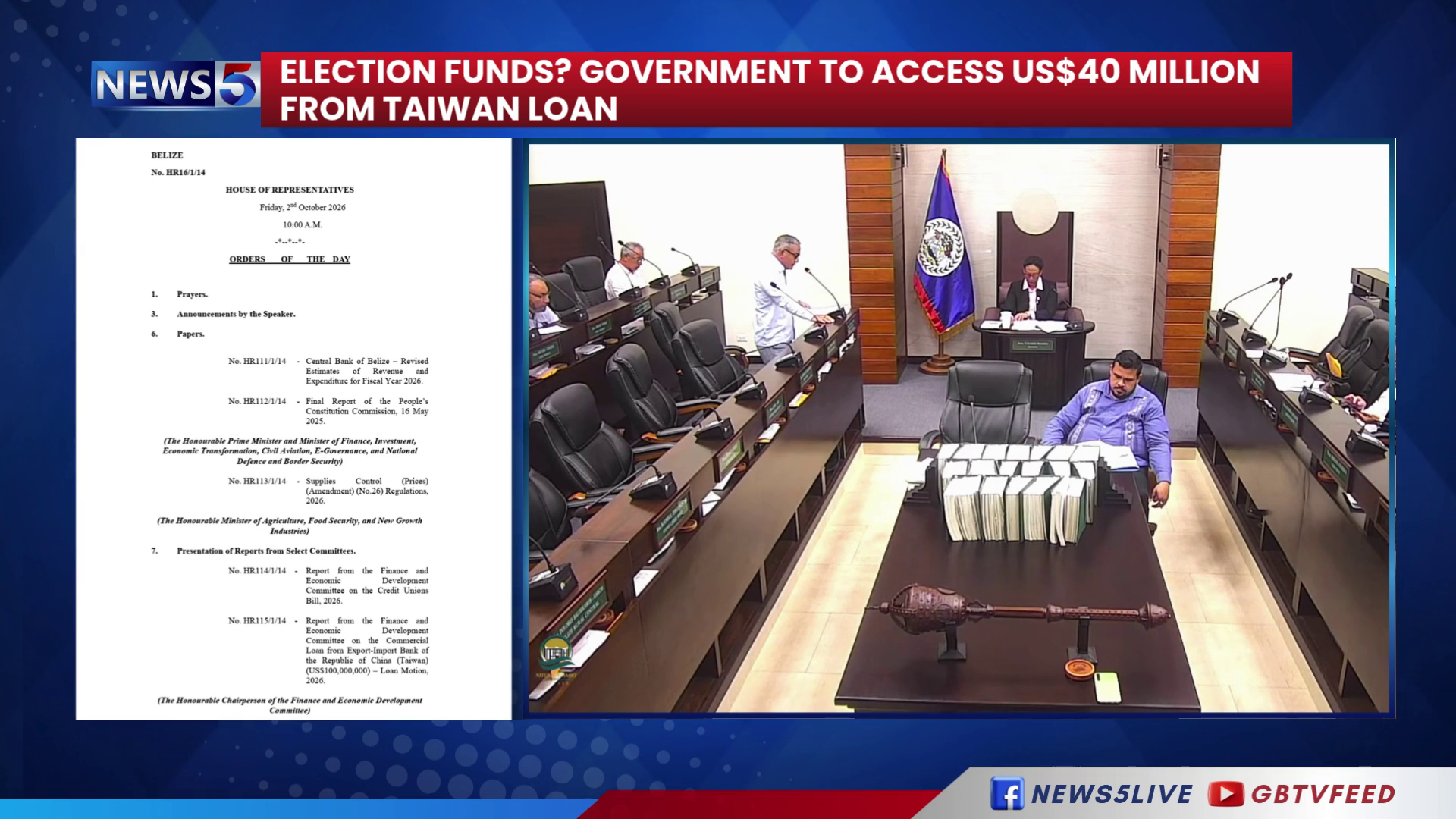
A controversial $100 million loan proposal from a Taiwan-linked financial institution has returned to Belize’s House of Representatives, reigniting debate over public spending plans just months ahead of the country’s upcoming municipal elections. Opposition lawmakers have raised sharp questions about the government’s timeline for accessing the funds, after confirmation that up to US$40 million of the total loan could be disbursed and drawn down before the end of 2026 – a timeline that overlaps with the lead-up to the municipal polls.
According to government officials, the full $100 million in borrowed funds is earmarked to support a five-year portfolio of public projects spanning core infrastructure development, education system upgrades, and expanded public health services. Despite this top-line outline, however, critics have pushed for full transparency, demanding a detailed, line-item breakdown of how the first $40 million tranche will be allocated to avoid diversion of public funds for election-related political gain.
Addressing the concerns raised by the opposition during Friday’s parliamentary proceedings, Prime Minister John Briceño formally presented the loan approval resolution to the chamber. In his address before the House, Briceño moved to confirm the terms of the agreement with the Export-Import Bank of China-Taiwan, urging lawmakers to approve the proposal.
“With your permission not to repeat the recitals, now therefore be it resolve that this Honorable House being satisfied that the loan proceeds will be utilized for the purpose stated above, approves and confirms that the government of Belize may enter into a loan agreement with the Export-Import Bank of China-Taiwan for the terms and conditions set out above and further authorizes the Minister of Finance to execute and deliver the said loan agreement, the promissory note and all other documents associated there with,” Briceño said in his address to parliament.
This article is adapted from a broadcast news transcript originally published by the outlet, with original speaker remarks preserved in their official context for accuracy. The full televised newscast is available for viewing via the original publication’s digital platform.