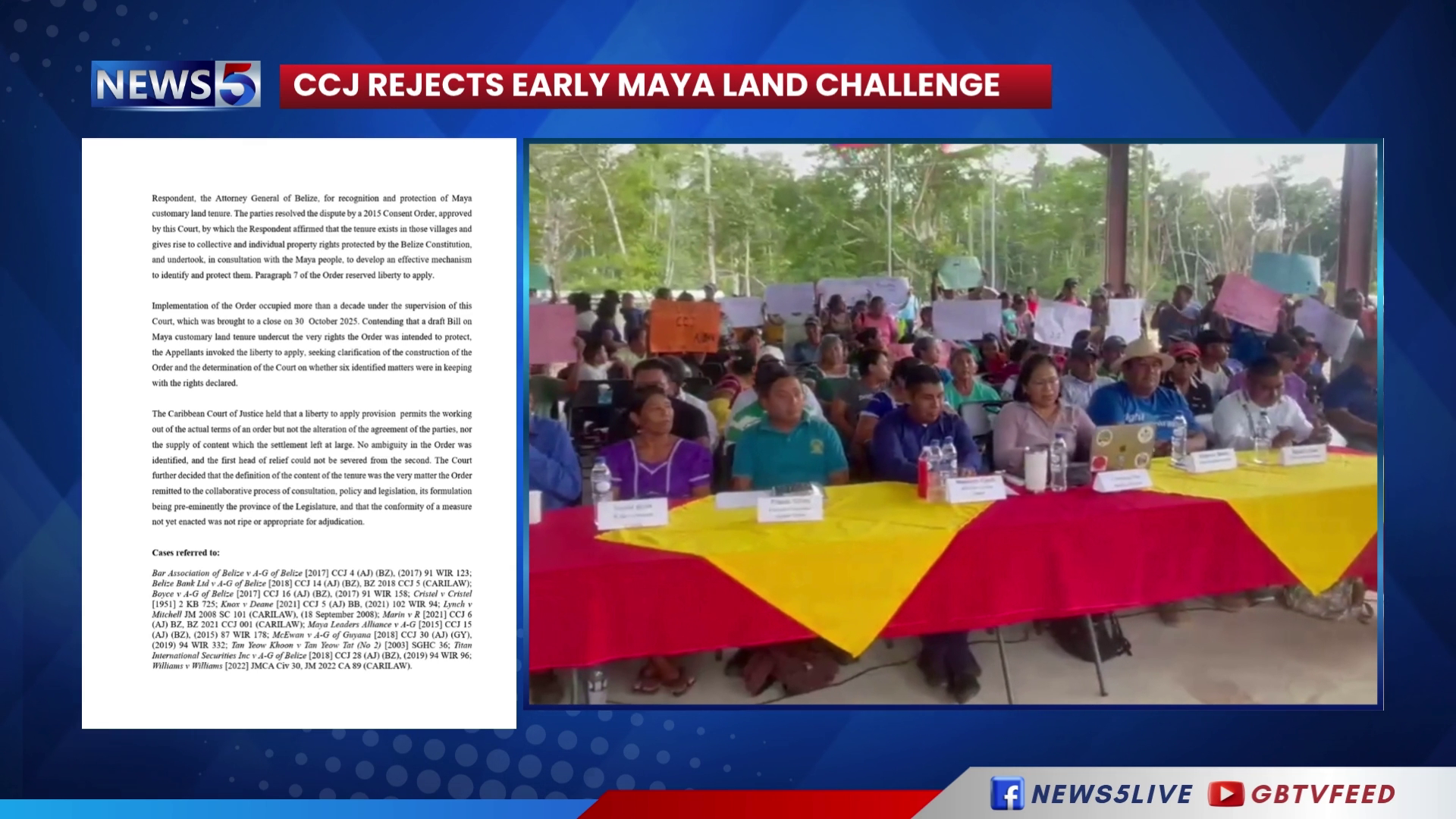
After more than a decade of legal wrangling over long-standing Maya customary land rights claims in Belize, the Caribbean Court of Justice (CCJ) has made a landmark procedural ruling that shifts the future of the dispute from the courtroom to the national legislature.
On Tuesday, the regional highest court dismissed a procedural application brought by Maya community leaders, ruling that the process outlined in the court’s groundbreaking 2015 consent order must run its full course through legislative negotiation and review before any further judicial intervention is considered. The ruling has cleared up key ambiguities around the dispute, while also formally placing the Belizean government on explicit notice that final legislation must center meaningful Maya community participation and align with global indigenous rights standards, according to Cristina Coc, spokesperson for the Maya Leaders Alliance (MLA).
Coc outlined the court’s core message to both parties in an interview following the ruling: “The court essentially told all stakeholders that the draft legislation currently on the table must go through full negotiation and consultation between the government and Maya communities. Only when that legislative process is complete, and if a final law is enacted that violates the 2015 court order or fails to meet international indigenous rights standards, can parties return to the CCJ for further action.”
She emphasized that the ruling removes any uncertainty around the government’s obligations, making clear that the state cannot unilaterally define Maya customary land tenure without direct input from the communities that have lived and stewarded these lands for centuries. “The court has confirmed that Maya land rights can only be properly understood through direct consultation with Maya people, who hold unique knowledge of their traditional land use, historical occupation, and deep cultural connection to their territories,” Coc said. “This is not something any outside group or government official can invent on their own.”
The ruling comes 11 years after the CCJ first issued its landmark consent order recognizing Maya customary land rights, a decision that was meant to clear the way for formal legal protections that have yet to be enacted. Despite more than a decade of negotiations, the process has been slowed repeatedly by procedural delays and disagreements over stakeholder participation. Most recently, the government added private third-party landowners to the multi-stakeholder review panel that is tasked with refining the draft legislation — a change that Coc says has set the process back significantly.
“After the July CCJ hearing, we returned to the review panel as we committed to do, but the addition of private landowners meant we essentially had to restart the entire process,” Coc explained. “Our first panel meeting after the ruling lasted just 45 minutes, and it was only to agree that Maya leaders would submit written, line-by-line edits to the current draft legislation. Even the private landowners acknowledged that they lack the expertise to speak to core components of the law, like the definition of Maya customary land tenure — a definition that only Maya communities can provide. They can only weigh in on sections that directly impact their own property interests, and the entire process is now delayed as all parties work to get new stakeholders up to speed.”
To date, Maya leaders have submitted their full set of formal recommendations to revise the government’s draft legislation, and the MLA is currently awaiting a formal response from Belizean officials. Another full review panel meeting is scheduled for early November, where stakeholders will discuss submitted feedback and map out the next steps in the legislative process. For Maya communities that have been fighting for formal recognition of their land rights for decades, the CCJ ruling keeps the path toward legal protection open, but also underscores how far the process still has to go.