标签: Belize

伯利兹

  • Fuel Costs Soared Over 100%; More Relief Carries Fiscal Risks

    Fuel Costs Soared Over 100%; More Relief Carries Fiscal Risks

    As skyrocketing global oil prices continue to fuel public and political pressure for deeper cuts to Belize’s fuel taxes, a new independent analysis lays bare the steep trade-offs facing the small Caribbean nation: meaningful relief for consumers at the pump would come at the price of massive government revenue losses, heightened strain on already fragile foreign reserves, and serious risks to the country’s overall fiscal stability.

    The analysis, conducted by The Reporter, cross-references official government fuel pricing schedules with volume estimates from the April 2025 Maritime Sector Baseline Assessment Report published for the Belize Port Authority, focusing exclusively on the two highest-consumption fuel types — regular gasoline and diesel — for which consistent annual volume data is available. Premium gasoline was excluded due to its separate tax structure, while kerosene was omitted because the report does not break out standalone volume estimates for the product.

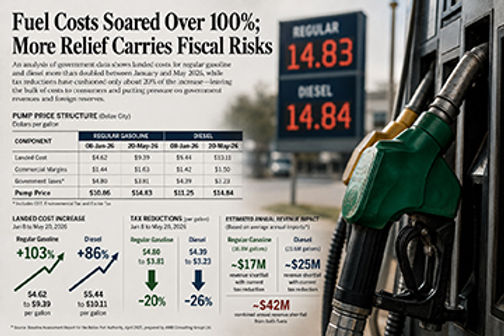
    Per the Port Authority’s estimates, Belize imports an annual average of 16.8 million gallons of regular gasoline and 21.6 million gallons of diesel to meet domestic demand. Government data shows that between January 8 and May 20, 2026, authorities already cut taxes on regular gasoline from $4.7992 per gallon to $3.8074 per gallon — a reduction of roughly $0.99 per gallon. When applied to the full estimated annual import volume, this existing cut translates to an annualized revenue shortfall of approximately $16.6 million if current rates hold for the full year.

    For diesel, the tax cut has been even larger: per-gallon taxes dropped from $4.3926 in January to $3.2342 by mid-May, a reduction of $1.16 per gallon. That cut alone would generate an estimated $25 million in annual lost revenue, bringing the combined annual revenue loss from the two fuel types to nearly $42 million under the current tax structure.

    Even with these existing cuts, however, consumers have only seen partial insulation from the global price shock. Official data shows the landed cost of regular gasoline — the price the country pays to import the fuel — more than doubled between January and May 2026, jumping from $4.6240 per gallon to $9.3875 per gallon. Over the same period, diesel’s landed cost surged from $5.4354 per gallon to $10.1072 per gallon. With only a 20 percent cut to taxes, the vast majority of these import cost increases have been passed directly to drivers and businesses, a dynamic industry analysts call “cost pass-through.”

    The Reporter’s calculation found that roughly 80 percent of the rise in regular gasoline’s landed cost has been shifted to consumers at the pump. To bring that pass-through rate down to 50 percent — a level that would offer far more meaningful relief to households — regular gasoline taxes would need to be cut an additional $1.41 per gallon, to just $2.40 per gallon. Under that scenario, annual revenue from regular gasoline taxes would plummet from the January 2026 level of $80.6 million to just $40.3 million, a $40 million annual shortfall from that single fuel category. A matching adjustment for diesel would add another $48 million in annual lost revenue, pushing the total annual revenue loss from a more aggressive relief strategy to nearly $88 million.

    Beyond the direct hit to government tax intake, the analysis outlines additional macroeconomic risks tied to deeper tax cuts. Because all fuel consumed in Belize is imported, rising global prices already increase demand for U.S. dollars to finance incoming shipments. If steep tax cuts or subsidies keep domestic fuel prices artificially low, demand for imported fuel will remain high even as global costs climb, creating extra pressure on the country’s balance of payments and depleting limited foreign reserve holdings.

    The findings also cast doubt on the long-term sustainability of Belize’s primary surplus, a key fiscal metric that depends on keeping revenues strong relative to government spending. While deeper fuel tax cuts would deliver much-needed short-term relief for cash-strapped consumers and businesses, the analysis makes clear that fully shielding the domestic market from global oil price volatility would carry severe, long-lasting fiscal and economic consequences for the country.

  • Cabinet Puts Brakes on High-Rise Construction in Four Communities

    Cabinet Puts Brakes on High-Rise Construction in Four Communities

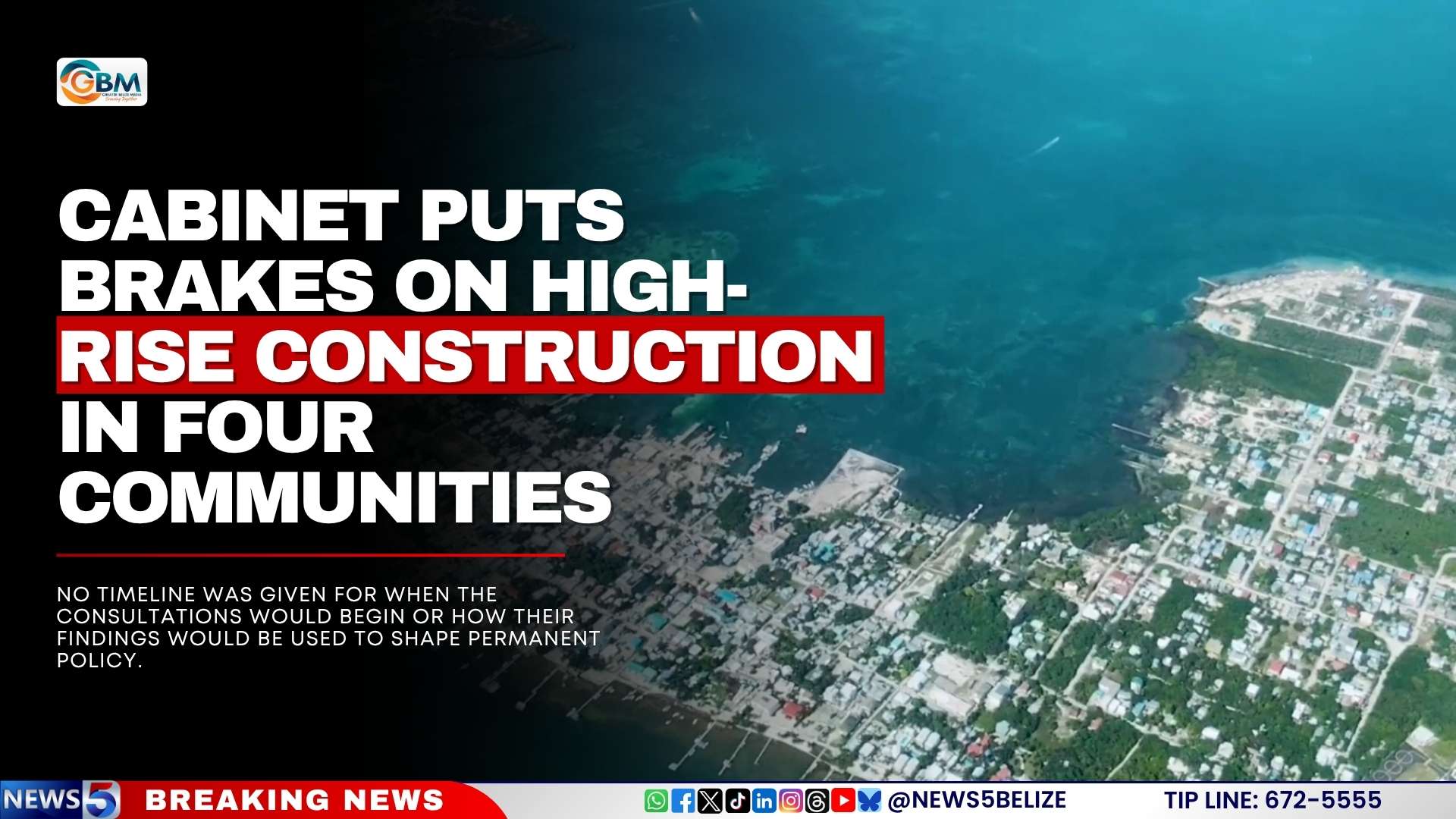
    In a policy shift responding to growing alarm over unregulated coastal development, Belize’s Cabinet has enacted a six-month moratorium blocking all new approvals and construction of high-rise structures across four of the nation’s most popular coastal tourism hubs. The temporary restriction applies to any building that exceeds 45 feet in height or spans more than three stories, covering Caye Caulker Village, Hopkins Village, the Placencia Peninsula, and Sittee River Village. The freeze will remain in effect while government officials carry out two core processes: broad public consultations with local residents and stakeholders, and independent technical assessments to gauge the cumulative environmental and social impacts of high-density, vertical development in these vulnerable areas.

    This policy action comes just weeks after growing public discourse around overdevelopment in San Pedro, the country’s busiest and most developed island tourism destination on Ambergris Caye. During a May 14 interview with local outlet News Five, Andre Perez, Area Representative for Belize Rural South, openly acknowledged that rapid growth on the island had reached a critical turning point that required urgent intervention. “It is growing by leaps and bounds and in fact it’s growing exponentially, especially up north. So this is where we have to find a balance,” Perez explained. He also noted that tourism industry stakeholders have repeatedly raised alarms about the risks of unplanned overdevelopment that could erode the natural appeal that draws visitors to the region.

    While Perez stopped short of formally calling for a full construction halt at the time, he emphasized that the breakneck pace of development could no longer be overlooked by officials. The debate around growth in Belize’s coastal areas has also exposed a tension between competing priorities: on one side, prospective homeowners argue they have a right to access property and pursue what many call the Belizean dream of building a home in these desirable coastal areas. On the other side, long-time residents and environmental advocates warn that unregulated growth is driving up housing prices beyond the reach of local communities and damaging sensitive ecosystems. Perez clarified that while the government is acutely aware of the pace of change, there is no current evidence that Belizean residents are being systematically priced out of the market entirely, but a pause is necessary to evaluate long-term impacts.

    Notably, San Pedro was not included in the Cabinet’s official moratorium announcement, but the new policy marks a clear shift from public conversation to concrete regulatory action for other at-risk coastal communities. All four regions now covered by the freeze share key traits with San Pedro: their local economies are heavily reliant on nature-based tourism, they sit on environmentally fragile landscapes, and they have seen a surge in foreign and domestic investment that has accelerated residential and resort construction over the past decade. Caye Caulker, like San Pedro, is a low-lying island with a highly vulnerable coastal ecosystem already facing threats from climate change and sea level rise. Hopkins and the Placencia Peninsula have emerged as top destinations for luxury resort development and second-home construction, while Sittee River Village borders the ecologically critical Cockscomb Basin Wildlife Sanctuary corridor, a protected habitat for endangered jaguars and other native species.

    As of the announcement, the government has not released a concrete timeline for when public consultations will begin, nor has it outlined how the findings from the technical assessments will be used to draft permanent long-term development regulations for the region. Officials also declined to comment on whether San Pedro, other coastal communities facing similar development pressure, could face identical temporary restrictions in the future as the government works to balance economic growth with environmental and social sustainability.

  • Special Envoy Pushes for National Sex Offenders Registry

    Special Envoy Pushes for National Sex Offenders Registry

    A decades-long campaign to establish a public national sex offenders registry in Belize has gained new urgency, with the Office of the Special Envoy for the Development of Families and Children reiterating its urgent call for the long-proposed system to finally be implemented, framing it as an indispensable tool to shield vulnerable women and children from violence, abuse and exploitation.

    In a firm, impassioned press statement released over the weekend, the office made the case that convicted sexual predators should no longer be able to conceal their identities from communities, while at-risk groups continue to face preventable harm. The statement pushed for stronger protective frameworks and greater public transparency, emphasizing that local communities have a right to access information that enables them to keep children out of danger.

    The renewed appeal comes on the heels of growing public anxiety over a string of recent sexual abuse allegations against figures in trusted, authoritative roles — including educators and law enforcement officers. The Special Envoy’s Office noted that these high-profile cases have amplified widespread public demands for greater institutional and individual accountability. Public anger and broader debate around child protection policy boiled over most recently after abuse allegations were leveled against a teacher in the small community of Bullet Tree Falls, dragging the long-stalled registry proposal back into the national spotlight.

    Beyond empowering families and local communities with life-saving information, the office stressed that a centralized national registry would also act as a powerful deterrent to repeat offending, by keeping communities informed and enabling close monitoring of convicted offenders. The press release closed with a call to action for all Belizeans to break the culture of silence around sexual abuse and stand united to protect the nation’s children.

    This latest push comes as persistent questions continue to swirl around the repeated delays that have derailed the registry for nearly a decade. The framework for Belize’s National Sex Offenders Registry was first written into law via amendments to the country’s Criminal Code all the way back in 2014. While official plans for the system were first publicly launched in 2018, implementation has hit repeated roadblocks over the past 10 years, leaving the promised framework stuck in limbo.

    The issue re-entered policy discussion most recently after top government officials announced plans for an enhanced, upgraded version of the registry. During a 2025 House of Representatives meeting, the then-Minister of Home Affairs outlined the government’s vision for a robust system including advanced security protocols for stored data, real-time location tracking of registered offenders, and regular compliance monitoring. Yet despite this and multiple prior official announcements, the system has still not been fully deployed for public use.

  • Youth Suicide on the Rise, PAHO Calls for Urgent Action

    Youth Suicide on the Rise, PAHO Calls for Urgent Action

    Across the Americas, suicide among adolescents and young adults is climbing at an alarming rate that has sent public health leaders sounding the alarm over systemic gaps in mental health access and prevention. New collaborative research from the Pan American Health Organization (PAHO), published in *The Lancet Regional Health – Americas*, delivers a stark statistical portrait of the crisis: in 2021 alone, more than 18,000 young people between the ages of 10 and 24 died by suicide in the region. Over the 21-year study period from 2000 to 2021, youth suicide rates jumped 38%, cementing suicide as the third leading cause of death for this age group across the hemisphere. What makes this trend particularly worrying for health experts is that the rate of increase among young people is outpacing growth in suicide rates among the general population. While men and young males still account for 75% of all youth suicide deaths, the rate of increase among girls and young women has accelerated far faster than their male counterparts. Most striking of all, the most dramatic surge in suicide deaths has occurred among children just 10 to 14 years old, a demographic that was rarely centered in mental health conversations decades ago. PAHO Director Jarbas Barbosa framed the study’s findings as a critical wake-up call for governments and public health systems across the region. “This steady increase among children and young people leaves no room for delay,” Barbosa emphasized, noting that the crisis exposes an urgent need to build robust prevention infrastructure and deliver early, targeted support to at-risk youth before crisis hits. Researchers have pinpointed a set of interconnected driving forces behind the rising trend. Modern pressures have pushed the onset of common mental health conditions including depression and anxiety to younger ages, while growing rates of substance abuse, pervasive cyberbullying, overwhelming social achievement pressure, and prolonged exposure to toxic, harmful online environments have compounded risks for young people. Easy access to lethal means of self-harm also stands out as a major modifiable risk factor that public health systems have yet to fully address. Crucially, public health officials stress that nearly all of these risk factors can be mitigated or treated if caught early. The report lays out a clear set of actionable recommendations, including expanding school-based mental health literacy and support programs, scaling up low-barrier emotional counseling services, implementing universal early mental health screening for youth, and strengthening community-led intervention networks to reach at-risk young people who may fall through the cracks of formal care. The analysis drew on mortality data from 35 countries compiled by the World Health Organization, tracking the rise from a regional rate of 5.7 deaths per 100,000 young people in 2000 to 7.84 per 100,000 in 2021. Disparities across the region are also stark, with North America and several parts of South America recording some of the highest youth suicide mortality rates. The crisis is not limited to larger nations: it has hit small countries like Belize particularly hard, where local mental health experts have documented deeply troubling upward trends among local adolescents. UNICEF Belize data shows that annual attempted suicide rates among 15 to 19-year-olds rose 39% each year between 2014 and 2016, and by 2017, the rate had nearly tripled compared to the start of the decade. This age group now has the highest rate of suicide attempts in the entire country. Alongside the regional risk factors, UNICEF has identified widespread community violence, chronic exposure to trauma, and limited access to substance abuse support as key stressors affecting Belizean youth. Systemic barriers remain a major hurdle: mental health services are severely underfunded and geographically limited across much of the country, leaving most young people unable to access affordable, confidential support when they need it most. Even more recent data tracking Belizean trends from 2019 to 2023 confirms that suicide and non-fatal suicide attempts have grown into one of the country’s most pressing unaddressed public health challenges. In response to this hemisphere-wide crisis, PAHO has launched a new Regional Suicide Prevention Initiative set to roll out in 2025. The initiative is designed to support member states in strengthening national suicide prevention strategies, expanding access to affordable youth-focused mental health care, and reducing the persistent social stigma that prevents many young people from seeking help before it is too late. Health leaders across the region stress that suicide is preventable, and reversing the current upward trend will require coordinated, cross-sector collaboration between national governments, school systems, local communities, and family units. For anyone experiencing suicidal thoughts or emotional distress, or anyone who is worried about a loved one, public health officials emphasize that reaching out to a trusted friend, family member, qualified health professional, or local mental health service can be life-saving.

  • Pitts Slams Pension Bill as “Judicial Elitism”

    Pitts Slams Pension Bill as “Judicial Elitism”

    In a sharp rebuke of the Briceno government’s proposed legislative changes, United Democratic Party Chairwoman Sheena Pitts has publicly condemned the newly tabled Judges Salaries and Pension Bill, accusing the administration of entrenching systemic “judicial elitism” through unequal benefit frameworks.

    The core controversy surrounding the bill lies in its starkly disparate eligibility requirements for retirement benefits across different tiers of the national judiciary. Under the proposed text, senior judges serving on the High Court and the Court of Appeal become eligible for full retirement benefits after completing just five years of service. In stark contrast, lower-court magistrates, who handle the vast majority of day-to-day judicial proceedings across the country, are required to complete 15 years of service before accessing comparable retirement protections that other public servants receive.

    Pitts has framed this tiered system as a fundamentally unfair arrangement that erodes public trust in the integrity of the national justice system. In a public statement criticizing the policy, Pitts argued that the government’s priority in advancing this legislation reveals a commitment to prioritizing the interests of a small, elite group over broader equity within the judicial branch. “This government is openly telling us that it is ready to convene the National Assembly to pass legislation that benefits the few, not the many,” she emphasized.

    While Pitts acknowledged that there is broad cross-party consensus that all judicial officers deserve fair compensation and a dignified retirement after years of public service, she stressed that the current draft of the bill creates unnecessary and unjust inequity between senior and lower-court judicial officers. The United Democratic Party leader has formally called on the Briceno administration to revise the legislation to eliminate the disparate eligibility rules and establish a fair, level playing field for all judicial professionals serving the country.

  • CARPHA Says Ebola Risk to Caribbean Low

    CARPHA Says Ebola Risk to Caribbean Low

    Three days after the World Health Organization (WHO) categorized the ongoing Ebola outbreak in the Democratic Republic of the Congo and Uganda as a Public Health Emergency of International Concern (PHEIC) on May 16, 2026, the Caribbean Public Health Agency (CARPHA) released a regional risk assessment from its Port of Spain headquarters, confirming that the threat of Ebola reaching Caribbean nations remains low while mandating heightened preparedness across all member states.

    The current outbreak is driven by the Bundibugyo Ebola strain, a variant that, while carrying a historically lower fatality rate than better-known Ebola strains, still causes severe, life-threatening illness in affected patients. Critically, no licensed vaccines or targeted treatments currently exist for this specific strain. Public health experts clarify that transmission only occurs through close, direct physical contact with bodily fluids from a symptomatic infected individual, or contact with materials contaminated by the virus. Symptoms develop between 2 and 21 days after exposure, and present as fever, intense headache, muscle ache, extreme fatigue, sore throat, vomiting, diarrhea, abdominal pain, and in some instances, unexplained bleeding or bruising. Individuals only become contagious after symptoms begin to manifest.

    CARPHA Executive Director Dr. Lisa Indar noted that the region’s central role as a major global travel hub creates the primary pathway for potential virus introduction: an infected traveler entering a Caribbean country. To mitigate this risk, CARPHA has implemented a multi-layered, proactive monitoring framework designed to deliver early warning of emerging threats, while supporting individual member states in strengthening their capacity for rapid detection, verification, and response to potential cases.

    To track the evolving outbreak, CARPHA leverages a suite of integrated regional surveillance tools, including the Tourism and Health Information System, the Caribbean Vessel Surveillance System, national syndromic monitoring via the District Health Information System, and social listening analytics through the Talkwalker platform. In a pre-emptive move on May 18, CARPHA partnered with the Caribbean Community Implementation Agency for Crime and Security to reactivate an advanced electronic border screening system. This tool is tailored to flag and review travel histories of passengers arriving from or transiting through the affected African regions, all without creating unnecessary disruptions to daily travel and commercial trade across the Caribbean.

  • Could Seaweed, Chocolate and Boats Be Belize’s Next Big Money Makers?

    Could Seaweed, Chocolate and Boats Be Belize’s Next Big Money Makers?

    For decades, Belize’s economic foundation has rested on two core pillars: mass tourism and traditional agricultural exports. But now, the Central American nation is pursuing a bold new path to economic resilience, launching its first-ever national industrial strategy centered on expanding sustainable green and blue industries that could turn local natural advantages into long-term, inclusive growth. The initiative, developed in partnership with the United Nations Industrial Development Organization (UNIDO), took a key step forward this week when stakeholders gathered in Belize City for a workshop that presented early findings to over 50 public officials and private sector leaders. The gathering centered on a single, critical question that will shape Belize’s economic future: how can the country cultivate new industries that deliver shared prosperity through job creation, boost export revenue, and protect the fragile natural ecosystems that are already central to its national identity? Early exploratory research has narrowed the focus to six high-potential sectors that align with the strategy’s dual goals of economic growth and environmental stewardship. For green industries, the priority areas are expanded cacao cultivation and artisanal chocolate production, value-added coconut product manufacturing, and sustainable bio-based sectors ranging from renewable bioenergy to compostable alternative materials and advanced agro-processing. On the blue economy side, the strategy targets three high-growth areas: commercial seaweed cultivation, sustainable fisheries and advanced aquaculture, and small-to-medium vessel boatbuilding. What sets these sectors apart is that Belize already holds significant natural advantages in each, but for years the country has mostly exported unprocessed raw materials to foreign buyers, capturing only a small fraction of the total value of its natural resources. The new industrial strategy aims to reverse that pattern by moving Belize higher up the global value chain. By investing in local processing, manufacturing, and branding, the government expects to retain a far larger share of revenue within the country, create higher-wage local jobs, and reduce Belize’s historical dependence on volatile tourism markets and commodity agriculture. This proactive push for economic diversification comes as many small coastal nations face growing pressure to build more resilient, sustainable economies that balance development with climate and environmental protection. For Belize, the strategy represents a calculated bet that leveraging its existing natural strengths through sustainable, value-added production will deliver more stable and inclusive growth for years to come.

  • 130 Council Workers Hit the Streets for Hurricane Cleanup

    130 Council Workers Hit the Streets for Hurricane Cleanup

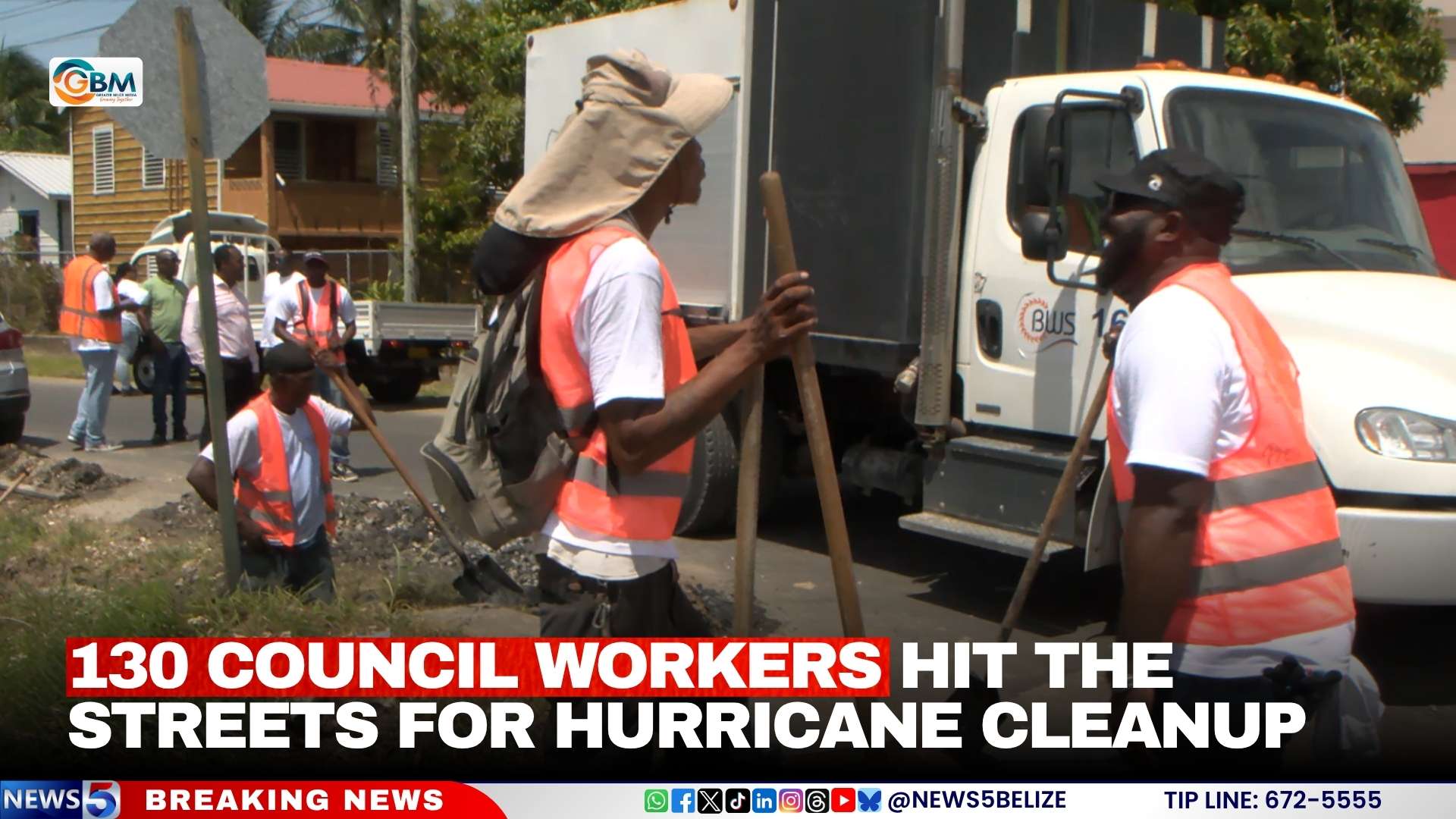
    As the 2026 Atlantic hurricane season draws near, Belize City Council has kicked off its second annual pre-hurricane cleanup initiative, deploying more than 130 municipal employees across the city’s most flood-vulnerable neighborhoods to boost community resilience ahead of extreme weather.

    Deputy Mayor Elude Miller confirmed that cross-departmental teams drawn from sanitation, public works, and public health divisions are leading the effort. Alongside clearing debris and unclogging drainage infrastructure, health inspectors are conducting door-to-door outreach to local residents. These conversations focus on educating households about proper waste disposal practices, the importance of unobstructed neighborhood drainage, and small proactive steps individuals can take to prevent system blockages during periods of heavy tropical rainfall.

    Unlike the 2025 campaign, which focused on four flood-prone districts including Pangyard, King Street, Dean Street, and Berkeley Street, this year’s operation targets seven priority locations: Victoria Street, Vernon Street, Mahogany Street, the surrounding area of St. Mary’s Primary School, Gabriel Lane, and St. Joseph Street. Miller explained that the selection of these zones was not arbitrary; it draws on 12 months of continuous flood risk mapping that identifies persistent problem areas across the city. The targeted approach allows the council to allocate limited resources where they will deliver the greatest reduction in flood risk.

    To maximize the effectiveness of the cleanup, the council has deployed specialized heavy equipment purpose-built for drainage maintenance. A vacuum truck and high-pressure sewer jet sweeper are being used to clear deep blockages that standard manual cleaning cannot reach, directly improving the city’s capacity to handle storm surge and heavy rainfall common during Atlantic hurricane season.

    Early engagement with local communities has been overwhelmingly positive, according to Miller. “Residents have been incredibly welcoming to our teams,” he noted in an on-the-ground interview. “I just spoke with Ms. Judith a few minutes ago, and she told me how grateful she is that we’re out here addressing this issue proactively. Many residents are not just happy to see us – they’re also sharing valuable local insights and suggestions that help our teams target problem spots we might have missed.”

    The annual pre-hurricane cleanup campaign forms a core part of Belize City’s annual disaster risk reduction strategy, designed to minimize flood damage, protect public safety, and cut down on post-storm recovery costs as the region enters what meteorologists warn could be another active hurricane season.

  • BTIA Demands Stop to Sand Mining in Placencia, Ambergris Caye

    BTIA Demands Stop to Sand Mining in Placencia, Ambergris Caye

    Belize’s leading tourism industry body has reignited calls for urgent government action to curb unregulated sand extraction and dredging in two of the country’s most ecologically sensitive and economically critical coastal regions: the Placencia Lagoon and targeted coastal zones of Ambergris Caye. The campaign, which has gained growing community backing, highlights the deep interconnectedness between Belize’s natural environment and its multibillion-dollar tourism sector, warning that unregulated extraction threatens both ecosystems and livelihoods across the country.

  • Belize Loses Second Airline in Months as JetBlue Exits

    Belize Loses Second Airline in Months as JetBlue Exits

    On Wednesday, May 21, 2026, low-cost U.S. carrier JetBlue completed its final commercial departure from Philip Goldson International Airport, ending its popular direct route connecting New York’s John F. Kennedy International Airport to Belize City. This move delivers a second heavy blow to Belize’s tourism-reliant economy in just a few months, following closely on the heels of Spirit Airlines’ decision to terminate all Belize-bound service earlier this year.

    JetBlue’s exit was not an unforeseen development. Back in February 2026, the airline publicly confirmed it would cut the Belize-New York route as a core component of its company-wide “JetForward” restructuring initiative. The strategic overhaul is designed to streamline the carrier’s route network, cut unnecessary operational costs, and guide the airline back to consistent profitability after a period of post-pandemic financial volatility.

    For Belize, whose national economy depends heavily on international tourism and counts affordable, accessible air travel as one of its most critical infrastructure assets, the loss of two low-cost carriers in such a short timeframe has created tangible strain across the tourism ecosystem. Efrain Perez, president of the Belize Tourism Industry Association, highlighted the severity of the challenge in comments to reporters, noting that consistent growth in airlift capacity is directly tied to increases in tourist overnight stays, the primary driver of revenue for hotels, tour operators, local businesses and hospitality workers across the country.

    “The departure of any airline is very critical for the tourism industry. We depend on increasing our airlift so that we can create more overnight stays,” Perez explained.

    Despite the obvious concerns, Perez was careful to put the setback in context, emphasizing that Belize still maintains robust air connectivity with North America and broader global markets through a roster of established major international carriers. These include American Airlines, Delta Air Lines, Copa Airlines and Air Canada, all of which continue to operate regular routes to Belize. Perez also pointed to a recent positive development: Air Canada launched a new direct route from Montreal to Belize City, a connection that opens up convenient same-day travel options for passengers coming from multiple European destinations, expanding Belize’s access to the key European tourism market.

    Perez added that both the Belize Tourism Board and the national Ministry of Tourism are currently working around the clock to court new air carriers, with the goal of replacing lost low-capacity routes and expanding overall airlift to the country. In a parallel move to offset the impact of reduced air access during the upcoming low travel season, national tourism authorities have launched a new targeted “green season” marketing campaign. The initiative encourages local hoteliers and hospitality providers to offer discounted accommodation rates to international visitors, with the aim of boosting booking volumes and softening the revenue dip that typically comes during the low-travel period.