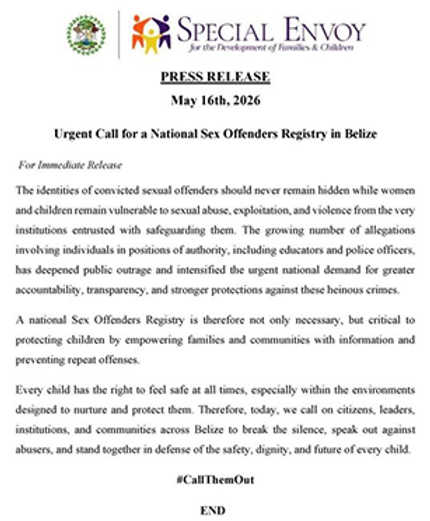
A decades-long campaign to establish a public national sex offenders registry in Belize has gained new urgency, with the Office of the Special Envoy for the Development of Families and Children reiterating its urgent call for the long-proposed system to finally be implemented, framing it as an indispensable tool to shield vulnerable women and children from violence, abuse and exploitation.
In a firm, impassioned press statement released over the weekend, the office made the case that convicted sexual predators should no longer be able to conceal their identities from communities, while at-risk groups continue to face preventable harm. The statement pushed for stronger protective frameworks and greater public transparency, emphasizing that local communities have a right to access information that enables them to keep children out of danger.
The renewed appeal comes on the heels of growing public anxiety over a string of recent sexual abuse allegations against figures in trusted, authoritative roles — including educators and law enforcement officers. The Special Envoy’s Office noted that these high-profile cases have amplified widespread public demands for greater institutional and individual accountability. Public anger and broader debate around child protection policy boiled over most recently after abuse allegations were leveled against a teacher in the small community of Bullet Tree Falls, dragging the long-stalled registry proposal back into the national spotlight.
Beyond empowering families and local communities with life-saving information, the office stressed that a centralized national registry would also act as a powerful deterrent to repeat offending, by keeping communities informed and enabling close monitoring of convicted offenders. The press release closed with a call to action for all Belizeans to break the culture of silence around sexual abuse and stand united to protect the nation’s children.
This latest push comes as persistent questions continue to swirl around the repeated delays that have derailed the registry for nearly a decade. The framework for Belize’s National Sex Offenders Registry was first written into law via amendments to the country’s Criminal Code all the way back in 2014. While official plans for the system were first publicly launched in 2018, implementation has hit repeated roadblocks over the past 10 years, leaving the promised framework stuck in limbo.
The issue re-entered policy discussion most recently after top government officials announced plans for an enhanced, upgraded version of the registry. During a 2025 House of Representatives meeting, the then-Minister of Home Affairs outlined the government’s vision for a robust system including advanced security protocols for stored data, real-time location tracking of registered offenders, and regular compliance monitoring. Yet despite this and multiple prior official announcements, the system has still not been fully deployed for public use.