As skyrocketing global oil prices continue to fuel public and political pressure for deeper cuts to Belize’s fuel taxes, a new independent analysis lays bare the steep trade-offs facing the small Caribbean nation: meaningful relief for consumers at the pump would come at the price of massive government revenue losses, heightened strain on already fragile foreign reserves, and serious risks to the country’s overall fiscal stability.
The analysis, conducted by The Reporter, cross-references official government fuel pricing schedules with volume estimates from the April 2025 Maritime Sector Baseline Assessment Report published for the Belize Port Authority, focusing exclusively on the two highest-consumption fuel types — regular gasoline and diesel — for which consistent annual volume data is available. Premium gasoline was excluded due to its separate tax structure, while kerosene was omitted because the report does not break out standalone volume estimates for the product.
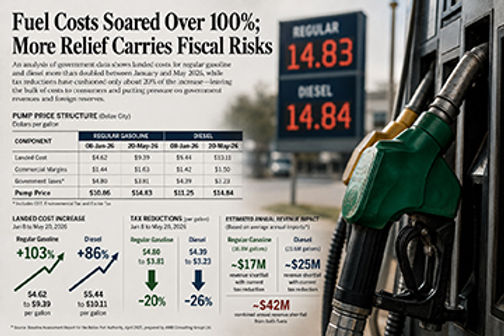
Per the Port Authority’s estimates, Belize imports an annual average of 16.8 million gallons of regular gasoline and 21.6 million gallons of diesel to meet domestic demand. Government data shows that between January 8 and May 20, 2026, authorities already cut taxes on regular gasoline from $4.7992 per gallon to $3.8074 per gallon — a reduction of roughly $0.99 per gallon. When applied to the full estimated annual import volume, this existing cut translates to an annualized revenue shortfall of approximately $16.6 million if current rates hold for the full year.
For diesel, the tax cut has been even larger: per-gallon taxes dropped from $4.3926 in January to $3.2342 by mid-May, a reduction of $1.16 per gallon. That cut alone would generate an estimated $25 million in annual lost revenue, bringing the combined annual revenue loss from the two fuel types to nearly $42 million under the current tax structure.
Even with these existing cuts, however, consumers have only seen partial insulation from the global price shock. Official data shows the landed cost of regular gasoline — the price the country pays to import the fuel — more than doubled between January and May 2026, jumping from $4.6240 per gallon to $9.3875 per gallon. Over the same period, diesel’s landed cost surged from $5.4354 per gallon to $10.1072 per gallon. With only a 20 percent cut to taxes, the vast majority of these import cost increases have been passed directly to drivers and businesses, a dynamic industry analysts call “cost pass-through.”
The Reporter’s calculation found that roughly 80 percent of the rise in regular gasoline’s landed cost has been shifted to consumers at the pump. To bring that pass-through rate down to 50 percent — a level that would offer far more meaningful relief to households — regular gasoline taxes would need to be cut an additional $1.41 per gallon, to just $2.40 per gallon. Under that scenario, annual revenue from regular gasoline taxes would plummet from the January 2026 level of $80.6 million to just $40.3 million, a $40 million annual shortfall from that single fuel category. A matching adjustment for diesel would add another $48 million in annual lost revenue, pushing the total annual revenue loss from a more aggressive relief strategy to nearly $88 million.
Beyond the direct hit to government tax intake, the analysis outlines additional macroeconomic risks tied to deeper tax cuts. Because all fuel consumed in Belize is imported, rising global prices already increase demand for U.S. dollars to finance incoming shipments. If steep tax cuts or subsidies keep domestic fuel prices artificially low, demand for imported fuel will remain high even as global costs climb, creating extra pressure on the country’s balance of payments and depleting limited foreign reserve holdings.
The findings also cast doubt on the long-term sustainability of Belize’s primary surplus, a key fiscal metric that depends on keeping revenues strong relative to government spending. While deeper fuel tax cuts would deliver much-needed short-term relief for cash-strapped consumers and businesses, the analysis makes clear that fully shielding the domestic market from global oil price volatility would carry severe, long-lasting fiscal and economic consequences for the country.