标签: Antigua and Barbuda

安提瓜和巴布达

  • The UWI Issues Warning Regarding Fraudulent Website

    The UWI Issues Warning Regarding Fraudulent Website

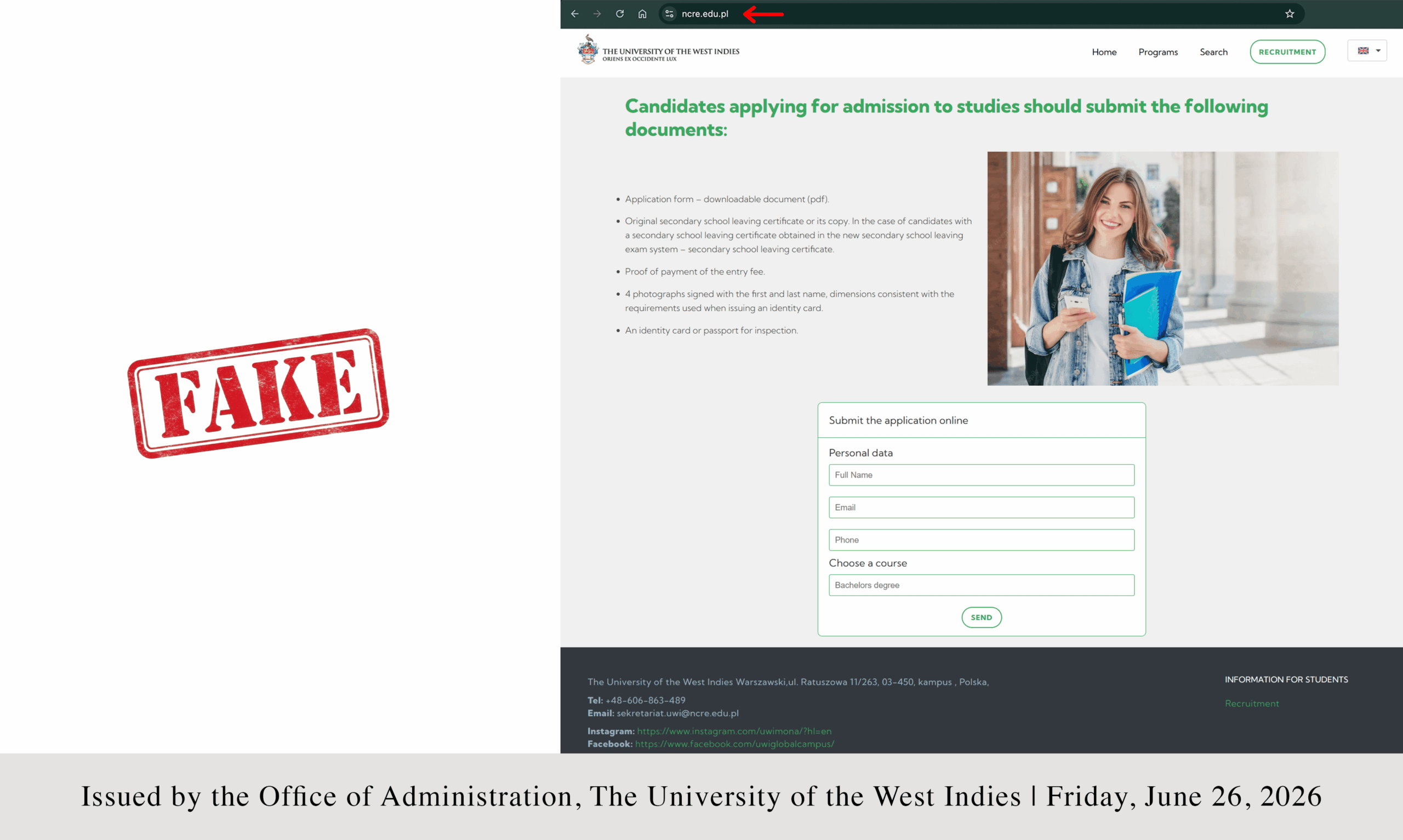
    In a recent official advisory, the University of the West Indies (UWI) has sounded the alarm over a malicious, unauthorised website that impersonates the prestigious regional higher education institution, targeting vulnerable prospective students and members of the public seeking enrollment information.

    University representatives confirmed that the fraudulent platform mimics UWI’s official branding, layout, and program descriptions to trick visitors into sharing sensitive personal data including national identification information, bank details and contact information. In many cases, scammers behind the fake site have demanded non-refundable upfront payments under the false pretense of processing admission applications or reserving spots in popular academic programs. Victims who pay these fees never receive legitimate admission offers, and their personal information is often exploited for further identity theft or financial fraud.

    UWI’s administration has stressed that the university only conducts official enrollment and payment processing through its verified, centralised official website and authorised partner channels. The institution has urged anyone who has interacted with the fake platform to immediately monitor their financial accounts for unauthorised activity, report any suspicious transactions to their local banks, and file a formal complaint with local law enforcement and cybercrime units. UWI also noted that it is working closely with cyberspace regulatory authorities to take down the fraudulent website and track down the individuals responsible for the scam, reminding the public to double-check the URL and authentication of any website claiming to be affiliated with the university before sharing personal or financial information.

  • LETTER: Sick Leave Does Not Mean a Lack of Integrity

    LETTER: Sick Leave Does Not Mean a Lack of Integrity

    In an anonymous letter addressed to the editor, a growing crisis in modern professional environments has been brought to light: the alarming erosion of empathy for employees taking sick leave. Far too often, workers on medical leave face unfair, snap judgments from colleagues and peers who know nothing about the specific realities of their health conditions or recovery journeys.

    One of the most common misconceptions that fuels this unfair judgment is the belief that any employee on sick leave must be confined to bed or trapped within their four walls around the clock. The reality of healing looks vastly different from person to person. While some acute illnesses and invasive medical procedures demand strict, extended bed rest, many other health scenarios allow – and even recommend – light activity as part of the recovery process. This can include gentle short walks to boost circulation, routine trips to pick up essential groceries, scheduled visits to healthcare providers, or simply spending time in fresh air to improve mental and physical wellbeing. Crucially, not all illnesses are visible to the outside eye, and no two recovery timelines or paths follow the same rigid template.

    It is undeniable that a small subset of employees do abuse workplace sick leave policies, claiming illness to take time off while pursuing activities that clearly have nothing to do with healing. But the letter argues that it is a deep injustice to paint every worker on medical leave with the same broad brush because of the poor choices of a few. These widespread, negative assumptions do more than make individual workers feel bad – they erode trust across entire teams and lay the groundwork for a toxic, hostile workplace culture that harms everyone.

    The author also reflects on a shifting norm in workplace relationships: where once colleagues would routinely reach out for a quick check-in, pass along well wishes, or offer support to a teammate on sick leave, those small, meaningful acts of kindness have become increasingly rare. Today, empathy in many workplaces has become a selective commodity, often extended only to popular, well-connected workers, while others are left without support or open to harsh judgment. All too often, a worker’s treatment during sick leave comes down to personal popularity rather than shared human respect: if a colleague is not personally liked, their health struggles are dismissed or ignored entirely.

    The letter makes a clear, pressing argument: respect and empathy should be extended equally to every employee, no matter the nature of personal relationships or the tangled dynamics of workplace politics. No outsider can ever fully understand what another person is navigating physically, mentally, or emotionally, even when they work side by side. As a community, the author argues we must work collectively to rebuild workplaces where people feel supported rather than scrutinized during their most vulnerable moments. A workplace rooted in a culture of genuine empathy does not only improve individual employee wellbeing – it also makes entire organizations stronger, by building a foundation of mutual respect that binds teams and businesses together for long-term success.

  • PM Browne Says Antigua Has “Enough” LGBTQ People Amid U.S. Talks

    PM Browne Says Antigua Has “Enough” LGBTQ People Amid U.S. Talks

    Amid ongoing regional negotiations with the United States over immigration resettlement, Prime Minister Gaston Browne has laid out Antigua and Barbuda’s non-negotiable conditions for accepting third-country nationals that Washington cannot repatriate to their home countries, drawing a firm line on additional LGBTQ asylum seekers and tying the policy to the small island nation’s limited domestic resources.

    In an appearance on the *Browne and Browne Show* this past Saturday, Browne referenced a recent case in neighboring St. Kitts and Nevis, where three third-country nationals were resettled under the US-led framework. According to information Browne received, two of those three individuals identify as LGBTQ. “I’m told the three that were sent to St. Kitts, two of them are LGBTQIAs,” Browne said, adding, “We have enough of those here.”

    The prime minister was quick to frame the government’s position as rooted in practical concerns rather than discrimination based on sexual orientation or gender identity, pointing to three core priorities: national security, public health, and the country’s strained public finances. “We do not want people who are criminals. We don’t want people who are sick. We do not want anyone who is going to become a charge [on the state],” he explained.

    Under the terms Antigua and Barbuda has put forward during negotiations, any individual accepted under the resettlement arrangement must pass rigorous, comprehensive security and medical screenings before they are allowed to enter the country. Additionally, the government has demanded that all resettled individuals hold valid, official travel documents from their countries of origin, rejecting the proposal that they enter with temporary documentation issued by US authorities.

    Browne confirmed that Antigua and Barbuda has left the door open to a limited annual intake, offering to consider accepting up to 10 third-country nationals per year. This offer, however, remains contingent on all applicants meeting the strict vetting requirements: no serious criminal record, no threat to national security, no public health risks, and full compliance with the government’s entry criteria.

    The prime minister emphasized that the island nation’s small geographic size and constrained public infrastructure make absorbing large numbers of resettled people unfeasible. He noted that once temporary US-funded support for resettled individuals expires, any long-term social assistance would fall to Antigua and Barbuda’s government, a burden the country cannot sustain at higher intake levels.

    Going forward, Browne confirmed that negotiating teams will continue talks with US officials, but the country will not compromise on its sovereign right to control who enters and establishes residence within its borders. The current talks between Antigua and Barbuda and the US are part of a broader diplomatic push by Washington, which has been negotiating with multiple Caribbean governments to resettle third-country nationals that cannot be sent back to their countries of origin as a key component of Washington’s wider immigration enforcement strategy.

  • Woman Pleads Not Guilty in Fatal Crash That Killed Keane Gregoire

    Woman Pleads Not Guilty in Fatal Crash That Killed Keane Gregoire

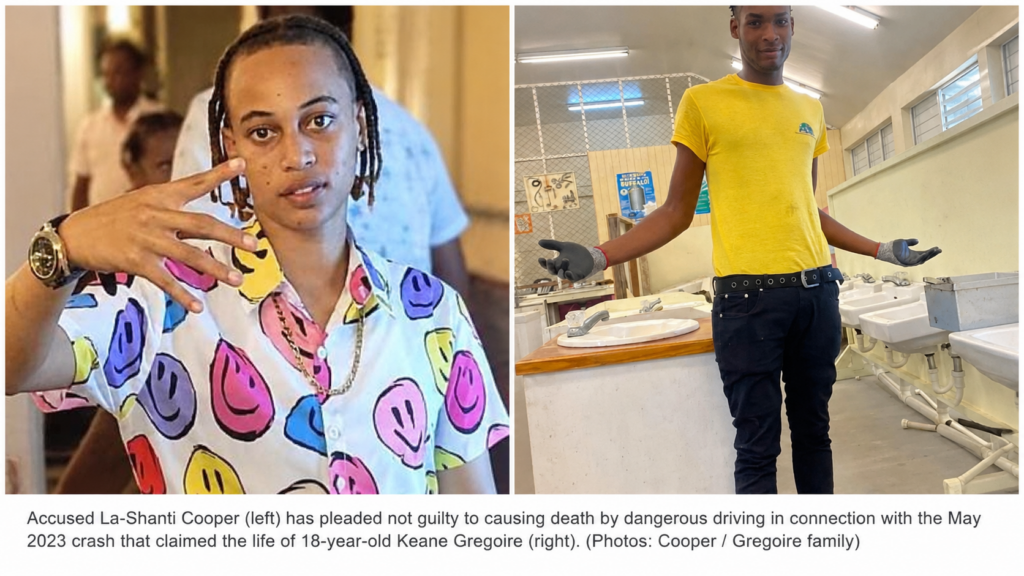
    Nearly two and a half years after a devastating car collision claimed the life of an 18-year-old local teen, the case is moving toward a public trial after the accused driver entered a formal plea of not guilty to a dangerous driving causing death charge.

    La-Shanti Cooper, who was 19 years old at the time of the 2023 crash, appeared in court recently to formally respond to the charge against her, entering a not guilty plea that paves the way for a full judicial examination of the incident. Court officials have scheduled a case management hearing for September 25, where legal representatives from both sides will address procedural matters and a final trial date is projected to be officially confirmed.

    The fatal collision unfolded on All Saints Road, close to the John I. Martin Race Track, on May 18, 2023. Keane Gregoire, the 18-year-old victim, was riding as a passenger in the vehicle driven by Cooper when the crash occurred. Gregoire was rushed to a local hospital with severe, life-threatening trauma after the incident, and he succumbed to his multiple injuries on May 19, 2023, just one day after the wreck.

    Law enforcement’s official account of the collision alleges that Cooper was operating a Toyota BB at excessive speed when she lost control of the vehicle. Per investigative reports, the car veered off the paved roadway, collided with a structural column, and eventually crossed over into the lanes of oncoming traffic on the opposite side of the road.

    Investigators have also noted that in the immediate aftermath of the crash, Cooper reportedly mislead responding officers, claiming she was not the driver of the vehicle and that the person operating the car had fled the scene shortly after the collision. After completing a full, systematic investigation into the crash details and evidence, law enforcement officials moved forward with formal charges of dangerous driving resulting in death against Cooper.

    Now, with Cooper maintaining her outright innocence in the case, the judicial process will proceed to a full trial once all pre-trial procedural steps are completed and a hearing date is finalized.

  • New Title? ‘Just Call Me Gassy Dread,’ PM Browne Tells Antiguans

    New Title? ‘Just Call Me Gassy Dread,’ PM Browne Tells Antiguans

    In a surprising display of lighthearted humor that has captured the attention of the entire nation of Antigua and Barbuda, Prime Minister Gaston Browne has openly embraced an unexpected viral nickname bestowed on him by local citizens – ‘Gassy Dread’.

    The unusual moniker began circulating across social media platforms and local community conversations in recent weeks, quickly gaining traction as a playful talking point among Antiguans. Instead of dismissing the joke or issuing a formal rebuke, which many would expect from a sitting head of government, Browne leaned into the moment during a recent public address to his constituents.

    When addressing the crowd, the prime minister acknowledged the nickname directly, telling Antiguans that they need not tiptoe around the playful title. “Just call me Gassy Dread,” he reportedly told attendees, breaking the tension of typical political speech and drawing laughter and applause from the audience.

    The moment has quickly become a viral talking point across Caribbean social media, with many members of the public praising Browne for his willingness to engage with informal public culture and show a more approachable, human side of political leadership. Political observers note that the move signals a refreshing break from the often stuffy formality that surrounds high-level political office, allowing voters to connect with their leader on a more personal level.

    While the origin of the nickname remains rooted in casual local wordplay linking Browne’s first name Gaston to the playful adjective, its unexpected adoption by the prime minister has turned a minor online joke into a defining moment of people-focused political communication in Antigua and Barbuda.

  • WATCH: PM Browne Wants Antiguans to Own Part of New Yeptons Beach Hotel

    WATCH: PM Browne Wants Antiguans to Own Part of New Yeptons Beach Hotel

    Antigua and Barbuda’s government is reshaping the proposed Yepton Beach hotel development into an inclusive public-private partnership (PPP) designed to open ownership stakes to domestic citizens and institutions, rather than ceding full control to foreign investors, Prime Minister Gaston Browne announced Saturday.

    Speaking during his regular weekly segment on Pointe FM, Browne outlined that the revised project structure aligns with the administration’s overarching policy goal: expanding local involvement across the nation’s $1.3bn tourism industry, the country’s primary economic driver, by creating clear investment pathways for ordinary citizens and state-backed entities. Unlike the country’s historic approach to tourism development, which sees the government sell land outright to foreign developers, the administration will maintain a permanent equity holding in the Yepton Beach project under the new framework.

    “We’re pursuing a public-private partnership structure,” Browne explained, noting that the model is crafted to guarantee the nation captures multiple layers of benefit from the resort development. Beyond the short-term gains of construction activity and new local jobs, the PPP structure will allow Antiguans and Barbudans to share in the long-term revenue and profits generated by the coastal hotel.

    Under the proposed arrangement, key domestic institutions including the national Social Security Scheme will be invited to take equity positions alongside the selected private developer and international hospitality brand. This structure creates accessible opportunities for Antiguan and Barbudan citizens at all income levels to hold shares in the high-potential resort project, a departure from the country’s long-standing status quo.

    For decades, tourism development in Antigua and Barbuda has followed a template where foreign investors hold full ownership and operational control of major resorts, with local participation restricted almost entirely to low and mid-level employment roles. Browne emphasized that shifting this dynamic is a core priority for his administration. “We want our people to have ownership,” he stated.

    Beyond expanding local economic inclusion, retaining a government equity stake will also unlock long-term fiscal benefits: the public sector will profit from future gains in the property’s value, creating a sustained stream of public revenue instead of a one-time payout from a land sale. Browne added that the balanced strategy supports both inclusion and growth: it enables citizens to build personal wealth through direct participation in profitable tourism assets, while still maintaining the open investment climate that attracts international capital and well-known global hotel brands to the country’s shores.

  • Antigua and Barbuda Seeks High-Level Meeting With EU Over Visa-Free Travel

    Antigua and Barbuda Seeks High-Level Meeting With EU Over Visa-Free Travel

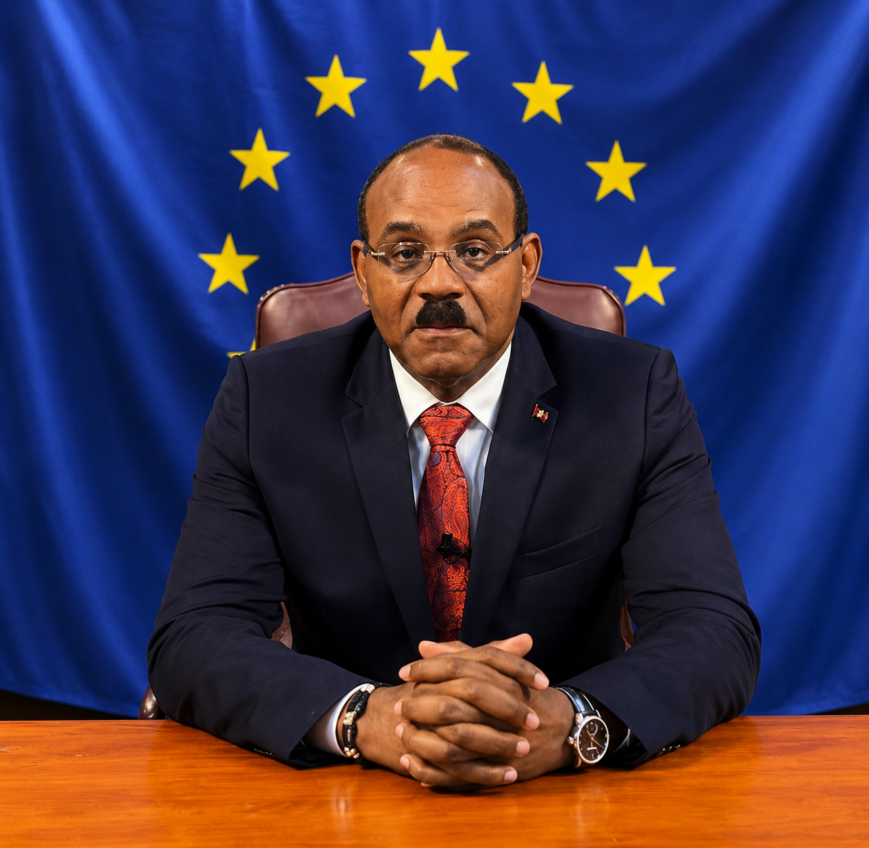
    In a public address on his weekly Pointe FM broadcast Saturday, Prime Minister Gaston Browne of Antigua and Barbuda laid out an aggressive high-level diplomatic strategy to protect the nation’s long-standing visa-free travel access to the European Union, amid growing uncertainty stirred by the EU’s review of global citizenship-by-investment programs.

    Browne emphasized that the Caribbean nation has not abandoned its efforts to convince EU policymakers to reverse proposed rules that could strip Antigua and Barbuda of its visa-free privilege before the close of 2024. While the final EU decision remains unconfirmed, the Browne administration is prioritizing direct, senior-level engagement to change the bloc’s position, the prime minister confirmed.

    At the core of Antigua and Barbuda’s negotiating position is a core argument: security concerns tied to investment migration programs can be mitigated through targeted enhanced safeguards, rather than the extreme measure of revoking visa-free access. Browne outlined that the government is pushing for the adoption of a regional electronic travel authorization system for citizens from nations running investment migration schemes, a reform he says addresses EU security worries without disrupting decades of cross-border travel arrangements.

    “We hold the position that an electronic travel authorization system would be more than sufficient to address any risks,” Browne said during the interview. “This is a sensible middle path that preserves the strong, positive relations we have built with the EU over decades. There is no need to throw the baby out with the bath water.”

    The prime minister added that Antigua and Barbuda has already enacted sweeping reforms to strengthen its own citizenship-by-investment program, and stands ready to implement any additional security measures that EU authorities request, including the pending adoption of mandatory biometric screening for applicants. “We have made a clear commitment to the EU: any safeguards you use in your own investment migration programs, we will put in place here,” Browne noted.

    He pushed back firmly against claims that Antigua and Barbuda’s program poses an unacceptable major security risk to European nations, pointing out that no immigration system in the world can claim to be 100% free from abuse. “We have already reinforced our program’s vetting processes extensively, and we are confident it does not present a meaningful risk to any country,” Browne explained. “We acknowledge that there will always be residual risk — occasionally a bad actor may slip through. But no system is ever completely foolproof.”

    Browne also called out what he described as double standards from larger nations that operate similar investor immigration schemes. He highlighted that even the United States’ well-known EB-5 investor visa program and Canada’s equivalent initiative have both had issues with bad actors infiltrating their systems, yet the EU only targets small Caribbean nations like his. “Larger countries have faced the exact same challenges we have, but they point fingers at us as if their systems are perfect and have never attracted criminal actors,” he said.

    Moving forward, Antigua and Barbuda will maintain sustained diplomatic engagement with EU officials, working to both preserve the visa-free arrangement and prove that the citizenship-by-investment program operates with full transparency and integrity. Browne also highlighted the program’s independent governance as proof of its integrity, noting that he has never overruled a rejection issued by the country’s Citizenship by Investment Unit (CIU), which operates with full institutional independence. “Our program is run with complete integrity, from start to finish,” he added.

  • Senate of Antigua and Barbuda is scheduled to meet Today

    Senate of Antigua and Barbuda is scheduled to meet Today

    In a plenary sitting held on June 16, 2026, the House of Representatives of Antigua and Barbuda approved a broad slate of legislative proposals, constitutional motions, and international ratifications, advancing five major bills to the Upper House for upcoming debate.

    The five bills heading to Upper House deliberation cover a wide range of policy priorities, from legal modernization to border security and immigration reform. The first, the Fatal Accidents Bill 2026, is designed to update the country’s outdated legal framework for damage claims stemming from fatal incidents, and will fully repeal the decades-old existing law, Fatal Accidents Act, Cap 166, replacing it with updated regulatory language. The Magistrate’s Code of Procedure (Amendment) Bill 2026 targets Section 38 of the existing Magistrate’s Code of Procedure Act, CAP 255, refining the statutory rules governing how search warrants are issued by judicial authorities. The Electronic Crimes (Amendment) Bill 2026 revises Section 18 of the 2018 Electronic Crimes Act, with changes focused on strengthening provisions related to production orders for digital evidence and updating penalties for entities or individuals that fail to comply with court-ordered information requests.

    On immigration and border management, two bills address longstanding policy gaps and bring domestic rules in line with global standards. The Immigration and Passport (Amendment) Bill 2026 establishes a formal amnesty program that allows undocumented residents to apply to have their immigration status formalized, creating a pathway to legal residency for eligible individuals. The Advanced Passenger Information and Passenger Name Record Bill 2026 introduces formal regulatory frameworks for the collection, transmittal, sharing, and secure storage of passenger data for people entering, departing from, or transiting through Antigua and Barbuda, aligning the country’s border security protocols with current international best practices.

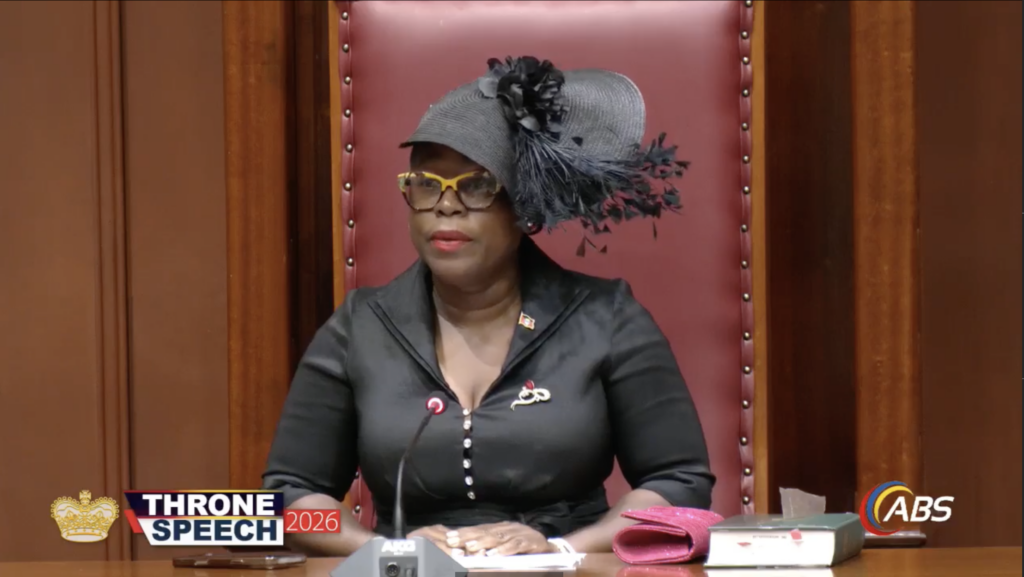
    In addition to the five bills bound for the Upper House, the sitting also approved two procedural motions that will be taken up by the upper chamber. One motion authorizes the compulsory acquisition of land for public use, specifically to build a secure entry and exit corridor and supporting public infrastructure for the planned National Performing Arts Centre. The second motion sets procedural arrangements for the Governor General’s official opening of Parliament scheduled for May 26, 2026, including the delivery of the traditional Throne Speech outlining the government’s upcoming policy agenda.

    Beyond the legislation moving to the Upper House, the House of Representatives approved a series of additional resolutions during the same sitting, including four international treaty ratifications that strengthen Antigua and Barbuda’s global engagement. These include ratification of an addendum to the Multilateral Competent Authority Agreement on the Automatic Exchange of Financial Account Information, a global transparency agreement designed to combat cross-border tax evasion. Members also approved ratification of the 1986 amendment to the Constitution of the International Labour Organization, updating the institutional framework of the global labor standard-setting body. A reciprocal visa exemption agreement between the governments of Antigua and Barbuda and the United Arab Emirates was also ratified, allowing citizens of both nations to travel visa-free between the two countries, a move expected to boost tourism, trade, and people-to-people ties. The final ratification approved by members was a 2016 protocol amending Articles 50(a) and 56 of the Convention on International Civil Aviation, signed in Montreal, which updates global civil aviation governance rules.

    The sitting also concluded the formal appointment of a new Public Accounts Committee, required under Section 98 of Antigua and Barbuda’s Constitution, which exercises legislative oversight of government spending to ensure public funds are used appropriately and transparently. The committee will be chaired by Hon. Jamale Pringle, MP for All Saints East and St Luke, with other members including Hon. Trevor Walker, MP for Barbuda; Hon. Anthony Smith Jr, MP for All Saints West; Hon. Michael Freeland, MP for St George; and Hon. Melford Nicholas, MP for St John’s City East.

    Official multimedia coverage of the full June 16 sitting has been released by the Government Information Service of Antigua and Barbuda.

  • Government Plans to Cut Down Rat Island for Major Port Expansion

    Government Plans to Cut Down Rat Island for Major Port Expansion

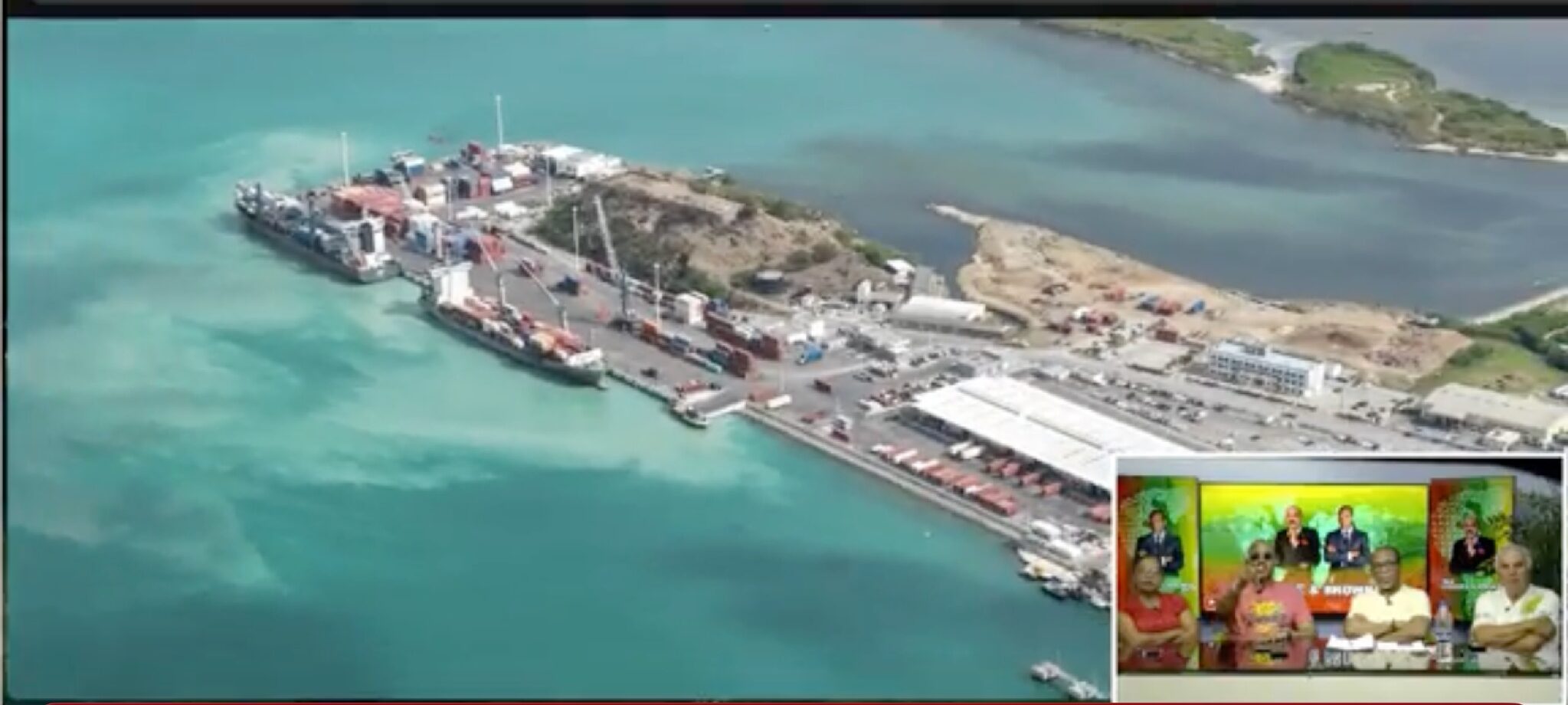
    Antigua and Barbuda is moving forward with an ambitious infrastructure overhaul of the St. John’s Port, a project that will reshape the country’s maritime landscape and boost its standing as a leading regional transshipment and logistics hub, Prime Minister Gaston Browne announced over the weekend. Speaking during his regular broadcast on Pointe FM Saturday, Browne outlined the centerpiece of the expansion initiative: the complete removal of nearby Rat Island, where excavated material will be repurposed for large-scale land reclamation to accommodate the port’s growing footprint.

    The core driver behind the expansion is a pressing shortage of container storage capacity that has limited the country’s ability to handle rising cargo volumes, Browne explained. While construction teams have already successfully reclaimed approximately nine acres of land along the port’s northern edge, the prime minister emphasized that this is far from enough to meet projected long-term growth in regional maritime trade. “Rat Island that we intend to cut down to create more land. And by so doing, we will have more space for container storage. I understand now we don’t have enough space,” Browne told listeners during the broadcast. Beyond the material sourced from Rat Island, the government plans to pursue additional land reclamation in adjacent coastal areas to support successive phases of the port’s expansion.

    Browne added that the upgraded port facility will cement Antigua and Barbuda’s strategic position in Caribbean trade routes. The country already acts as a key transshipment stop for cargo traveling from Panama through the Dominican Republic en route to final distribution across smaller Eastern Caribbean island nations. The expansion project is designed to build on this existing role, turning the country into a full-fledged regional logistics center that can attract new shipping lines, logistics firms and maritime business that have historically bypassed the region for larger hubs.

    In a key update on the project’s progress, the prime minister disclosed that the Antiguan government is currently in advanced discussions with a major United States-based firm that is poised to serve as the anchor tenant and primary operator of the expanded transshipment terminal. A larger, more modern port will not only boost cargo handling capacity but also improve consumer access to imported goods across Antigua and Barbuda, while opening new avenues for trade diversification by strengthening economic ties with markets across the Dominican Republic, Central America and South America, he noted.

    The St. John’s Port expansion is just the latest phase of a broader waterfront revitalization effort already underway in the country’s capital. Browne pointed to previous successful reclamation projects that have transformed once-blighted areas of the waterfront previously occupied by abandoned, derelict barges. Completed and ongoing projects in the area include the development of the new Global Ports cruise terminal, a major infrastructure investment that is already boosting the country’s tourism and cruise shipping sectors.

  • Antigua Plans Undersea Power Link With St. Kitts and Nevis to Import Geothermal Energy

    Antigua Plans Undersea Power Link With St. Kitts and Nevis to Import Geothermal Energy

    Against a backdrop of volatile global fossil fuel markets and growing regional momentum for clean energy transition, the Prime Minister of Antigua and Barbuda Gaston Browne announced Saturday that the island nation is evaluating a plan to build an undersea electricity cable that would connect it directly to St. Kitts and Nevis. The project forms part of a broader regional push to unlock cross-border access to renewable energy and cut heavy reliance on carbon-intensive fossil fuel imports.

    Speaking during his regular weekly appearance on local outlet Pointe FM, Browne explained that the proposal grew out of high-level discussions among leaders of the Organisation of Eastern Caribbean States (OECS), which have centered on strengthening collaborative energy governance and shoring up long-term energy security across the region. Under the framework of this cooperation, member states with untapped or underdeveloped geothermal resources would be able to expand their production capacity and export excess clean power to neighboring islands that lack the geological conditions for domestic geothermal development.

    “For nations like Antigua and Barbuda that don’t have domestic geothermal reserves, this arrangement would let us buy affordable, reliable clean power from neighbors that do,” Browne noted in his address. He confirmed that early bilateral talks between Antigua and Barbuda and St. Kitts and Nevis are already underway to work out details of the subsea transmission line, which would run from Nevis to Antigua and enable the import of steady baseload electricity for Antigua and Barbuda in the coming years.

    This energy partnership is just one component of a wider OECS strategy to deepen integration across key priority sectors including energy connectivity, transportation infrastructure, and cross-border trade. A core goal of this broader initiative is to reduce the vulnerability of small island member states to unpredictable global economic and energy shocks that have disproportionately impacted Caribbean nations in recent years.

    While Browne declined to share a formal construction timeline or disclose preliminary cost estimates for the proposed cable, he emphasized that regional governments remain fully committed to advancing collaborative renewable energy infrastructure projects across the Eastern Caribbean. St. Kitts and Nevis has already made significant progress in developing its domestic geothermal reserves, and regional leaders project that this resource could eventually become a foundational clean power source for a interconnected regional energy grid that serves multiple neighboring islands.

    For Antigua and Barbuda, expanding access to imported geothermal power delivers three key long-term benefits: it will diversify the nation’s current energy portfolio, cut reliance on costly imported fossil fuels, and build greater overall energy resilience at a time when global petroleum markets continue to see extreme price volatility, Browne added.