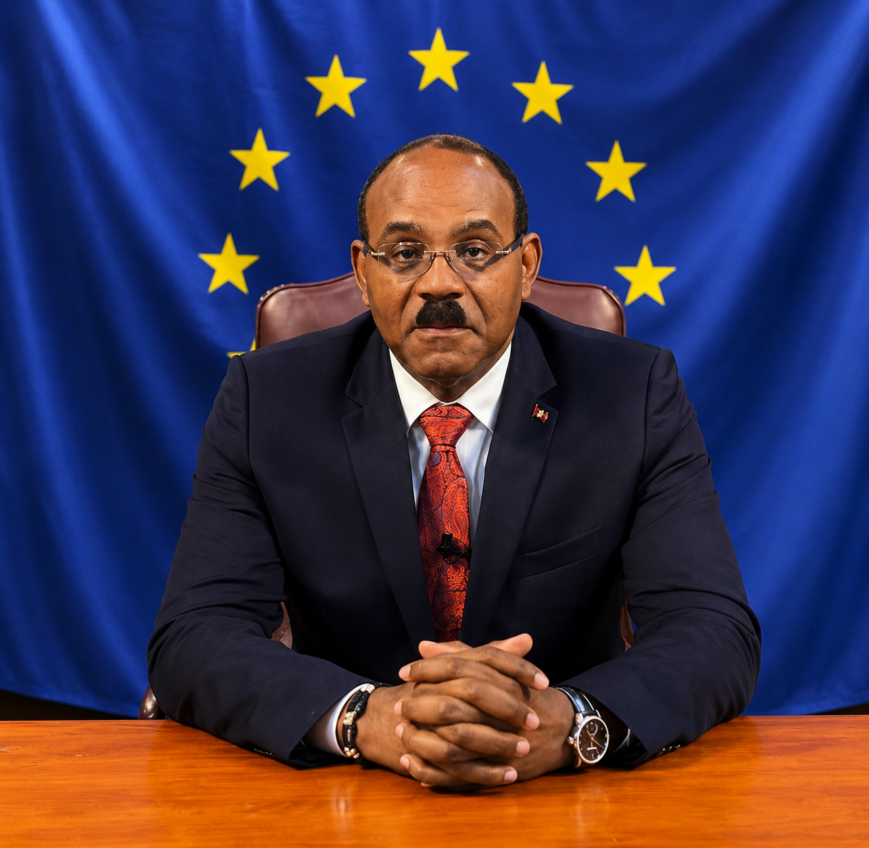
In a public address on his weekly Pointe FM broadcast Saturday, Prime Minister Gaston Browne of Antigua and Barbuda laid out an aggressive high-level diplomatic strategy to protect the nation’s long-standing visa-free travel access to the European Union, amid growing uncertainty stirred by the EU’s review of global citizenship-by-investment programs.
Browne emphasized that the Caribbean nation has not abandoned its efforts to convince EU policymakers to reverse proposed rules that could strip Antigua and Barbuda of its visa-free privilege before the close of 2024. While the final EU decision remains unconfirmed, the Browne administration is prioritizing direct, senior-level engagement to change the bloc’s position, the prime minister confirmed.
At the core of Antigua and Barbuda’s negotiating position is a core argument: security concerns tied to investment migration programs can be mitigated through targeted enhanced safeguards, rather than the extreme measure of revoking visa-free access. Browne outlined that the government is pushing for the adoption of a regional electronic travel authorization system for citizens from nations running investment migration schemes, a reform he says addresses EU security worries without disrupting decades of cross-border travel arrangements.
“We hold the position that an electronic travel authorization system would be more than sufficient to address any risks,” Browne said during the interview. “This is a sensible middle path that preserves the strong, positive relations we have built with the EU over decades. There is no need to throw the baby out with the bath water.”
The prime minister added that Antigua and Barbuda has already enacted sweeping reforms to strengthen its own citizenship-by-investment program, and stands ready to implement any additional security measures that EU authorities request, including the pending adoption of mandatory biometric screening for applicants. “We have made a clear commitment to the EU: any safeguards you use in your own investment migration programs, we will put in place here,” Browne noted.
He pushed back firmly against claims that Antigua and Barbuda’s program poses an unacceptable major security risk to European nations, pointing out that no immigration system in the world can claim to be 100% free from abuse. “We have already reinforced our program’s vetting processes extensively, and we are confident it does not present a meaningful risk to any country,” Browne explained. “We acknowledge that there will always be residual risk — occasionally a bad actor may slip through. But no system is ever completely foolproof.”
Browne also called out what he described as double standards from larger nations that operate similar investor immigration schemes. He highlighted that even the United States’ well-known EB-5 investor visa program and Canada’s equivalent initiative have both had issues with bad actors infiltrating their systems, yet the EU only targets small Caribbean nations like his. “Larger countries have faced the exact same challenges we have, but they point fingers at us as if their systems are perfect and have never attracted criminal actors,” he said.
Moving forward, Antigua and Barbuda will maintain sustained diplomatic engagement with EU officials, working to both preserve the visa-free arrangement and prove that the citizenship-by-investment program operates with full transparency and integrity. Browne also highlighted the program’s independent governance as proof of its integrity, noting that he has never overruled a rejection issued by the country’s Citizenship by Investment Unit (CIU), which operates with full institutional independence. “Our program is run with complete integrity, from start to finish,” he added.