博客

  • T&TEC threatens to sue Scotland, Kydd-Hannibal

    T&TEC threatens to sue Scotland, Kydd-Hannibal

    The Trinidad and Tobago Electricity Commission (T&TEC), the country’s state-owned power utility, has formally initiated pre-legal action against Port of Spain South Member of Parliament Keith Scotland, a senior counsel, and associate attorney Keisha Kydd-Hannibal, alleging professional misconduct that led to the permanent loss of more than $2.39 million in outstanding public funds.

    The pre-action protocol letter, delivered Monday by Freedom Law Chambers led by Senior Counsel Anand Ramlogan, outlines multiple legal claims against the two legal professionals, including professional negligence, breach of client contract, fraudulent and negligent misstatement, and intentional deceit. The proposed lawsuit stems from T&TEC’s years-long failed effort to recover $2,392,220.11 in unpaid electricity bills from local food manufacturing firm Flavorite Foods Ltd.

    Under the terms of the letter, T&TEC is seeking full compensatory damages equal to the total value of the unrecoverable debt, plus accrued interest, all accumulated legal costs, and compensation for additional related losses. The utility has also signaled it will pursue aggravated and exemplary damages to address the gravity of the alleged misconduct.

    The controversy first became public earlier this October, when Prime Minister Kamla Persad-Bissessar addressed the allegations from the floor of Parliament. During her address, the Prime Minister accused Scotland of mishandling the debt recovery litigation, confirmed that the state utility would pursue formal legal action, and announced the matter would be referred to the national Fraud Squad for criminal investigation. She also noted that disciplinary proceedings before the Trinidad and Tobago Law Association could be launched against the attorneys in the coming weeks.

    Shortly after the parliamentary announcement, Scotland spoke to reporters outside the legislative chamber and denied all wrongdoing, challenging the Prime Minister to repeat her accusations outside of Parliament, where she is protected by parliamentary privilege that shields her from defamation claims. “I invite the Prime Minister to make these claims outside of the Parliament,” Scotland stated at the time.

    He has consistently maintained that court proceedings were properly initiated against Flavorite Foods, and has produced official court documents that he says confirm his team followed all required procedures. Scotland has also forcefully rejected unconfirmed suggestions that he maintained an improper personal or professional relationship with Flavorite chairman Louis André Monteil, calling collusion allegations baseless and gravely damaging to his reputation.

    When reached for comment Monday following the delivery of the pre-action letter, Scotland declined to make any additional public statement, noting only that he would respond to all allegations fully through his own legal team.

    The 17-page pre-action letter, drafted by Freedom Law Chambers attorney Ganesh Saroop, centers on three separate lawsuits filed against Flavorite Foods between 2022 and 2024, none of which have resulted in a final court judgment against the indebted company. T&TEC alleges that the first two claims were never properly advanced through the court system and were ultimately struck from the docket, while the third lawsuit was filed without the utility’s knowledge, formal authorization, or required court approval.

    “Three claims were commenced, and not one was brought to judgment,” the letter notes, outlining the breakdown of the litigation process. For months, T&TEC leaders say they were repeatedly assured by the two attorneys that default judgment applications had been submitted to the court and were just awaiting administrative processing from court officials. But internal checks and official court confirmation revealed that no such applications had ever been filed with the court.

    “The court records, and the Registrar’s own confirmations, establish that no request or application for default judgment was ever filed in either the 2022 or the 2023 claim,” the letter states. “T&TEC was thus led to believe that the delay lay with the administration of the Court, when its true cause was the failure of its own attorneys to take the most basic procedural steps.” Due to these procedural delays and missteps, the statute of limitations has now expired on the debt, leaving it permanently unrecoverable, T&TEC argues.

    The timeline of the retainer traces back to October 2022, when T&TEC hired Scotland, who was then practicing through Virtus Chambers, to pursue the unpaid debt after Flavorite Foods failed to respond to an initial pre-action demand letter. Per the retainer agreement, T&TEC says Kydd-Hannibal was assigned to manage most day-to-day correspondence and litigation logistics, while Scotland served as lead counsel and provided strategic guidance on the case.

    The utility alleges the first claim, filed in December 2022, was never properly served on Flavorite Foods and automatically expired per court rules. A second claim, filed in October 2023, suffered the same fatal procedural flaws, according to the complaint. Throughout 2024, T&TEC says Kydd-Hannibal repeatedly updated the utility that the default judgment application had been filed and was awaiting review from the Registrar of the Supreme Court.

    In one January 2024 message included as evidence in the letter, Kydd-Hannibal allegedly wrote: “Yes it was, the Clerk is following up with the counter.” A later update claimed the application was “before the Registrar for consideration.” T&TEC confirms these statements are false, as court records show no application was ever submitted.

    Most notably, the utility alleges that a third claim was filed in T&TEC’s name on October 22, 2024, without required authorization from T&TEC’s corporate secretary or board of directors. The letter also directs sharp criticism at Scotland for continuing to advise on the case after his appointment to the national Cabinet in July 2024, raising questions about compliance with parliamentary and ethical standards for sitting cabinet members. T&TEC says it will present evidence that Scotland continued to shape litigation strategy, recommended withdrawing and refiling a previous application, and even communicated directly with a court Registrar regarding the case, despite his cabinet position.

    Both Scotland and Kydd-Hannibal have been given a 28-day window to respond to the pre-action letter, requiring them to explicitly state whether they admit or deny liability and address each allegation outlined in the document. T&TEC has warned that if a satisfactory response addressing all claims is not received within the timeframe, formal civil proceedings will be launched immediately without further notice, and additional disciplinary complaints will be filed with legal regulatory bodies.


  • St Vincent announces launch of Executive Air’s regional cargo Service – WIC News

    St Vincent announces launch of Executive Air’s regional cargo Service – WIC News

    On June 25, 2026, officials from Argyle International Airport (AIA) in St. Vincent and the Grenadines announced the official launch of a new regional air cargo service operated by regional carrier Executive Air. Hailed as a transformative infrastructure milestone for the island nation, the new route network is projected to unlock broad economic benefits across key local industries, from agriculture to tourism.

    Executive Air’s new cargo service connects St. Vincent and the Grenadines to an extensive web of more than 30 destinations across the Caribbean, covering major travel and trade hubs from Anguilla and Antigua to the Bahamas, Jamaica, Trinidad and Tobago, and Puerto Rico’s San Juan. Unlike limited existing cargo options, this dedicated service closes critical gaps in regional air freight connectivity that have long held back local businesses.

    For St. Vincent’s core tourism and hospitality sectors, the service solves a long-standing pain point: reliable, timely access to imported specialty goods, from food and beverages to hospitality supplies. This is expected to reduce delivery delays and lower logistics costs for resorts, hotels, and restaurants across the islands, improving their ability to serve the growing number of international tourists visiting the region each year.

    For local smallholder and commercial farmers, the launch creates what AIA officials describe as “massive export pipelines” that open up new international markets for Vincentian agricultural produce. Previously, high logistics costs and limited cargo capacity made it difficult for local producers to compete across the Caribbean; the new service removes these barriers, creating new income streams for farming communities and supporting the expansion of the island’s agriculture sector.

    Overall, the initiative is positioned as a key driver of sustainable long-term economic growth for St. Vincent and the Grenadines, strengthening both the country’s aviation infrastructure and its cross-regional trade capabilities. Ahead of operations kicking off, AIA officials have issued a note of guidance for shippers: all customers looking to send freight should contact Executive Air directly before arranging shipments, as several destinations across the carrier’s network enforce unique requirements for incoming cargo that shippers must comply with.

  • Contractor loses $90m claim against THA

    Contractor loses $90m claim against THA

    After nearly two decades of unresolved disagreement over a major Tobago road construction project, a Trinidad and Tobago High Court judge has delivered a definitive ruling, throwing out a contractor’s $90 million-plus damages claim against the Tobago House of Assembly (THA) and ordering the firm to cover the public body’s legal costs.

    The claim was brought by Raghunath Singh and Company Ltd, which was awarded the contract for the L’Anse Fourmi-Charlotteville Road Project back in May 2002 through the Central Tenders Board. The original corrected contract value was set at $34.7 million, excluding value-added tax, with an 18-month timeline for completion. What was meant to be a year-and-a-half project stretched out significantly due to multiple reported delays, and the contractor ultimately fully exited the construction site in March 2007.

    That August, the project’s supervising firm Lee Young & Partners issued a Certificate of Provisional Acceptance and certified a final closing payment of just over $1 million. For eight years after this step, the contractor took no formal legal action, only submitting a self-described final account and claim to the THA in May 2015. It then waited another seven and a half years before launching formal court proceedings in November 2022.

    In its claim, the contractor argued that the extended delays were not its fault. It pinned responsibility on last-minute design changes ordered by authorities, severe weather events including 2004’s Hurricane Ivan and Tropical Storm Earl, unanticipated escalation in construction materials and labor costs, and additional compliance mandates imposed by the Environmental Management Authority. It demanded more than $27 million in special damages, over $53 million in accumulated interest, pushing the total claimed amount to over $90 million when VAT was included.

    Delivering his judgment this week, High Court Justice Frank Seepersad left no room for ambiguity, dismissing the entire claim and ordering Raghunath Singh and Company Ltd to pay $636,590.07 in legal fees to the THA.

    Justice Seepersad’s core finding was that the claim was statutorily barred under Trinidad and Tobago’s Limitation of Certain Actions Act, which requires all contractual dispute claims to be filed within a four-year window. He rejected the contractor’s argument that the THA’s failure to issue a formal Final Completion Certificate kept the claim legally active, noting that the law prioritizes timely, diligent action over inaction.

    “Contractual mechanisms requiring timely certification and the prompt resolution of disputes exist not merely for administrative convenience but because justice itself is best served when claims are advanced while the underlying facts remain capable of objective verification,” Justice Seepersad wrote in his ruling.

    Beyond the statutory limitation, the judge found that the contractor had failed to comply with multiple core procedural requirements laid out in the original construction contract. These included mandates to submit a draft final account statement shortly after project completion and to initiate binding arbitration when disputes first emerged during construction. He stressed that procedural requirements in large construction contracts are not meaningless technicalities, but foundational elements that ensure commercial certainty for all parties.

    “Commercial certainty is an indispensable feature of construction contracts,” he said. “Such contracts invariably contain carefully calibrated provisions governing certification, claims, variations, extensions of time and dispute resolution. Those mechanisms are not mere technicalities.”

    Justice Seepersad further noted that courts lack the authority to rewrite contractual agreements years after the original work was completed, or to override the terms that commercial parties freely agreed to when entering a contract. “Courts are not at liberty to reconstruct contractual relationships many years after the relevant events have occurred or to substitute broad notions of fairness for the bargain freely entered into by commercial parties. The judicial function is to enforce contracts according to their terms and not to relieve parties from the consequences of failing to invoke the procedures to which they agreed,” he added.

    The judge also highlighted that the agreement was a fixed-price contract with no clauses allowing for adjustments due to cost fluctuations, meaning the risk of any unexpected cost increases was explicitly borne by the contractor from the start. He added that the 15-year gap between the project’s completion and the filing of the claim makes a fair, reliable judicial review impossible: over time, witness memories fade, key project documents are lost or misplaced, and the original context of on-site decisions becomes impossible to accurately reconstruct.

    Representing the contracting firm were attorneys Peter Taylor, Egon Embrack and Nehanda Samuel, while the THA was represented by a legal team led by Senior Counsel Russell Martineau, with support from Dominique Martineau and Avionne Thomas.

  • CITY CELEBRATES

    CITY CELEBRATES

    As the Port of Spain Corporation commemorates its 112th year of municipal governance, the capital city’s top elected official has opened up about the persistent systemic challenges holding back progress, with violent crime and chronic budget shortages topping the list of urgent concerns.

    Mayor Chinua Alleyne shared these observations during a celebratory cocktail reception held Wednesday at Port of Spain’s City Hall on Knox Street, marking the institution’s more than a century of public service.

    Despite ongoing efforts to turn the tide on public safety, Alleyne acknowledged that the city has not yet overcome its most pressing issues. “There is still critical work ahead of us,” he noted, describing crime as a burden he bears personally for the community. He stressed that the city’s own municipal police force has gone above and beyond the call of duty, volunteering extra hours to boost patrols and public safety outreach, and continues to deliver strong results for residents. The city maintains close collaboration with the national Trinidad and Tobago Police Service (TTPS), and Alleyne reaffirmed that this partnership would remain a top priority moving forward.

    On the financial side, Alleyne and the municipal council are waiting on the Ministry of Finance to release urgently needed allocated funds, with expectations pinned on the upcoming national Mid-Year Budget Review to unlock critical support. Additional funding, he said, would allow the council to expand its work across more neighborhoods and advance long-overdue city modernization projects. Alleyne also teased that he would share full details of his ambitious agenda for citywide beautification and infrastructure upgrades at the upcoming Statutory Meeting and Civic Awards reception scheduled for Friday.

    This is not the first time Alleyne has sounded the alarm about budget gaps. Back in April, he warned that severe funding shortages threatened to disrupt core municipal services, including regular residential garbage collection, and could even leave municipal workers without scheduled pay checks.

    The 112th anniversary celebrations extended beyond the City Hall reception, including an interfaith service held at the Cathedral of the Immaculate Conception on Port of Spain’s Independence Square. Addressing the multi-religious gathering, Local Government Minister Khadijah Ameen urged Alleyne and the municipal council to stay the course in their service to Port of Spain’s residents.

    “As elected representatives, our core mission is to stand for the people we serve,” Ameen told attendees. She acknowledged that local government work is often uncompensated in public recognition, noting “I know at times it can be a thankless job — decades from now, many residents may not recall our names. But that does not diminish our responsibility to serve with excellence and distinction. Our calling is to lift up the lives of the most vulnerable among us.” Ameen also highlighted that local officials are always the first responders to community crises, from violent tragedies to natural disasters, making their consistent, dedicated service all the more critical.

    Ameen closed her remarks by sharing the guidance of Prime Minister Kamla Persad-Bissessar, who encourages public servants to “put God first and walk behind” in their work, before offering a blessing for the council and the city.

    She also reflected on the unique cultural and religious pluralism that defines Trinidad and Tobago, noting that the multi-faith gathering in a Roman Catholic cathedral was a powerful testament to that legacy. “It is a special gift to live in a country where people of every religious tradition can gather in one another’s places of worship — whether churches, mandirs, or mosques,” she said. “In too many parts of the world, this kind of interfaith gathering is impossible, even deadly. This is what makes our beautiful, cosmopolitan nation so special.”

  • Baitali legt zich neer bij uitvoering Van ‘t Hogerhuysstraat, maar zet juridische strijd Voort

    Baitali legt zich neer bij uitvoering Van ‘t Hogerhuysstraat, maar zet juridische strijd Voort

    On June 25, Farsi Khudabux, chief executive of Surinamese construction firm Baitali NV, announced that the company will not block the implementation of the long-awaited Van ‘t Hogerhuysstraat rehabilitation project, despite losing a summary injunction lawsuit against the Surinamese state. The firm, however, maintains its opposition to what it calls an unjustified disqualification from the public tender for the project, and is currently reviewing potential further legal action against the government.

    Khudabux shared his response one day after the state signed a formal contract for the project with Kuldipsingh Infra, the winning bidder selected after Baitali’s disqualification. He pointed out that it was notable for the government to move forward with executing the court ruling within 24 hours of its issuance, a level of speed the government rarely demonstrates for other court decisions that do not align with its priorities.

    “It is good that the state follows up on a ruling within one day — we wish they were always this efficient,” Khudabux sardonically noted, adding that the accelerated timeline demonstrates the government’s pattern of prioritizing rulings that benefit its agenda while leaving unfavorable court orders stagnant for extended periods.

    Despite this criticism, the Baitali CEO emphasized that the firm respects the court’s ruling and will comply with its requirement to allow work to move forward. “We operate under the rule of law, and we will abide by the court’s decision,” Khudabux said. “But where we disagree with the outcome, we will exhaust every legal recourse available to us to defend our position.”

    He clarified that Baitali never sought to derail the rehabilitation project entirely. Months ago, the firm informed the Ministry of Public Works that it had no objection to Kuldipsingh Infra carrying out construction work, as long as existing contractual agreements with Baitali were honored. Khudabux stressed that the company’s fight has never been about claiming the project for itself, but about challenging the validity of its disqualification from the bidding process.

    In the recent ruling, the judge did not make any substantive ruling on whether the disqualification itself was legally justified. Instead, the court weighed the public interest of advancing the long-delayed infrastructure project against Baitali’s commercial interests, and ruled to allow work to proceed immediately. The core question of the tender’s fairness has been deferred to a full trial on the merits, if Baitali chooses to move forward with that legal route.

    Currently, Baitali is working with its legal advisors to outline next steps. Both an appeal of the summary ruling and a full substantive trial on the tender disqualification remain on the table, according to Khudabux. The CEO acknowledged that the court ruled the judgment immediately enforceable, meaning the government can proceed with construction regardless of whether Baitali files an appeal. Even so, the firm extended a wish of success to Kuldipsingh Infra for the execution of the project.

    Khudabux reaffirmed his claim that the international tender process was riddled with irregularities. He highlighted that three out of the five total bidders were disqualified, including two experienced international contracting firms with extensive global infrastructure experience. Adding to the suspicion around the evaluation process, Khudabux noted that Baitali recently qualified for a far larger international infrastructure project overseas, despite being disqualified from this smaller municipal rehabilitation project in Suriname — where the firm has operated as a trusted contractor for decades.

    “That discrepancy leads us to believe that something went wrong in the bid evaluation process,” Khudabux said. “That is why we will continue to fight until a court makes a clear ruling on whether our disqualification was justified.” He closed by reiterating the firm’s commitment to the rule of law, confirming Baitali will respect the court’s ruling while pursuing all legal avenues to have its disqualification reviewed.

  • Soeroredjo: lopende grondconversieaanvragen worden opnieuw beoordeeld

    Soeroredjo: lopende grondconversieaanvragen worden opnieuw beoordeeld

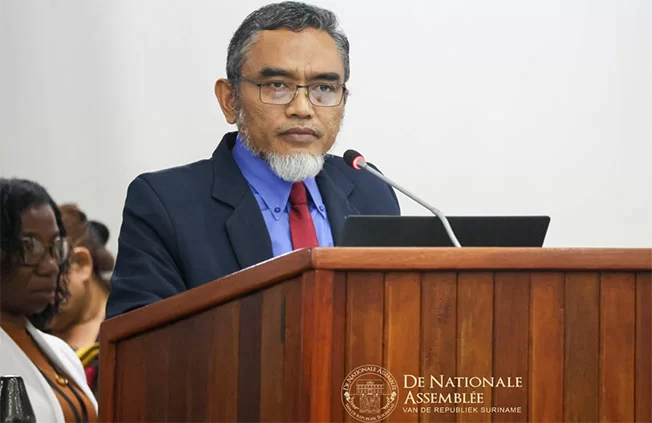
    In a budget address delivered to the National Assembly, Minister Stanley Soeroredjo of the Ministry of Land Policy and Forest Management (GBB) has outlined the Suriname government’s plan to overhaul the country’s existing land conversion policy, citing systemic gaps that have opened the door to abuse and widespread land speculation. The government remains committed to completing a full review of the current policy framework, and all pending land conversion applications will now be assessed on a strict individual basis, with the government also considering potential refunds for applicants who have already paid processing fees for unapproved claims. Soeroredjo stressed that the government does not oppose land conversion in principle – the original policy was designed to deliver greater property rights security for ordinary citizens who have lived on or invested in state-owned plots for years. Instead, the review is targeting critical flaws embedded in the current state decree that run counter to that original mission. Three core gaps have been identified by the ministry: the current framework places no limit on the number of parcels a single individual or legal entity can convert to private ownership, sets no cap on the total amount of land one party can acquire, and requires no minimum holding period before conversion can be approved. These oversights have created a loophole that allows speculators to convert plots to private ownership immediately after they are allocated, a practice that directly contradicts the original intent of the policy, according to Soeroredjo. GBB is also currently investigating reports of large-scale, questionable land conversions carried out through foundation structures, as well as cases where land was converted to private ownership at valuations far below market rate. All of these findings will be incorporated into the ongoing policy evaluation. Recognizing that thousands of ordinary applicants have already incurred processing costs for their claims, the ministry will sort applications by their current stage of review and assess each case separately. Once the full evaluation is complete, the government will issue clear guidance on next steps for all pending claims, including a formal decision on whether refunds will be issued for applications that cannot ultimately be approved. Looking forward, the government is already drafting an updated regulatory framework for land conversion that will close the existing loopholes. Proposed new rules include caps on the number of parcels and total land area a single entity can convert, a mandatory minimum holding period before conversion is allowed, and additional safeguards to crack down on speculative activity. Soeroredjo emphasized that the end goal of the overhaul is to build a balanced system: one that delivers the property rights security guaranteed to honest, eligible citizens, while preventing misappropriation of state land through abuse and speculation that diverts public assets from their original public purpose.

  • Cricket West Indies to Begin Procurement for Antigua High Performance Centre

    Cricket West Indies to Begin Procurement for Antigua High Performance Centre

    Cricket’s regional governing body Cricket West Indies (CWI) is preparing to launch the procurement phase for its transformative new High Performance Centre (HPC) development based in Antigua, chief executive Chris Dehring has confirmed. Requests for proposals (RFPs) for multiple core elements of the multi-faceted project are set to be distributed imminently, clearing the way for on-site construction to get underway in the coming weeks.

    Dehring made the announcement during a collaborative symposium co-hosted by CWI, the Antigua and Barbuda Intellectual Property and Commerce Office (ABIPCO) and the University of the West Indies Five Islands Campus, framing the initiative as a landmark step toward building a world-class cricket development hub for the Caribbean region.

    “Construction is going to start very shortly,” Dehring told attendees. “We will be issuing RFPs from our offices for the core high-performance centre, an indoor cricket facility, a dedicated television broadcast infrastructure, and an on-site hotel for the campus.”

    While no official completion timeline was disclosed during the address, Dehring laid out a far-reaching vision for the campus that goes far beyond basic elite athlete training facilities. The full development will integrate a range of complementary components designed to support training, education, tourism and cultural preservation.

    At its core, the project will house a fully equipped high-performance training centre outfitted with cutting-edge sports science technology, alongside a climate-controlled indoor cricket centre for year-round practice. A purpose-built television broadcast facility will enable professional coverage of on-site events and matches, while the on-site hotel will provide accommodation for visiting teams, athletes, event staff and cricket fans traveling to Antigua.

    A key academic component of the development is a full-time residential CWI Academy, where young student-athletes will be able to pursue accredited academic coursework alongside specialized cricket training, creating a structured pathway for emerging talent to build both athletic and academic credentials.

    The project also incorporates a cultural element: an immersive “West Indies Cricket Experience” museum that will leverage interactive audio-visual tools and artificial intelligence to chronicle the iconic history of West Indies cricket, and explore the sport’s outsized role in shaping the social and cultural identity of the Caribbean.

    For Antigua, Dehring emphasized that the large-scale investment is designed to cement the island’s position as the world’s leading destination for elite cricket training, athlete rehabilitation and cricket-focused sports tourism. He noted that Antigua holds unique competitive advantages over other potential regional hubs, including its deep connection to generations of cricket legends, existing pre-built sporting infrastructure, and a century-old rich cricketing heritage that draws fans from across the globe.

    As the procurement process gets underway, stakeholders across regional cricket and Antigua’s tourism sector are awaiting further updates on the project’s completion timeline.

  • China neemt Amerikaanse kroon over voor snelste supercomputer ter wereld

    China neemt Amerikaanse kroon over voor snelste supercomputer ter wereld

    For the first time in nearly a decade, a Chinese supercomputer has seized the number one position on the world’s most influential ranking of high-performance computing systems, ending a multi-year run of U.S. leadership and underscoring Beijing’s expanding capacity to compete with Washington in cutting-edge technological development.

    The new champion, LineShine, is hosted at the National Supercomputing Centre in Shenzhen. It recorded a performance of 2.198 exaflops — equivalent to more than two quintillion calculations per second — giving it a 20% performance lead over the previous title holder, the U.S.-built El Capitan supercomputer. El Capitan, located at Lawrence Livermore National Laboratory in California, had held the top spot on the biennial TOP500 ranking since November 2024. Following LineShine and El Capitan in the updated rankings are two other U.S. systems: Frontier at Oak Ridge National Laboratory in Tennessee takes third place, and Aurora at Argonne National Laboratory in Illinois claims fourth. Germany’s Jupiter rounds out the top five, with other top 20 spots distributed across nations including the United Kingdom, Japan, South Korea, Italy, the Netherlands, and Switzerland.

    This milestone marks the first time a Chinese system has topped the TOP500 list since 2017, when China’s Sunway TaihuLight held the leading position. Industry analysts say LineShine’s ascent is particularly notable because it comes despite years of strict U.S. export restrictions targeting advanced semiconductors for high-performance computing. Jack Dongarra, an emeritus professor of computer science at the University of Tennessee and one of the lead organizers of the TOP500 project, noted that LineShine’s performance proves China remains competitive in the supercomputing space even amid trade barriers. “Export restrictions may slow China’s access to certain imported components, but they have also accelerated the development of domestic alternative solutions,” Dongarra explained. He added that China’s return to the top position was not entirely unexpected.

    A unique feature of LineShine that sets it apart from other leading exascale systems is its all-central processing unit (CPU) architecture. Unlike graphics processing units (GPUs), which have become the standard for powering large AI models such as ChatGPT and Claude due to their parallel processing capabilities, CPUs have fewer cores and are generally slower for complex AI workloads. Even with this design choice, the TOP500 confirms LineShine is the first and only CPU-only supercomputer to ever break the 2 exaflop performance threshold.

    First launched in 1993, the TOP500 list is published twice yearly, ranking systems based on their performance on the LINPACK Benchmark, a standard test that measures how quickly a system can solve a large system of linear equations. China previously dominated the global supercomputing landscape, holding nearly half of all TOP500 spots in 2019, but its representation on the list declined in recent years amid worsening U.S.-China geopolitical tensions.

    While the TOP500 has remained an influential industry benchmark for decades, some experts argue its relevance has faded as computing priorities have shifted following the AI boom. Most of the world’s most powerful AI-optimized computing systems are operated by large private tech corporations including Microsoft, Amazon, Meta, and Alphabet, and these private systems rarely participate in the voluntary TOP500 ranking, which is dominated by public sector and academic systems. For context, a 2025 analysis from Cornell University estimated that El Capitan holds only 22% of the total computing power of xAI’s private Colossus supercomputer.

    Dongarra emphasized that the TOP500 only measures performance on one specific benchmark, and should not be treated as a comprehensive measure of overall global technological leadership. “Scientific output, energy efficiency, software maturity, reliability, usability, and support for broad research communities are all equally important metrics,” he said.

    Addison Snell, co-founder of technology research firm Intersect360 Research, noted that while LineShine’s top ranking was not surprising, it is notable that Chinese developers have returned to active participation in the TOP500 ranking after years of reduced involvement. Snell argued that LineShine’s new leading position will have ripple effects for the United States, Europe, and Japan as they compete for global AI dominance. “The U.S. still holds an overall technological lead, but the gap has narrowed dramatically,” Snell said. “With rapid advancements across the sector, the global technology order can shift very quickly. Digital sovereignty has become a core priority in supercomputing and AI, and every major region is now investing heavily to build its own independent capabilities.”

    For a decade, the U.S. and China have been locked in intensifying competition for global leadership in advanced technology sectors including AI, with export controls and sanctions used as key tools in this rivalry. A 2026 research report from Stanford University found that China has effectively closed the performance gap with the U.S. in core AI model capabilities. While the U.S. still produces more leading-edge large AI models, China leads the world in AI-related patents and industrial robot adoption.

    Snell added that even if large private tech firms could outperform the TOP500’s top-ranked systems, the ranking remains critical for scientific supercomputing, a distinct field from consumer-facing AI development. “AI dominance does not automatically translate to scientific computing dominance,” he explained. While consumer AI applications such as image generation, automated translation, and chatbots are important, they are not sufficient to meet global research needs. “Policy should support AI development for scientific progress, not pit AI investment against scientific computing investment. Governments need to invest in both areas to secure long-term technological competitiveness.”

  • Education Ministry Announces Return of STEM InFuSED Summer Camp

    Education Ministry Announces Return of STEM InFuSED Summer Camp

    A beloved annual hands-on STEM learning program is set to return for young students across the region, after an official announcement from the Ministry of Education, Science and Technology. The six-week STEM InFuSED Camp, crafted to spark early interest in science, technology, engineering and mathematics through immersive, practical activities, will welcome eligible participants between July 6 and August 11, 2026. All on-site programming will be hosted at Sir Novelle Richards Academy, located in Tomlinson’s Estate.

    The camp is open to students falling in the 8 to 17 age range, creating opportunities for both elementary and secondary school learners to dive into STEM content tailored to their skill levels. Unlike traditional classroom-based learning that focuses heavily on theoretical concepts, the InFuSED Camp centers on active, student-led participation. Attendees will work through a structured schedule that includes hands-on scientific experiments, cross-team innovation challenges, informational talks led by industry and academic STEM experts, and group collaborative projects. Every activity is intentionally designed to build core soft skills that benefit learners across all academic areas, including advanced critical thinking and creative problem-solving.

    Camp organizers have issued a reminder to interested families that spots in the program are limited, and are urging parents and guardians to complete their registration as early as possible to secure a place for their child. Registration can be completed digitally via either the QR code or the dedicated online form published on the official camp promotional flyer.

  • Antigua and Barbuda Among Caribbean Communities Celebrated During Philadelphia Heritage Month

    Antigua and Barbuda Among Caribbean Communities Celebrated During Philadelphia Heritage Month

    June’s Caribbean American Heritage Month celebrations in Philadelphia are turning a well-deserved spotlight on Antigua and Barbuda, along with a host of other Caribbean nations, as local community organizers work to lift up the profound, often underrecognized contributions that Caribbean-born and Caribbean-descended residents have made to the city’s cultural fabric and civic landscape.

    Danielle Mellanson, who serves as president of the United Caribbean Association of Philadelphia (UCAP), carries representation for two island nations — Antigua and Barbuda and Saint Kitts and Nevis — and called the responsibility a tremendous point of personal and professional pride. For Mellanson, growing up and building a life in Philadelphia as a person of Caribbean heritage is a uniquely meaningful experience, blending the deep traditions of her home region with the distinct character of the city she calls home. “Being of Caribbean descent and living in Philadelphia means the world to me. I am proud of my heritage and cultural background mixed with a little Philly flair,” Mellanson shared in a recent profile highlighting regional community leaders.

    Mellanson pointed to the annual Philly Caribbean Carnival as the most prominent annual showcase of Caribbean culture in the city. Far more than a public celebration, she explained, the event serves as a living tribute to four core values that have defined Caribbean communities for generations: freedom, resilience, resistance against injustice, and the shared cultural heritage that unites Caribbean people across geographic boundaries.

    As part of this year’s Caribbean American Heritage Month programming, the feature profiling community leaders also highlighted representatives from Guyana and Jamaica. These leaders detailed how their respective national communities have built deep, lasting roots across Philadelphia, with a visible presence spanning a wide range of sectors: from grassroots cultural associations and locally owned small businesses to neighborhood churches and civic public service roles.

    In wrapping up its coverage of regional contributions, the publication emphasized that Caribbean Americans remain a foundational force in shaping Philadelphia’s modern social, cultural, and civic identity. Even as they continue to shape the city’s future, these communities actively preserve the unique cultural traditions and national identities of their home countries, creating a rich, diverse dynamic that strengthens Philadelphia as a whole.