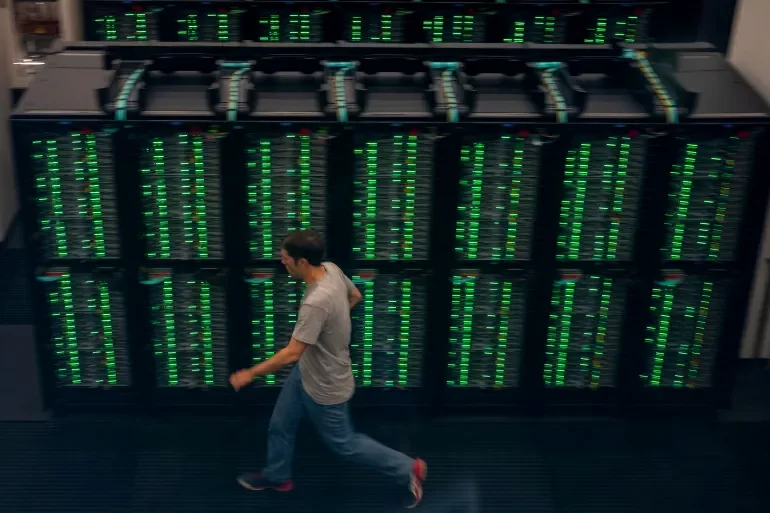
For the first time in nearly a decade, a Chinese supercomputer has seized the number one position on the world’s most influential ranking of high-performance computing systems, ending a multi-year run of U.S. leadership and underscoring Beijing’s expanding capacity to compete with Washington in cutting-edge technological development.
The new champion, LineShine, is hosted at the National Supercomputing Centre in Shenzhen. It recorded a performance of 2.198 exaflops — equivalent to more than two quintillion calculations per second — giving it a 20% performance lead over the previous title holder, the U.S.-built El Capitan supercomputer. El Capitan, located at Lawrence Livermore National Laboratory in California, had held the top spot on the biennial TOP500 ranking since November 2024. Following LineShine and El Capitan in the updated rankings are two other U.S. systems: Frontier at Oak Ridge National Laboratory in Tennessee takes third place, and Aurora at Argonne National Laboratory in Illinois claims fourth. Germany’s Jupiter rounds out the top five, with other top 20 spots distributed across nations including the United Kingdom, Japan, South Korea, Italy, the Netherlands, and Switzerland.
This milestone marks the first time a Chinese system has topped the TOP500 list since 2017, when China’s Sunway TaihuLight held the leading position. Industry analysts say LineShine’s ascent is particularly notable because it comes despite years of strict U.S. export restrictions targeting advanced semiconductors for high-performance computing. Jack Dongarra, an emeritus professor of computer science at the University of Tennessee and one of the lead organizers of the TOP500 project, noted that LineShine’s performance proves China remains competitive in the supercomputing space even amid trade barriers. “Export restrictions may slow China’s access to certain imported components, but they have also accelerated the development of domestic alternative solutions,” Dongarra explained. He added that China’s return to the top position was not entirely unexpected.
A unique feature of LineShine that sets it apart from other leading exascale systems is its all-central processing unit (CPU) architecture. Unlike graphics processing units (GPUs), which have become the standard for powering large AI models such as ChatGPT and Claude due to their parallel processing capabilities, CPUs have fewer cores and are generally slower for complex AI workloads. Even with this design choice, the TOP500 confirms LineShine is the first and only CPU-only supercomputer to ever break the 2 exaflop performance threshold.
First launched in 1993, the TOP500 list is published twice yearly, ranking systems based on their performance on the LINPACK Benchmark, a standard test that measures how quickly a system can solve a large system of linear equations. China previously dominated the global supercomputing landscape, holding nearly half of all TOP500 spots in 2019, but its representation on the list declined in recent years amid worsening U.S.-China geopolitical tensions.
While the TOP500 has remained an influential industry benchmark for decades, some experts argue its relevance has faded as computing priorities have shifted following the AI boom. Most of the world’s most powerful AI-optimized computing systems are operated by large private tech corporations including Microsoft, Amazon, Meta, and Alphabet, and these private systems rarely participate in the voluntary TOP500 ranking, which is dominated by public sector and academic systems. For context, a 2025 analysis from Cornell University estimated that El Capitan holds only 22% of the total computing power of xAI’s private Colossus supercomputer.
Dongarra emphasized that the TOP500 only measures performance on one specific benchmark, and should not be treated as a comprehensive measure of overall global technological leadership. “Scientific output, energy efficiency, software maturity, reliability, usability, and support for broad research communities are all equally important metrics,” he said.
Addison Snell, co-founder of technology research firm Intersect360 Research, noted that while LineShine’s top ranking was not surprising, it is notable that Chinese developers have returned to active participation in the TOP500 ranking after years of reduced involvement. Snell argued that LineShine’s new leading position will have ripple effects for the United States, Europe, and Japan as they compete for global AI dominance. “The U.S. still holds an overall technological lead, but the gap has narrowed dramatically,” Snell said. “With rapid advancements across the sector, the global technology order can shift very quickly. Digital sovereignty has become a core priority in supercomputing and AI, and every major region is now investing heavily to build its own independent capabilities.”
For a decade, the U.S. and China have been locked in intensifying competition for global leadership in advanced technology sectors including AI, with export controls and sanctions used as key tools in this rivalry. A 2026 research report from Stanford University found that China has effectively closed the performance gap with the U.S. in core AI model capabilities. While the U.S. still produces more leading-edge large AI models, China leads the world in AI-related patents and industrial robot adoption.
Snell added that even if large private tech firms could outperform the TOP500’s top-ranked systems, the ranking remains critical for scientific supercomputing, a distinct field from consumer-facing AI development. “AI dominance does not automatically translate to scientific computing dominance,” he explained. While consumer AI applications such as image generation, automated translation, and chatbots are important, they are not sufficient to meet global research needs. “Policy should support AI development for scientific progress, not pit AI investment against scientific computing investment. Governments need to invest in both areas to secure long-term technological competitiveness.”