博客

  • No word on minimum pension rise despite NIS “making surpluses”

    No word on minimum pension rise despite NIS “making surpluses”

    GEORGETOWN, Guyana – At a public event Wednesday announcing expanded digital payment options for National Insurance Scheme (NIS) pensioners, senior leadership of Guyana’s 57-year-old social security agency highlighted five consecutive years of investment surpluses and rapid contributor growth, but offered no clear timeline for a long-awaited increase to the agency’s minimum old-age pension.

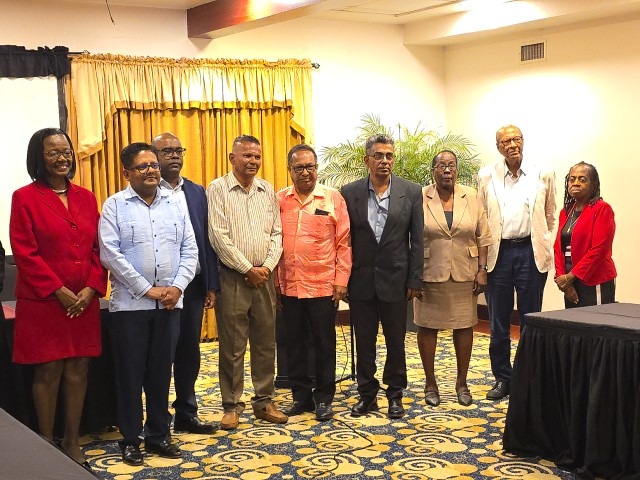
    The event brought together NIS General Manager Holy Greaves, Guyana’s Finance Minister Dr. Ashni Singh, and members of the NIS Board of Directors to mark a key expansion of pension access: starting immediately, NIS pension payments can be received through popular local and global financial services including Mobile Money Guyana, MoneyGram, and Bill Express.

    During remarks at the ceremony, NIS Board Chairman Ramesh Persaud emphasized that the agency’s financial position has strengthened dramatically over the past half-decade. “The NIS…is in a very strong position today for the last five years. The NIS has been making surpluses that we are reinvesting for the future pensioners of the organisation, and again, I think that that’s a very well-meaning accomplishment,” Persaud said.

    Officials attributed the agency’s solid financial performance to broad-based economic expansion across Guyana’s traditional and emerging industries, which has driven a sharp rise in the number of active workers contributing to the social security system. Finance Minister Dr. Singh detailed that over the past five and a half years, NIS has added nearly 70,000 new contributors – a 38% jump from the 2020 baseline. The number of self-employed workers enrolled in the scheme has also doubled over the same period, reaching almost 9,000.

    “These numbers reflect the dynamics in the Guyanese economy because more persons are working, more persons are employed, more employment opportunities, there’s more investment, private investment, more employment opportunities are being created, more persons are working, more entrepreneurial opportunities are being created, and more persons are entering entrepreneurial activities and becoming self-employed persons,” Dr. Singh explained.

    When pressed by reporters on whether the agency’s improved financial standing would lead to an imminent increase to the NIS minimum pension, Persaud deferred all decision-making authority to the Finance Ministry, which oversees the NIS’s administrative and policy framework. “That is in the domain of the Minister of Finance to provide guidance on…The Board is independent but the structure of the NIS is that it is under the administration of the Ministry of Finance and those fiscal and policy decisions are guided by the Minister of Finance,” Persaud told Demerara Waves Online News. Dr. Singh declined to provide any comment on the question of a pension adjustment when approached.

    According to official data published on the NIS website, the last adjustment to the minimum old-age pension took effect on January 1, 2025, when the monthly rate was raised from GY$35,000 to GY$43,075. Today, that minimum payment is less than half of Guyana’s current minimum public sector salary, which stands at GY$102,346 per month, highlighting the gap between pension benefits and baseline living costs for many retirees.

    In an interview with reporters, President Irfaan Ali reaffirmed his administration’s broad commitment to expanding and strengthening social welfare programs across Guyana, which currently include universal cash grants for eligible adult residents, school-aged children, people living with disabilities, pensioners, and other vulnerable groups.

    “The ecosystem surrounding different segments of the population, including the pensioners, is being continuously analysed so I would say as the year’s analysis continues in the new budget and subsequent budgets, we will continue to look at ways in which we can improve and expand social benefits to the population,” President Ali said.

    While the government has already finalized all policy and spending measures for the 2026 national budget, President Ali did not rule out a future pension increase, but stopped short of confirming a specific timeline for the adjustment. He stressed that any change to pension rates would be implemented only once it fits within the government’s broader social support framework and is sustainable for the national economy.

    “We are not only looking at this from a single barrel perspective. We are looking at this from a wholistic perspective and whilst we have concluded our policy initiative for 2026, we are continuously looking at these issues and at the appropriate time, once the economy can afford it and once it falls in the broader framework of social support, we will be looking at it,” the President told Demerara Waves Online.
  • June in History

    June in History

    June stands as a month marked by pivotal turning points in Grenada’s colonial and social history, with events spanning three decades that left enduring legacies across the island nation’s governance, infrastructure, education, and public health.

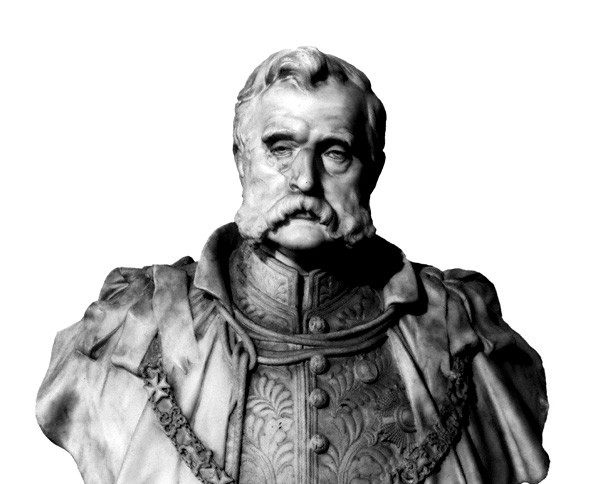
    The most consequential of these events arrived on 1 June 1885, when Grenada was formally designated the administrative headquarters of the Windward Islands Government, a unified colonial body overseeing four island territories: Grenada itself, St. Lucia, St. Vincent, and Tobago. Overseeing this new administrative structure from its inception was Walter J. Sendall, who served as Governor-in-Chief of the Windward Islands from June 1885 through November 1889.

    Sendall’s tenure left a lasting imprint on Grenada that persists to this day. He championed expanded overland transport infrastructure to connect growing communities across the island, spearheaded the founding of Grenada’s iconic botanical garden, and ultimately overcame initial hesitation to approve public funding for what would become Grenada Boys’ Secondary School (GBSS) — an institution that remains a cornerstone of secondary education on the island decades later. In recognition of his contributions, Grenada’s only vehicular tunnel was named in his honor, with surviving photos showing its eastern entrance off Monckton Street and its western exit onto Bruce Street.

    Long before Sendall took office, June 1857 brought foundational progress to Grenada’s education system. That year, colonial legislators passed a landmark act that established the territory’s first formal education board and created a grammar school in the capital St. George’s to provide structured secondary education. Records from that era show the territory already supported 30 operating primary schools serving a total of 1,482 students, with religious institutions leading much of the early education work: 19 schools were run by the Anglican Church, seven by the Roman Catholic Church, and four by Wesleyan denominational groups.

    Three decades before Grenada became the Windward Islands headquarters, June 1854 brought devastating public health crisis to the island colony: an outbreak of Asiatic cholera that would claim close to 4,000 lives before it was contained. The first cases emerged on the night of 10 June at barracks in Fort George, the site that later housed the Colony Hospital and old General Hospital. From there, the disease spread rapidly: it moved from Richmond Hill to nearby cottages before reaching the Calivigny Estate, where panicked management and overseers abandoned on-site laborers, who were forced to barricade themselves in their living quarters.

    Sanitary authorities responded by evacuating the surviving workers and incinerating all contaminated belongings to slow transmission, but the outbreak could not be contained quickly. Over six weeks, cholera spread across the entire main island of Grenada and extended to the smaller dependent islands of Carriacou and Petite Martinique, killing an average of 16 people every day. Entire communities along the banks of the River St. John, just outside St. George’s, were wiped out entirely. A striking anomaly of the outbreak, however, offered early public health insight: not a single case was recorded in the town’s central jail, a outcome that public health officials of the era directly attributed to the enforced cleanliness standards maintained for the facility and its inmates. By the end of September 1854, the epidemic had run its course, leaving a lasting mark on the island’s collective memory.

    This historical reflection, compiled by NOW Grenada contributors, notes that the outlet does not take responsibility for contributor-shared opinions or content, and invites users to report any abusive content via official channels.

  • Venezuela Earthquake Death Toll Rises to 164 After Strongest Quake in More Than a Century

    Venezuela Earthquake Death Toll Rises to 164 After Strongest Quake in More Than a Century

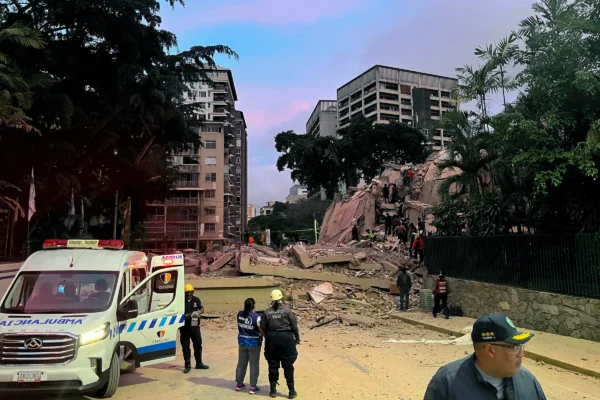
    On a Wednesday public holiday in Venezuela, two powerful earthquakes struck the nation’s northern coast within just 60 seconds, marking the strongest seismic event to hit the South American country in over 100 years. As of early Thursday morning, the official death toll stood at 164, with 971 people injured, and acting national leadership has warned that the final casualty count and scale of destruction will likely be far higher as rescue teams continue to reach affected areas.

    The sequence of seismic activity began just after 6:04 p.m. ET, when a magnitude 7.2 foreshock hit near San Felipe, the capital of Yaracuy state. A mere 40 seconds later, a larger magnitude 7.5 earthquake struck approximately 23 kilometers southeast of Yumare, another town in the same northern state. Because the disaster struck on a national public holiday, many residents were at home or gathered at public events when the shaking started, increasing vulnerability to injury and death. Shaking from the quakes was felt across every Venezuelan state, and even reached neighboring Colombia hundreds of kilometers from the epicenter.

    Geolocated videos verified by CNN captured chaotic scenes across the country: terrified residents fled crumbling buildings with family members and pets, gathering in open streets to avoid falling debris. Martha Añez, a resident of the capital Caracas who was trapped in her apartment during the quake, described her harrowing experience to reporters. “We couldn’t get out; there was hammering from one side and kicking from the other. I don’t know who actually rescued us, because they were shouting, ‘Get away from there, we’re coming and we are about six!’, until they finally burst through the door,” Añez said. She added that three floors of her apartment building are completely destroyed.

    Acting President Delcy Rodriguez, who assumed office earlier this year after U.S. forces captured sitting President Nicolás Maduro, confirmed the rising casualty numbers in a video address early Thursday. The updated toll marked a sharp increase from initial overnight counts, indicating how much damage remains unaccounted for. Rodriguez confirmed that dozens of structures have collapsed across the country, with the northern coastal state of La Guaira suffering the worst damage; the state has been formally designated a disaster zone. “We are currently engaged in arduous rescue operations to save as many lives as God allows. This is truly a tragedy,” Rodriguez said.

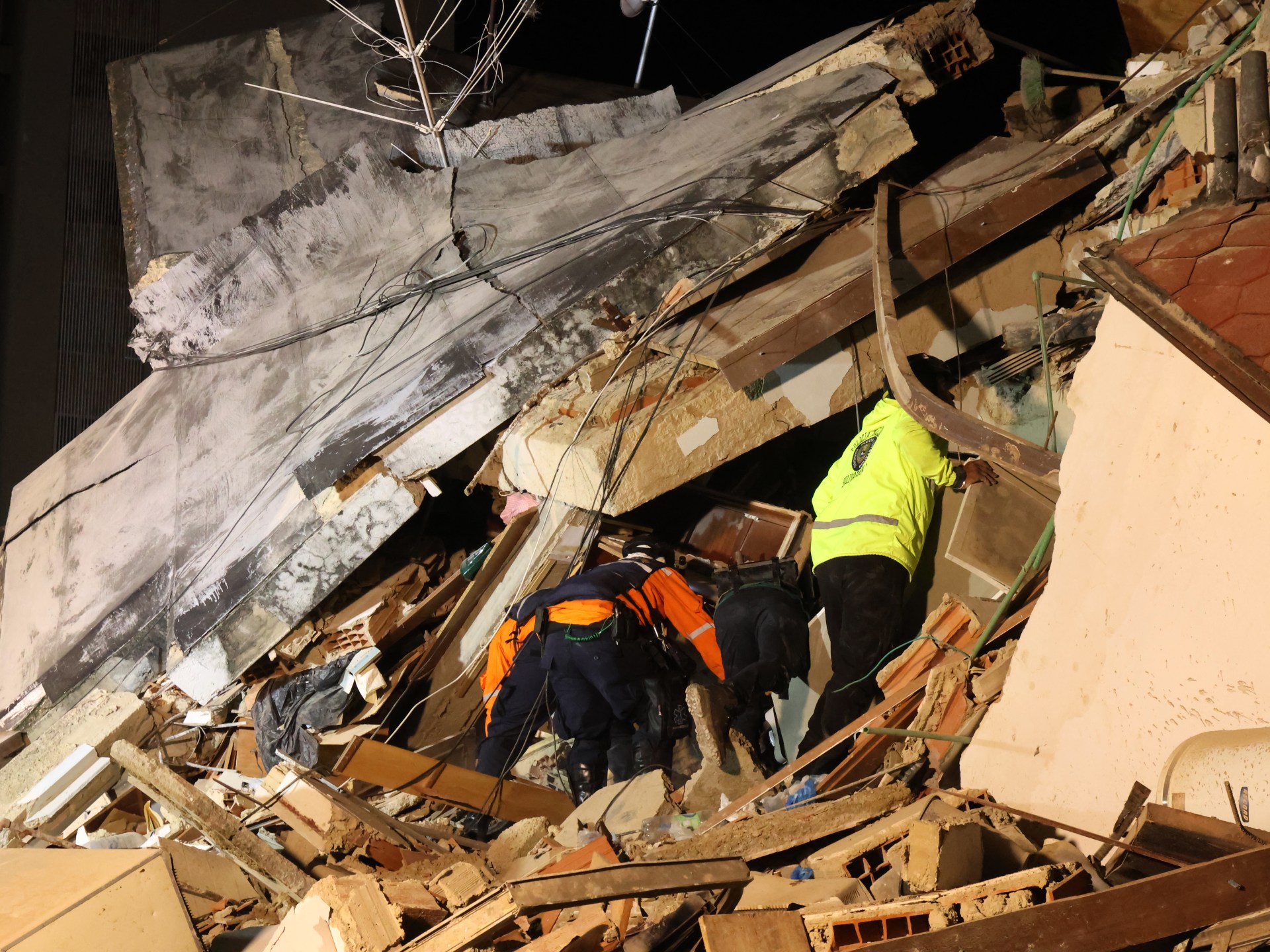
    Verified footage confirms widespread destruction to residential and commercial infrastructure across Venezuela, including in Caracas. In the La Guaira town of Macuto, a large waterfront hotel has been completely reduced to rubble, while neighboring Catia La Mar has recorded multiple collapsed residential buildings and severe structural damage to high-rise towers. The U.S. Geological Survey issued two separate red alerts via its PAGER alert system immediately after the quakes, warning of likely high casualties and extensive damage. The agency noted that most housing and public buildings in the affected region are constructed with materials that are highly vulnerable to intense seismic shaking.

    Connectivity watchdog NetBlocks reported that national internet connectivity dropped sharply after the quakes damaged power and telecommunications infrastructure across the affected northern regions.

    The disaster comes at an already catastrophic moment for Venezuela, which has been grappling with years of deep political and economic instability, including prolonged hyperinflation that has crippled the national economy. In response to the quakes, Rodriguez announced a nationwide state of emergency, the formation of a high-level inter-agency task force to coordinate search and rescue, and an initial $200 million fund for reconstruction and relief efforts. Caracas’ Simon Bolivar Airport has been temporarily closed due to structural damage, and all public schools across the country will be suspended for one week. All rail services and non-essential government activities have also been temporarily halted, and interfaith nationwide prayer gatherings are scheduled for 7 p.m. local time.

    Venezuela’s Ministry of Communication and Information confirmed that national security forces have been deployed across all affected regions, and utility authorities have cut direct gas supply to damaged structures as a safety precaution while structural assessments are conducted.

    In a show of global solidarity, multiple countries have mobilized rescue teams and humanitarian aid to support Venezuela’s response. Rodriguez confirmed that U.S. rescue teams were expected to arrive in the country early Thursday, after former President Donald Trump publicly voiced support for the relief effort. Additional specialized rescue teams are being deployed from the Dominican Republic, France, El Salvador, Mexico, and Qatar, while China, Brazil, and multiple Caribbean nations have committed to sending critical humanitarian aid supplies. This is a developing story, and updates will be issued as more information becomes available.

  • Jamaica’s Prime Minister on State visit to Guyana

    Jamaica’s Prime Minister on State visit to Guyana

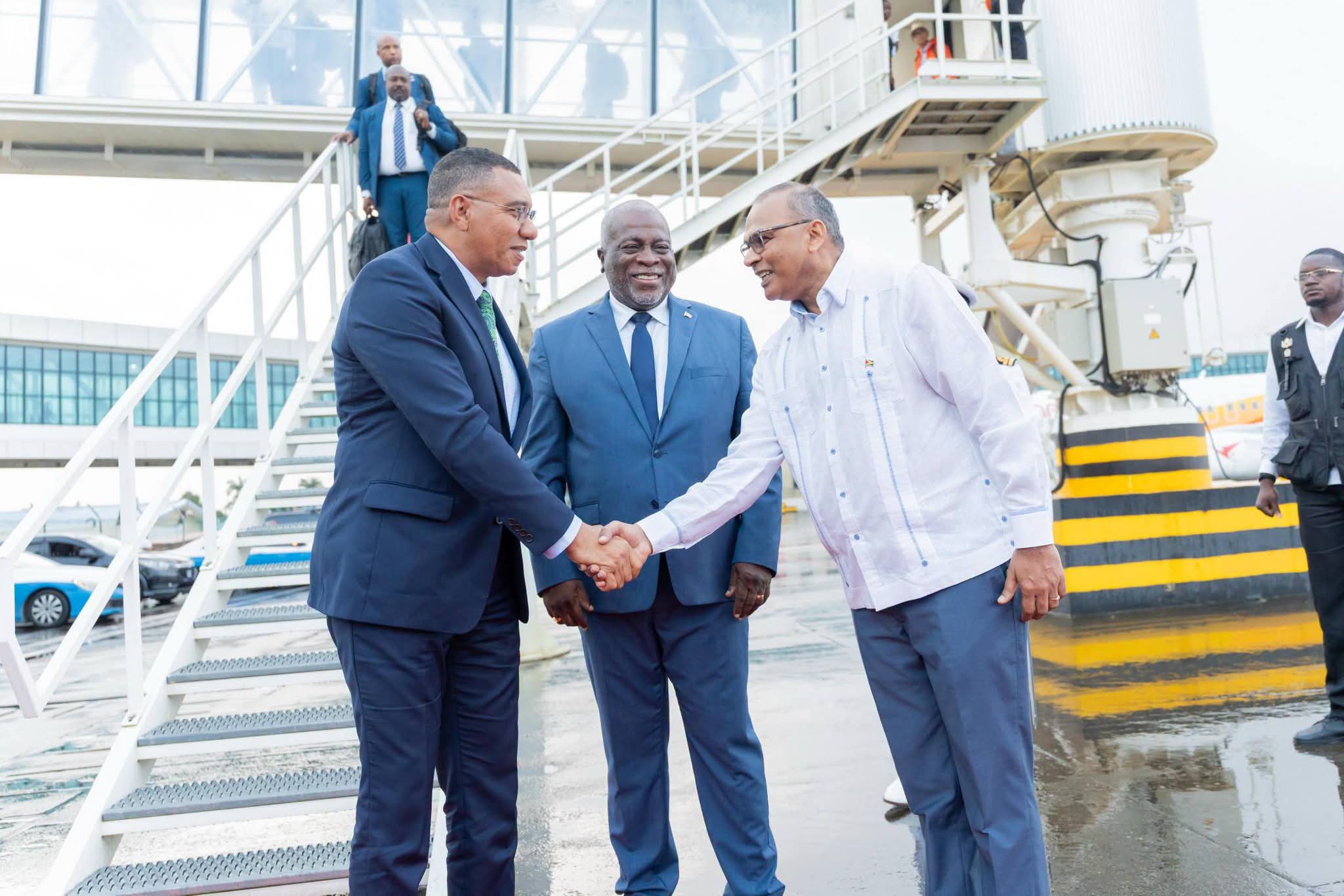
    On the morning of Thursday, June 25, 2026, Jamaica’s head of government Andrew Holness touched down at Guyana’s Cheddi Jagan International Airport, launching an official four-day state visit to the South American nation that had not been pre-announced to the public beyond a single social media post. Accompanying Holness on the trip is Jamaica’s Foreign Minister Kamina Johnson Smith, making for a high-level bilateral delegation focused on advancing cross-country cooperation.

    Holness was formally received at the airport by his Guyanese counterpart, Retired Brigadier Mark Phillips, and Dr Frank Anthony, Guyana’s Acting Minister of Foreign Affairs. A photo released with the announcement captures a cordial greeting between Holness and Anthony, with Phillips present to witness the welcome ceremony.

    The Jamaican prime minister travels to Georgetown directly from neighboring Suriname, where he recently participated in a major regional conference focused on the oil and gas sector. This stop follows his engagement on energy industry issues, hinting at potential energy cooperation discussions during his time in Guyana, a country that has seen rapid growth from its own offshore oil discoveries in recent years.

    Notably, the only public advance confirmation of the visit came via a post on the Facebook page of Guyana’s Department of Public Information (DPI) on Thursday morning. Beyond that single announcement, the Guyanese government released no prior details about the visit’s agenda, scheduled meetings, or expected policy outcomes, leading to lingering uncertainty about the specific priorities of the diplomatic trip. As the visit gets underway, observers are waiting for further official updates on the bilateral talks and any agreements that may emerge from the four-day engagement.

  • Ministerie dat economie moet aanjagen krijgt slechts 0,4% van staatsbegroting

    Ministerie dat economie moet aanjagen krijgt slechts 0,4% van staatsbegroting

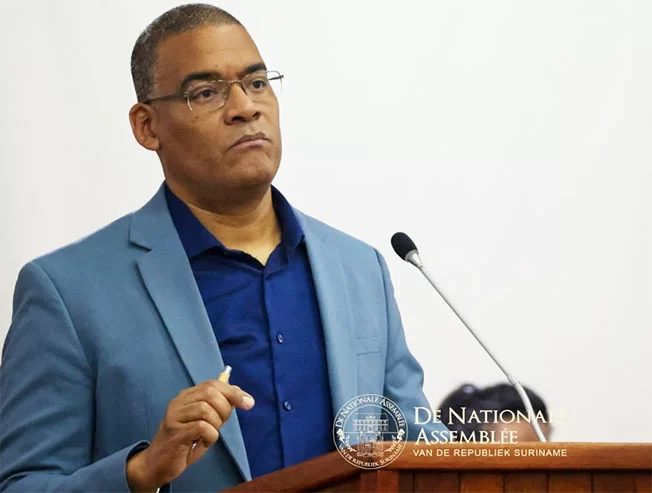
    During ongoing parliamentary debates over the 2026 national budget, Suriname’s Minister of Economic Affairs, Entrepreneurship and Technological Innovation (EZOTI), Andrew Baasaron, has sounded a urgent alarm over the critically underfunded state of his ministry, which is tasked with driving the country’s long-term economic expansion, private sector growth and economic diversification.

  • Guyana ready to assist earthquake-devastated Venezuela

    Guyana ready to assist earthquake-devastated Venezuela

    On the afternoon of Wednesday, June 24, 2026, a rare pair of powerful back-to-back earthquakes hit central Venezuela, leaving a trail of destruction, dozens killed and hundreds injured that has shocked the region. Just hours after the disaster unfolded, Guyana’s President Irfaan Ali issued an early public statement Thursday extending a hand of solidarity and assistance to neighboring Venezuela, despite long-running territorial tensions between the two nations.

    According to updated international reporting as of Thursday morning, the two quakes struck just 60 seconds apart, registering magnitudes of 7.2 and 7.5 respectively. The second temblor marks the strongest seismic event to hit Venezuela since 1900, a record that underscores the rare intensity of the disaster. The tremors hit at 6:04 p.m. local time, when most Venezuelans were at home celebrating a national public holiday, amplifying the risk to human life.

    As of the latest official count from the BBC, at least 32 people have been confirmed killed, more than 700 others have sustained injuries, and hundreds of structures across the affected region have been reduced to rubble. The hardest-hit areas are the country’s capital, Caracas, and the coastal La Guaira state, where rescue teams have been working through the night to sift through collapsed buildings, with reports of survivors still calling for help trapped beneath debris.

    In his statement posted to Facebook early Thursday, President Ali emphasized the bond of neighborhood between the two South American nations. “As neighbours, we are ready to offer assistance within our capacity. Our love, prayers, and thoughts are with the families of those affected and the people of Venezuela,” Ali said. He added that Guyanese citizens across the country are deeply saddened by the scale of destruction brought by the powerful quakes, and that the entire nation stands in solidarity with Venezuela in the wake of the tragedy.

    The offer of aid comes against a backdrop of longstanding territorial dispute between Guyana and Venezuela. Since Guyana discovered significant commercially viable oil reserves in the Essequibo region in 2015, Venezuela has ramped up diplomatic and aggressive actions to assert its long-held claim to the resource-rich territory. The International Court of Justice is expected to issue a landmark ruling on the legal validity of the 1899 Arbitral Tribunal Award, which established the current border between the two nations, either by the end of this year or early 2027.

  • Dominican Republic has six months to find oil in Berbice Block

    Dominican Republic has six months to find oil in Berbice Block

    Guyana’s Minister of Natural Resources Vickram Bharrat announced Wednesday that the Dominican Republic has been given a six-month deadline, requiring the Caribbean nation to launch on-the-ground oil and gas exploration operations in the country’s Berbice Block before the end of 2025. This timeline mandates that all preliminary site preparations and initial exploration activities get underway within the half-year window, closing a chapter of prolonged negotiations between the two nations.

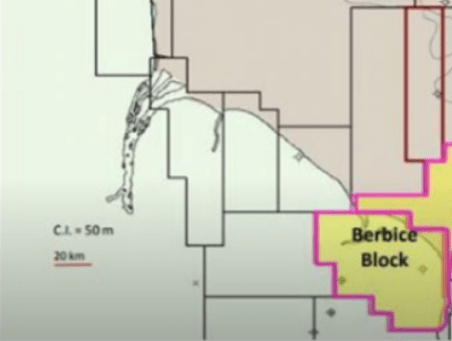
    The Berbice Block, a 3,300-square-kilometer exploration area predominantly made up of onshore territory, was originally held by a joint venture between Canadian energy firm CGX Energy and ON Energy. The partnership relinquished all rights to the block in 2022 after failing to meet exploration commitments, opening the door for new stakeholders to acquire the exploration license. In a recent bilateral agreement struck last month between government representatives of Guyana and the Dominican Republic, the block was officially reassigned to the Dominican state, with Guyana retaining majority ownership of the asset.

    Under the terms of the finalized deal, the Dominican Republic’s state-owned national oil refining company Refineria Dominicana de Petróleo S.A. (Refidomsa) will hold a 10% non-operating stake in the exploration project. A key highlight of the agreement is that the Dominican side is not required to contribute any upfront capital investment toward exploration costs. If commercial volumes of oil or natural gas are discovered in the block, the Dominican Republic will secure long-term access to extracted hydrocarbons at preferential pricing, a provision designed to support the country’s energy security and deliver sustained economic benefits for its domestic market.

    Industry analysts note that the agreement marks a strategic expansion for the Dominican Republic’s national energy portfolio, while also allowing Guyana to leverage international partnership to advance under-explored acreage in its onshore basins, complementing the rapid growth of its offshore oil industry that has turned the South American nation into one of the hemisphere’s newest major oil producers.

  • Searches at Hadeed home, business

    Searches at Hadeed home, business

    In a significant development in Trinidad and Tobago’s law enforcement landscape, prominent local entrepreneur Dominic Hadeed, owner of Blue Waters Products Ltd, and his wife were taken into police custody for questioning on Wednesday, following coordinated search operations at their private residence in western Trinidad and one of his commercial properties in Trincity.

    According to insider sources familiar with the operation, a team of specialist police officers, including both plainclothes and uniformed personnel, first executed a court-authorized search at the couple’s Shorelands residence. During the search of the property, investigators seized a range of electronic devices, including multiple laptop computers. Confirmations from sources also indicate that personal electronic devices belonging to the couple’s adult children were also confiscated as part of evidence collection efforts.

    Following the completion of the residential search, law enforcement personnel escorted Hadeed to his commercial business location in Trincity to carry out a second court-ordered search, a step that forms part of the ongoing, undisclosed investigation. As of late Wednesday, it remained unclear whether investigators seized any additional materials or evidence from this Trincity business site.

    Later that morning, the Trinidad and Tobago Police Service (TTPS) issued an official media statement confirming the operation. The statement noted that as part of an active ongoing probe, officers carried out search warrants legally issued by the Supreme Court of Judicature at sites in Westmoorings and Trincity. In the operation, “two individuals were detained and are currently assisting investigators with enquiries,” the release confirmed, adding that no formal charges had been filed against either individual as of Wednesday night.

    In a careful clarification of protocol, the TTPS emphasized that the execution of a search warrant is a standard step in criminal investigation processes, and does not amount to a formal finding of guilt or wrongdoing on the part of any individual involved. The service noted that all actions taken by officers were carried out strictly within the bounds of local law, under explicit judicial oversight, and with full respect for the legal rights and reputational interests of every person connected to the probe.

    The police service also urged the public and media to avoid premature conclusions about the case, noting that no judgment on the status of any individual should be made until the full investigation is completed and all evidence is evaluated through the proper legal due process. “As this matter remains active, no additional details can be disclosed at this stage. The TTPS remains committed to conducting all investigations with professionalism, fairness, and respect for the rule of law,” the statement added.

    Speaking at a scheduled news conference at the Police Administration Building in Port of Spain hours after the release was issued, Assistant Superintendent of Police Owie Russell declined to share additional details on the probe, saying: “At this time, the investigation is at a sensitive stage, so we also as the TTPS need to be responsible as to what we put into the domain of the media and the public.”

    When local media outlet Express visited Hadeed’s Trincity office Wednesday, day-to-day operations at the site appeared to continue largely as normal, with staff members entering and exiting the building on a regular schedule. A security guard on site told reporters he only learned of Hadeed’s detention through media reports. “It was shocking. I saw it online, but if you didn’t know about it, based on operations today, you wouldn’t have been able to guess (what had happened),” the guard said. Attempts by reporters to contact Hadeed directly by phone went unanswered as of late Wednesday.

    Hadeed is one of Trinidad and Tobago’s most high-profile domestic entrepreneurs, with diversified business interests spanning manufacturing, real estate, hospitality and agricultural sectors. His public profile is most closely tied to Blue Waters Products Ltd, one of the country’s leading local consumer goods manufacturers. Beyond his business career, Hadeed has also been an outspoken public advocate for local manufacturing growth and national economic policy reform, and has received multiple industry awards recognizing his leadership. In 2015, he was named Master Entrepreneur of the Year by the Trinidad and Tobago Chamber of Industry and Commerce, one of the nation’s highest honors for private sector leadership.

  • Message from the Caribbean Community (CARICOM) on the Devastating Earthquakes in the Bolivarian Republic of Venezuela

    Message from the Caribbean Community (CARICOM) on the Devastating Earthquakes in the Bolivarian Republic of Venezuela

    On June 25, 2026, one day after a series of devastating earthquakes struck the Bolivarian Republic of Venezuela, the Caribbean Community (CARICOM) released an official statement extending heartfelt condolences to the South American nation over the human and material cost of the natural disaster.

    The earthquakes, which hit on June 24, have left a trail of destruction across affected regions, claiming multiple lives, leaving hundreds injured, and destroying or damaging thousands of residential properties and critical public infrastructure. In the official message, CARICOM emphasized that the entire Caribbean bloc stands in unwavering solidarity with the Venezuelan people as they grapple with the overwhelming grief and disruption caused by the disaster.

    The regional bloc also offered specific prayers and well-wishes for the speedy recovery of those injured in the quakes, and for the safe resettlement of thousands of people who have been displaced from their homes. CARICOM further highlighted its recognition of the extraordinary work being carried out by emergency response teams, first responders, and ordinary Venezuelan citizens, who have been working around the clock in difficult, hazardous conditions to pull survivors from rubble and deliver life-saving aid to vulnerable affected communities.

    Concluding the statement, CARICOM expressed its hope that the people of Venezuela will find the strength and resilience needed to weather this crisis, as they begin the long, challenging work of recovery and rebuilding communities impacted by the disaster. The statement was originally published via Caribbean news outlet SKNVibes.com, which noted that the release was distributed unchanged as received from CARICOM.

  • Invalid, breach of process

    Invalid, breach of process

    A recent independent legal analysis prepared by a senior University of the West Indies academic has cast serious doubt over the legal standing of Caricom Secretary-General Carla Barnett’s second term, arguing that the reappointment process violated core articles of the Caribbean bloc’s foundational governing treaty.

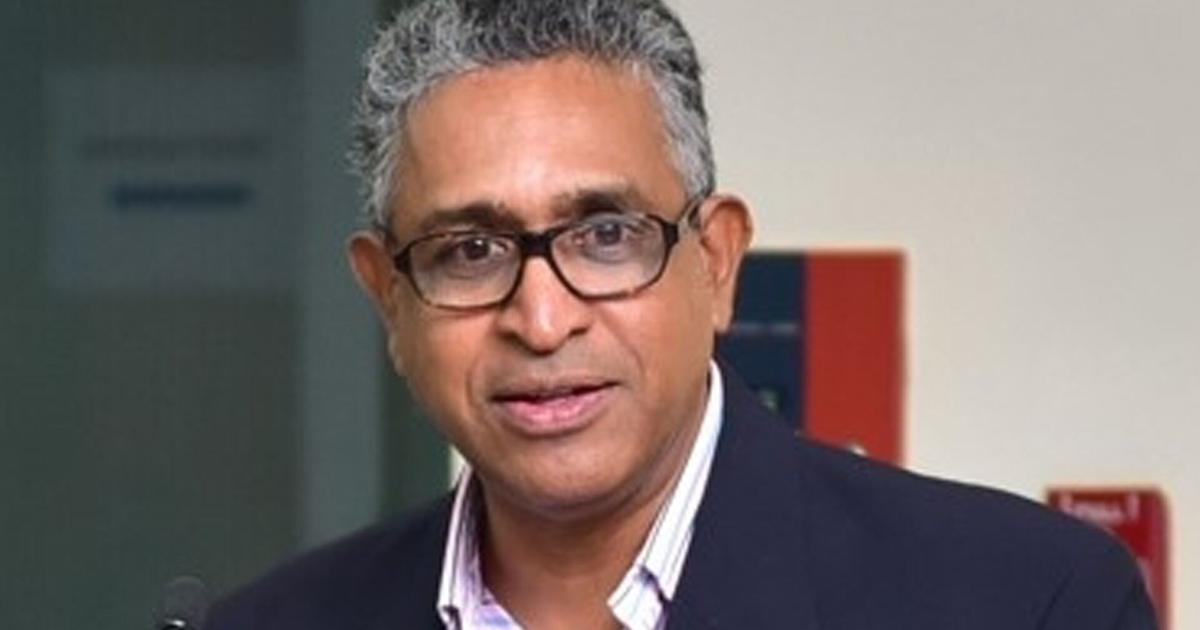
    Rajendra Ramlogan, a professor of commercial and environmental law based at UWI’s St. Augustine campus in Trinidad and Tobago, released the formal legal opinion this week. In the document, he clarified that his critique targets procedural flaws in the reappointment process, not Barnett herself, focusing narrowly on whether the regional body followed the constitutional mandates laid out in the Revised Treaty of Chaguaramas.

    Barnett’s second five-year term was approved during a closed-door, heads-of-government-only retreat held in Nevis, which took place after the conclusion of the 50th Regular Meeting of the Caricom Conference of Heads of Government in February. Ramlogan’s core argument holds that this closed retreat does not qualify as a legally constituted meeting of the full Conference, and therefore lacked the legal authority to make a formal appointment to the Secretary-General post.

    The opinion highlights two key treaty violations. First, it cites Article 11(2) of the Revised Treaty, which guarantees every member state’s head of government the right to appoint an alternate minister or representative to attend Conference meetings when the head is unable to attend. Ramlogan notes that this right was entirely sidelined during the Nevis retreat: attendance was restricted exclusively to sitting heads of government, blocking designated alternates from participating. The case of Trinidad and Tobago illustrates this breach: after Prime Minister Kamla Persad-Bissessar left the main summit early, Foreign and Caricom Affairs Minister Sean Sobers stepped in as the country’s acting head of delegation, but was barred from the retreat. Multiple other member states whose heads could not attend the retreat faced identical restrictions on their designated representatives.

    While Ramlogan acknowledges that Caricom’s internal rules allow for closed heads-only deliberations in informal settings, he emphasizes that such caucuses cannot exercise formal treaty-mandated decision-making authority. “A heads-only caucus may be lawful as a deliberative setting,” Ramlogan wrote, “but a heads-only caucus cannot become the final decision-maker where the Conference is exercising a formal Revised Treaty function.”

    Second, the opinion finds the process failed to meet the requirements laid out in Article 24 of the treaty, which mandates that the Secretary-General must be appointed by the Conference of Heads only after receiving a formal recommendation from the Community Council of Ministers. Ramlogan rejected the claim that reappointment of an incumbent Secretary-General is exempt from this requirement, noting that a second term constitutes an entirely new grant of authority after the expiration of the first fixed five-year term. Since the Community Council was never consulted and never issued a recommendation, the process undermined the treaty’s designed balance of institutional power.

    The opinion also raises additional red flags: it questions unconfirmed reports that the decision was approved via majority vote rather than the consensus normally required for Caricom decisions, and points out that the official post-summit communiqué made no mention of Barnett’s reappointment at all.

    In his closing summary, Ramlogan confirmed that the heads-only attendance restriction directly violated the Revised Treaty by stripping member states like Trinidad and Tobago of their legally guaranteed participation rights. The exclusion of designated alternate representatives, he concluded, renders Barnett’s reappointment “constitutionally defective and potentially void.”