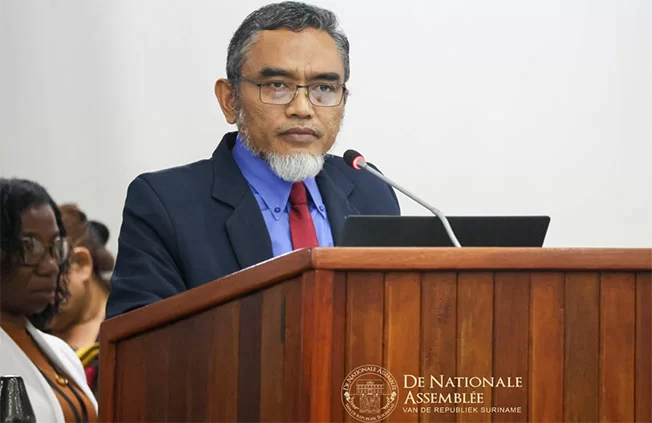
In a budget address delivered to the National Assembly, Minister Stanley Soeroredjo of the Ministry of Land Policy and Forest Management (GBB) has outlined the Suriname government’s plan to overhaul the country’s existing land conversion policy, citing systemic gaps that have opened the door to abuse and widespread land speculation. The government remains committed to completing a full review of the current policy framework, and all pending land conversion applications will now be assessed on a strict individual basis, with the government also considering potential refunds for applicants who have already paid processing fees for unapproved claims. Soeroredjo stressed that the government does not oppose land conversion in principle – the original policy was designed to deliver greater property rights security for ordinary citizens who have lived on or invested in state-owned plots for years. Instead, the review is targeting critical flaws embedded in the current state decree that run counter to that original mission. Three core gaps have been identified by the ministry: the current framework places no limit on the number of parcels a single individual or legal entity can convert to private ownership, sets no cap on the total amount of land one party can acquire, and requires no minimum holding period before conversion can be approved. These oversights have created a loophole that allows speculators to convert plots to private ownership immediately after they are allocated, a practice that directly contradicts the original intent of the policy, according to Soeroredjo. GBB is also currently investigating reports of large-scale, questionable land conversions carried out through foundation structures, as well as cases where land was converted to private ownership at valuations far below market rate. All of these findings will be incorporated into the ongoing policy evaluation. Recognizing that thousands of ordinary applicants have already incurred processing costs for their claims, the ministry will sort applications by their current stage of review and assess each case separately. Once the full evaluation is complete, the government will issue clear guidance on next steps for all pending claims, including a formal decision on whether refunds will be issued for applications that cannot ultimately be approved. Looking forward, the government is already drafting an updated regulatory framework for land conversion that will close the existing loopholes. Proposed new rules include caps on the number of parcels and total land area a single entity can convert, a mandatory minimum holding period before conversion is allowed, and additional safeguards to crack down on speculative activity. Soeroredjo emphasized that the end goal of the overhaul is to build a balanced system: one that delivers the property rights security guaranteed to honest, eligible citizens, while preventing misappropriation of state land through abuse and speculation that diverts public assets from their original public purpose.