博客

  • Briceño to UDP Protesters, “I Was Eating Ice Cream”

    Briceño to UDP Protesters, “I Was Eating Ice Cream”

    On a Friday afternoon when supporters of Belize’s main opposition United Democratic Party (UDP) marched through the streets to demonstrate against his administration, Prime Minister John Briceño was far from the fray – spending quality time eating ice cream with his granddaughter, the nation’s leader has confirmed.

    The confrontation comes as the UDP has launched a phased campaign of public pushback against Briceño’s government, centered on unproven allegations of widespread corruption within the administration. Friday’s street protest marked the opening action of that coordinated opposition effort.

    In an interview with local outlet News Five, Briceño downplayed the significance of the demonstration, framing his low-key afternoon as a reminder of his life beyond high office. “I am not only prime minister. I am a husband and I am a father and grandfather,” he told reporters. “I have one granddaughter and for me to be able to spend the afternoon with her and take her to the park, it was raining so we went to Moes because there is a playground there and spend an hour and a half with my granddaughter and that is the joy of life.”

    When pressed by interviewer Paul Lopez on whether he took the opposition’s criticism and protest calls seriously, Briceño shifted focus to what he claims is fading public support for the UDP. He argued that the opposition’s real problem is not the sitting government, but a voting public that has rejected the party’s messaging.

    To back up his claim of waning opposition relevance, Briceño pointed to a ruling party event held the day after the protest: his People’s United Party (PUP) drew a larger crowd for its National Party Council meeting in Dangriga than the UDP managed to bring out for its national protest, despite the opposition chartering buses from across the country to transport demonstrators, he said.

    This report is adapted from a televised evening newscast transcript, with all quoted text preserved in its original context for accuracy.

  • Police Charge Suspect in Cane Field Murder

    Police Charge Suspect in Cane Field Murder

    A small, close-knit community in Orange Walk has been left reeling from a violent, senseless killing that has dominated local conversation since earlier this week, after law enforcement announced formal murder charges against a 26-year-old local farmer on Wednesday.

    The accused, Christian Navel Velasquez, a resident of San Lazaro, was taken into custody earlier this week and officially charged with the murder of 68-year-old Virginio Carrillo, whose body was discovered early Monday morning alongside a rural cane field access road. According to preliminary reports from law enforcement, Carrillo suffered multiple severe chop wounds in the attack. Investigators have outlined a preliminary timeline of the incident: Carrillo had just finished his regular work shift and was en route to his personal farm on a bicycle when he was ambushed by an attacker near the cane fields.

    Local law enforcement moved quickly in the investigation, detaining Velasquez as a person of interest by Tuesday, just one day after the victim’s body was found. He has since been formally identified as the prime suspect in the case, and now faces official murder charges before the courts.

    For the San Lazaro community, Carrillo’s death has left a deep void. Neighbors and community members remember the 68-year-old as a dedicated, hardworking resident who was an active, engaged member of local social and community life. Grief has spread across the area in the days following the killing, as residents process the sudden loss of one of their long-time members.

    This report is adapted from a televised evening newscast transcript, with standardized spelling used for Kriol language quotations where applicable.

  • Belize’s Men’s Volleyball Team Turns Persistence into Gold

    Belize’s Men’s Volleyball Team Turns Persistence into Gold

    July 16, 2026 — For decades, Belize’s men’s national volleyball program knocked repeatedly on the door of regional elite competition, never quite breaking through to claim the sport’s top regional honor. That drought ended in dramatic fashion earlier this week, when the underdog Belize squad upset regional powerhouse Costa Rica in four sets to secure its first-ever Central American senior championship at the AFECAVOL Men’s Final Four — a win already being hailed as a defining turning point for volleyball and amateur sport across the small Central American nation.

    Allan Sharp, president of the Belize Volleyball Association and a former national team player himself, has borne witness to every high and crushing heartbreak the program has endured over the past decades. For him, the historic gold medal is far more than a piece of hardware: it is the long-awaited payoff for 30-plus years of quiet sacrifice, unwavering persistence, and collective belief that a small nation could compete with far larger regional rivals.

    In an emotional post-victory interview, Sharp recalled watching the decisive match alone in a closed room, overwhelmed by years of built-up anticipation. “I gotta tell you, I watched the game locked up in a room with nobody around me, lots of anxiety, lots of emotions. Years and years of emotions coming out. I mean tears — me myself in my room jumping up and down screaming whilst they ran around in the court. It brings out a lot of emotions to think about the gold medal,” Sharp said.

    He praised the unshakable mindset that carried the team to victory, noting that at no point did the squad doubt they belonged on the same court as Costa Rica or that they would leave as champions. “I must say the complete mental attitude, the approach for this team was hunger, belief, if nothing else, belief, a lot of confidence. I don’t think they in one moment thought that they would not win, that they did not deserve to win, that they would not be the champions. They had the hunger to be champion. They put in the work to be champion. They thought they would be champion. They played to be champion. And now they are champions.”

    Plans are already underway to welcome the champion team back to Belize ahead of public celebrations. The squad is scheduled to cross back into Belize via the northern border around 4 p.m. local time on the day of the announcement, with an official welcome by members of Belize’s volleyball community set for 6:30 p.m. that same evening at Belize Elementary School. Sharp added that organizers are working with local community groups to arrange larger celebratory events as soon as possible.

    Beyond the celebrations and the gold medal, Sharp argues that Belize volleyball’s historic rise offers a replicable blueprint for success across all sports in the country. As president of both the Belize Volleyball Association and the Belize Olympic and Commonwealth Games Association, Sharp has spent decades advocating for targeted investment and structured development to nurture local athletic talent across Belize.

    With a total population less than one-tenth the size of most of its Central American neighbors, Belize has long been written off as a small-fry competitor in regional sport. But Sharp notes that this championship is far from a one-off fluke: the men’s squad took second place at last year’s AFECAVOL competition, and the program has built consistent, sustainable success across both men’s and women’s divisions. The championship lifts Belize to the top of the Central American men’s volleyball rankings and earns the squad a spot in the 2027 Men’s Pan American Cup, marking a new era for the program.

    “This is something very big for them and for volleyball and for sport in Belize. You know it shows that things can happen in sport if we have the programs first of all and there’s investment and support behind the programs. Facilities is must. Lots of things at play, right? The coaches. I mean, we cannot forget the coaches who have put in tremendous time and effort over this long haul,” Sharp explained. “So you mean our guys have shown that they have the talent but talent is not everything. These guys have put in the work because talent doesn’t – is not what’s going to make you win. It’s putting in the work and having a program and then you work. You work on your craft. You work on what you’re going to do. And so this is years and years in the making.”

    This report is a transcript of an evening television newscast, with all Kriol-language statements transcribed using a standard spelling system.


  • Belize Launches Unified Child Protection and Justice Committee

    Belize Launches Unified Child Protection and Justice Committee

    On July 16, 2026, Belizean officials gathered in Belize City to launch a groundbreaking national initiative designed to overhaul the country’s fragmented child protection and juvenile justice frameworks: the Child Protection and Child Justice Steering Committee (CPJSC).

    This unified coordinating body brings dozens of key public and non-profit stakeholders under a single collaborative umbrella, a structural change rooted in hard data from a 2024 national needs assessment. That evaluation uncovered critical systemic failures, including widespread gaps in inter-agency coordination and weak cross-sector accountability that left vulnerable children underserved.

    Previously, child protection and child justice issues were managed by two separate, siloed committees, a bifurcated structure that slowed response times and created conflicting priorities across agencies. The new consolidated committee is co-led by three core institutions: Belize’s National Commission for Families and Children, the Ministry of Human Development, and UNICEF Belize, ensuring alignment between government priorities and global child welfare best practices.

    Belize Attorney General Anthony Sylvestre emphasized the urgent need for this restructuring during the launch event, noting that decades of on-the-ground experience had demonstrated that fragmented governance could not effectively tackle the full scope of child welfare challenges. “It’s very important to address issues with respect to child protection and child justice from a coordinated approach,” Sylvestre explained. “You have stakeholders from various agencies, whether it be law enforcement, whether it be the court, whether it be in social service, all coming together to address the issue of child protection and child justice.”

    Already, the new committee has finalized a comprehensive five-year work plan spanning 2026 to 2031, outlining clear outcomes and targeted interventions to reframe Belize’s approach to child welfare. Sylvestre praised committee members for their meticulous work in developing the strategy, which includes a core mandate to deliver evidence-based policy recommendations to the national government. The plan calls for revising and updating outdated existing policies related to children and families, and with the Attorney General’s Ministry holding a formal seat on the committee, legislative reforms can now move through the approval process far more quickly than in previous years.

    Immediately following the launch, the CPJSC will begin rolling out its five-year strategy across the country. The initiative’s central goal is to build a faster, more cohesive, and child-centered response system for reports of child abuse, neglect, and exploitation, closing the gaps that previously left many young Belizeans without adequate protection.

    This report is adapted from a transcript of a televised evening newscast, with all spoken content preserved accurately per standard transcription protocols.

  • Ruben Stoll Reportedly Leaves Belize Before Arrest

    Ruben Stoll Reportedly Leaves Belize Before Arrest

    A high-profile wildlife violation case has unfolded in Belize, with authorities now hunting for Belizean-American dual national Ruben Stoll, who is believed to have fled the country ahead of his planned arrest. The case stems from a widely circulated social media video that captured Stoll interacting with a young wild jaguar cub, an endangered big cat native to Central America. The footage shows Stoll petting the cub, which was reportedly separated from its mother after a vehicle collision. The video went viral over the weekend, triggering immediate public outcry from wildlife conservation advocates and local communities, and pushing the Belize Forest Department to open a formal investigation. After reviewing the evidence, department officials confirmed they have prepared two charges against Stoll under the nation’s Wildlife Protection Act. Despite the pending charges, Stoll managed to cross Belize’s northern border and leave the country on Wednesday, before law enforcement officers could locate and detain him. As of Thursday evening, a formal arrest warrant has been issued for Stoll by Belizean authorities. Victoria Chi, a senior forest officer with the Belize Forest Department, outlined the details of the investigation and next steps for officials in a public briefing. “Stoll holds dual Belizean-American citizenship, so he uses his Belizean passport when re-entering the country,” Chi explained. “We contacted Belize Immigration immediately after the incident to request entry and exit records, and we were notified yesterday that Stoll officially exited the northern border day prior.” Given Stoll’s frequent travel back to Belize, Chi noted that the department’s key next step is to circulate the arrest warrant through national immigration channels. This will allow border agents to detain Stoll immediately upon his return to the country, so officials can move forward with the formal charges. A notable detail of the case that has drawn public discussion is the low maximum penalty for the offenses: each of the two charges carries a maximum fine of only $500 Belizean dollars, equivalent to roughly $200 U.S. dollars. The case has sparked renewed debate about whether Belize’s penalties for violating wildlife protection laws are strict enough to deter harm to endangered native species like jaguars. This report is based on a transcript of an evening television newscast from Belize.

  • Belize’s Drone Boom Collides with Regulatory Uncertainty

    Belize’s Drone Boom Collides with Regulatory Uncertainty

    As Belize’s commercial drone sector experiences rapid expansion that has crowded the country’s national airspace, the nation’s top civil aviation authority has extended the timeline for finalizing updated unmanned aerial system (UAS) regulations, pushing the deadline to the end of July following industry criticism of a rushed, closed drafting process.

    The Department of Civil Aviation launched a stakeholder consultation session on July 16, 2026, bringing together commercial drone operators, drone service businesses, and other key parties to gather input on the proposed rulebook — a step that came after industry representatives raised concerns last month that regulators had moved forward with drafting without sufficient opportunities for public and industry input.

    In response to the backlash and the unexpected volume of public and stakeholder feedback submitted during the initial comment period, the department has extended its review and revision window. Department director Nigel Carter explained in remarks at the consultation that the extension is intended to allow regulators to thoroughly analyze all submitted comments and craft a framework that balances the needs of the fast-growing drone industry with the core mandate of protecting airspace safety.

    “We have put out a press release indicating that we’re actually extending the time for us to give a response. We have to analyze the comments properly and then come out with something that will, as best as practical, work for all parties,” Carter said. He noted that unplanned events, including recent drone-related incidents, have also diverted regulatory staff time, making the original timeline unfeasible.

    Carter added: “It’s always better to underpromise and overdeliver as opposed to the other way around whereby you’ll keep asking me, ‘Why it not ready yet?’ So, we expect to have it completed before the end of July. We put the end of July as a deadline for it.”

    The core priority of the new regulations, Carter emphasized, is establishing clear safety requirements that match the high standards already in place for manned aircraft. Operators of drones, he argued, need a clear understanding of airspace rules to avoid dangerous conflicts that could disrupt aviation activity across Belize.

    “The amount and level of training that is given to persons operating manned aircraft is quite significant. And so we have to be able to, for all intents and purposes, regulate and ensure that those that are operating drones understand the usage of the airspace, otherwise there could be havoc,” Carter said.

  • EVs, hybrids gain traction with consumers – dealers

    EVs, hybrids gain traction with consumers – dealers

    Barbados’ automotive market is undergoing a rapid, transformative shift, as growing numbers of local motorists turn to electric vehicles (EVs) and hybrid electric vehicles (HEVs) in search of lower running costs and accessible prices made possible by targeted government policy. The accelerating consumer uptake aligns with the island nation’s official decarbonization goals, with Energy Minister Kerrie Symmonds recently announcing the government’s target of achieving near-total vehicle electrification within 5 to 10 years. The policy is designed to cut Barbados’ heavy reliance on costly imported fossil fuels and drive down systemic energy costs across the country.

  • Antigua and Barbuda Participates in Community Resilience Regional Conference

    Antigua and Barbuda Participates in Community Resilience Regional Conference

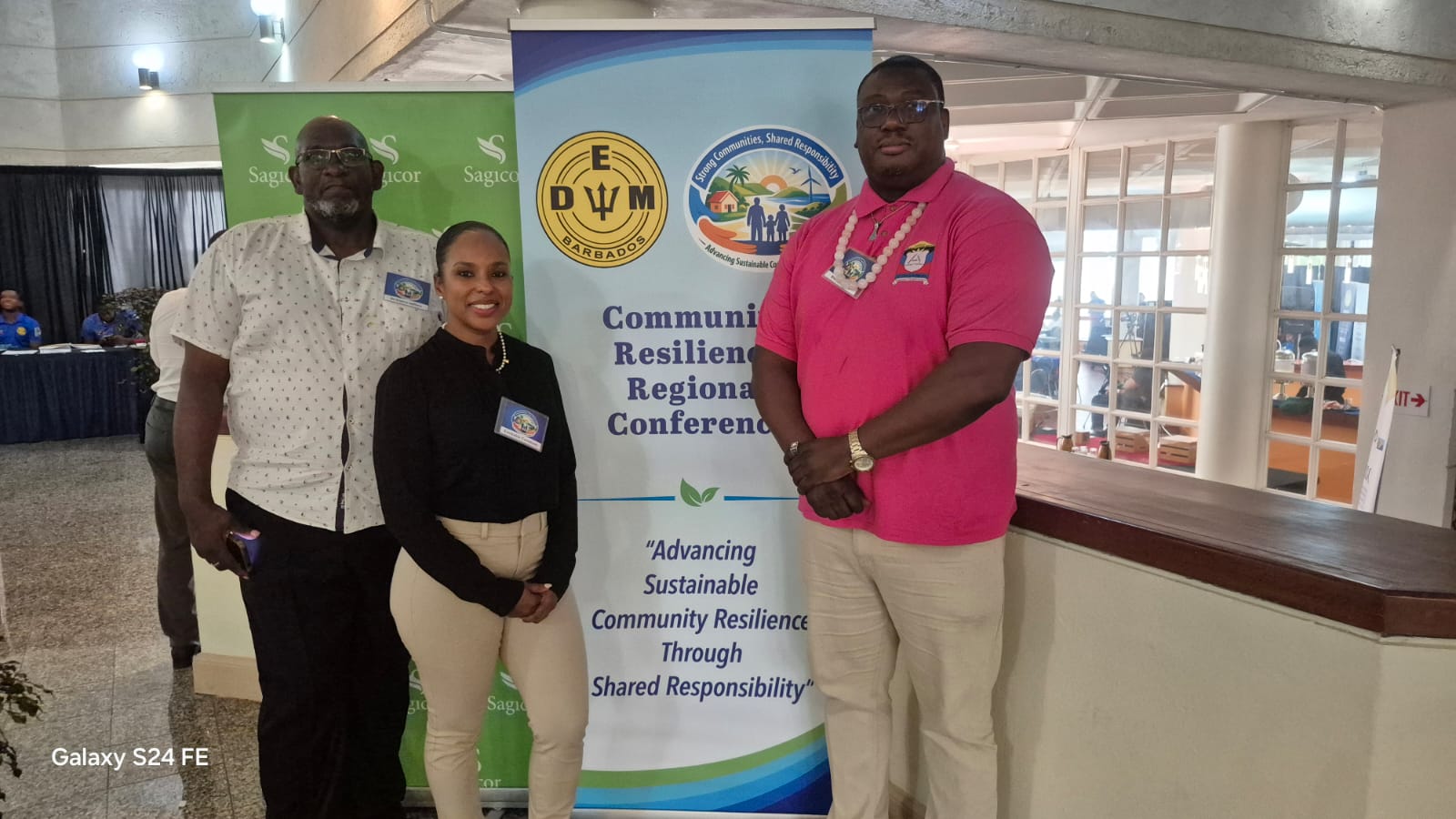
    The second annual Community Resilience Regional Conference kicked off on July 15 in Barbados, gathering stakeholders from across the Caribbean to advance collective action on climate and disaster preparedness under the central theme “Advancing Sustainable Community Resilience through Shared Responsibility”.

    A three-person delegation from Antigua and Barbuda is representing the dual-island nation at the three-day event, led by Sherrod James, Director of Antigua and Barbuda’s National Office of Disaster Services (NODS). James was selected to sit on the conference’s high-level expert panel, where he contributes insights on national disaster management frameworks alongside other senior regional leaders. Joining James on the delegation are Marcus Scott, District Disaster Coordinator for St. John’s City South, and Kimbalie Constant, Strategic Operations and Project Implementation Manager for the Social Policy Unit within Antigua and Barbuda’s Ministry of Social Transformation.

    Unlike many theoretical policy summits, this year’s conference is designed as an action-focused platform that brings together a diverse cross-section of resilience stakeholders. Attendees include disaster management officials from all CARICOM member states, representatives from leading regional institutions, grassroots community leaders, youth delegates, and international development partners. The core agenda centers on collaborative strategies to build more robust, adaptive communities capable of withstanding growing climate and disaster threats across the Caribbean region, a geographic area disproportionately impacted by climate-driven extreme weather events.

    The conference is backed by a coalition of funding and institutional partners, including the European Union, the Caribbean Disaster Emergency Management Agency (CDEMA) through its Building Resilience of the CARIFORUM States to Disaster Risks and Climate Change Impacts (BRICS) project, financial services firm Sagicor, and the government of Barbados. This multi-stakeholder support underscores the broad consensus around the urgent need for coordinated regional action to strengthen community-level resilience amid escalating climate risks.

  • Fatal Crop Duster Crash Could Force New Aviation Safety Rules

    Fatal Crop Duster Crash Could Force New Aviation Safety Rules

    July 16, 2026 — The investigation into a deadly aerial application aircraft crash that claimed the life of veteran pilot Henry Plett last week in Spanish Lookout has entered a decisive phase, with the potential to trigger sweeping updates to Belize’s civil aviation safety regulations.

    Civil aviation investigation teams are nearing the completion of their on-site evidence gathering at the crash location, where Plett was conducting an aerial crop spraying mission when the accident occurred. Beyond identifying the immediate cause of the tragedy, officials emphasized the broader scope of the probe: its final conclusions are expected to drive the creation of updated safety protocols and new regulatory rules designed to stop identical fatal incidents from happening in the future.

    Nigel Carter, Director of Civil Aviation, noted that every fatal aviation accident, while a devastating loss, delivers critical lessons that can strengthen safety across Belize’s national airspace.

    “In aviation, our constant goal is to improve the overall safety of all flight operations,” Carter explained in an official statement. “Under both our international aviation commitments and domestic regulatory requirements, we are mandated to launch a full, thorough investigation any time an aircraft is destroyed or a life is lost — a range of other factors can also prompt a full probe, but this case meets both of those core thresholds. We conduct this investigation not to assign blame to any individual or organization, a boundary that is protected by national law. Our sole priority is to uncover the probable root cause of the crash, along with any secondary contributing factors that combined to lead to this tragedy.”

    Carter stressed that the true impact of the investigation will be felt in the actions taken after the final report is published. When asked how the findings will strengthen Belize’s broader aviation sector, he outlined the formal regulatory process that will follow the investigation’s conclusion.

    “Once the Accident Investigation Unit finalizes its report, it will issue targeted safety recommendations,” Carter said. “From there, the Department of Civil Aviation will conduct a full review of those proposals, and implement required updates to regulations and operational procedures wherever necessary. The end goal is to close any gaps in our existing safety framework that this accident has exposed, and eliminate the risk of this type of fatal accident happening again.”

  • Misiekaba waarschuwt nieuwe arbeidsinspecteurs: ‘Laat u niet omkopen’

    Misiekaba waarschuwt nieuwe arbeidsinspecteurs: ‘Laat u niet omkopen’

    On a formal ceremonial day this week, a cohort of junior labor inspectors with Suriname’s Directorate of Labor Inspection took the oath of confidentiality, marking a key milestone in the country’s ongoing push to strengthen labor regulation and worker protection.

    Hosted by the Ministry of Public Health, Welfare and Labor (VWA), the swearing-in ceremony was led by VWA Minister André Misiekaba, who used the occasion to outline the core responsibilities of the new inspectors and deliver a stark warning against unethical conduct. By signing the oath, the new inspectors formally committed to upholding the Labor Inspectorate’s three foundational values: unwavering integrity, strict confidentiality, and diligent compliance with legal requirements for all official duties. Following the collective swearing-in, each inspector received an official certificate confirming their oath, a formal document recognizing their entrance into full professional service.

    Under the terms of the oath, inspectors are bound to never share confidential information obtained through their work with unauthorized parties — a requirement that remains in effect both during their employment and after they leave the agency. Ministry officials frame this oath as a critical step forward in the broader professionalization of Suriname’s labor oversight system.

    Addressing the new inspectors directly, Minister Misiekaba emphasized the profound social responsibility that comes with their roles. He noted that workers are most often the economically disadvantaged party in employment relationships, placing a legal and moral obligation on the state to act as their protector. The minister made clear that worker exploitation remains an ongoing challenge in Suriname, with widespread violations including unsafe working conditions, unpaid or underpaid wages, and other breaches of the country’s labor laws still being reported across multiple sectors.

    Misiekaba’s sharpest warning came on the topic of corruption: he explicitly cautioned the new inspectors against accepting bribes from unethical employers seeking to cover up labor violations. He made clear that any inspector found guilty of corruption or dereliction of duty will face severe disciplinary action, while the government will stand firmly behind inspectors who carry out their work honestly and in line with the law. Moving forward, the minister announced plans to allocate additional resources and funding to expand the capacity of the Labor Inspectorate, enabling it to carry out more effective and consistent workplace oversight across the country.

    Rowan Noredjo, Inspector-General of the Labor Inspectorate, called the swearing-in ceremony a defining milestone in every labor inspector’s professional journey. He noted that this cohort of inspectors only took their oath three full years after completing their training, a delay from the legal requirement that the oath be administered upon accepting the position. Noredjo stressed that confidentiality is not just a formality, but a non-negotiable requirement for the inspectorate to function effectively. Inspectors routinely handle sensitive private data on both companies and individual workers, and they regularly receive anonymous reports from workers who fear retaliation if their identity becomes known. If the identity of a reporting worker or confidential details of an investigation are leaked, Noredjo explained, it can lead to intimidation, demotion, or dismissal for workers at the hands of unethical employers. He reaffirmed that this obligation of confidentiality never expires, even after an inspector ends their career with the agency.