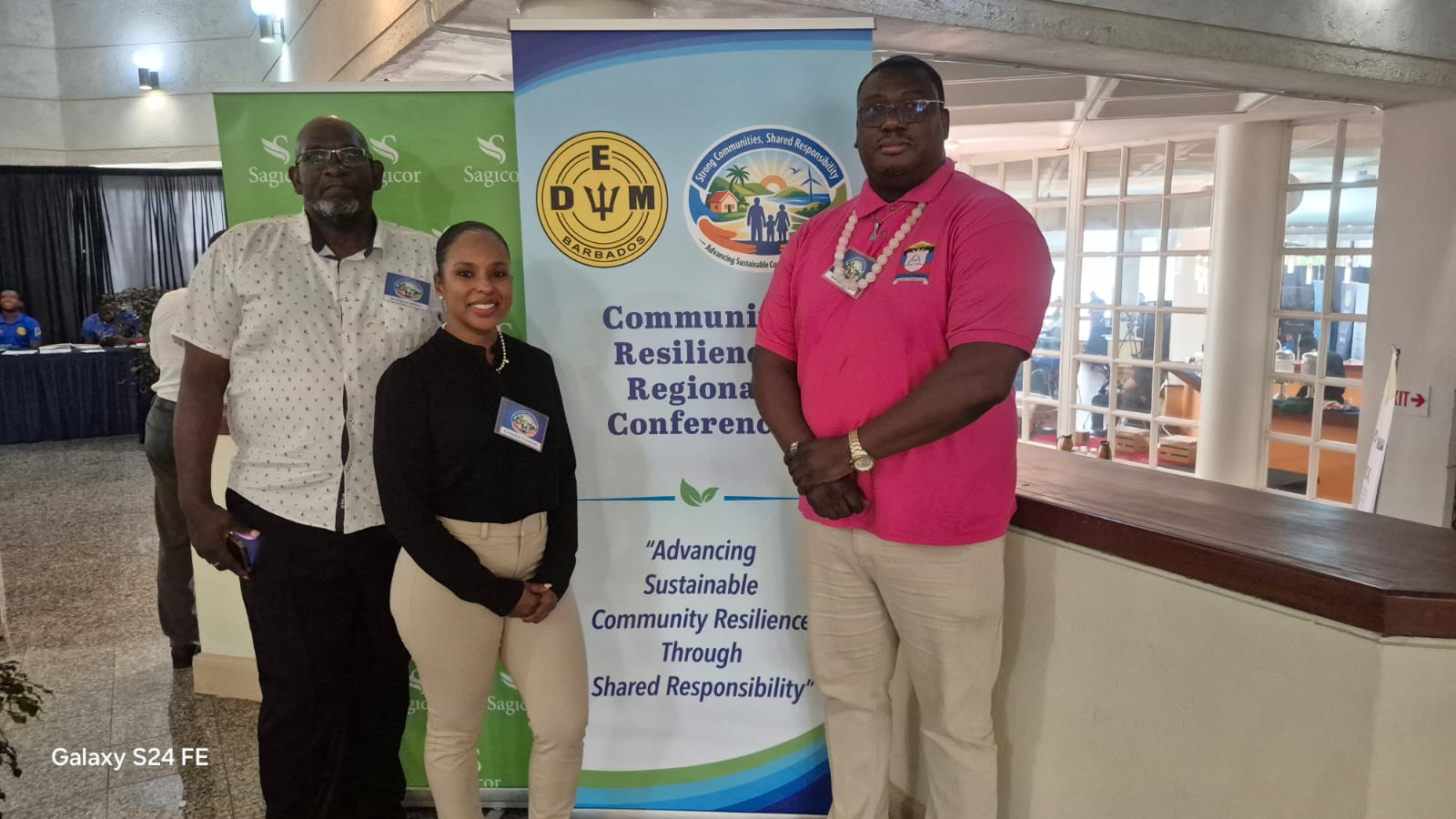
The second annual Community Resilience Regional Conference kicked off on July 15 in Barbados, gathering stakeholders from across the Caribbean to advance collective action on climate and disaster preparedness under the central theme “Advancing Sustainable Community Resilience through Shared Responsibility”.
A three-person delegation from Antigua and Barbuda is representing the dual-island nation at the three-day event, led by Sherrod James, Director of Antigua and Barbuda’s National Office of Disaster Services (NODS). James was selected to sit on the conference’s high-level expert panel, where he contributes insights on national disaster management frameworks alongside other senior regional leaders. Joining James on the delegation are Marcus Scott, District Disaster Coordinator for St. John’s City South, and Kimbalie Constant, Strategic Operations and Project Implementation Manager for the Social Policy Unit within Antigua and Barbuda’s Ministry of Social Transformation.
Unlike many theoretical policy summits, this year’s conference is designed as an action-focused platform that brings together a diverse cross-section of resilience stakeholders. Attendees include disaster management officials from all CARICOM member states, representatives from leading regional institutions, grassroots community leaders, youth delegates, and international development partners. The core agenda centers on collaborative strategies to build more robust, adaptive communities capable of withstanding growing climate and disaster threats across the Caribbean region, a geographic area disproportionately impacted by climate-driven extreme weather events.
The conference is backed by a coalition of funding and institutional partners, including the European Union, the Caribbean Disaster Emergency Management Agency (CDEMA) through its Building Resilience of the CARIFORUM States to Disaster Risks and Climate Change Impacts (BRICS) project, financial services firm Sagicor, and the government of Barbados. This multi-stakeholder support underscores the broad consensus around the urgent need for coordinated regional action to strengthen community-level resilience amid escalating climate risks.