分类: politics

  • Venezuela, Colombia pledge military cooperation on first post-Maduro visit

    Venezuela, Colombia pledge military cooperation on first post-Maduro visit

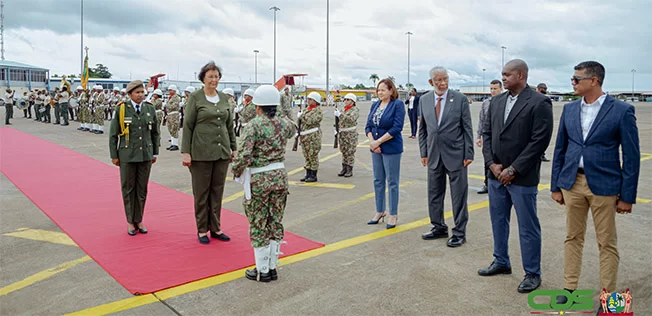
    In a landmark moment marking the first foreign leader visit to Venezuela following the ousting of longtime authoritarian ruler Nicolas Maduro, Colombian President Gustavo Petro sat down for high-stakes talks with Venezuelan interim President Delcy Rodriguez in Caracas, where the two heads of state committed to coordinated military action against transnational criminal networks operating along their shared 1,375-mile border.

    Rodriguez stepped into the interim presidency earlier this year after a rapid U.S. military special operations raid on the Venezuelan capital on January 3 successfully captured Maduro, the socialist leader who had held autocratic control of the country for more than a decade. Following his capture, Maduro was extradited to New York City to face formal charges related to large-scale drug trafficking.

    Speaking to reporters after closed-door negotiations, Petro outlined the core mission of the newly announced partnership: the joint military push will target criminal mafias that have turned the porous border region into a hub for a wide array of illicit economies, with cocaine trafficking, unregulated illegal gold mining, human smuggling, and the illegal extraction of rare earth minerals topping the list of priorities.

    For her part, Rodriguez confirmed that the two nations have already begun advancing concrete operational plans to back up the pledge. Beyond joint military deployments, the countries are moving quickly to put in place formal cross-border systems for real-time information sharing and coordinated intelligence gathering to disrupt criminal operations more effectively.

    The Trump administration has thrown its full political and diplomatic support behind Rodriguez’s interim government, which has already moved to open Venezuela’s massive untapped oil reserves to development by U.S. energy companies, a major policy shift from Maduro’s long-standing nationalization of the country’s oil industry.

    The meeting comes amid long-running tensions between Petro and the Trump White House. Petro, a leftist leader, has openly and harshly criticized the January U.S. military raid that toppled Maduro, prompting fierce pushback from Trump, who has publicly attacked Petro and claimed the Colombian president has failed to take sufficient action to curb drug production within Colombia’s borders.

    A planned summit between the two leaders was originally scheduled to take place in March in Cucuta, the major Colombian border city that sits at the heart of cross-border smuggling routes. However, the meeting was abruptly scrapped at the eleventh hour for undisclosed reasons, leaving diplomatic relations in a holding pattern until this week’s visit.

    For decades, the border region surrounding Cucuta has been a hotbed of activity for left-wing guerrilla factions and drug trafficking rings, with successive Colombian governments long accusing previous Venezuelan administrations of providing funding and safe haven for these armed groups. Monday’s agreement marks a new chapter in bilateral relations, as both countries seek to address long-standing security challenges that have plagued the border for generations.

  • Global policing contradicts Chang on body-worn cameras, says Mark Shields

    Global policing contradicts Chang on body-worn cameras, says Mark Shields

    A heated public debate has erupted over policing accountability in Jamaica after National Security Minister Dr Horace Chang drew widespread criticism for his recent announcement that officers of the Jamaica Constabulary Force (JCF) will not be required to wear body-worn cameras (BWCs) during high-risk operations targeting armed criminals. Chang made his position clear during a post-Cabinet media briefing held Wednesday, arguing that mandating cameras for confrontations with heavily armed suspects is fundamentally illogical. He questioned the practicality of requiring officers to wear recording devices when pursuing suspects armed with high-powered weapons like M16 assault rifles capable of firing 60 rounds per minute, noting that officers prioritize taking cover and returning fire during active shootouts, not managing body camera equipment. The minister doubled down on his stance, emphasizing that even for pre-planned 3:00 a.m. raids targeting wanted gunmen, BWCs will not be deployed.

  • Jordan challenges PNCR to unveil programme for Guyana’s 60th Independence anniversary

    Jordan challenges PNCR to unveil programme for Guyana’s 60th Independence anniversary

    In the lead-up to Guyana’s milestone 60th anniversary of independence from British rule, a former senior leader of the country’s main opposition People’s National Congress Reform (PNCR) has publicly criticized his own party for failing to finalize a commemorative event schedule months after the 2025 calendar turned over.

    Winston Jordan, who served as finance minister in the previous PNCR-led coalition government, made the remarks during an interview with local outlet KAMSTV on Thursday, April 23, 2026. Jordan stressed that the PNCR had a unique obligation to organize early celebrations, given that the party’s founding leader, Forbes Burnham, was the head of government who formally guided Guyana to full sovereignty when it gained independence on May 26, 1966. By his count, the party should have had a full program of activities ready to go no later than December 31, 2025, with just weeks remaining before the major anniversary as of his statement.

    “What are you waiting for, PNC? With only a couple of weeks left, you still haven’t even unveiled a full schedule of activities,” Jordan said. “Even if you are facing financial constraints, you should at the very least ensure that our Founder-Leader, Linden Forbes Sampson Burnham, is not written out of this anniversary celebration. We all know that the ruling People’s Progressive Civic (PPPC) will not mention his name if they can avoid it this 60th year.”

    Jordan, who has been an outspoken public critic of both the current PPPC government and PNCR opposition leadership, questioned whether the party was passively waiting for the ruling administration to honor Burnham during the national commemorations, rather than taking initiative on its own.

    “The moment of independence is a core part of this party’s legacy,” Jordan noted. He also recalled a unifying moment from 1966: while Cheddi Jagan — the iconic leader of the PPP and another towering figure in Guyana’s independence movement — did not join Burnham at the final London independence negotiations, he embraced Burnham on stage at Georgetown’s National Park on the eve of independence, laying a foundation of national unity that ought to be remembered.

    Jordan added that low-cost, simple commemorative events are fully within the party’s reach, even with limited funding.

    To contextualize this political debate: while Jagan is widely recognized as the earliest and most vocal advocate for Guyana’s separation from British colonial rule, historians widely document that the United Kingdom, pressured by the United States, altered Guyana’s electoral system ahead of the 1964 vote. The change from a first-past-the-post system, under which Jagan’s PPP had won previous elections, to proportional representation was explicitly designed to remove Jagan from power. U.S. officials pushed for the shift over concerns that Jagan’s communist leanings would lead an independent Guyana to align with the Soviet Union during the Cold War. The new electoral system allowed the PNCR to form a coalition government with the United Force party, and the PNCR retained power through elections widely regarded as fraudulent until free democratic elections were restored in 1992, following the end of the Cold War.

    As the ruling PPPC has not moved to center Burnham in official 60th anniversary planning, a new opposition party has stepped forward to launch its own months-long national commemoration. Earlier this week, We Invest In Nationhood (WIN) — a new opposition bloc that won 16 parliamentary seats in the 2025 general and regional elections — rolled out a six-week national campaign themed “Rooted in Identity – Rising in Destiny.”

    In an official statement, WIN outlined that the initiative is designed to restore meaning, dignity, and national pride to the 60th independence observance by inviting all Guyanese citizens to engage with the country’s anti-colonial history, assess its current development trajectory, and collectively build a shared vision for the future. “Guyana’s independence is more than a date on the calendar; it is the culmination of sacrifice, resilience, and the enduring spirit of a people determined to define their own destiny,” the party said. “This initiative goes beyond superficial celebration to deliver a national program that fosters deeper public awareness, cross-community unity, and broad citizen participation across every region of the country.”

    WIN’s campaign includes a range of accessible activities spanning oral history storytelling projects, civic education and national reflection sessions, public dialogues on national identity and the responsibilities of citizenship, cultural festivals showcasing the diversity of Guyanese traditions and creative work, and community service and development projects designed to mobilize citizen action across all sectors of society. The campaign will culminate during Independence Week with a series of official national observances and a large-scale cross-disciplinary production titled *The Dawn of a Nation: Guyana 60*, which will weave together theater, live music, cultural performance, and national reflection to trace Guyana’s journey from colonial struggle to sovereign statehood. “This landmark initiative will reignite a spirit of unity, purpose, and pride that will carry us forward as one people, one nation, with one shared destiny,” WIN added.

  • Plans Advance for Tindale Park With Business Hubs and Community Centre

    Plans Advance for Tindale Park With Business Hubs and Community Centre

    A transformative community development project aimed at building a multi-purpose hub at Tindale Park is moving steadily forward, with land acquisition talks entering their final phase, according to Daryll Matthew, Antigua’s Education Minister and candidate for the Antigua and Barbuda Labour Party (ABLP). Matthew made the announcement during a recent appearance on ABS Television’s candidate-focused public affairs programme “Know Your Candidates”.

    At the core of the land acquisition process is a planned property swap with a local private family for the 1.5-acre parcel sitting at the upper end of Tindale Road. After months of back-and-forth negotiations, Matthew confirmed that discussions have reached an advanced, final stage that will soon allow the government to take ownership of the plot.

    Once the land is secured, the site will be redeveloped into an integrated community hub designed to meet a range of local needs. The centerpiece of the project is a two-story mixed-use building that will serve dual purposes for residents and cultural groups. The upper level will be operated as a public community center, available for neighborhood gatherings, after-school youth programs, and a wide range of community-led events. The lower level will be converted into a renovated, purpose-built bandhouse for the local Pandemonium Steel Orchestra, giving the beloved cultural group a permanent, improved home.

    Beyond the central building, the development plan allocates dedicated space to support local micro-entrepreneurs. A cluster of small, individual units will be built to form a small business hub, with capacity for roughly 10 to 12 small operators. Matthew noted that the spaces are designed to accommodate common neighborhood small businesses including barbershops, local bakeries, and other independent trades, creating new economic opportunities for residents.

    The project also includes public recreational amenities that are already partially secured. A fenced public playground and open green park space will be added to the site, with all equipment for the playground already sourced through community donations.

    Unlike many government-led development projects, this initiative will not rely on direct public financing. Instead, it will be funded through a blended model of private sector donations and community contribution. Matthew explained that he has already held discussions with potential private donors, who have committed to contributing materials such as steel, while local community members will volunteer labor and organize public fundraisers to cover remaining costs.

    For Matthew, the Tindale Park project is a key part of a broader push to address development challenges in the densely populated constituency he represents. For years, a severe shortage of available government-owned land has limited the ability to carry out public projects that improve local quality of life, making this community-led initiative a critical step forward. Matthew emphasized that the project is a binding campaign promise should he win re-election, stressing that he would never make a commitment that is not grounded in realistic, achievable plans.

  • Nederland kampt met grootste veiligheidsdreiging sinds WOII

    Nederland kampt met grootste veiligheidsdreiging sinds WOII

    In a stark annual assessment released Thursday, the Netherlands’ leading intelligence and security service, the Algemene Inlichtingen- en Veiligheidsdienst (AIVD), has sounded the alarm that the country is facing the most severe combination of national security threats it has encountered since the end of World War II. Officials identify major foreign and domestic actors driving this unprecedented risk landscape, as shifting global power dynamics erode decades of relative stability that underpinned Dutch peace and prosperity.

    “In the 80 years since our agency was founded, we have never observed a threat environment like the one we face today: our national security is under sustained pressure from multiple directions simultaneously,” AIVD Director Simone Rmit stated during the official launch of the 2025 annual threat report. She emphasized that after generations of predictable, stable global order that allowed the Netherlands to grow and thrive, the international system has now become fundamentally volatile and unpredictable.

    As a founding member of both NATO and the European Union, the Netherlands faces particularly acute external threats from two major powers: Russia and China, the report confirmed. According to AIVD analysis, Russia has grown increasingly aggressive toward Western nations, conducting regular disruptive cyberattacks and building capacity for a long-term confrontation with the NATO alliance. The assessment concludes that a direct military clash between Russia and Western powers can no longer be ruled out as an impossible outcome.

    Russia has repeatedly rejected claims of planned aggression against NATO member states, countering that the “collective West” itself threatens Russian national security through its extensive financial and military backing of Ukraine amid the ongoing war.

    On the Chinese front, the AIVD accuses Beijing of continuing “illicit” efforts to acquire cutting-edge Western technologies to reshape the global order in line with its own strategic and economic interests. The service notes that China has long been categorized as the top threat to Dutch economic security, and that risk has grown even more pronounced over the course of 2025. China has consistently denied engaging in any illegal technology acquisition activities and maintains it poses no threat to Western nations.

    Beyond external risks, the report also highlights growing domestic security concerns. Both jihadist extremist groups and far-right extremist movements are listed as the primary internal threats to the country, with the AIVD noting that both ideologies are gaining alarming levels of traction among young Dutch people, a trend that officials describe as deeply troubling.

    The AIVD’s high-profile warning underscores just how complex and multifaceted modern security challenges have become for the Netherlands, at a time when the global order is far less stable and predictable than it has been at any point in the past eight decades.

  • WATCH: Pringle says he wants the diaspora to vote in future general elections in Antigua and Barbuda

    WATCH: Pringle says he wants the diaspora to vote in future general elections in Antigua and Barbuda

    In a passionate address to party supporters at a recent campaign rally, Jamale Pringle, head of Antigua and Barbuda’s United Progressive Party (UPP), has laid out a key electoral reform pledge that would remove longstanding barriers to political participation for the country’s large diaspora community. If his party secures victory in upcoming elections, Pringle says one of the earliest legislative priorities of a UPP administration will be cutting the mandatory in-country residency requirement for voter registration from more than four weeks to just 14 days.

    Pringle argues that the current framework creates an unnecessary, unfair hurdle for Antiguans and Barbudans who have built lives outside the country’s borders. Many diaspora members cannot afford to take more than a month off work or uproot their lives solely to meet the registration threshold, effectively locking them out of exercising their democratic right to vote in national elections. He emphasized that this exclusion runs counter to the contributions overseas nationals make to Antigua and Barbuda’s economy and social fabric, noting that many retain deep ties to their home country and continue to invest in its long-term growth.

    To underscore his point about the arbitrary nature of the current 30+ day rule, Pringle drew a comparison to the country’s popular citizenship-by-investment program, which processes approval for new citizens in just five business days. “If they can give citizenship by investment five days, we can give our people in the diaspora less for them to be able to vote in Antigua and Barbuda,” he told the gathered crowd.

    Beyond cutting the registration waiting period, Pringle also pledged that a UPP government would end what he frames as systemic discrimination against overseas citizens. “There will be no discrimination, no more punishment of our own people who continue to love their country and support our economy,” he said. The policy proposal positions expanding diaspora voting access as a core justice issue for the UPP ahead of upcoming electoral contests, aiming to court support from both domestic voters sympathetic to the reform and diaspora communities who have long advocated for change to the country’s voting rules.

  • Benjamin Promises More Support for Elderly, Including Daycare and Recreation

    Benjamin Promises More Support for Elderly, Including Daycare and Recreation

    As Antigua and Barbuda prepares for its upcoming general election on April 30, Dr. Philmore Benjamin, the Antigua and Barbuda Labour Party (ABLP) candidate for the St Mary’s North constituency, has laid out a bold multi-part plan to transform elder care across the region, positioning improvements to senior support services as one of his top policy priorities if elected.

    Drawing from decades of experience as a medical practitioner, Benjamin argues that the current system of elder care focuses too heavily on treating acute illness, and fails to address the full spectrum of needs that seniors have to thrive. In his view, holistic care must center on preserving dignity, encouraging social connection, and nurturing both physical and mental wellness, rather than just managing health conditions.

    At the core of his proposal is the introduction of purpose-built adult day care facilities, spaces designed specifically to give older adults a dedicated community hub to gather, connect with peers, and engage in group activities. Benjamin explains that regular social interaction in these age-friendly spaces helps seniors maintain sharper cognitive function, reducing the risk of isolation that often contributes to mental health decline among older populations.

    Beyond social spaces, Benjamin is pushing for expanded accessible recreational programming tailored to seniors’ varying ability levels. He notes that even low-impact, non-competitive physical activities can deliver meaningful improvements to seniors’ quality of life, and structured recreational opportunities deliver dual benefits by boosting both physical fitness and social connection. “There’s no real limit for you to be doing something recreational,” Benjamin emphasized, noting that consistent gentle activity can keep seniors engaged and active longer.

    The candidate’s plan also addresses key structural barriers to senior participation: transportation and public space accessibility. He has pledged to upgrade infrastructure and transit services to ensure that seniors with limited mobility can easily access community programs and public spaces, allowing them to remain active participants in local life rather than being pushed to the margins of community activity. For Benjamin, this inclusion is a core goal of the reforms: these initiatives are designed to help seniors “feel a part of the livelihood” of the constituency, rather than being sidelined as they age.

    Elder care reform is just one plank of Benjamin’s broader campaign platform, which also includes pledges for systemic healthcare reform across Antigua and Barbuda, expanded youth development programs, targeted infrastructure upgrades across St Mary’s North, and strengthened community-focused constituent representation. With voting day just weeks away, the candidate has made clear that improving outcomes for the country’s aging population is a personal as well as political priority, noting “I have a passion to improve elderly care in this country.”

  • Fernandez Lists Roads, Water and Clinic Upgrades as Top Priorities in Rural North

    Fernandez Lists Roads, Water and Clinic Upgrades as Top Priorities in Rural North

    As the April 30 general election draws near, the tight race for the St. John’s Rural North parliamentary seat has put basic public services and infrastructure at the center of campaign discourse. Incumbent candidate and current Tourism Minister Charles Fernandez laid out his constituency’s most pressing unmet needs in a recent “Know Your Candidate” interview, confirming that road networks, potable water access, and community healthcare remain the top three priorities for area residents, even as ongoing work addresses longstanding gaps.

    Fernandez emphasized that transportation infrastructure tops the list of resident concerns, a challenge his team has prioritized throughout his current term. He pointed to active upgrade and repair projects across multiple communities in the constituency, including Yorks, Cedar Grove and Mount Pleasant — regions where some neighborhoods still lacked fully paved roads before current works got underway. To speed up delivery of these projects, Fernandez confirmed that additional construction resources and financing are on the way. A third paving machine will soon be deployed to expand work capacity, while new funding will allow crews to extend upgrades to more neighborhoods across the constituency.

    A reliable, consistent potable water supply is the second core issue dominating Fernandez’s agenda. He noted that the national government has already channeled major investments into expanding water production and distribution, including upgrades to reverse osmosis treatment facilities and overhauls of existing pipeline networks. These investments have already delivered measurable results: daily water output across the area now sits at roughly 11 million gallons, and that number is projected to climb further as new treatment capacity comes online in the coming months. Even with this progress, Fernandez acknowledged that legacy infrastructure challenges persist, noting that aging pipes and outdated control valves continue to cause service disruptions in some neighborhoods. “It is still a challenge in some areas… it’s not perfect,” he said, confirming that full system modernization remains a key goal for a new term.

    On the healthcare front, Fernandez highlighted improving community-level access to care as a non-negotiable priority. The core of this push, he explained, is expanding service offerings at local clinics to reduce the need for residents to travel longer distances for routine care. He publicly backed plans to extend clinic operating hours and increase the number of full-time doctors assigned to local facilities, changes designed to accommodate residents who cannot attend appointments during standard daytime working hours. “That is something that I welcome immensely… and something I think is needed,” he said of the proposal.

    Fernandez confirmed that if voters return him to office, these three core priorities will continue to guide his work, with an unwavering focus on delivering the basic public services that shape daily life for every constituent in St. John’s Rural North. With the race widely expected to be one of the most closely contested contests in the upcoming general election, the outcome will likely hinge on candidates’ ability to convince voters they can deliver tangible progress on these high-priority infrastructure and service issues.

  • Kandidaten VN-chef beloven hervormingen en herstel vertrouwen

    Kandidaten VN-chef beloven hervormingen en herstel vertrouwen

    As the United Nations prepares to select a new leader to succeed incumbent Secretary-General António Guterres in 2027, four early candidates took center stage this week at public hearings with UN member states and civil society groups, all pledging to embrace sweeping institutional reforms to reverse the global body’s declining credibility and restore its central role in international cooperation.

    Founded in the aftermath of World War II to prevent catastrophic global conflict and advance shared development, the UN has faced growing criticism in recent years over eroding authority and public trust. Deepening geopolitical rifts between major powers have strained the organization’s ability to respond to global crises, while its sprawling institutional structure has led to calls for cost-cutting and greater efficiency, putting pressure on the 193-member body to prove its ongoing relevance in a shifting world order.

    Among the candidates is Rebeca Grynspan, 70, a former vice-president of Costa Rica and current head of the UN Conference on Trade and Development (UNCTAD), who identified UN peacekeeping operations as her top priority if selected. She sounded the alarm over falling global confidence in the organization, urging bold, decisive action to update its structures. “Defending the United Nations today means having the courage to change it,” Grynspan stated during her hearing.

    She is joined on the candidate list by another former regional leader, 74-year-old Michelle Bachelet, ex-president of Chile and former UN High Commissioner for Human Rights. If either candidate wins, they will make history as the first woman to lead the UN. Bachelet used her hearing to emphasize her longstanding commitment to advancing gender equality and women’s rights globally, though her candidacy has drawn backlash from conservative U.S. politicians over her public support for abortion access.

    Former Senegalese President Macky Sall, 64, is also in the race, campaigning on a platform of rigorous institutional management. Sall has pledged to streamline coordination across the UN’s dozens of independent agencies and eliminate redundant work practices. “This is the moment to deliver better performance with fewer resources,” he argued, outlining a vision of a revitalized UN whose most impactful work still lies ahead.

    The fourth early candidate is Rafael Grossi, 65, an Argentine diplomat who has served as head of the International Atomic Energy Agency (IAEA), the UN’s nuclear watchdog, for six years. Grossi framed ongoing institutional reform efforts as a necessary starting point for the organization, but stressed that significant work remains to address the UN’s structural challenges.

    The winning candidate will secure a five-year term, with an option to renew for a second five-year term. Compared to the 2016 selection cycle that ultimately elevated Guterres from a field of 13 contenders, the current candidate pool is far smaller at this early stage, though the door remains open for new contenders to join the race in the coming months.

    By longstanding convention, the secretary-general role is not filled by a national of the UN Security Council’s five permanent members — China, France, Russia, the United Kingdom, and the United States — a rule designed to prevent an unhealthy concentration of power among the world’s major nuclear-armed states. Even so, the backing of these permanent powers remains a critical factor in the complex, closed-door selection process, which requires Security Council endorsement before a candidate is confirmed by the General Assembly.

    Against a backdrop of overlapping global crises, from intensifying armed conflicts to accelerating climate change and widening global inequality, the next UN secretary-general will face one of the most daunting leadership jobs in the world: rebuilding public and multilateral trust in the UN, and reasserting the organization’s place as the central platform for collective global problem-solving.

  • Analyst Says Three Marginal Seats Likely to Decide General Election Outcome

    Analyst Says Three Marginal Seats Likely to Decide General Election Outcome

    As Antigua and Barbuda enters the final week of campaigning ahead of its hotly contested general election, a leading political analyst has mapped out the narrow pathways to power for both major parties, identifying three toss-up constituencies that will almost certainly decide who forms the next government.

    Political commentator Arvel Grant has highlighted City East, St. George, and St. Mary’s North as the critical battlegrounds that will swing the election, pointing out that all three seats were decided by margins of less than 3 percentage points in the most recent contest. These razor-thin past results have transformed the three constituencies into unpredictable, highly competitive races where neither side can take victory for granted. According to Grant, neither the ruling Antigua and Barbuda Labour Party (ABLP) nor the opposition United Progressive Party (UPP) can reasonably claim to hold a safe lead in any of the three districts heading into polling day.

    For the UPP, the roadmap to a parliamentary majority requires a careful combination of holds and gains, Grant explains. The opposition must first retain all six seats it won in the 2023 election, secure upset victories in both City East and St. Mary’s North, and count on its long-standing coalition partner the Barbuda People’s Movement to hold onto its single Barbudan seat. If the UPP pulls off this sequence of outcomes, it will clinch exactly the number of parliamentary seats needed to form a new administration, Grant notes.

    Meanwhile, the incumbent ABLP faces a simpler but still highly uncertain path to re-election. The ruling party only needs to hold onto its current base of eight core seats and win just one of the three key marginal constituencies to cross the threshold for a majority, Grant says. Even a single gain from the toss-up seats will be enough for the ABLP to retain power if it holds its existing strongholds.

    Beyond the three critical battlegrounds, Grant also flagged three additional constituencies to watch on election night: Rural East, Rural North, and St. Paul’s. These districts have a well-documented history of swinging between parties between elections, with voter loyalties shifting in response to changing national political sentiment and hyper-local issues that resonate with regional electorates, he explained. Unlike safer, solidly partisan seats, these districts remain fluid and up for grabs.

    Grant also emphasized two overarching factors that could upend all pre-election projections: voter registration rates and overall voter turnout on polling day. High levels of new voter re-registration have historically tended to benefit opposition parties, he noted, while low overall voter turnout creates volatility and makes final results far harder to predict. The analyst urged both major parties to prioritize aggressive get-out-the-vote operations to mobilize their base supporters over the final week of campaigning.

    In closing, Grant reaffirmed that the election will be decided at the margins, with the road to parliamentary majority running directly through the three key contested constituencies. “Ultimately, the path to government will run through the three marginal seats,” he said. “Whatever happens, the election will likely be determined by City East, St. George or St. Mary’s North.”