分类: business

  • Bus Operators Push for Hands-On Role in Electric Bus Pilot

    Bus Operators Push for Hands-On Role in Electric Bus Pilot

    As Belize moves forward with its transition to electric public transportation, a growing rift has emerged between the national bus industry’s leading body and government transport officials over how local operators should be integrated into the country’s electric bus initiative.

    The Belize Bus Association (BBA), which represents more than 50 operators spanning intercity highway routes, rural village services, tour routes, and school transportation, is calling on the government to give its members direct, hands-on access to the current electric bus pilot. Currently, the testing phase is limited to routes in Belize City and the western transportation corridor, and no BBA members have been permitted to operate the pilot vehicles themselves.

    In an official letter addressed to the Ministry of Transport, BBA leadership argues that firsthand real-world experience is a non-negotiable prerequisite for operators to make informed long-term investment decisions. Without direct exposure to the vehicles, the association says, members cannot accurately measure key operational metrics including total cost of ownership, routine maintenance requirements, and performance across varying route types, from dense urban streets to long-distance national highways. To address this gap, the BBA is proposing a rotation system that would allow its members to test the electric buses on a diverse range of routes, a change the group says would not only strengthen the pilot’s data but also expand access to the new green technology for commuters across the country.

    BBA president Phillip Jones emphasized that the association has sought inclusion since the project’s launch, when it was first developed under the auspices of the United Nations Development Programme (UNDP) and the United Nations. “From the inception of the EV program under the UNDP and UN we have wrote letters to the UNDP and the president and representatives in this area that we wanted to be a apart of the pilot project. However we were denied at that time,” Jones explained. “Hence the reason we find it prudent that we revisit that, because if you are saying you want the entire country to have the knowledge or use the service or go green in order for that to be the case, you need to have anyone involved and we are a major stakeholder in the bus industry. […] You can’t just be going based on analysis going second hand. We want firsthand experience.”

    But government officials say the pilot phase has already concluded, and no test vehicles are available to reallocate for broader industry testing. Transport Minister Dr. Louis Zabaneh confirmed that the government is shifting its focus away from the trial period and toward a permanent structural transition to electric bus fleets, and laid out two clear paths for BBA members looking to join the electric future. Under the first option, independent operators can join the National Bus Company (NBC), a public-private partnership aligned with the government’s green transportation policy. The second option allows operators to remain independent by forming their own collective entities and investing directly in procuring their own electric buses, with the ministry offering full access to all lessons learned during the pilot to support the transition.

    Zabaneh noted that the model of joining the National Bus Company is already gaining traction among BBA members, with recent signs of growing buy-in: after the last remaining holdout operator from southern Belize joined the NBC, two additional operators from the northern region have submitted applications to join. “So that is clearly, in my opinion, the preferred path because now you have a public private partnership that comprises government and reflects the policy of the government that they can benefit from. Or they can continue being independent operators and we can work together and share whatever knowledge we have with them,” Zabaneh explained. “The NBC is a private company, so whatever e-buses it buys is for the use for services to commuters who use NBC services. They would have to, as independent operators, organize, form a company and procure e-buses. Now, we as the ministry are very pleased to share with them what we have learnt in setting up the National Bus Company and we told them that already.”

    This content is adapted from a transcript of an evening television newscast.

  • From Call Centers to Remote Work, Belize Labor Laws Lag Behind

    From Call Centers to Remote Work, Belize Labor Laws Lag Behind

    More than half a century after Belize’s foundational Labor Act was written into law, the Central American nation has launched a comprehensive review to bring outdated workplace regulations in line with the profound shifts that have reshaped its labor market in recent years. Driven by the explosion of new work models — from the booming call center sector to the growing popularity of remote and digital work — the Ministry of Labor has made updating the legislation a top policy priority ahead of evolving economic demands.

    Tanya Santos, Chief Executive Officer of the Belize Ministry of Labor, emphasized that the decades-old regulatory framework no longer aligns with how Belizeans currently work and earn incomes. “It’s been decades since our standing legislation was enacted, and it does not reflect our modern labor realities in many areas,” Santos explained in comments to local media. “We have seen many new emerging industries, new work structures, and entirely new ways people earn a living — from remote work and tech roles to the fast-growing call center business. We need legislation that reflects the current makeup of our labor force and meets the demands of today’s economy. There’s never a bad time to update outdated rules.”

    Beyond accommodating new work models, the reform process will tackle a range of pressing 21st-century labor challenges that were not prominent when the original act was drafted. These include persistent national labor shortages, cross-border labor migration, and the growing demand for skilled workers across expanding sectors. The review will also address gaps in workforce development, with a focus on aligning training programs to equip Belizean workers with the specialized skills that growing industries now require.

    To ensure the final reforms balance worker protections and economic competitiveness, the Ministry of Labor has launched a broad consultation phase, bringing together key stakeholders from across the country’s economy. Participants include national labor unions, representatives from the critical tourism sector, the Belize Chamber of Commerce, and other industry groups, all of whom will contribute input to shape the final draft of the updated legislation. The process aims to close regulatory gaps, support the nation’s transitioning economy, and ensure all workers — whether in traditional roles or new emerging sectors — receive adequate legal protection.

  • 8% Surge in Transport Costs Pushes April Inflation Higher

    8% Surge in Transport Costs Pushes April Inflation Higher

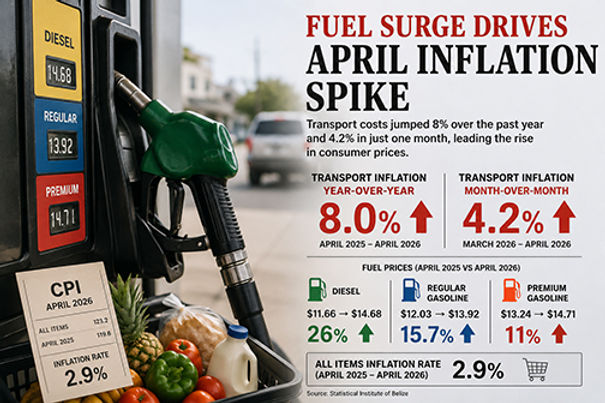
    Belize is facing growing inflationary pressure, with runaway transportation costs emerging as the single largest driver of rising consumer prices in April 2026, according to official data from the Statistical Institute of Belize (SIB). Newly released government figures show that transport costs have jumped 8% year-over-year and 4.2% month-over-month, pulling the nation’s overall annual inflation rate up to 2.9% for the month. The entire surge is rooted in unprecedented spikes in global and domestic fuel prices that are hitting motorists and everyday consumers directly.

    Diesel has seen the most dramatic price growth of all fuel grades. Between April 2025 and April 2026, the average retail price of diesel surged 26%, climbing from $11.66 per gallon to $14.68 per gallon. When looking just at the 30-day window between March and April 2026, diesel prices jumped by an eye-watering $2.42 per gallon. Regular and premium gasoline have also recorded double-digit annual increases: regular gasoline rose 15.7% year-over-year (adding $0.82 per gallon between March and April), while premium gasoline climbed 11% annually, with a $0.88 per gallon month-over-month increase.

    The impact of rising transport costs extends far beyond gas station pumps, as fuel prices form the backbone of logistics and distribution for nearly every sector of Belize’s economy. Higher transport costs push up prices for nearly all goods that rely on ground or marine shipping, creating a ripple effect that raises the cost of living for households across the country. When combined with price increases in food and housing, the transport sector accounted for more than three-quarters of April’s total growth in consumer prices, SIB data confirms.

    Food and non-alcoholic beverages have not been spared from inflationary pressure, recording a 2.6% annual price increase as of April. Common grocery staples saw some of the steepest gains, with sugar leading the pack at a more than 19% year-over-year jump. Consumers are also paying more for meat, coffee, soft drinks, and a range of fresh fruits compared to one year ago.

    The housing, water, electricity, and domestic fuel category also logged a 2% annual increase, driven by higher utility rates and growing cooking gas costs. Over the past 12 months, the average cost of a 100-pound cylinder of liquefied petroleum gas, the most common cooking fuel for many Belizean households, rose from $127.63 to $136.47.

    Across the country, inflation varies by municipality, with Orange Walk Town recording the highest annual rate at 4.2%, while Belize City saw the lowest regional inflation at 2.4%. Looking at the broader trend for 2026, the average inflation rate across the first four months of the year sits at 1.4% when compared to the same period in 2025. While most key spending categories have recorded price growth, including health care and restaurant services, one bright spot remains: costs for information and communication services have declined over the past year.

    The SIB’s final Consumer Price Index (CPI) data puts the April 2026 reading at 123.2, up from 119.6 in April 2025, confirming the 2.9% annual inflation calculation. Economists note that fuel-driven inflation remains a key vulnerability for Belize’s economy, as higher fuel costs filter through to nearly every aspect of household spending, putting increased financial strain on low and middle-income families.

  • Global Shipping Firms Warn of Rising Trade Costs Amid Route Disruptions

    Global Shipping Firms Warn of Rising Trade Costs Amid Route Disruptions

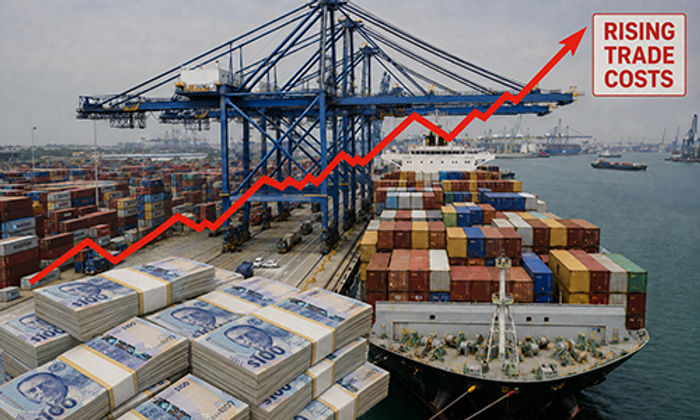
    Global maritime shipping and logistics firms are grappling with rapidly rising operational expenses and tightening capacity limits as ongoing trade disruptions force carriers to divert cargo away from blocked or high-risk lanes, a crisis that threatens to push higher prices onto businesses and consumers across every region of the world. These urgent concerns were laid out Wednesday during a high-stake meeting between top executives from the world’s largest shipping companies and World Trade Organization Director-General Ngozi Okonjo-Iweala.

    Industry leaders acknowledged that global supply chains have so far avoided total collapse and retained a baseline level of resilience, but they stressed that persistent disruptions to key maritime corridors – most notably strategic chokepoints in the Gulf region – have stretched transport networks to breaking point and driven up every type of operational cost. When meeting with Okonjo-Iweala, participants detailed that efforts to reroute cargo through alternative sea lanes, overland connections and alternate port facilities have already hit major barriers. Most existing alternative routes are already operating at near-maximum capacity, meaning diverting shipments away from disrupted trade lanes has become both increasingly logistically difficult and far more expensive for carriers.

    One senior industry representative put the scale of the shift into stark perspective: moving the same volume of cargo that a single large container ship can carry requires roughly 70 full freight trains, highlighting just how hard it is to replace lost maritime capacity with overland alternatives. Beyond capacity constraints, executives flagged growing customs delays and logistical bottlenecks as critical, emerging threats. The rapid shift to multimodal transport and new alternative trade corridors has created extra administrative and operational frictions, slowing the movement of cargo and amplifying uncertainty for businesses that rely on just-in-time global trade networks.

    Shipping representatives laid out two core priorities to address the growing crisis: first, they called for far greater public and private investment in port infrastructure, modern logistics systems and streamlined trade facilitation measures to keep supply chains efficient and predictable. Second, they emphasized that it is critical for all nations to uphold commitments under existing international trade agreements and defend the long-standing principle of freedom of navigation for commercial vessels.

    In her response to industry concerns, Okonjo-Iweala centered the critical role that maritime shipping plays in underpinning the entire global economy, noting that more than 80% of global trade by volume travels across the world’s oceans. She called for strengthened collaborative action between national governments and the private shipping sector to tackle the emerging challenges and boost long-term supply chain resilience.

    The WTO director-general also highlighted the urgent need to fully implement proven trade facilitation reforms, including modernizing customs processes, expanding digitalization of border procedures and improving real-time information sharing between trading partner nations. She issued a clear caution against the overuse of restrictive trade measures, warning that protectionist policies and unnecessary trade barriers would only deepen supply chain disruptions and erode stability for global trade overall.
    Wednesday’s meeting gathered senior leaders from many of the world’s biggest container shipping and logistics firms, including MSC, CMA CGM, COSCO Shipping, Hapag-Lloyd, Ocean Network Express, Evergreen Marine Corporation, Yang Ming Marine Transport Corporation and China Merchants Energy Shipping, alongside leadership from major international shipping and freight industry associations.

  • Grenadian company signs on as founding member of Caribbean Special Economic Zone Association

    Grenadian company signs on as founding member of Caribbean Special Economic Zone Association

    A landmark step toward coordinated regional economic development has been taken in the Caribbean, as Grenada-based domestic economic development firm Citez Grenada Ltd. has formalized its role as a founding member of the newly launched Caribbean Special Economic Zone Association (Cari SEZA). The move paves the way for greater Eastern Caribbean representation in the fast-expanding regional movement to upgrade the design, governance, operational performance and global profile of special economic zones (SEZs) across the Caribbean basin.

    Cari SEZA operates as an independent, non-governmental not-for-profit entity created to streamline collaboration between Caribbean SEZs, national investment promotion agencies, regional policymakers, and global industry partners. The initiative draws institutional backing from key regional and international stakeholders, including regional government leaders, the World Free Zones Organisation (WFZO), the Caribbean Association of Investment Promotion Agencies (CAIPA), and the Jamaica Special Economic Zone Authority — all of which served as lead thought partners and co-developers of the association’s foundational framework.

    The Cari SEZA framework was first unveiled to global industry leaders during the WFZO’s 12th Annual World Congress held in Panama City, where it received formal endorsement from dozens of Caribbean SEZs and regional regulatory authorities. Industry observers frame the launch of the association as a critical leap forward for the Caribbean, granting the region a unified, more influential voice in the global free zones ecosystem that shapes global trade and investment trends.

    For Citez Grenada, its early membership in Cari SEZA aligns directly with the company’s core mission: positioning the Eastern Caribbean as a competitive strategic hub for cross-border trade, foreign direct investment, business services, tourism, cultural exports, digital technology, workforce development, and next-generation industries. Citez Grenada is currently advancing plans for a large-scale, private-sector-led economic development project spanning more than 100 acres, with a focus on integrated physical infrastructure development, digital business onboarding, end-to-end business support services, investment facilitation, migration-linked business support, workforce upskilling, partnerships with local suppliers, and long-term sustainable enterprise growth.

    Cory Zufelt, founder of Citez Grenada Ltd., emphasized that early membership is rooted in a commitment to ensuring Eastern Caribbean interests are centered from the association’s earliest stages. “Grenada has a unique opportunity to help shape the next generation of Caribbean economic zones,” Zufelt explained. “Free zones have evolved far beyond their traditional roots in warehousing, manufacturing, and tax incentives. Today, they function as global platforms for advanced services, digital trade, cross-border investment, tourism development, cultural entrepreneurship, innovation, workforce development, and transparent, sustainable commerce. Citez Grenada is proud to support the launch of Cari SEZA and secure a seat at the table for Grenada as the region builds a more coordinated approach to SEZ development.”

    The launch of Cari SEZA comes at a pivotal moment for Caribbean economies, which are actively pursuing new strategies to attract resilient, long-term foreign investment, diversify their economic bases beyond traditional sectors such as commodity exports and mass tourism, and build integrated regional platforms that compete on the global stage. Citez leadership notes that Grenada is well-positioned to play an outsized role in this new chapter by developing a modern, transparent, locally rooted, and globally connected SEZ platform that creates shared value for international investors, local businesses, workers, domestic entrepreneurs, and Grenadians both at home and in the global diaspora.

    “Our core goal is to create a model that connects global capital to local opportunity,” Zufelt added. “For Grenada, that means building clear pathways for new business formation, expansion of cultural exports, workforce upskilling, growth of digital services, tourism-linked investment, and scaling of local enterprises. Membership in Cari SEZA strengthens our ability to learn from regional and international peers, collaborate on shared priorities, and align our work with global best practices for SEZ development.”

    As a Grenadian-owned economic development firm, Citez Grenada focuses exclusively on building integrated platforms to support trade, investment, business services, migration-linked economic integration, workforce development, digital onboarding, and future-ready industries across the Eastern Caribbean. Its flagship proposed private-sector-led project is designed to establish the subregion as a strategic connector for global business, investment, tourism, culture, and innovation.

  • Antigua Breaks Ground on US$200 Million Long Bay Zen Resort

    Antigua Breaks Ground on US$200 Million Long Bay Zen Resort

    A new chapter of tourism-focused growth has opened for Antigua and Barbuda, following an official groundbreaking ceremony for the Long Bay Zen Resort along the island nation’s eastern Antigua coastline. The milestone marks one of the most substantial private investments aligned with the country’s landmark Vision 2030 national development and tourism transformation agenda, bringing a fresh focus on sustainable luxury and wellness travel to the Caribbean destination.

    Valued at an estimated $200 million, the luxury development is positioned to reshape the local tourism landscape by elevating the country’s offerings in experiential and wellness travel, while delivering tangible long-term benefits including expanded sustainable economic output, new local job opportunities, and a more diverse national tourism portfolio that goes beyond traditional beach vacation offerings.

    Speaking at the groundbreaking event, Charles Fernandez, the country’s Minister of Tourism, Civil Aviation, Transportation and Investment, framed the project as a game-changing investment that perfectly matches the shifting goals of Antigua and Barbuda’s evolving tourism strategy. “This project represents a new direction for tourism in Antigua and Barbuda,” Fernandez shared at the ceremony. “Long Bay Zen Resort embodies the evolving demands of the modern traveler — one who seeks more than just accommodation, but experience, wellness, authenticity, tranquility and connection.”

    Fernandez emphasized the project comes at a critical juncture for Antigua and Barbuda’s tourism sector, which is currently in a period of rapid expansion focused on growing international air access and upgrading core tourism infrastructure. “As our airport expansion continues and as we aggressively pursue increased airlift and new international routes into Antigua and Barbuda, the demand for quality room stock continues to grow,” Fernandez explained. “Developments such as this position us strongly for the future.”

    The minister added that the resort directly advances the government’s broader Tourism Vision 2030 framework, which is built around five core pillars: sustainability, innovation, high-value luxury development, local community engagement, and long-term national economic resilience. “This project forms part of our broader Tourism Vision 2030, a vision focused on sustainability, innovation, luxury development, community involvement and long-term economic resilience,” he said.

    Sophie Zhong, lead developer for the project, echoed the government’s vision, noting that the resort was specifically designed to answer the call for a smarter, more climate-resilient and sustainable future for Antigua and Barbuda laid out by Prime Minister Browne’s administration. “Antigua and Barbuda is already a champion of sustainable tourism. Prime Minister Browne has taken that further. He has set a bold vision for a Smart Island future — where renewable energy, artificial intelligence, and climate resilience shape how this nation welcomes the world. Long Bay Zen Resort is our answer to that call,” Zhong stated.

    Planned around the popular contemporary “quiet luxury” design philosophy, the resort will feature 113 high-end accommodations that prioritize understated elegance, guest wellness, and seamless integration with the unspoiled natural coastal landscape of Long Bay. “With rising visitor numbers and record air connectivity, demand for the very best Antigua has to offer has never been stronger. We are responding with 113 luxury keys, built in the spirit of quiet luxury — understated, refined, and deeply connected to this landscape,” Zhong said.

    One of the resort’s most unique signature amenities will be an overwater chapel, a feature developed to strengthen Antigua and Barbuda’s standing as a top global destination for luxury weddings. “I believe it will further cement Antigua’s reputation as the Caribbean’s premier destination wedding location,” she added.

    Aligning with the national sustainability and smart island goals, the development will integrate a full suite of green and smart technology features, including on-site renewable energy generation, low-carbon building and operational systems, AI-powered personalized guest services, and automated low-emission transportation for guests across the resort property. “At the heart of this resort is our commitment to sustainability. We rely heavily on green energy, with low-carbon operations designed to leave the lightest possible footprint on this protected coastline,” Zhong explained.

    Preparatory work is already well underway: demolition of existing structures on the site has been completed, with full-scale main construction set to kick off in the fourth quarter of this year. Developers have indicated they expect to move through the construction phase at an accelerated pace to meet projected opening timelines.

  • Crew vacancies: TradeWinds Yacht Support Grenada Limited

    Crew vacancies: TradeWinds Yacht Support Grenada Limited

    TradeWinds Yacht Support Grenada Limited, a growing player in the regional luxury yacht charter sector, has announced a round of new hiring to staff its expanding fleet of term-charter catamarans based out of Grenada. The company is looking to fill a total of nine open positions across on-water crew and on-shore management roles as it ramps up operations in the Caribbean yachting hub.

    For on-water crew positions, the company is seeking 5 experienced charter yacht captains and 5 first mates/hosts to join its team. All candidates applying for crew roles are required to hold extensive prior experience working in the global charter yacht industry, demonstrate full fluency in English, and hold proficiency in a second major international language as a non-negotiable requirement.

    Specific qualification requirements vary by role. Captains must hold a valid RYA Yachtmasters Offshore captain’s ticket with Commercial Endorsement (or an equivalent certification from a recognized maritime body), as well as all mandatory STCW certificates. For first mate and host roles, candidates need a valid RYA Dayskippers ticket, complete STCW certification, and a Food Safety and Hygiene Level 2 certificate.

    The company is also hiring for two senior management roles to oversee its growing local operations: one base manager and one operations manager to handle daily activities for its four new term-charter catamarans. Both management roles require candidates to have a minimum of two years of experience in comparable yacht industry management positions, plus at least five years of prior experience working as yacht crew in the charter sector.

    Base manager candidates must meet the same certification requirements as captains: a RYA Yachtmasters Offshore captain’s ticket with Commercial Endorsement (or equivalent) and all STCW certificates. Operations managers, by contrast, need the same credentials as first mates: a RYA Dayskippers ticket, full STCW certification, and a Food Safety and Hygiene Level 2 certificate.

    Across all open roles, TradeWinds has stated that qualified local candidates who are residents of Grenada and meet all experience, skill, and certification requirements will be given priority consideration. This policy aligns with the company’s goal of supporting local employment as it grows its footprint in Grenada’s yachting economy.

    Interested candidates are instructed to submit a complete, up-to-date curriculum vitae that includes contact information for professional references to the official email address [email protected]. For inquiries, candidates can also reach out via WhatsApp at +1-284-542-1133.

    The recruitment posting closes with a promotional tagline highlighting Grenada as an ideal yachting destination: “Grenada — your home port. Your next adventure.” This posting was published by NOW Grenada, which notes that it does not take responsibility for contributor-provided content, opinions, or statements, and provides a channel for users to report abusive content if needed.

  • You Are Paying More for Gas, Food and Electricity

    You Are Paying More for Gas, Food and Electricity

    For working households across Belize, the financial squeeze of cost-of-living growth tightened further in April 2026, as across-the-board increases in fuel, food, and electricity pushed the nation’s annual inflation rate to 2.9 percent, new official data shows.

    The latest Consumer Price Index (CPI) report, published by the Statistical Institute of Belize (SIB), documents a clear upward shift in consumer prices: the overall index climbed from 119.6 in April 2025 to 123.1 in April 2026. When broken down by spending category, the data reveals transportation costs far outpaced all other sectors, with the surge directly tied to widespread fuel price increases across the country.

    Among fuel products, diesel recorded the most dramatic jump, soaring 26 percent year-over-year to reach $14.68 per gallon in April 2026, up from just $11.66 per gallon a year prior. Regular gasoline followed with a 15.7 percent increase, while premium gasoline prices rose by 11 percent compared to April 2025.

    For millions of Belizean families already stretching budgets to cover basic daily needs, rising grocery bills added additional strain. The SIB reports that prices for food and non-alcoholic beverages rose by 2.6 percent year-over-year, with double-digit increases recorded for multiple staple goods. Stew pork saw a nearly 14 percent jump, while whole fish prices rose 9.4 percent and beef steak climbed 9.3 percent. Sugar notched one of the largest increases among groceries, surging 19.3 percent from April 2025 levels, and produce also grew far more expensive: limes, a common cooking staple across the country, rose by 29.2 percent.

    Higher utility and household energy costs also contributed significantly to the overall inflation growth. The broad “Housing, Water, Electricity, Gas and Other Fuels” category saw a 2 percent year-over-year price increase, driven by two key factors: new higher electricity tariffs implemented at the start of 2026, and rising liquefied petroleum gas (LPG) prices for cooking. The average cost of a standard 100-pound cooking gas cylinder rose from $127.63 in April 2025 to $136.47 this year, a nearly 7 percent increase.

    Additional sectors saw modest but noticeable price growth last month: restaurant and café prices ticked upward, and healthcare costs rose 3.3 percent year-over-year, pushed by higher fees for doctor consultations, increased prescription medication prices, and more expensive medical procedures.

    Inflation levels varied across Belize’s municipal regions. Orange Walk Town recorded the highest regional inflation rate at 4.2 percent, while Belize City saw the lowest annual price increase at 2.4 percent, according to the SIB data.

  • PRESS RELEASE: OECS launches second call for proposals for window 2 of the Regional MSME Matching Grants Programme

    PRESS RELEASE: OECS launches second call for proposals for window 2 of the Regional MSME Matching Grants Programme

    The Organization of Eastern Caribbean States (OECS) Commission has opened a second round of funding applications for Window 2 of its regional micro, small and medium enterprise (MSME) matching grants program, rolling out new collaborative growth opportunities for the blue economy across three Eastern Caribbean nations: Grenada, Saint Lucia, and Saint Vincent and the Grenadines.

    Officially launched via a virtual event on May 22, 2026, this funding window is specifically tailored to support registered Value Chain Groups operating in three core blue economy sectors: fisheries, coastal tourism, and waste management. Eligible groups can access grants between $100,000 and $150,000 to scale operations, boost productivity, embed more sustainable practices, and expand inclusive economic opportunity across the region’s blue economy.

    The initiative is implemented as part of the broader Unleashing the Blue Economy of the Caribbean (UBEC) project, and builds on the proven success of Window 1, which has already delivered tangible improvements to the operations and livelihoods of individual MSMEs across the OECS region.

    Kyle Garnes, senior grants advisor at UBEC/OECS, emphasized that collective collaboration between small businesses is the cornerstone of the program’s design. “Value Chain Groups are central to the success of the OECS Regional MSME Matching Grants Programme because they empower MSMEs to collaborate, strengthen market linkages, and create greater value across the OECS Blue Economy,” Garnes explained. “By working together, MSMEs can improve competitiveness, build resilience, and unlock sustainable growth opportunities that no single enterprise could achieve alone. Collaboration is how we transform individual MSMEs into stronger, more connected blue economy ecosystems.”

    For context, a Value Chain Group is defined as a coalition of three or more MSMEs operating within the same industry that partner to strengthen product offerings, improve service delivery, and expand access to regional and global markets. Practical examples include a fisher partnering with a seafood processor and a local restaurant or export business, a waste collection team joining forces with a recycler and a manufacturing firm that uses recycled inputs, or a coastal tour operator collaborating with a local boat captain and small accommodation provider to elevate visitor experiences and expand market reach.

    Program organizers are urging eligible groups to begin preparing their applications without delay, noting that the funding has the potential to drive measurable business expansion, create new local jobs, and strengthen household livelihoods across target communities. Early participants from Window 1 have already shared tangible success stories from their grant support.

    Kasha Ragbersingh, managing director of Glamping Grenada, a coastal tourism enterprise that received Window 1 funding, explained how the grant transformed her business’s sustainability efforts. “We operate in a very harsh environment and water conservation is a very important part of our operations,” Ragbersingh said. “The grant has allowed us to add capacity for an additional 2000 gallons of water – and it’s not just any water, we are literally harvesting rain water. This will allow us to service our pool and our garden area without putting extra strain on the public water system.”

    Cenus Hinds, co-owner of Cariway, a kayaking and paddle board tourism business based in Saint Vincent and the Grenadines, reported similar benefits. Hinds noted that his small business lacked key safety infrastructure before receiving the grant: “One of the things that we did not have before is a support vessel that would follow the kayaks along or would follow the paddle boards, but when we got the grant that was one of the major things we wanted. The grant enabled us to get a 14 foot dingy and we were able to get an electric engine,” he said.

    To qualify for Window 2 funding, applicant groups must meet a clear set of eligibility requirements. All groups must be legally registered and actively operating in one of the three eligible countries, structured as a Value Chain Group with a minimum of three member MSMEs, and active in the fisheries, coastal tourism, or waste management sectors. Additional requirements include official business registration documentation, a minimum two-year operating track record supported by two years of financial or bank statements, fewer than 50 total employees across the group, combined annual revenue below $1 million, a demonstrated commitment to growth, innovation, sustainability and job creation, verifiable market demand for their offerings, and no business activities that cause significant environmental harm.

    Proposals will be evaluated based on criteria including alignment with program goals, innovative approaches, potential for scalability, long-term environmental and social sustainability, positive environmental impact, and projected benefits to the regional MSME sector.

    The OECS Commission is specifically encouraging participation from a diverse range of stakeholders, including independent entrepreneurs, cooperative groups, women-led businesses, youth-led ventures, and emerging blue economy innovators, to take advantage of the opportunity to build stronger regional collaboration through value chain partnerships.

    Full details on the second call for proposals, application guidelines, and submission instructions are available on the official Window 2 Matching Grants webpage at https://bit.ly/4dh0ZX9. General inquiries can be sent to [email protected], and completed applications should be submitted to [email protected].

  • Consumers Losing Confidence in Economy

    Consumers Losing Confidence in Economy

    New data from the Statistical Institute of Belize (SIB) confirms that Belizean consumer confidence extended its steady downward trajectory through April 2026, marking another month of growing pessimism about short- and long-term economic outlooks across most of the country. The national Consumer Confidence Index (CCI) fell 3.7 percentage points from 45.7 in March to 44.0 in April, a decline that SIB analysts trace to fading optimism about both 12-month macroeconomic conditions and individual household financial stability.

    Breaking down the CCI into its core subcomponents reveals stark differences in how consumers assess current versus future economic conditions. The Expectations sub-index, which captures consumer outlooks for the coming year, suffered the sharpest decline, plummeting 7.7 points from 54.6 in March to 50.4 in April. Meanwhile, the Present Conditions sub-index, which measures how consumers rate current economic and household finances compared to 12 months prior, fell a more moderate 5 points, dropping from 43.2 to 41.0 over the same period.

    Against this overall gloomy trend, the survey recorded one small bright spot: attitudes toward large household purchases improved marginally. The Durable Goods sub-index, which tracks willingness to commit to big-ticket buys like home appliances, furniture and motor vehicles, rose 3.3 points from 39.3 in March to 40.6 in April, suggesting consumers are slightly less hesitant to make major spending commitments than they were last month.

    Geographically, the decline in confidence was far from uniform across Belize’s districts. Stann Creek recorded the most dramatic drop, with its CCI plummeting 14.1 points from a relatively optimistic 51.9 in March to 44.6 in April. SIB analysts attribute this steep decline to sharply worsening views of current local economic conditions and fading hope for improvements in personal finances over the coming year.

    In a notable exception to the national trend, Belize District was the only region to post an increase in consumer confidence last month. Sentiment there rose 4.4 points, climbing from 44.5 in March to 46.5 in April, with all three subcomponents of the index recording improvements to drive the overall gain.

    Demographic breakdowns of the survey data also reveal significant gaps in sentiment across gender, age and ethnic groups. Male consumer confidence fell 4.6 percent in April, more than double the 2.1 percent decline recorded among female respondents. Among age cohorts, consumers aged 25 to 34 saw the largest drop in confidence, with their index falling 10.5 percent month-over-month. Conversely, consumers aged 55 and older reported a notable improvement in sentiment, with their confidence index rising 7.6 percent.

    By ethnic identification, people who identify as Mestizo or Hispanic recorded the steepest decline in confidence, with their index falling 11.8 percent in April. At the same time, consumers of Mayan descent posted the largest improvement in sentiment, with their confidence rising 5.1 percent over the March reading.