
作者: admin

  • BULLYING CRISIS

    BULLYING CRISIS

    Over the past several years, Jamaica has faced a steady, alarming upward trend in reported bullying incidents among its youth population, according to new official data that has put renewed pressure on education authorities to address the growing crisis.

    Figures compiled by the National Children’s Registry, an arm of Jamaica’s Child Protection and Family Services Agency (CPFSA), and obtained by the Jamaica Observer, show that between January 1 and March 26 of 2026 alone, 49 bullying cases have already been logged to authorities. A monthly breakdown of the first quarter data reveals 22 incidents were reported in January, 11 in February, and 16 in March. A long-term trend analysis covering the past three full calendar years confirms this consistent growth: 130 reported cases in 2022, 140 in 2023, 151 in 2024, and a further jump to 167 recorded incidents in 2025.

    The disturbing trend moved from statistical data to public outrage over the weekend, when a video showing a violent bullying incident circulated widely across Jamaican social media platforms. The footage captured uniformed students from Jamaica College, an all-boys secondary school located in St Andrew, brutally attacking a fellow student. In an official statement released Monday evening, school leadership condemned the behavior shown in the video as “reprehensible and unacceptable”, confirming that all individuals involved in the assault had been identified. The students will soon appear before the school’s Disciplinary Committee to face formal disciplinary action aligned with the institution’s internal policies.

    Senator Dana Morris Dixon, Jamaica’s Minister for Education, Skills, Youth and Information, publicly condemned the viral incident, calling the recorded assault deeply disturbing. She confirmed that a full official investigation into the event has been launched to guide next steps. To ensure all affected parties receive appropriate support, Parliamentary Secretary in the education ministry Senator Marlon Morgan, Director for Safety and Security in Schools Richard Troupe, and regional school safety teams are scheduled to work directly with Jamaica College to provide therapeutic support and any other assistance required by the victim, witnesses, and the broader school community.

    Speaking in response to the overall rising trend in bullying reports, Morgan acknowledged that the increasing numbers are a major cause for concern for the government. Despite the challenges, he emphasized that the ministry remains committed to ongoing work to reduce and eliminate all forms of bullying across the country’s education system.

    “We will remain undaunted and redouble our efforts, including our resources, human and otherwise, to eradicate the scourge,” Morgan told the Jamaica Observer. He went on to frame bullying in schools as a reflection of broader societal challenges: “We know that schools are basically a microcosm of our society, and therefore some of the challenges that manifest at the level of households and indeed communities may spill over into our schools on account of the behaviour of some of the persons who may be predisposed to violence in and around them.”

    Morgan explained that the government’s core goal is to build a national culture of peaceful conflict resolution. “As a Government, we are particularly keen on fostering a culture of peace in the country, and we continue to note that peace doesn’t mean the absence of conflict or dispute. What we mean by peace is that even where disputes and conflicts arise, people utilise appropriate, mature, and responsible ways of dealing with them rather than resorting to violence or engaging in vigilante justice or reprisals, because those things are counter-productive and it just fosters a cyclical culture of violence in the society.”

    The education ministry upholds a strict zero-tolerance policy for all bullying incidents, and Morgan encouraged students, teachers, parents and other education stakeholders to use official, non-violent channels to resolve conflicts. To back this policy, the ministry has deployed a multi-disciplinary support network including national school safety coordination teams, police school resource officers, and full-time employed clinical psychologists and trained mental health professionals. These experts are available across the education system to provide targeted support and intervention to drive positive behavior change among young people.

    As a signatory to the United Nations Convention on the Rights of the Child, Jamaica is legally bound to protect children from all forms of violence, including bullying, physical harm, and psychological abuse. The convention notes that bullying violates children’s fundamental rights to education, health, and personal dignity, requiring signatory nations to implement binding legislative and social measures to prevent bullying, support victims, and maintain safe, inclusive learning environments.

    In a step to strengthen national action against bullying, the education ministry launched BullyProofJA last October, a national public awareness campaign with a digital focus designed to address the widespread harm of bullying in Jamaican schools and communities. The campaign was paired with the official proclamation of October 7 as National Anti-Bullying Day, an initiative developed in partnership with the CPFSA. The proclamation, signed by Jamaica’s Governor General Sir Patrick Allen, reaffirms the country’s shared commitment to confronting bullying in all its forms and protecting the well-being and dignity of all children and young people across Jamaica.

  • Treacherous!

    Treacherous!

    In the quiet community of Hopeton, south St James, what was once a little-used local thoroughfare has become a flashpoint for public frustration, forcing residents to take extreme action to demand long-overdue infrastructure repairs. For decades, the narrow, steeply winding Charlie Mount road was known locally for its hairpin turns, deadly gullies along one edge and jagged boulders protruding into the lane on the other. Local resident Marsha Thomas summed up the route in one word: treacherous.

    The situation shifted dramatically last October, when Hurricane Melissa carved a large chasm into the nearby Spring Mount road, cutting off that primary route between Montego Bay, St Elizabeth and surrounding regions. Left with no viable alternative, most drivers diverted onto Charlie Mount, turning the quiet local road into a major throughfare. The sudden surge in traffic has accelerated the road’s already rapid deterioration, and inexperienced drivers unfamiliar with the route’s dangerous twists pose a constant threat to themselves and other users.

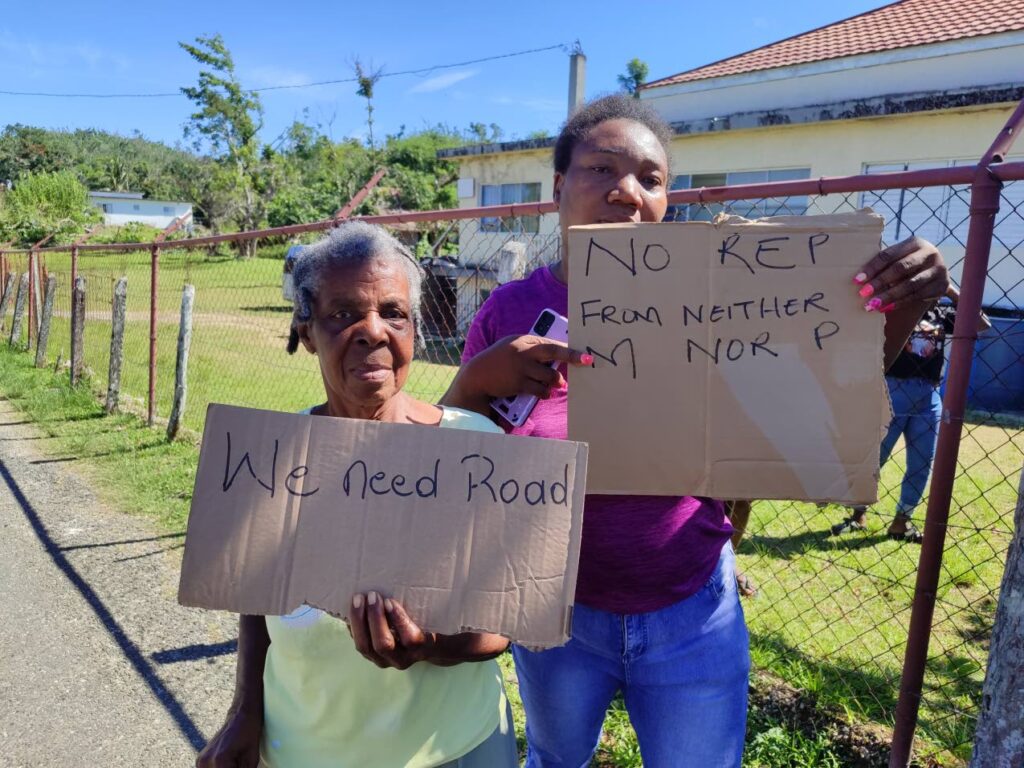
    By early Monday morning, fed up with months of unfulfilled promises of repair, dozens of Hopeton residents gathered to block the road, mobilizing felled trees, large boulders and even a discarded concrete light pole to close off access to through traffic. Protesting with hand-held placards starting just after 5 a.m., the group made clear their message: urgent government action is needed to fix the crumbling route before a deadly accident occurs.

    Speaking to the Jamaica Observer at the protest, Thomas pointed out that the road’s edges are already eroding, and continued overuse will leave the route completely unusable for local residents. The damage at Spring Mount, she noted, has left that route only passable for single-file foot traffic, despite repeated official warnings to residents against using the dangerous broken section. Officials have proposed an alternate route through Anchovy to reduce pressure on Charlie Mount, but drivers have rejected the option, as it adds significant time and fuel costs to every trip.

    With traffic backed up along the narrow strip of usable road, conflicts between drivers have become a daily occurrence, with tempers often flaring into heated arguments over right of way and driving ability. Thomas told reporters she has witnessed three separate incidents of buses veering off the road and into the gullies that line parts of Charlie Mount. While no fatalities have been recorded to date, one driver was trapped in his wrecked vehicle overnight before residents found him the next morning, calling for help. Thomas added that all recent patching work on the road has been completed by local residents, with no support from elected officials, who have failed to follow through on promises of intervention.

    Elderly resident Monica Willoughby, a lifelong Hopeton resident who joined the protest after seeing neighbors gathering, said poor road conditions have plagued the community for years, but the crisis has reached unbearable levels since Hurricane Melissa. Her son, a taxi operator who uses the route daily, is forced to replace damaged bus parts on a weekly basis due to the poor road surface, she explained.

    The road blockade left thousands of local students and school staff unable to reach their campuses Monday, but protestors refused to end their action, arguing that dramatic steps were the only way to cut through government bureaucracy and draw attention to their urgent needs.

    Local councillor Uvel Graham, representing the Spring Mount Division for the Jamaica Labour Party, arrived at the protest and argued that residents had acted prematurely, claiming repair plans were already in motion. Graham explained that a contractor was scheduled to arrive Monday to lay marl on the Camrose leg of the local road network, which would allow traffic to be diverted away from Charlie Mount while permanent repairs are carried out. He added that unseasonable rainfall earlier in April had delayed the start of work, as officials opted to wait for dry conditions to avoid wasting limited resources on asphalt that would be ruined by rain. Graham acknowledged that residents face daily hardship from the poor road conditions, and committed funds allocated to him through the St James Municipal Corporation to fill potholes across the entire parochial route.

    For the damaged Spring Mount road, which falls under the jurisdiction of the National Works Agency (NWA), Graham said preliminary work including soil testing and cost assessments has already been completed, though no official starting date for reconstruction has been announced. When contacted by the Observer Monday, NWA western region communications manager Janel Ricketts confirmed that repair plans for Spring Mount are still in the design stage, with no timeline for construction released to date.

  • Scorpions all-rounder calls for patient bowling approach vs Pride

    Scorpions all-rounder calls for patient bowling approach vs Pride

    The ongoing four-day West Indies Championship match between Jamaica Scorpions and Barbados Pride at Kingston’s Sabina Park has been heavily disrupted by wet weather, leaving the two sides with contrasting but confident outlooks heading into the third day of play.

    By the close of play on the truncated second day, Barbados Pride had responded to Jamaica’s first-innings total of 457 all out with a solid 125 for one from 27 overs, leaving them well placed to challenge for the all-important first-innings advantage that often proves decisive in four-day first-class cricket.

    The day began with Jamaica Scorpions resuming from their overnight score of 354 for three wickets, with the visiting Barbados side delivering a disciplined bowling performance that quickly dragged the hosts into trouble. Within the first session, Jamaica lost four wickets for just 34 runs, sliding from 354 for three to 388 for eight. Overnight batsman Brad Barnes fell for 40 at 367 for five, Abhijai Mansingh was out for a duck just one run later, fellow overnight batter Romaine Morris departed for 25, and tailender Peat Salmon added only three to the score.

    It was a dogged, attacking late-wicket partnership between all-rounder Odean Smith and number nine batter Ojay Shields that pulled Jamaica past the 400-run mark and up to a final total of 457. Smith, in particular, delivered a thrilling half-century, hitting five fours and four sixes in a 70-ball 54 to anchor a 68-run ninth-wicket stand that transformed the innings. Shields eventually fell for 14 as Jamaica were dismissed all out in 103 overs.

    Barbados pace bowler Shamar Springer turned in the standout bowling performance for the Pride, finishing with impressive figures of three wickets for 99 runs from 24 overs. The 28-year-old all-rounder credited tighter execution of pre-match plans for his side’s improved showing on the second day, after a sloppy opening day display that allowed Jamaica to reach 331 for three at stumps on day one.

    “We had clear plans and we stuck to them a little longer than on Sunday, and we executed better as a result,” Springer explained.

    In response to Jamaica’s formidable 457, Barbados openers Kraigg Brathwaite and Shayne Moseley got the innings off to a flying start, putting on a fluent century opening stand against what Smith described as inconsistent, overly aggressive bowling from the Scorpions. The partnership was broken at 105, when off-spinner Salmon deceived the attacking Moseley to bowl him for a 60-ball 53.

    At the tea break, Brathwaite, the former West Indies Test captain, remained unbeaten on 51 from 87 deliveries, with Jonathan Drakes not out on 17 at the other end. However, persistent rain that set in during the interval wiped out the entire final session of the day, forcing umpires to call off play early.

    When play resumes at 9:30 on the third morning, Brathwaite and Drakes will return to the crease to build on Barbados’ solid start. For Jamaica, Smith says the side must adjust its approach if it is to dismiss Barbados before they can overhaul the first-innings total. The 29-year-old all-rounder admitted the Scorpions made a key error in their first day of bowling, prioritizing attacking wicket-taking over patient line-and-length pressure.

    “I think we tried to blast them out for most parts instead of being patient and staying on a good length for longer,” Smith told Jamaica Observer. “They got away but I think we have to come back tomorrow and work on the patience game. They have lost only one wicket but we still have a big lead and they have a long way to go if they are going to get first innings advantage. I think we have the quality to bowl them out before they even get close to 457.”

    For his part, Springer remained optimistic about the Pride’s chances, saying the opening partnership had given his side the perfect platform to push on for a first-innings lead.

    “I think it’s a good start, a good platform to have. We have some quality batters to come, but hopefully the guys at the crease can take us all the way through to get first innings and then we would assess from there,” he said.

  • Digicel marks 25 years with star-studded bash

    Digicel marks 25 years with star-studded bash

    On a vibrant Saturday in downtown Kingston, Digicel’s corporate headquarters was transformed into a sea of deep crimson, as hundreds of attendees gathered to mark the telecommunications giant’s 25 years of operations in Jamaica. Loyal customers, senior company leadership, government representatives, and some of Jamaica’s biggest music stars all dressed in the brand’s signature red to join the anniversary celebrations, turning the company’s parking lot into one of the year’s most energetic public gatherings.

    From the first hours of the event, electric anticipation filled the air, with popular hosts Talia Soares-Brown and Christopher “Johnny” Daley keeping the growing crowd engaged and entertained. Early arrivals were rewarded with exclusive giveaways, where quick reflexes and a bit of luck let dozens of happy customers walk away with hundreds of dollars in free mobile credit.

    The centerpiece of the day was a star-studded musical showcase that highlighted the full breadth of Jamaica’s iconic musical talent. Opening the performances was instrumentalist Verlando Small, whose smooth, soulful set featuring reimagined versions of *Loving You*, *I Wanna Know*, *Can We Talk*, and *Best Part* resonated deeply with the audience, drawing particularly warm applause from female attendees. Next up was beloved gospel artist Jermaine Edwards, who shifted the energy with uplifting, soul-stirring performances of *God Is With Me* and *It’s a Beautiful Day*, adding a heartfelt spiritual layer to the celebratory occasion.

    Fresh off his 2024 Digicel Rising Stars win, Akeen Fennell took the stage next with a nostalgic set paying tribute to Jamaican reggae legends. He worked through classic tracks including Sanchez’s remake of *Missing You Now* and Wayne Wade’s *I Love You Too Much*, before transitioning into fan favorites *Oh Me Oh My* and *Stuck on You*. He ramped up the energy with a rousing rendition of Buju Banton’s *Love Me Browning*, closing his set with his own original hit *It’s Over*.

    Powerhouse vocalist Tessanne Chin kept the momentum building, drawing from her decades-long catalog of hits to deliver crowd-pleasing performances of *Messenger*, *Underneath It All*, and *Hideaway*. Following Chin was iconic reggae artist Bugle, one of the event’s special invited guests, who turned the venue into a lively Rasta party with his electrifying set. His performances of *What I’m Gonna Do*, *Don’t Blame Life*, *Pearly Gate*, and *Nuh Compatible* served as an unexpected bonus for the already hyped gathering, leaving fans cheering for more.

    Dancehall breakout star Valiant took command of the stage next, delivering a short but high-octane set packed with his viral fan favorites, including *100 Milli*, *Passenger Princess*, *West Indies*, *Narcissistic*, and *Baddiedeh*, leaving the crowd buzzing with raw energy.

    The night came to a close with a headline set from Chris Martin, one of Digicel Rising Stars’ most successful alumni, who took the stage after a dazzling cake-cutting ceremony and fireworks display that drew gasps from the crowd. Martin took attendees on a nostalgic journey through his 21-year career, opening with *A Change Is Gonna Come*, the track that first launched him to fame on the Digicel singing competition. He followed with a string of his biggest hits, including *Big Deal*, *Cheaters Prayer*, *Giving It*, *Chill Spot*, *Paper Loving*, and *Wife and Sweetheart*. The night’s biggest highlight came when Martin brought out fellow Digicel Rising Stars winner Romain Virgo for a surprise joint performance. The two artists wowed the crowd with their natural chemistry on *Leave People Business*, before Virgo transitioned into *Fade Away*, his popular collaboration with Agent Sasco. Martin stepped seamlessly into Sasco’s verse, showcasing the close camaraderie and shared musical roots between the two Jamaican stars.

    In a reflective speech marking the 25-year milestone, Digicel Jamaica CEO Stephen Murad shared his pride in the company’s transformative journey across Jamaica. “Who would have thought 25 years ago Digicel would come along and change the face of the telecommunications industry in Jamaica? We now have thousands of employees here in Jamaica and over 2 million mobile customers that we serve every year. Tonight we’re here in the car park of our headquarters, and just seeing everyone in the crowd listening in on this amazing concert I’m so proud and I want to say thank you to all of our customers,” Murad said.

    Daryl Vaz, Jamaica’s Minister of Science, Energy, Telecommunications and Transport, also praised Digicel’s far-reaching impact on the country beyond its telecommunications services. “This is a very huge achievement. Digicel came in as the new kid on the block 25 years ago and they have established themselves as a corporate entity with a lot of social benefits to Jamaica through their foundation which has proven to be one of their most successful foundations in terms of upliftment across Jamaica, and so I wish them well,” Vaz said.

    Fresh off his closing performance, Martin shared his gratitude for the opportunity to help mark the milestone that launched his own career. “I’m feeling great. It’s the 25th anniversary, my career started with this and now to close out this special occasion, it’s big vibes. They said 30 minutes so we tried to cram as much songs as we possibly could. The energy was awesome and the vibes from the people was infectious, so we give thanks. At the end of the day we can do music and it fall on deaf ears. So to be doing this for 21 years and people still love me and we stay relevant and we still in the people’s hearts, it’s a blessing.”

  • ‘LET ME HELP!’

    ‘LET ME HELP!’

    Nine years after hanging up his sprint spikes as the most decorated sprinter in Olympic history, Jamaican track and field icon Usain Bolt still holds an unshakeable grip on the sport’s record books — and he’s now pushing for sweeping change to bring back the fan engagement that defined his legendary career.

    Bolt, who retired in 2016 with eight Olympic gold medals and 11 World Championship titles, still owns three world records that have stood unbroken for nearly 15 years: his 9.58-second 100m and 19.19-second 200m marks, both set at the 2009 World Athletics Championships, and the 36.84-second 4x100m relay record he helped secure at the 2012 London Olympics. Since his departure from competitive running, the sport has faced consistent criticism that it lacks the star power and electric energy Bolt brought to every track he stepped on, a gap that has left many casual fans tuning out.

    World Athletics leadership has pushed back on that narrative in recent months. Last December, association president Sebastian Coe highlighted robust growth across the sport, pointing to sold-out event attendance, a record-breaking 40 billion global digital impressions, and an unprecedented 84 countries qualifying athletes for the World Athletics Championships finals. He also teased new, high-stakes opportunities coming in 2026, headlined by the inaugural Ultimate Championships set to take place in Budapest. In September 2024, Bolt was named the Ultimate Legend for the new event, a ceremonial role intended to build hype for the competition. But the sprint legend says that title isn’t enough — he is pushing for a far more expanded role to help steer the sport’s growth, and has made his desire for change clear to World Athletics leadership.

    In an interview with CNN Sports, Bolt argued that the sport needs a full revamp to recapture the attention of casual viewers, saying that the current product lacks the excitement that keeps audiences coming back. “People watch for excitement, and I think the sport needs to figure out a way to get people engaged in track and field,” he explained. “I’m not the only one saying it. People always say to me, ‘Usain, track and field is going down.’ Even now when I travel, people tell me they don’t watch anymore because I left. It’s missing that excitement, that vibe, that energy people crave. It’s not always about the clock — it’s about the competition, the personality athletes bring, that’s what draws people in.”

    Bolt’s comments echo a widespread belief that track and field has struggled to produce transcendent, charismatic stars with the cross-over appeal that turned the Jamaican into a global household name. He added that he actively celebrates emerging athletes who bring distinct personalities to the sport, noting that that authenticity is what helps new fans connect.

    For Bolt, who turned 30 the year he retired and says he has no regrets about stepping away when he did, the pull of the sport remains deeply personal. “It’s pretty much my life, it made me who I am,” he said of his connection to track and field. “So I’ll play any role possible to help to uplift it, help to push it and help to keep it afloat and get better. I’ve been saying it, I’ve told them all the time that I’m willing to be a bigger part of this.”

    Even away from the track, Bolt says he still feels the rush of competition. He recalled attending a recent World Championships as a spectator, saying the experience was surreal. “It felt weird not being on the track, and I felt a lot more nervous than I normally would be competing myself,” he said. “When I watch my fellow Jamaicans compete, I get more nervous than anything else. I do miss just the excitement and just the energy from the crowd.”

    Outside of his work with World Athletics, Bolt recently partnered with luxury watch brand Hublot to launch a limited-edition timepiece that honors the milestones of his iconic sprint career.

  • Island grid pulls out of $130m power grid contract

    Island grid pulls out of $130m power grid contract

    The future of New Providence’s $130 million electricity transmission and distribution (T&D) overhaul has been thrown into uncertainty after the project’s lead management firm, Island Grid, formally exited its contract two years into what was originally planned as a 25-year partnership. The sudden departure has prompted Opposition Leader Michael Pintard to call on the Davis administration to deliver immediate clarity and full transparency to the Bahamian public over the project’s trajectory.

    Island Grid, an infrastructure firm founded by principal Eric Pike to pursue utility projects across small island nations, confirmed its withdrawal from the management agreement with Bahamas Grid Company (BGC) — the special purpose vehicle created to own and upgrade New Providence’s energy grid — took effect yesterday. Alongside the firm’s exit, Pike and fellow Island Grid executive Mei Shibata stepped down from their BGC board positions. Anthony Ferguson, chief executive of Bahamas-based investment firm CFAL, has been named BGC’s new chairman, replacing Pike.

    BGC is structured as a public-private partnership, with Bahamas Power & Light (BPL) holding a 40% minority stake and a consortium of private investors controlling the remaining 60% stake. The firm announced the appointment of two new Bahamian senior leaders alongside the leadership transition: Dareo McKenzie, a 30-year energy sector veteran with stints at GE Vernova and Consolidated Edison of New York, as chief executive, and Gladys Fernander, a former Commonwealth Bank CFO and certified public accountant with 20-plus years of regulated finance experience, as chief financial officer.

    In a statement responding to media inquiries, the Bahamian government sought to reassure the public that Island Grid’s exit would not disrupt ongoing infrastructure work. “The management agreement has come to an end. The investment is ongoing and continues to progress as planned,” said Latrae Rahming, communications director for Prime Minister Philip Davis. “The company is now Bahamian-led, and we have full faith and confidence in its leadership, capacity and ability to deliver on its commitments.”

    Ferguson echoed that sentiment in BGC’s official release, framing the transition as a milestone shift to a fully independent, all-Bahamian-led operating model. “Together, Dareo and Gladys bring the operational and financial leadership required to grow a resilient, high-performing utility,” Ferguson said. “Just as importantly, this transition reflects the strength and capability of Bahamian leadership at every level of the organisation. On behalf of the Board, I want to thank Eric, Mei and the entire Island Grid Solutions team for their leadership and expertise in building Bahamas Grid Company into a fully operational utility and strengthening New Providence’s transmission and distribution system. We now move forward as a fully Bahamian-led organisation, focused on delivering long-term performance for our country.”

    Pike also released a brief statement praising the project’s progress to date. “We are honoured to have had the opportunity to set up Bahamas Grid Company and conduct the biggest grid upgrade project for New Providence over the past two years,” he said. “I would like to recognise the dedicated employees of Island Grid, Pike and Bahamas Grid Company, whose hard work and commitment were instrumental to this achievement, and extend our best wishes for Bahamas Grid Company’ continued success.”

    However, the sudden exit of Island Grid, which was contracted to manage the project for an initial 25-year term with an option to extend for an additional 10 years, has left dozens of unanswered questions that remained unaddressed as of press time. Multiple industry observers and political leaders have raised pointed concerns over the implications of the exit for the project, for energy consumers, and for the government’s broader clean energy goals.

    Tribune Business had reported unconfirmed rumors of growing tensions and potential withdrawal for several weeks prior to yesterday’s announcement. Officials emphasized that Island Grid’s exit is unconnected to last month’s fatal shooting of a Pike Electrical employee, for which a senior Bahamian police superintendent has been charged. Roughly 40 Pike workers left the Bahamas immediately after the shooting to attend the deceased worker’s funeral and support his family, but roughly the same number are expected to return to complete existing contract obligations, meaning Pike Electrical’s on-the-ground work may continue despite Island Grid’s exit. There has been unconfirmed speculation that TPG and La Caisse, the private equity consortium that acquired a majority stake in Pike Electrical in November 2025, may step into Island Grid’s role, but no confirmation of that arrangement has been made public.

    For decades, Pike Electrical — a family-founded firm established in 1945 — has supplied the labor, equipment, technical expertise, and training for the $130m upgrade that has been underway for two years. Original project documents confirm that BGC was structured to rely heavily on Island Grid’s technical and operational capacity: the 2024 Heads of Agreement between the government, BGC, and Island Grid granted Island Grid exclusive rights to develop and manage the entire project, and tasked the firm with assembling a team of global and local experts to oversee all implementation. Financial documents for the project’s $30m equity raise and $111m debt financing show Island Grid was contracted to earn $4.359m in annual management fees for the first five years of the project, with fees sliding gradually as T&D revenues grew.

    One anonymous financial industry insider questioned the logic of Island Grid’s early exit, noting that the entire project was built around a decades-long investment horizon. “To get a return on investment, you aren’t taking over the entire grid for a short period of time. Your investment horizon is decades. They cannot claim this is all done and planned. This wasn’t for the short-term,” the source said. The insider added that BGC will be unlikely to replicate the preferential pricing and supply chain access Island Grid secured through its ties to the Pike network, particularly for large grid equipment that requires months-long lead times. “They [BGC] cannot replicate the Pike partnership. They do not have the reach and expertise, and level of people to pull from,” the source said. The insider also argued that Island Grid’s exit undermines BGC’s core purpose as a special purpose vehicle, noting that the entity already adds an extra layer of costs for taxpayers and energy consumers that could be eliminated by folding BGC’s functions back into BPL.

    The exit also raises concerns for BGC’s investors, who were sold $111m in bonds based on offering materials that promised long-term Island Grid involvement. Bondholders are owed regular interest payments and the eventual return of their principal, and the unplanned transition has created new uncertainty over their returns.

    Opposition Leader Pintard emphasized that the government’s entire energy strategy, including plans to bring 172 megawatts of new utility-scale solar power online via independent power producers (IPPs), hinges on the successful completion of the T&D grid overhaul. Without a fully upgraded grid, IPPs cannot safely connect and deliver their power to New Providence’s 100,000-plus BPL customers, which include both households and businesses.

    “Much of what the Government has forecast depends on the grid,” Pintard told Tribune Business. “If we are talking about solar deals being signed on New Providence, has the grid upgrade work been completed to the extent it can receive power from IPPs? If the T&D system has not been dealt with, how does that impact all the IPPs relying on a stable grid that has the capacity to receive power from them? Everything hinges on this. It’s a fundamental issue.”

    Pintard called on Prime Minister Davis and Energy Minister Jobeth Coleby-Davis to immediately open the process to public scrutiny, noting that Coleby-Davis claimed shortly after the shooting that the project remained on track, a statement that is contradicted by Island Grid’s exit. “Their overall strategic plan relies substantially on what happens with the transmission and distribution system,” Pintard said. “The Government has an obligation to clarify for the public whether or not the grid agreement they put in place, which was supposed to fix deteriorating T&D infrastructure, whether or not they have completed that. If they have not completed that, at what stage are they at in this process, and under what circumstances have Pike and the others transitioned from previous positions they held, and where does that leave Bahamas Grid and the grid contract the Government entered into with them?”

    Pintard added that he had spoken with a senior BPL union leader who confirmed widespread uncertainty among the utility’s 123 T&D staff, the vast majority of whom already opposed plans to transfer or second them to BGC.

    Island Grid’s exit also comes as BGC had previously stated it planned to complete the initial $130m upgrade by late April 2026, reporting that outage frequency had dropped 45% and outage duration had fallen 35% in 2025 compared to 2024. It remains unclear whether the new leadership will be able to hit that completion target.

    The original Heads of Agreement also includes provisions that require parties to negotiate a buyout if the management agreement is terminated early, including granting the Bahamian government a right of first refusal to acquire 100% of BGC’s shares if a termination occurs. As of press time, no requests for comment from Pike, Ferguson, or Coleby-Davis had been returned.

  • Candidates defend net worth increase

    Candidates defend net worth increase

    Multiple political candidates from the Bahamas’ ruling Progressive Liberal Party (PLP) have pushed back against growing scrutiny over sharp jumps in their declared net worth this week, offering a range of explanations tied to personal finance, business gains, and life events even as several others declined to address questions about their wealth increases.

    The debate over candidate financial disclosures emerged after new filings revealed substantial growth in the net assets of dozens of PLP candidates since the last disclosure round in 2021, with some seeing their total net worth multiply by as much as three or five times over the three-year period.

    Leslia Miller-Brice, the PLP’s candidate for the Seabreeze constituency, told reporters her current $8.7 million net worth – up from $3.1 million in 2021 – reflects jointly held assets with her husband, accumulated through the couple’s shared private business ventures. Her disclosure filings show the vast majority of her assets are tied up in residential and commercial real estate and market securities, with no reported outstanding liabilities, $81,000 in savings, and $187,000 held in a checking account.

    Keith Bell, the party’s candidate for Carmichael, saw his net worth jump from just over $1 million in 2021 to $3.9 million in the latest filing. Bell attributed the sharp gain to proceeds from a life insurance policy held by his late wife, who passed away recently, as well as natural appreciation in the value of long-held family real estate holdings. He noted that his experience underscores the critical role of long-term financial planning and life insurance in protecting family financial stability during unplanned life events.

    For Kirk Cornish, the PLP’s North Abaco candidate, net worth grew from just under $145,000 in 2021 to more than $819,000 this year. Cornish forcefully rejected any insinuations that his wealth increase was obtained through improper or unethical means tied to his public office, explaining that the 2021 disclosure reflected an artificially low net worth after he was forced to draw down his savings when placed on unpaid leave by the Water and Sewerage Corporation board that year.

    Since his election to Parliament, Cornish said, he retired from the Water and Sewerage Corporation and received his full retirement payout, which he saved in full. He added that he has continued to save a portion of his parliamentary salary and has built up additional value through personal real estate investments. “I worked for that,” Cornish said. “I didn’t steal it. It didn’t come about suddenly. I earned that.”

    Other candidates saw equally large jumps that have not been explained publicly. Clay Sweeting, candidate for Central and South Eleuthera, saw his net worth rise from $1.5 million in 2021 to $4.5 million, but declined to comment on the gain when reached by reporters. Two other PLP candidates, Leon Lundy of Central and South Andros and Leonardo Lightbourne of North Andros, also reported double-digit percentage increases in their net worth but had not responded to requests for comment as of press time.

    Deputy Prime Minister Chester Cooper recorded the largest overall increase among PLP candidates, with his net worth doubling from $14.8 million in 2021 to $28 million in the latest filing. Cooper also declined to comment on the growth of his assets. Dozens of other sitting PLP officials and candidates, including Myles Laroda, Pia Glover-Rolle, Glenys Hanna-Martin, McKell Bonaby, Wayne Munroe, and Jobeth Coleby-Davis, also reported higher net worth in their latest disclosures.

    The sudden, unexplained jumps in candidate wealth have prompted renewed calls for stronger regulation and oversight of public official financial disclosures from governance advocacy groups. Matt Aubry, executive director of the Organisation for Responsible Governance, said the current disclosure framework fails to deliver the transparency that Bahamian voters deserve, and candidates running for public office must be held accountable for their financial interests to prevent conflicts of interest and misuse of public contracts and funds.

    Aubry explained that advocacy groups have long pushed for revisions to the existing public disclosure law to expand public oversight, mandate regular, detailed reporting, and add clear context to asset declarations. The current law, he argued, relies on an overly opaque process for collecting information, with minimal public access to full details, no requirement to reconcile changes in net worth over time, and no meaningful penalties for non-compliance or inaccurate reporting.

    Without clear, verifiable information about candidates’ financial interests, Aubry warned, the public risks losing trust in elected institutions and civic engagement in the democratic process will erode over time.

  • WATCH: Man dies in Manchester crash, five injured

    WATCH: Man dies in Manchester crash, five injured

    MANDEVILLE, JAMAICA – A devastating late-evening collision on the Winston Jones Highway in Mandeville has claimed one life and left five other people hospitalized, according to official law enforcement updates. The victim, identified by police and family members as Dave Ebanks Jr, widely known by his nickname “DJ”, worked at Holsum Bakery located in the Manchester community of Williamsfield. He died after succumbing to critical trauma suffered in the head-on crash that unfolded on Monday.

    Preliminary law enforcement accounts place the time of the incident at approximately 9:00 p.m. Reports outline that Ebanks was operating a Honda Integra heading uphill along the highway when he lost control of his vehicle. The car then collided head-on with a downhill-bound Toyota Wish, a vehicle registered as a public passenger taxi that was carrying five passengers at the time of the crash.

    First responders including local firefighters and police officers arrived at the crash site promptly, where they extricated Ebanks from his heavily damaged vehicle and coordinated emergency transport for all injured parties to a nearby medical facility. Ebanks was pronounced dead by medical staff shortly after arriving at the hospital, while the five occupants of the taxi were admitted for overnight care for their injuries.

    Investigating officers at the scene noted that the crash occurred in an area with solid unbroken white lane markings, an indicator that passing is prohibited. Based on initial site assessments, law enforcement says speeding and illegal improper overtaking are the most likely contributing factors to the fatal collision. The case is currently being handled jointly by the Manchester Traffic Department and the Area Three Accident Investigation and Reconstruction Unit, which are conducting a full probe to confirm the exact cause of the incident.

    Local authorities have reminded motorists to obey all traffic markings and speed limits, particularly on winding or hilly highways, to prevent similar tragic incidents.

  • Pintard tells PM to ‘take a look’ at Cooper’s $13m wealth jump

    Pintard tells PM to ‘take a look’ at Cooper’s $13m wealth jump

    A recently published round of mandatory financial disclosure filings for Bahamian politicians has sparked heated political friction, with Opposition Leader Michael Pintard calling out a striking surge in Deputy Prime Minister Chester Cooper’s declared net worth and pressing the prime minister to review the assets of senior ruling party officials.

    According to the newly released documents, Cooper’s reported personal net worth now sits at $28 million — a nearly 90 percent jump from his 2021 declaration of $14.8 million, and a more than threefold increase from the $7.9 million he reported in 2017. Pintard highlighted this dramatic growth in comments to reporters on Wednesday, arguing that the size of the increase, when paired with what he calls inconsistent disclosure practices among the ruling Progressive Liberal Party (PLP), demands internal scrutiny from the country’s top executive.

    “One cabinet minister saw his net worth double in a single term? That’s an extraordinary gain,” Pintard told reporters. “I truly believe that if a government chooses to, it can investigate these disclosure filings. I would recommend the prime minister take a closer look at a few of his colleagues. If someone can double their wealth in one term, they should have been the minister of finance!”

    Pintard also drew a direct contrast between the opposition Free National Movement (FNM) and the ruling PLP, claiming FNM members have always fulfilled their annual disclosure requirements on time, submitting complete details of the prior year’s assets and liabilities without delay. He accused the PLP of operating under a persistent “pattern of darkness” when it comes to financial transparency for its elected officials.

    Notably, Pintard’s critique included a false claim that no PLP parliamentarian had ever submitted their required disclosures. Local newspaper The Tribune, which first reported on the disclosure filings, has previously confirmed that multiple members of Prime Minister Philip Davis’ administration have submitted the required financial documents in past years.

  • Henfield slams civil servants for wearing PLP campaign gear

    Henfield slams civil servants for wearing PLP campaign gear

    A political firestorm has erupted in The Bahamas after a former cabinet minister exposed apparent violations of longstanding political neutrality rules by senior public servants, throwing the integrity of the upcoming electoral process into question. Darren Henfield, who previously led the Ministry of Foreign Affairs, is raising urgent concerns after photos circulated last week showing two of the country’s top public officials wearing branded gear from the ruling Progressive Liberal Party (PLP).

    At the center of the controversy is Melvin Seymour, the permanent secretary at the Ministry of Foreign Affairs—the most senior non-partisan civil servant in the department. Consul General to Toronto Clayton Fernander, a former police commissioner, also appeared in photos in a PLP-branded shirt. When contacted by reporters this week, Seymour declined to address questions about his public display of partisan affiliation. Current Foreign Affairs Minister Fred Mitchell also declined to comment on the record about the allegations.

    Henfield’s concern extends far beyond the public display of party apparel, rooted in the critical role foreign service officers play in managing the country’s overseas voting process. Ahead of upcoming elections, the government has stationed foreign affairs staff in overseas missions to oversee ballot security and ensure all balloting procedures are carried out fairly. If the most senior leader of the department is openly aligned with the ruling party, Henfield argues, that creates an unacceptable appearance of bias that erodes public confidence in the integrity of overseas voting.

    “That’s a very grave concern for me,” Henfield told reporters. “I read some memorandum recently that said that officials will be put in place in overseas offices to ensure that the voting is done properly, but with the permanent secretary wearing PLP paraphernalia, we don’t know what that means.”

    The former minister added that the main opposition Free National Movement cannot trust the electoral process if public officials tasked with its oversight are openly displaying partisan loyalty. He went further to allege that members of the Royal Bahamas Defence Force have also been spotted campaigning alongside National Security Minister Wayne Munroe while wearing his campaign merchandise, though he had not shared supporting evidence by the time of this report.

    Under Bahamian regulations, all senior public servants are bound by strict rules that limit partisan political activity to protect the neutrality of the civil service. General Order 94 categorizes senior foreign affairs and other public officers as members of the “Politically Restricted Group”, which bars them from canvassing voters or distributing political materials on behalf of any party or candidate. While the rules do allow public servants to hold private membership in a political party, they require all public officers to maintain a strict code of reserve when it comes to public political expression, noting that open partisan displays can undermine the public expectation of impartial service.

    Henfield, who recalled his own experience discreetly engaging in political activity earlier in his public service career, said the open violation of these norms by senior leaders signals a worrying shift for the country. “I used to tie my hair down in one scarf, and go incognito and participate in the rallies,” he said. “It is forbidden. But to see a PS, a permanent secretary in the government, wearing political paraphernalia openly, is disturbing. What have we come to in this country? Permanent secretaries in the government wearing PLP paraphernalia? That’s unacceptable.”