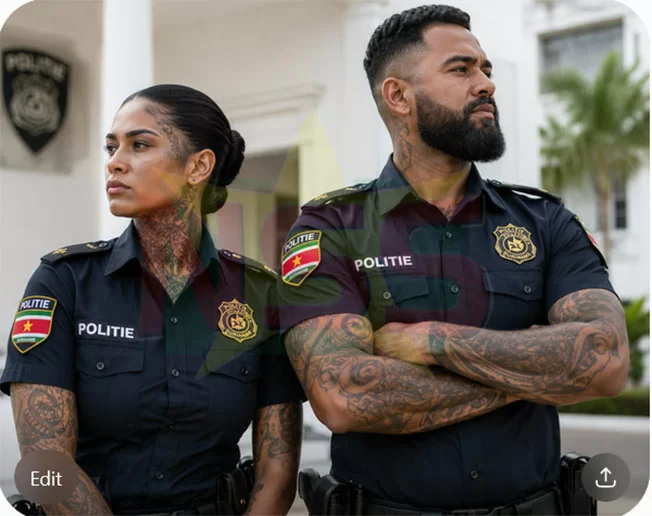
Public discourse has long served as a mirror held up to society, reflecting more about the core values and unwritten norms of a community than it does about the specific topic being debated. The arguments people deploy, the reactions they share, and the priorities they highlight all combine to paint a clear picture of what a given society holds important. This truth has once again been proven by a fiery new conversation ignited by a recent op-ed from Revelino Eijk, chair of the Suriname Police Union.
In his submitted article, Eijk laid out a straightforward argument about grooming standards for officers of the Suriname Police Corps, specifically addressing the rules surrounding beards and visible tattoos. His core position is unambiguous: a beard does not interfere with an officer’s ability to carry out police work, and a tattoo does not impact an officer’s capacity to complete official reports. Eijk stressed that the quality of a police officer is not determined by superficial physical traits, but by four critical factors: training, discipline, integrity, and professional skill.
This perspective is rooted in on-the-ground experience: anyone who has worked alongside an ethical, skilled police officer knows that character cannot be read from a person’s facial hair, haircut, or visible ink. A clean-shaven face, by the same logic, does not automatically make an officer more competent or trustworthy. Professionalism is defined by actions, not outward appearance.
Yet despite this logical framing, hundreds of public comments on the Starnieuws platform reveal the debate is far from settled. In fact, the discussion has only grown more divided, with a large segment of Surinamese society arguing that police officers should be held to higher standards than just basic professional competence. For many ordinary citizens, an officer does not only represent themselves — they are the public face of state authority. And for a large share of the public, that authority demands a specific, traditional public image. This is not an unreasonable viewpoint.
A police uniform is never just work clothing. Judges wear robes to signal their institutional role, military personnel wear uniforms to mark their service, and police officers interact with the public every day as representatives of the national government. Before an officer even speaks, members of the public already form an immediate first impression. Whether one considers this fair or not, outward appearance shapes how the public perceives authority. But this raises a critical, unanswered question: who ultimately gets to define what that appropriate public image is? Does that power lie with the police union, the police leadership, the national government, or is it ultimately the public that sets the norms, consciously or unconsciously, for what it expects from the people tasked with guaranteeing its safety? That question, many argue, is the most important takeaway from this entire conversation.
Throughout the debate, many participants have pointed to international precedents to bolster their arguments, particularly pointing to grooming rules for police officers already in place in the Netherlands. But observers warn against adopting foreign standards wholesale. Suriname is not the Netherlands, they note. It has its own unique national history, its own distinct cultural identity, and a one-of-a-kind mix of population groups and religious communities. What is considered appropriate appearance for police in the Netherlands does not automatically translate to Suriname’s social context.
For this reason, many commentators including this piece’s author argue that this conversation deserves more than a quick exchange of opposing views on social media. It requires a broad, inclusive public conversation across all layers of Surinamese society. This dialogue should not aim to exclude officers with beards or tattoos; instead, its goal should be to collectively define what public image Suriname expects of its national police force in the 21st century. A careful, broad conversation could ultimately lead to a modern, widely supported grooming and dress regulation that carefully balances competing priorities: professional competence, public representation, personal autonomy for officers, and societal expectations of authority.
It is also important to acknowledge that societal norms change over time. There was once a time when no one debated topics like police hat standards, acceptable mustache styles, or hair length for officers. Today, the debate centers on beards and tattoos; tomorrow, it will likely shift to new, unforeseen topics. This is not a sign of division or chaos — it is simply proof that institutional authority must continuously adapt to a changing society.
For all these reasons, the outcome of this debate should not be decided by emotion, personal preference, or foreign examples alone. It demands a deliberate, thoughtful public conversation that gives full weight both to the rights of individual police officers and the expectations of the communities they serve. At its core, this debate is not about ink under the skin or hair on the face. It is about public trust, it is about institutional authority, and it is about answering a fundamental question: what does Suriname want the public face of its police force to look like?