A diplomatic row over a displayed map at a major Surinamese energy conference has put the long-running Tigri territorial dispute back in the spotlight, with Suriname’s vice president reaffirming the country’s long-held position while committing to peaceful negotiations with neighboring Guyana.
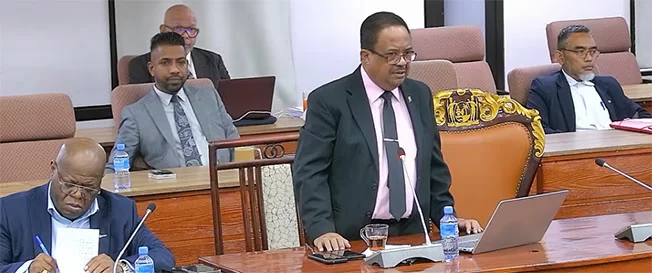
Speaking Thursday during budget debates in Suriname’s National Assembly, Vice President Gregory Rusland addressed questions from ruling VHP party legislator Mahinder Jogi, who pressed for government clarity following cross-border criticism of the map shown at the 2026 Suriname Energy, Oil & Gas Summit (SEOGS). Guyanese parties had raised formal objections to the map’s depiction of the contested Tigri region, prompting Jogi’s request for details on what concrete actions Suriname’s administration had taken in response.
Rusland confirmed that the Surinamese government has reviewed statements from multiple Guyanese private sector organizations regarding the map presented at SEOGS 2026. He stressed that the government maintains its long-standing, unchanged position on the disputed border region. At the same time, Rusland emphasized that Suriname remains committed to building positive, constructive ties with Guyana, rooted in the principles of mutual respect, good neighborly relations and peaceful diplomatic dialogue.
The vice president pushed back against framing the energy summit as a stage for territorial tensions, noting that SEOGS functions as an international platform designed to drive investment, innovation and cross-border collaboration in the energy sector, not to advance political or territorial disputes. He acknowledged that maps including contested border areas can lead to diverging interpretations, but reiterated that such disagreements should only be resolved through official diplomatic channels, not public controversy.
“Suriname attaches great importance to expanding cooperation with Guyana across energy, trade, infrastructure and regional development. This cooperation must continue to grow in an atmosphere of mutual trust and respect,” Rusland added. His comments echo earlier statements from Foreign Minister Melvin Bouva, who had previously confirmed that Suriname’s position on Tigri is unambiguous and that the country has already taken official diplomatic action with Guyana regarding the dispute.
Opposition NDP legislator Ebu Jones, a former Surinamese ambassador to Guyana, voiced full support for the government’s response. Jones drew on his own diplomatic experience, recalling that he had personally filed a formal protest during an official meeting when an incorrect map of Suriname was presented by the other side. He noted that it is standard diplomatic practice for nations to issue protests when they disagree with a map or territorial stance, acknowledging that Guyana has a right to voice its objections.
“That Guyana protests is their right. But that does not change our position,” Jones said, reaffirming that Suriname’s territorial claim remains unaltered. “Tigri belongs to Suriname, and Tigri will remain Suriname’s.”
Despite the vice president’s explanation, Jogi said he accepted the government’s commitment to positive bilateral relations but argued that his core question about specific diplomatic steps Suriname has taken in response to the map controversy remains unanswered.