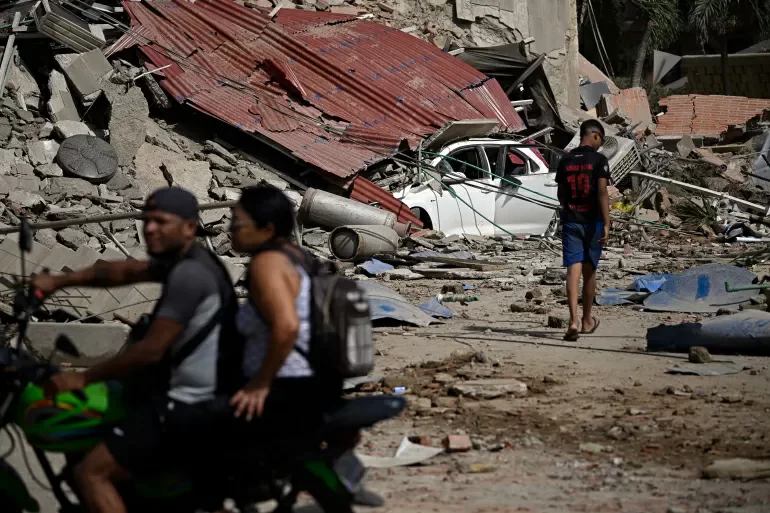
On Wednesday evening, a pair of powerful back-to-back earthquakes struck northern Venezuela, leaving a devastating trail of destruction and loss of life that has put the already crisis-battered nation to an extreme test. As of the latest official update from Venezuelan Health Minister Carlos Alvarado, the confirmed death toll has climbed to 235. Speaking in an interview with state television, Alvarado confirmed that local hospitals received 235 people who arrived with no vital signs or succumbed to their injuries shortly after admission. Rescue teams are currently working around the clock in dangerous, rubble-strewn conditions to locate any remaining survivors trapped under collapsed structures.
Geological data confirms that the two tremors hit within one minute of each other: an initial 7.2-magnitude foreshock followed immediately by a 7.5-magnitude main shock, the most powerful seismic event to hit Venezuela in more than a century. The epicenter was located off the country’s northern Caribbean coast, with the worst damage concentrated in the coastal state of La Guaira, which authorities have formally declared a disaster zone. Dozens of buildings across the state have collapsed, including the well-known Hotel Eduard. Damage has also been reported in the capital city of Caracas and at the country’s main international airport, disrupting travel and logistical operations.
The disaster comes at an extraordinarily vulnerable moment for Venezuela, whose economy has already been crippled by years of deep recession, hyperinflation, and long-running U.S. and international sanctions. The U.S. Geological Survey estimates that total economic damage from the earthquakes could reach as high as 7% of Venezuela’s annual gross domestic product, equivalent to more than $7.5 billion. A major point of concern for humanitarian groups is whether existing international sanctions will block or slow the delivery of life-saving aid to affected communities. Experts from the Center for Economic and Policy Research and other research institutions warn that current financial restrictions and complex bureaucratic requirements make it extremely difficult for donors and aid organizations to move funds and emergency supplies into the country.
Despite these structural barriers, an international humanitarian response has mobilized rapidly in the aftermath of the quakes. The United States, which has recently pursued diplomatic rapprochement with the interim government led by Delcy Rodríguez, has committed to deploy search-and-rescue teams, medical supplies, and general humanitarian aid. U.S. Secretary of State Marco Rubio reaffirmed this support during a phone call with Rodríguez. Beyond the U.S., a wide range of nations have pledged support: Canada is contributing $3.5 million in initial emergency aid, Mexico is sending specialized medical and rescue personnel, Brazil is delivering more than 9 tons of emergency equipment including a field hospital and water purification systems, and Cuban medical personnel already based in Venezuela have been reassigned to support disaster response efforts. Iran, Spain, France, Germany, the Netherlands and dozens of other countries have also pledged to send rescue teams, emergency equipment, or financial support. The International Monetary Fund has also announced it is working with Venezuelan authorities to support a $200 million reconstruction fund for long-term recovery.
In a notable policy shift prompted by the emergency, the Venezuelan government has partially lifted a nearly two-year-long block on social media platform X (formerly Twitter). According to VE Sin Filtro, a local digital freedom watchdog, multiple internet service providers have restored access to the platform, though slow loading times for images and video remain common. Andres Azpurua, director of VE Sin Filtro, noted that the government relaxed restrictions under pressure from the public and the U.S. Embassy, after authorities recognized that open access to information is critical during a large-scale disaster. Most independent news websites remain blocked across the country, however.