标签: Suriname

苏里南

  • Illegale olieverwerking in Paranam: tankers en loods uitgebrand

    Illegale olieverwerking in Paranam: tankers en loods uitgebrand

    A significant fire erupted at an unauthorized oil processing facility in Paranam on Sunday evening, drawing attention to illegal industrial operations in the region. The two storage tanks that caught fire belong to local entrepreneur J.H. (55), who authorities confirm was operating without valid permits.

    Police investigations revealed that the businessman had been processing lubricating oil into fuel oil despite previous enforcement actions. The operation had been previously shut down through coordinated efforts between law enforcement and the Administrative Service due to permit violations. While the operator has reportedly submitted a new license application, official approval remains pending at the time of the incident.

    Emergency responders arriving at the Naaldvarenweg facility discovered a fully engulfed warehouse containing storage tanks, industrial machinery, and a combustion furnace. Firefighters successfully contained the blaze, preventing potential environmental contamination and further property damage.

    Authorities noted no casualties at the scene, as the facility was unoccupied during the incident. Multiple attempts to contact the business owner for questioning have thus far been unsuccessful, according to Police Public Relations officials. The investigation continues to determine the exact cause of the fire and potential regulatory violations.

  • VS geeft Trinidad en Tobago licenties voor olie- en gasactiviteiten met Venezuela

    VS geeft Trinidad en Tobago licenties voor olie- en gasactiviteiten met Venezuela

    The United States has issued two General Licenses to Trinidad and Tobago, enabling the Caribbean nation to legally conduct specific oil and gas activities in Venezuela and within their shared maritime border region. This development marks a significant shift in hemispheric energy cooperation following previous sanction-related disruptions.

    Prime Minister Kamla Persad-Bissessar announced the licenses via social media, characterizing them as a crucial advancement for regional energy security. She emphasized that this U.S. authorization not only strengthens diplomatic ties with Washington but also positions Trinidad and Tobago as a “reliable energy hub” in the Caribbean basin.

    “We remain optimistic about enhancing our role in regional energy markets, supporting domestic industry, securing employment opportunities, and contributing to stable supply chains that benefit the broader region,” the Prime Minister stated. She further committed that all activities would adhere to applicable legal and regulatory frameworks with strong emphasis on transparency and governance.

    The licenses contain specific financial provisions requiring all payments from oil and gas ventures—including taxes or royalties to Venezuela’s government, state oil company PdVSA, or its entities—to be deposited into special accounts designated by the U.S. Department of the Treasury. The regulations explicitly exclude commercially unreasonable payments, debt swaps, or transactions involving gold or digital currencies.

    This authorization follows broader U.S. sanctions easing that has enabled major energy corporations including Shell, BP, Chevron, Eni, and Repsol to consider or expand operations in Venezuela. The move reverses the April 2025 revocation of previous licenses that had suspended development of the Dragon and Cocuina-Manakin gas fields, projects with substantial economic implications for Trinidad and Tobago.

    Energy analysts view the development as both an opportunity for regional energy security and a challenge due to Venezuela’s complex geopolitical landscape. Persistent sanctions, political volatility, and international tensions continue to influence the operating environment. While the new licenses potentially pave the way for future investments and collaborations, experts caution that strict adherence to international regulations and ongoing diplomatic coordination will be essential for long-term success.

  • Agroproject moet jongeren warm maken voor landbouwcarrière

    Agroproject moet jongeren warm maken voor landbouwcarrière

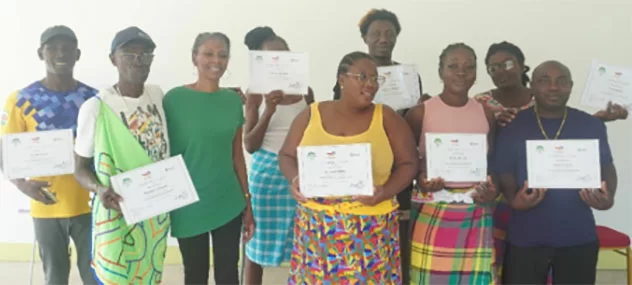
    In a remarkable initiative blending agricultural education with practical experience, eight children from Kasabaholo have successfully harvested their first crop after three months of dedicated farming. The Kids Agro Future project, spearheaded by The Bridge Diaspora organization, has yielded impressive results including football-sized cabbages, perfect okra for soup, and spinach with remarkably large leaves.

    Orlando Cairo, one of the driving forces behind the initiative, expressed profound pride in the children’s accomplishments. “They have performed excellently. I was truly astonished myself,” Cairo remarked. The program combines theoretical knowledge with practical mini-GAP (Good Agricultural Practices) training, already convincing three participants to pursue agricultural careers.

    The project’s methodology emphasizes systematic agricultural practices. Participants receive seeds to plant at home while meticulously documenting planting dates, seed depth, watering frequency, and germination progress. “You can see their joy when the first seedling emerges,” Cairo noted, emphasizing the need for more opportunities for children to engage actively with agriculture.

    Suriname’s Minister of Agriculture, Livestock and Fisheries, Mike Noersalim, has thrown his full support behind the initiative. During a meeting with the young farmers, he highlighted agriculture’s critical role in the nation’s future. “Without agriculture and livestock, we face significant problems. We cannot survive without food. You are not only the future but also ensuring that future by choosing agriculture,” Minister Noersalim told the children.

    The ministry is actively pursuing collaborations with organizations and educational institutions including Natin, PTC, and potentially Anton de Kom University of Suriname to encourage youth engagement in agriculture. Minister Noersalim encouraged participants to “choose a direction not just because it generates income, but primarily because you have passion for it.”

    Project coordinator John van der Zijden emphasized how modern technological developments are making agriculture more attractive and efficient. “The traditional tools alone are no longer sufficient. We must work more efficiently and implement new technology,” he stated. Van der Zijden demonstrated drone technology for digital irrigation and remote crop monitoring, along with innovative water conservation techniques increasingly vital in times of climate change.

    Through this combination of hands-on experience, knowledge transfer, and modern technology, the initiative aims to inspire young people toward sustainable agricultural careers, potentially addressing future food security challenges while revitalizing Suriname’s agricultural sector.

  • Veiligheidsconferentie: toenemende geopolitieke spanningen eisen internationale samenwerking

    Veiligheidsconferentie: toenemende geopolitieke spanningen eisen internationale samenwerking

    The annual Munich Security Conference concluded with a resounding appeal for strengthened international cooperation amidst escalating geopolitical tensions. The three-day gathering, which focused extensively on the Ukraine conflict, evolving US-Europe relations, and shifting global power dynamics, highlighted the critical need for collaborative action and dialogue.

    European Commission President Ursula von der Leyen captured the profound transformation occurring among European leaders when she stated: ‘Boundaries have been crossed that cannot be reversed.’ This sentiment emerged against the backdrop of strained transatlantic relations following Donald Trump’s return to the White House. The American president’s attempt to annex Greenland has dramatically intensified European doubts about Washington’s commitment to continental protection through NATO.

    US Secretary of State Marco Rubio offered limited reassurance to European attendees in his conference address. While expressing desire for cooperation and employing a warmer tone than Vice President JD Vance previously, Rubio criticized Europe’s recent political direction and notably avoided any mention of NATO, Russia, or Moscow’s war in Ukraine—issues that have created significant rifts within the alliance.

    With the conflict approaching its fifth year and Moscow increasingly perceived as a growing threat by its European neighbors, continental leaders declared they would accelerate efforts to strengthen their own defense capabilities and reduce dependence on the United States.

    This position theoretically aligns with the Trump administration’s expectation that Europe will assume primary responsibility for conventional defense of the continent. In exchange, Washington would maintain its nuclear umbrella over Europe and honor NATO’s mutual defense pact.

    German Chancellor Friedrich Merz, French President Emmanuel Macron, and British Prime Minister Keir Starmer pledged their commitment to building a stronger ‘European pillar’ within NATO. However, enhanced independent defense capabilities also serve as insurance should Trump or future American leaders decide against defending Europe.

    ‘This new beginning is correct under all circumstances. It is correct if the United States continues to distance itself. It is correct as long as we cannot independently guarantee our own security,’ Merz stated during Friday’s sessions.

    In another indication of unease regarding American security commitments, Merz revealed he had initiated discussions with Macron about European nuclear deterrence. France possesses Europe’s only truly independent nuclear deterrent, as Britain’s Trident missiles are manufactured and maintained by the United States.

    The central challenge for European leaders remains translating rhetoric into reality—acquiring and developing new weapons systems, addressing arsenal gaps in areas like long-range missiles, and coordinating efforts effectively.

    Current signals are mixed. Driven by fear of Russia and Trump’s prodding, European nations have increased defense spending. NATO members agreed last year to raise core defense expenditures from 2% to 3.5% of GDP, with an additional 1.5% allocated for other security-related investments. Von der Leyen noted that European defense spending has surged by nearly 80% since before Ukraine’s invasion.

    European countries are forming consortia to develop complex weapons systems. Defense ministers from France, Germany, Italy, Poland, and Sweden signed a letter of intent to advance the European Long-range Strike Approach (ELSA), a project focused on developing ‘deep strike’ missiles. During a parallel NATO defense ministers meeting, European coalitions agreed to collaborate on four projects including ballistic missile defense and air-launched munitions.

    However, several high-profile pan-European initiatives face significant challenges. The future of the French-German-Spanish FCAS fighter jet project hangs by a thread after months of disputes over work distribution among involved companies. Debates surrounding EU defense projects continue regarding whether they should remain exclusive to EU companies or open to external participants.

    France remains the strongest proponent of ‘buy European’ clauses, while Germany and the Netherlands advocate for a more open approach.

    Amid these discussions at the luxurious Bayerischer Hof hotel, Ukrainian President Volodymyr Zelensky presented the stark reality of modern warfare, surrounded by massive screens displaying imagery and statistics of Russian attacks. Ukraine alone faced over 6,000 drones and 150 missiles last month.

    ‘During this war, weapons are evolving faster than political decisions designed to stop them,’ he told delegates.

    As the Munich Security Conference concludes, the world continues to confront urgent security challenges while maintaining hope that collective efforts may yield sustainable solutions within an increasingly complex geopolitical landscape.

  • Column: Een wereld die bewapent en wegkijkt

    Column: Een wereld die bewapent en wegkijkt

    The 62nd Munich Security Conference has delivered a sobering assessment of the current global landscape, with German Chancellor Friedrich Merz declaring that ‘the old world order no longer exists.’ The gathering revealed a world increasingly characterized by rearmament, geopolitical tensions, and diminishing trust among nations.

    Major powers are actively redistributing spheres of influence while strengthening their military arsenals, often appearing indifferent to human suffering in conflict zones that fall outside their strategic interests. What was once viewed as an era of globalization and interconnectedness is rapidly transforming into an age of fragmentation and intense competition.

    Europe is accelerating its rearmament efforts, largely driven by the ongoing war in Ukraine which is perceived as an existential threat. Simultaneously, as the United States and China escalate their power struggle, numerous crisis regions including Syria, Sudan, Myanmar, Kenya, and Gaza continue to demand international attention and humanitarian assistance that remains insufficient.

    The conference highlighted concerning trends: the rules-based international order that provided stability since the end of the Cold War appears increasingly obsolete. Major nations are prioritizing their own security interests above collective action, resulting in eroding trust among traditional allies. Recent tensions surrounding Greenland and ongoing trade conflicts between the US and European partners illustrate this fragmentation.

    This new reality emphasizes national sovereignty as the supreme value while international cooperation faces unprecedented pressure. The emerging paradigm requires nations to ensure self-reliance in security matters, leading to increased military spending, technological competition, cybersecurity enhancements, and expansion of geopolitical influence.

    Alarmingly, as global powers focus on armament and strategic positioning, millions suffer in forgotten conflicts. Syria’s decade-long war has produced hundreds of thousands of casualties and millions of refugees. Sudan descends into chaos amid renewed conflict, Myanmar remains trapped under military dictatorship, Kenya experiences escalating violence, and Gaza continues to endure daily casualties in a conflict spanning decades.

    The Munich Conference served as a mirror reflecting this troubling reality—a world where sanctions, alliance-building, and weapons accumulation take precedence over human security. The fundamental question remains: how can sustainable peace be achieved when the international community turns away from the suffering of its most vulnerable populations?

    The path forward requires conscious choice between continuing the cycle of distrust and armament or investing in innovative forms of cooperation and trust-building. True security may ultimately depend less on military might and more on recognizing shared humanity across all nations and conflicts.

  • LVV start traject om export van sopropo naar EU te hervatten

    LVV start traject om export van sopropo naar EU te hervatten

    The Surinamese Ministry of Agriculture, Animal Husbandry and Fisheries (LVV) has initiated a comprehensive strategy to restore bitter melon (sopropo) exports to the European Union market after a multi-year suspension due to insect contamination issues.

    Agriculture Minister Mike Noersalim confirmed to media outlets that authorities are developing a detailed documentation package for EU submission to facilitate export resumption. The action plan has already been shared and discussed with vegetable exporters, whose input Minister Noersalim described as ‘essential’ to the process.

    The ministerial approach recognizes that agricultural exports involving air freight require cross-governmental coordination. The Ministries of Transport, Communications and Tourism (TCT) and Justice and Police are key participants in addressing both phytosanitary concerns and logistical challenges.

    Following recent consultations with exporters, Minister Noersalim committed to engaging with relevant ministerial counterparts within two weeks. These discussions will address not only sanitary issues but also organizational aspects affecting export efficiency. ‘Suriname’s success as an exporting nation depends on all actors involved in this process,’ Noersalim emphasized.

    The National Plant Protection Organization (NPPO) presented data on export-related notifications received by Suriname, leading to proposed operational improvements for the coming period.

    LVV’s policy focuses on accelerated agricultural sector development and expanded export capabilities. Additionally, the ministry aims to promote increased processing of locally produced raw materials, with the Directorate of Agricultural Research, Marketing and Processing playing a pivotal role.

    The government plans to maintain regular consultations with vegetable exporters, seeking both problem identification and immediate solutions where possible. Noersalim characterized the effort as a collaborative process requiring close cooperation among all stakeholders.

    ‘This is a process that demands new thinking patterns. We will not avoid the challenges surrounding vegetable exports,’ the minister asserted, indicating a determined approach to market reentry.

  • Grote brand bij olieverwerkingsbedrijf aan Naaldvarenweg

    Grote brand bij olieverwerkingsbedrijf aan Naaldvarenweg

    A severe fire incident has engulfed an oil processing company located on Naaldvarenweg, with two massive storage tanks completely consumed by flames. Emergency response teams from multiple fire stations have been deployed in a large-scale operation to contain the dangerous blaze.

    According to preliminary reports, the fire originated around 8:00 PM at the terminus of Naaldvarenweg, adjacent to the industrial estate where the facility operates. Dramatic footage shows flames shooting meters high into the night sky, creating a visible inferno across extensive areas of Para district. Local residents have reported intense burning odors and substantial smoke proliferation throughout the region.

    Firefighting authorities have initiated a comprehensive containment strategy utilizing numerous tanker trucks and specialized response units. As a safety precaution, Naaldvarenweg has been temporarily closed to all vehicular traffic. Officials are advising nearby residents to keep windows and doors securely closed due to potentially hazardous air quality conditions resulting from the substantial smoke emissions. The cause of the explosion and subsequent fire remains under investigation by relevant authorities.

  • Soeng Ngie luidt Chinees Nieuwjaar feestelijk in

    Soeng Ngie luidt Chinees Nieuwjaar feestelijk in

    Suriname’s Soeng Ngie Oriental Market transformed into a vibrant hub of cultural celebration on Sunday as it welcomed the Lunar New Year with a series of community-focused events. The weekly street market adjacent to the establishment became the stage for an immersive Chinese New Year experience, blending culinary traditions, family values, and cross-cultural exchange.

    Entrepreneur and chef Micle Fung You Kee, the driving force behind Soeng Ngie & Co, orchestrated the festivities as what he describes as “our way of giving back.” Attendees were treated to an array of traditional Chinese delicacies, complimentary candied fruit samples, and the opportunity to participate in a lighthearted ‘horse race’ game within the store premises. “I do this with all my love,” Fung You Kee told Starnieuws, emphasizing the personal significance of the event.

    The celebration notably incorporated Korean culinary elements through a market vendor who distributed containers of kimchi made with Chinese vegetables. Visitor Françoise Redout expressed enthusiastic appreciation for the intercultural experience: “It was delicious and different. I’m not accustomed to it, but it was quite spicy. I sampled both the chicken and pork dishes – perfect for a quick snack.”

    Beyond its culinary dimensions, the event served as a poignant tribute to Fung You Kee’s late brother, Robby Fung-You-Kee, the former general director who passed away in December. “If I may say so, this is a double ode to him,” the emotional chef shared. “He was truly the engine behind many things, and we are grateful to him.” Despite recently concluding the mourning period, the family consciously chose to proceed with the celebration, knowing Robby’s affection for such community gatherings.

    The symbolic ‘horse race’ activity allowed customers to compete against Fung You Kee himself, though the entrepreneur clarified that the focus remained on camaraderie and public interaction rather than competition. Meanwhile, products like spicy amalan and new year sauces were introduced to customers, with Henny Madan and his daughters among those sampling the offerings. “The products here are better, especially the sauces are delicious,” noted Madan, whose family regularly travels from Wanica District to shop at the market.

    The celebration extended beyond single-day activities, with many attendees planning to continue their Lunar New Year observance at Tuesday’s Temple Fair in the Anthony Nesty Sports Hall. Organized by the Suriname Chinese United Association and the Chinese Embassy in Suriname, the event promises a full day of bazaar activities, musical performances, and cultural shows starting from 10:00 AM.

    Redout, who plans to attend with friends, highlighted the broader significance of such cultural exchanges: “The atmosphere and culture are simply different and very pleasant to experience. You also meet other people,” reflecting the event’s success in fostering community connections across cultural boundaries.

  • Van Dijk en Punwasi herkozen in Advocaten Tuchtcollege

    Van Dijk en Punwasi herkozen in Advocaten Tuchtcollege

    In a significant development for Suriname’s legal community, the Surinamese Bar Association (SOVA) conducted elections on Saturday for positions within the Advocaten Tuchtcollege (ATC), the nation’s Attorney Disciplinary Council. The special general membership assembly, convened at the Lalla Rookh building, witnessed the participation of 160 legal professionals exercising their voting rights.

    The election results confirmed the re-appointment of Nailah van Dijk and Sandra Punwasi-Raghoebier as attorney members of the disciplinary body. Both incumbents secured renewed four-year mandates following a competitive selection process that featured five candidates vying for these principal positions.

    Additionally, the assembly elected Benito Pick and Sardha Sitaram as deputy members to the council. This contingent was selected from a pool of eight candidates competing for substitute roles within the disciplinary framework.

    The proceedings underscore the legal community’s commitment to maintaining professional standards through democratic processes. The re-election of experienced members suggests continuity in the disciplinary council’s approach to overseeing attorney conduct and ethics within Suriname’s judicial system.

  • 40 kampen ontmanteld in Royal Hill–Redi Bergi; spanningen bij aanvang

    40 kampen ontmanteld in Royal Hill–Redi Bergi; spanningen bij aanvang

    Surinamese authorities have initiated a major security operation targeting illegal mining activities in the sensitive region between New Koffiekamp and the Rosebel Gold Mine. On Saturday, a joint task force comprising elements from the Suriname Police Corps and the National Army launched ‘Operation Clean Sweap’ to dismantle unauthorized mining camps in the Redi Bergi area.

    The multi-agency operation involved specialized units including RBT-Central, base police, Central Surveillance, the Mobile Unit, the National Army’s Riot Team, and a dedicated Task Force. During the initial phase of the operation, security forces encountered resistance from local community members and traditional authorities.

    Approximately 20-25 villagers, supported by some traditional leaders, erected a barricade using heavy equipment near the so-called lever past New Koffiekamp. The barrier remained in place for approximately twenty minutes before security personnel employed tactical de-escalation measures to dismantle it without major incident.

    Police Public Relations confirmed that despite continued temporary resistance from other villagers, the situation was contained without serious confrontations between the mixed security unit and local residents. Some protesters eventually dispersed from the location voluntarily.

    The operation resulted in the dismantling of forty illegal mining camps thus far. Authorities have declared their intention to continue the clearance operation until the entire concession area of Zijin Mining, the Chinese company operating the Rosebel Gold Mine, is completely cleared of unauthorized mining activities.