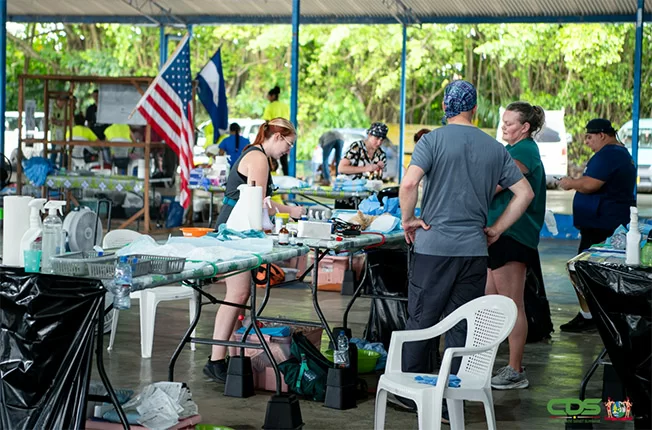
On Wednesday, the U.S.-based non-profit Caribbean Spay Neuter launched its 21st annual spay and neuter initiative for dogs and cats across Suriname at the Indra Mayu complex. A long-running staple of the country’s animal welfare efforts, the project has operated annually since 2016, with a core mission to curb the growing overpopulation of domestic cats and dogs, reduce widespread animal suffering, and cut down on public nuisance caused by unmanaged stray populations.
This year, however, the ongoing session will be the only one held in 2026 — a change from the organization’s usual schedule of two projects per year — caused by a critical shortage of funding that has forced the group to scale back its operations.
Angelique Tjang-A-Sjin, treasurer of Caribbean Spay Neuter, explained that the overpopulation crisis is driven in large part by economic barriers facing local pet owners. Most Surinamese pet owners cannot afford the high fees charged by private local veterinarians for sterilization procedures, leaving many animals unaltered and allowing stray populations to surge rapidly. “When owners can no longer care for unexpected litters of puppies and kittens, they often end up abandoning the animals on the street, and that’s when the cycle of hardship begins,” Tjang-A-Sjin noted.
Registration for the 2026 project opened in early March, with heavily subsidized participation rates made possible by private donations: just 500 Surinamese dollars for a dog procedure, and 300 Surinamese dollars for a cat, a fraction of the 2,000 Surinamese dollar price tag for the same procedure at a private clinic. The initiative brings together a mixed team of international and local volunteers, with a goal of completing at least 700 sterilization procedures during the current session. Even unowned stray animals are included in the effort, with volunteers trapping, feeding, and caring for the animals before and after their procedures.
Tjang-A-Sjin added that the organization relies almost entirely on the voluntary goodwill of international supporters, who even cover their own travel and accommodation costs to participate in the project. The group has long called on Suriname’s Ministry of Agriculture, Livestock and Fisheries to develop long-term, structural policy to manage cat and dog populations, noting that without consistent sterilization efforts, the number of unmanaged stray animals could grow by thousands in just a few years.
Project founder and chair Karin Wanner, who resides in the United States, was unable to attend the 2026 launch due to personal health issues. She continues to coordinate the initiative remotely from the U.S., where she mobilizes a team of volunteer veterinarians drawn mostly from the U.S. and Nicaragua. The visiting medical team works alongside 20 local volunteers, including university students and working professionals, to carry out the daily procedures and care for participating animals.
Joyce Kerstens, a board member of local animal welfare group Stichting Help Save Animals Suriname, emphasized that the low-cost initiative fills a critical gap in the country’s animal welfare infrastructure, making life-saving population control accessible to low-income owners and reducing systemic animal suffering. Local pet owner Anand Khemai, who brought two of his own cats to be sterilized through the project, praised the effort as a vital public and social good. “Uncontrolled population growth creates so many problems for both animals and communities,” Khemai said. “This project addresses a real need that no other local service is filling.”