标签: Suriname

苏里南

  • Guyana Energy Conference: Interesse in nauwere samenwerking met Suriname groeit

    Guyana Energy Conference: Interesse in nauwere samenwerking met Suriname groeit

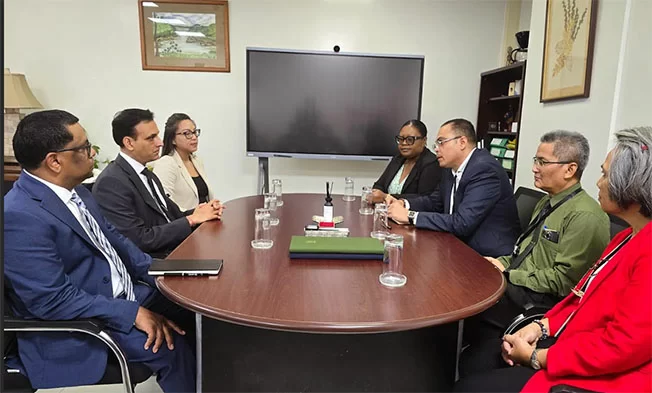
    Georgetown witnessed significant developments in regional energy cooperation during the fifth Guyana Energy Conference and Supply Chain Expo held at the Marriott Hotel. President Irfan Ali of Guyana articulated a strategic vision for leveraging energy resources to drive national development, while simultaneously revealing potential collaborative ventures with neighboring Suriname in gas development.

    Staatsolie CEO Annand Jagersar, attending the conference, confirmed in an exclusive interview that formal dialogue regarding bilateral partnerships is imminent. “Exxon has approached us to initiate discussions, and there’s concurrent interest from the Guyanese government,” Jagersar stated. He outlined multiple potential cooperation frameworks, including Suriname’s possible procurement of Guyanese gas, joint infrastructure development such as pipelines and transportation networks, and the consolidation of gas discoveries from both nations to achieve necessary project scale.

    “Gas projects fundamentally require scale economics. By combining discoveries from both countries, we can establish stronger economic viability,” Jagersar emphasized, highlighting the strategic rationale behind the proposed collaboration.

    The CEO revealed that scheduled discussions with Exxon are already set for this week, with parallel negotiations involving Guyanese government officials expected shortly. Jagersar identified the Berbice region as a geographically logical hub for cross-border cooperation, suggesting potential economic development activities on both sides of the river.

    President Ali reinforced the critical connection between infrastructure and sustainable development during his address. “Large-scale development must begin with infrastructure foundations,” he asserted, noting that economic growth only becomes sustainable when supported by robust transportation networks, port facilities, and energy infrastructure. He specifically referenced Guyana’s gas-to-energy project, scheduled to become operational later this year.

    Since his re-election in September 2025, President Ali has prioritized optimal utilization of Guyana’s gas reserves. Beyond the current project, authorities are evaluating a second gas-to-energy initiative in Berbice. The president emphasized that energy sector development should not only strengthen Guyana’s economy but also generate regional opportunities.

    The conference served as a platform for industry experts, regional partners, and stakeholders to discuss investment opportunities, local participation, and supply chain expansion. With increasing oil and gas activities in both Guyana and Suriname, strategic cooperation focusing on scale optimization, infrastructure development, and joint market approaches is receiving heightened attention.

  • Putin ontmoet Cubaanse Buza-minister in Moskou

    Putin ontmoet Cubaanse Buza-minister in Moskou

    Russian President Vladimir Putin hosted Cuban Foreign Minister Bruno Rodríguez Parrilla at the Kremlin’s Senate Palace on Wednesday, delivering strong criticism of recent U.S. sanctions against the Caribbean nation. During the high-level diplomatic encounter, Putin characterized the newly imposed restrictions as “unacceptable” while reaffirming Moscow’s commitment to supporting Havana.

    The meeting between the Russian leader and Cuba’s top diplomat occurred against the backdrop of escalating tensions between Washington and Havana. Russian state news agency TASS reported Putin’s explicit condemnation of the American measures, with the president stating: “This is a special period, new sanctions. You know how we think about this. We do not accept such things.”

    President Putin further emphasized the positive development of bilateral relations between Russia and Cuba, signaling continued cooperation between the two nations. The discussions built upon previous commitments made by senior Russian diplomats who pledged material assistance to help Cuba counter U.S. efforts to restrict the island’s oil supplies.

    In parallel diplomatic engagements, Russian Foreign Minister Sergey Lavrov held separate talks with his Cuban counterpart, urging the United States to avoid implementing a full naval blockade against Cuba. Instead, Lavrov advocated for diplomatic negotiations as the preferred approach to resolving tensions.

    Kremlin spokesman Dmitry Peskov clarified that Moscow had not discussed the Cuba matter with Washington, despite the conclusion of trilateral peace talks involving Russia, Ukraine, and the United States earlier that same day in Geneva. This positioning highlights Russia’s deliberate separation of the Cuba issue from other international negotiations.

  • Onderzoek naar mogelijke cassaveziekte in Marowijne na melding landbouwer

    Onderzoek naar mogelijke cassaveziekte in Marowijne na melding landbouwer

    Agricultural authorities in Suriname have initiated a comprehensive scientific investigation following reports of a potentially devastating disease affecting cassava plantations in the Marowijne District. The Directorate of Agricultural Development (DOAB) and the Ministry of Agriculture, Livestock and Fisheries (LVV) are leading the emergency response to address the agricultural threat.

    A specialized team led by DOAB Director Hermien Pavion conducted field visits to affected areas, accompanied by agricultural experts from both agencies and a research scientist from the Center for Agricultural Research in Suriname (CELOS). The interdisciplinary approach underscores the seriousness with which authorities are treating the potential crop epidemic.

    Prior to the field assessment, officials consulted with District Commissioner Marvin Vyent, emphasizing the critical need for enhanced monitoring systems and strengthened reporting capabilities within the administrative service. Commissioner Vyent acknowledged the particular significance of cassava as a staple food throughout the district, pledging close oversight of developments.

    One affected farmer reported losing approximately three hectares of cultivation after initially detecting symptoms. In a remarkable development, the grower claims to have independently developed an experimental treatment that reportedly restored diseased plants to healthy growth within three weeks. The farmer has temporarily declined to disclose the composition of this apparently effective treatment.

    Research teams have collected samples from both infected and treated plants for laboratory analysis. Scientists aim to identify the pathogen responsible for the disease while simultaneously evaluating the efficacy of the farmer’s unconventional treatment method. Authorities have committed to maintaining vigilant monitoring and will provide public updates as investigative results become available.

  • Geen doorbraak bij moeizame vredesgesprekken Oekraïne-Rusland

    Geen doorbraak bij moeizame vredesgesprekken Oekraïne-Rusland

    Geneva witnessed the conclusion of high-stakes peace negotiations between Ukraine and Russia on Wednesday, with diplomatic efforts yielding no tangible agreements after two days of intensive discussions. The US-mediated talks, facilitated by American envoy Steve Witkoff and former presidential advisor Jared Kushner, concluded amid heightened tensions and mutual accusations of procedural obstruction.

    Ukrainian President Volodymyr Zelensky openly criticized Moscow for employing delay tactics during the negotiations, while simultaneously facing mounting pressure to make concessions. The central disputes revolved around territorial sovereignty in eastern Ukraine’s Donetsk region and operational control over the Zaporizhzhia Nuclear Power Plant, Europe’s largest nuclear facility. Russia demanded Ukrainian surrender of partially occupied territories, while Ukraine proposed joint management of the nuclear plant with US involvement—a proposition Moscow deemed unacceptable.

    The negotiations coincided with the fourth anniversary of Russia’s full-scale invasion, which has resulted in hundreds of thousands of casualties and displaced millions according to Ukrainian estimates. Despite previous failed mediation attempts in Abu Dhabi, Ukrainian officials expressed appreciation for continued American diplomatic engagement while voicing concerns that upcoming US elections might divert attention from the peace process.

    Parallel military discussions involving US defense officials addressed potential security guarantees for Ukraine in any future peace arrangement. Sources characterized the atmosphere as ‘highly tense,’ with Ukrainian delegates deliberately maintaining modest expectations.

    Current Russian occupation encompasses approximately 20% of Ukrainian territory, including the annexed Crimean Peninsula. Recent aerial assaults on energy infrastructure have created widespread power and heating outages during harsh winter conditions, exacerbating humanitarian challenges for hundreds of thousands of civilians.

    European allies from France, Germany, and the United Kingdom observed proceedings in Geneva without direct participation, as Ukraine urged greater European involvement in future diplomatic initiatives. The inconclusive outcome underscores the profound complexity of resolving Europe’s most significant military conflict, with the international community monitoring developments while hoping for a breakthrough that might end the bloodshed.

  • Holi valt dit jaar op dinsdag 3 maart

    Holi valt dit jaar op dinsdag 3 maart

    The Ministry of Home Affairs of Suriname has formally declared Tuesday, March 3rd as the official date for this year’s Holi celebration, according to an official government announcement. Minister Marinus Bee, who signed the proclamation, confirmed that the national holiday will carry the same legal status as Sunday observances.

    Holi, traditionally known as Phagwa within Surinamese culture, represents one of the most significant festivals for the Hindu community. This vibrant celebration embodies the symbolic victory of righteousness over malevolence while simultaneously heralding the arrival of spring. The festivities emphasize core values of communal harmony, reconciliation, and collective joy through traditional rituals and colorful ceremonies.

    The governmental recognition underscores Suriname’s commitment to cultural diversity and religious inclusion. By granting national holiday status equivalent to Sundays, the administration ensures widespread participation across all societal segments. This institutional acknowledgment reflects the country’s rich multicultural tapestry where Hindu traditions form an integral part of the national identity.

    The announcement follows established protocols for cultural and religious observances within the South American nation, where Hindu festivals maintain significant cultural prominence due to historical demographic patterns. The fixed date determination provides clarity for public and private sector planning while honoring the spiritual significance of the ancient festival.

  • Ramadan begint in Gaza temidden van puinhopen van verwoeste moskeeën

    Ramadan begint in Gaza temidden van puinhopen van verwoeste moskeeën

    As the holy month of Ramadan commenced in Gaza on Wednesday, Palestinian worshippers turned to the shattered remnants of destroyed mosques and improvised prayer spaces constructed from tarpaulins and wood, demonstrating remarkable spiritual resilience amid widespread devastation.

    The landscape of Gaza City reveals the profound scale of destruction, with the dome of the obliterated Al Hassaina mosque now resting atop mounds of rubble. What was once a courtyard filled with worshippers has transformed into a living space where displaced families now sleep, cook, and hang laundry between broken columns and debris.

    Sami Al Hissi, a 61-year-old mosque volunteer, expressed profound grief while standing amidst the ruins: “I cannot bear to look at this destruction. We once prayed here comfortably, surrounded by friends and loved ones. Now there are no loved ones, no friends, and no mosque remaining.”

    The current reality represents both spiritual and societal devastation for Gaza’s residents. According to figures from the Hamas-run government’s media office, 835 mosques have been completely destroyed and 180 partially damaged during the conflict that began after Hamas’s cross-border attack on October 7, 2023, which Israeli authorities say killed 1,200 people. Additionally, 40 of Gaza’s 60 cemeteries have reportedly been destroyed.

    Israel maintains that its military operations target Hamas infrastructure and accuses Palestinian armed groups of using civilian areas, including mosques, for military purposes—an allegation Hamas denies. Palestinian health authorities report approximately 72,000 Palestinian casualties since the conflict began.

    Despite catastrophic damage and severe shortages of construction materials, community efforts have created 430 makeshift prayer spaces using repurposed plastic greenhouse covers, wood, and tent materials, according to Amir Abu Al-Amrain, director of Gaza City’s religious affairs ministry.

    Khitam Jabr, a displaced resident now sheltering in a mosque, articulated the collective disappointment: “We had hoped to celebrate Ramadan in a different atmosphere. With most mosques destroyed, we now pray in tents that have become shelters for the displaced.”

    The commencement of Ramadan in Gaza underscores both the depth of religious faith persisting through conflict and destruction, and the community’s extraordinary resilience despite overwhelming hardship. The situation highlights the urgent need for humanitarian assistance and sustainable solutions to alleviate Palestinian suffering in the region.

  • Nieuw Koffiekamp dringt bij krutu aan op eigen werkgebied binnen ZiJin-concessie

    Nieuw Koffiekamp dringt bij krutu aan op eigen werkgebied binnen ZiJin-concessie

    The Surinamese Ministry of Regional Development has engaged in crucial talks with the New Koffiekamp community regarding ongoing tensions with Chinese mining corporation ZiJin. During a traditional krutu meeting held Tuesday at the Obed Van der Kamp Krutu Hoso, Minister Miquilla Huur listened to residents’ concerns about the persistent conflict over gold mining activities in the region.

    Community representatives articulated their proposal for a clearly demarcated work area where local miners could operate legally and under regulated conditions. This formalized zone would require participant registration and identification badges, creating a system that would prevent unauthorized individuals from entering ZiJin’s concession area through the village—a solution residents believe would benefit both the government and the mining company.

    The discussions revealed severe unemployment within the village, compelling unemployed residents, including so-called ‘oekemmangs’ (informal miners), to enter the mining area to collect and process gold-bearing stones for survival.

    Beyond economic concerns, residents expressed serious environmental apprehensions. With the gold mine located less than three hundred meters from the village, dynamite explosions from mining operations have reportedly caused structural damage to homes, creating visible cracks in residential buildings.

    Fabian Afoemang, Chairman of the Gold Sector Organization Committee of New Koffiekamp, highlighted the severely limited communication between the community and ZiJin, exacerbating tensions as villagers feel constant pressure due to their location within the company’s concession boundaries.

    The Ministry of Regional Development has committed to discussing the raised concerns with relevant authorities and stakeholders, aiming to develop a sustainable and balanced solution. The meeting was attended by Minister Huur, RO Director Mavrick Boejoekoe, Brokopondo District Commissioner Gregory van der Kamp, and traditional authorities of New Koffiekamp.

  • Bestuurder overleden na ongeval op Weg naar Atjoni

    Bestuurder overleden na ongeval op Weg naar Atjoni

    A tragic traffic accident on the Weg naar Atjoni near Poeiri Bergi has resulted in the death of a 47-year-old driver identified as M.T. The fatal incident occurred during the early hours of Tuesday morning, according to authorities from the Brownsweg police department.

    Police responders arriving at the scene discovered four surviving passengers from the vehicle on the left side of the roadway. Following directions from these individuals, officers located the driver’s body in the immediate vicinity. The victim displayed no signs of life and had sustained a severe skull injury in the crash.

    Preliminary investigation indicates that the vehicle was traveling along Gaama Agbagoweg toward Atjoni when the driver lost control at a critical section of the road. The accident occurred at a gentle right-hand curve combined with a slight upward gradient near Poeiri Bergi. The vehicle subsequently veered off the roadway and descended into a ravine parallel to the left side of the road.

    The Forensic Investigation Department and Central Region Traffic Unit conducted on-site examinations to determine the exact circumstances surrounding the incident. Following authorization from the Public Prosecutor’s Office, the victim’s remains have been released to family members for funeral arrangements.

  • RO  wil via liba krutu vaart brengen in grenswet Suriname–Frans-Guyana

    RO wil via liba krutu vaart brengen in grenswet Suriname–Frans-Guyana

    The Ministry of Regional Development has committed to facilitating the resolution of the long-standing border demarcation issue between Suriname and French Guiana. This initiative aims to reinvigorate the stalled border legislation process that was temporarily suspended following protests in November 2025.

    During high-level consultations between the National Border Commission and Minister Miquella Huur alongside her executive team, Commission Chairman Harold Kolader emphasized the critical urgency of finalizing border determinations to enable eventual adoption of the border law. The previous suspension occurred after the Aucaan community submitted a formal petition raising specific concerns about the legislative proposal.

    The resolution strategy centers on implementing liba krutu – traditional community assemblies where the Ministry can directly engage with indigenous and tribal authorities along the Marowijne and Lawa rivers. These dialogues will be supplemented with informational videos to enhance outreach to remote villages. The Ministry assumes responsibility for organizing these consultations and managing all community communications.

    Kolader further stressed the necessity of a targeted public awareness campaign to clarify both the content and significance of the border legislation. He noted that French Guiana has expressed willingness to collaboratively establish the definitive border alignment in accordance with mutual agreements. Through these renewed consultation efforts and educational initiatives, Suriname anticipates revitalizing progress toward finalizing this crucial international boundary legislation.

  • Jaar van het Vuurpaard: Kan het Chinese Nieuwjaarsfestival de economie stimuleren?

    Jaar van het Vuurpaard: Kan het Chinese Nieuwjaarsfestival de economie stimuleren?

    China commenced its most significant cultural celebration on Tuesday as approximately 1.4 billion people welcomed the Lunar New Year, marking the beginning of the Year of the Fire Horse. This rare astrological combination—occurring only once every six decades—signals a period brimming with optimism, dynamic energy, and unexpected opportunities, according to traditional Chinese zodiac interpretations.

    The Spring Festival, renowned for triggering the planet’s largest annual human migration known as Chunyun, witnesses hundreds of millions traversing the nation for family reunions. This mass movement coincides with a substantial economic stimulus for the world’s second-largest economy, traditionally export-dependent but now increasingly focused on domestic consumption.

    Extended festivities spanning nine days—one day longer than typical—feature elaborate traditions including thorough home cleaning, decorative displays of red lanterns and prosperity symbols, elaborate family banquets, and the customary exchange of red envelopes containing monetary gifts symbolizing luck and blessings. The celebrations will culminate in the Lantern Festival, characterized by spectacular fireworks, vibrant dragon and lion dances, and bustling markets across urban and rural landscapes.

    Economically, the festival generates unprecedented consumption spikes across retail sectors including food, festive commodities, entertainment, and tourism. Government projections indicate a record-breaking 9.5 billion passenger journeys during the 40-day festive period, supplemented by state-issued consumer vouchers exceeding 360 million yuan (approximately $52 million) to further stimulate domestic spending. This aligns with China’s broader five-year plan to boost household expenditure, currently constrained by high savings rates approaching one-third of income.

    Technological advancements took center stage during the annual Lunar New Year’s Eve gala, where humanoid robots delivered a groundbreaking collaborative martial arts demonstration, showcasing Beijing’s rapid progress in robotics and artificial intelligence.

    The celebrations transcend national borders, with distinct cultural observances throughout East and Southeast Asia. Vietnam celebrates Tết Nguyên Đán with family gatherings and traditional foods like bánh chưng, while South Korea observes Seollal with ancestral rites and tteokguk soup. Multicultural societies including Singapore and Malaysia recognize the festival with official holidays, while diaspora communities in major global cities like San Francisco, London, and Sydney host large-scale parades, dragon boat races, and pyrotechnic displays.

    Adding contemporary cultural resonance, the Year of the Horse acquired an unexpected mascotte through linguistic coincidence: Draco Malfoy, the notorious antagonist from the Harry Potter franchise. The Mandarin transliteration of his name—”马耳福” (Mǎ ěr fú)—incorporates the character for “horse” (马) and concludes with “blessing” (福), creating an auspicious connection embraced by popular culture.