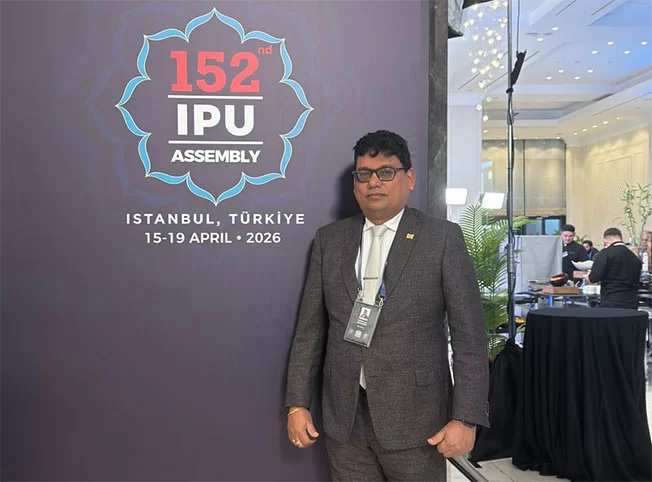
At the 152nd General Assembly and a working session of the Inter-Parliamentary Union’s (IPU) High-Level Advisory Group (HLAG), Asis Gajadien, parliamentary group leader of Suriname’s Progressive Voters Party (VHP) and member of the Surinamese National Assembly, has urged the global community to launch coordinated, targeted international action to address youth marginalization and the global youth employment crisis.
Gajadien, who joined the Surinamese parliamentary delegation to the IPU meeting hosted in Turkey, warned that overlapping global crises – from ongoing armed conflicts across multiple regions to widespread post-pandemic economic instability – are eroding the future prospects of young generations worldwide. He emphasized that the persistent lack of sustainable, dignified work for young people does not only harm individual livelihoods; it also fuels simmering social tension, weakens community resilience, and erodes public trust in democratic and governmental institutions.
The Surinamese lawmaker argued that global policy frameworks must explicitly recognize the interconnected nature of armed conflict, economic disruption, and soaring youth unemployment. He positioned decent work as a core foundation for long-term sustainable peace, arguing that this goal can only be achieved through strengthened, inclusive international cooperation. “A generation robbed of future opportunity is a risk the world simply cannot afford to take,” Gajadien stated during his address.
Turning to the root causes of terrorism and violent extremism during the HLAG session, Gajadien stressed that these threats cannot be separated from systemic economic inequality, social exclusion, and the lack of long-term perspective for disenfranchised young people. He pushed back against relying solely on repressive security measures to counter extremism, noting that such approaches fail to address the underlying conditions that drive radicalization.
Instead, Gajadien called for targeted investments in robust public institutions, inclusive economic development, and expanded access to economic opportunity as a long-term, structural solution to prevent radical recruitment. He also drew attention to the growing role of digital platforms in spreading extremist ideology online, highlighting the urgent need for balanced regulatory legislation that protects public safety while upholding fundamental human rights and digital freedoms.
Across his remarks, Gajadien advocated for a cohesive, integrated global approach to tackling these linked challenges, arguing that security, sustainable development, and the rule of law are inherently interconnected and cannot be advanced independently of one another.