标签: Guyana

圭亚那

  • Give working class more money before uncapping former presidents benefits- Buxton-Foulis NDC Chairman

    Give working class more money before uncapping former presidents benefits- Buxton-Foulis NDC Chairman

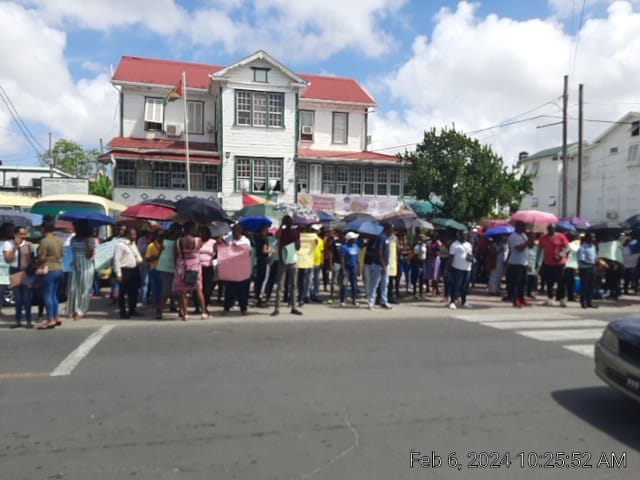
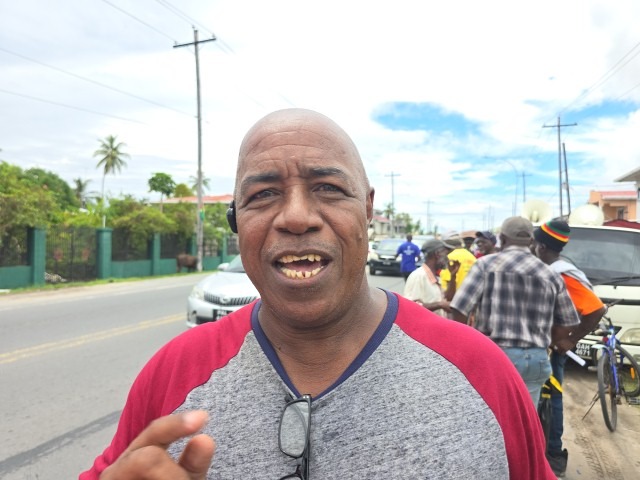
    On a sunny Sunday along Guyana’s Buxton Public Road, a small but vocal group of demonstrators gathered to push back against a highly controversial proposed bill that would grant former heads of state uncapped lifetime benefits and full tax exemptions. The demonstration has brought long-simmering public frustration over unequal public resource allocation to the forefront of national political debate.

    Walston Martins, Chairman of the Buxton-Foulis Neighbourhood Council and one of the protest leaders, laid out a conditional compromise for the government: he will not oppose the bill only if lawmakers first approve sweeping, substantial increases to public benefits for ordinary Guyanese. Martins’ demands include a $400,000 Guyanese dollar (GYD) after-tax minimum salary for public servants, a GYD$120,000 cash grant for school-aged children, a GYD$100,000 monthly old-age pension, free land plots for all adult citizens, and high-quality upgrades to the nation’s deteriorating road and bridge infrastructure.

    “If you want this legislation to pass, I have no personal objection – but you must deliver every benefit I have outlined to the Guyanese people before you move forward with the bill,” Martins told reporters from Demerara Waves Online News. “Outside of that, we will never back this bill, because it is entirely unreasonable and unfair to everyday citizens.” Despite pushback from economic observers who warn such large increases could stoke inflation and exacerbate the country’s already high cost of living, Martins – who stressed he is not a professional economist – said he does not share those concerns.

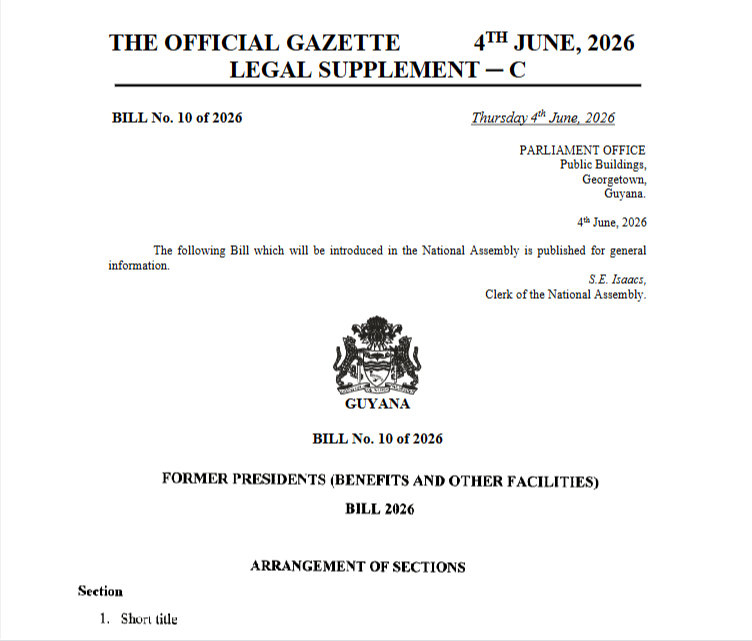
    The 2026 Former Presidents Benefits Bill, if approved, will replace the 2015 legislation enacted by the previous APNU+AFC coalition government. The current 2015 law places strict caps on benefits for former presidents: it limits combined monthly utility allowances for water, electricity and telephone services to GYD$25,000 per service, restricts the number of assigned vehicles, security personnel and support staff, caps annual medical expense coverage, and bars former presidents from receiving these benefits if they engage in profitable private business or trade.

    The new proposal effectively reinstates the 2009 law passed during former President Bharrat Jagdeo’s administration, which was repealed when the 2015 legislation went into effect. Unlike the current law, the 2026 bill sets no upper limits on any benefits for former presidents, and removes the ban on benefits for former leaders engaged in gainful private employment. These uncapped benefits come on top of the already generous monthly pension of more than GYD$2 million that all former presidents currently receive. Four living former presidents – Jagdeo, Samuel Hinds, Donald Ramotar and David Granger – would immediately qualify for these expanded benefits if the bill passes.

    While Martins offered a conditional compromise, other opposition figures are calling for the bill to be scrapped entirely. Kidackie Amsterdam, an executive member of the Working People’s Alliance, estimates the uncapped benefits could drain between GYD$100 million and GYD$200 million from the national treasury every year – money he says would be far better directed to easing the cost-of-living crisis for current low-income pensioners, who receive just GYD$46,000 per month in old-age benefits.

    Amsterdam announced that Sunday’s protest is just the first step in a broader public mobilization campaign. He is set to organize a public panel discussion in the coming weeks to build widespread public opposition, with the goal of staging large-scale national protests to force the government to abandon the legislation. “Today’s small turnout doesn’t reflect the level of public anger – we’re just starting the conversation to raise awareness,” Amsterdam explained. “Someone has to get this movement off the ground, and that’s exactly what we’ve done today.”

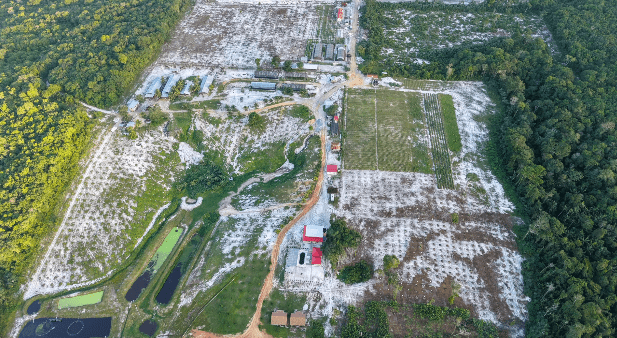
    Amsterdam also raised alarms over potential personal benefits for incumbent President Irfaan Ali, arguing Ali could exploit the bill’s tax exemption provisions to avoid paying taxes on his private 150-acre farm located off the Linden-Soesdyke Highway. “This farm is projected to generate multi-million-dollar profits, but not a single cent in taxes would go to the Guyanese people, while billions in public funds are drained from our treasury to pay for former and sitting presidents’ benefits,” he said.

    Annette Ferguson, a senior member of the People’s National Congress Reform, echoed Amsterdam’s opposition, saying the government’s ability to pass the bill with its simple parliamentary majority ultimately depends on how aware ordinary Guyanese are of the legislation’s fiscal impact. “Once more Guyanese understand how much this will cost our country at the expense of working people and retirees, they will push back,” Ferguson said. “When that public pressure builds, I don’t see the government being able to move forward with this unfair proposal.” She added that revelations about the incumbent president’s private tax-exempt farm have already galvanized additional public anger against the legislation.
  • Trinidad and Tobago wants reappointment of CARICOM SG sent to CCJ

    Trinidad and Tobago wants reappointment of CARICOM SG sent to CCJ

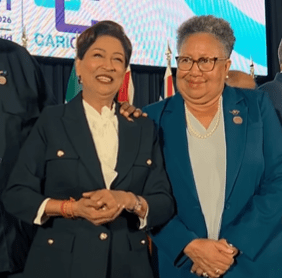
    CASTRIES, St. Lucia – July 6, 2026 – A major constitutional dispute has emerged at the 51st Caribbean Community (CARICOM) Heads of Government Summit, after Trinidad and Tobago Prime Minister Kamla Persad-Bissessar formally challenged the legality of incumbent Secretary-General Carla Barnett’s reappointment, framing the objection as a defense of institutional integrity rather than a personal or political attack.

    In a 22-page confidential letter shared with regional leaders and obtained by the Caribbean Media Corporation (CMC), Persad-Bissessar laid out detailed legal objections to Barnett’s February 2026 reappointment, which was approved during a heads of government retreat in St. Kitts and Nevis. Barnett, the first woman to hold the CARICOM Secretary-General post, began her first term in August 2021.

    The Trinidad and Tobago Prime Minister emphasized that her administration’s position is not intended to sow division within the regional bloc, but to protect the constitutional order that underpins CARICOM’s legitimacy. “Regional unity cannot rest upon expediency and irregular practices masquerading as precedent. It must rest upon adherence to the rules which every Member State has freely accepted and undertaken to uphold,” Persad-Bissessar wrote.

    Persad-Bissessar outlined four core violations of the Revised Treaty of Chaguaramas, CARICOM’s founding legal framework. First, she noted that Article 24 of the treaty explicitly grants the power to appoint and reappoint the Secretary-General to the full Conference of Heads of Government, not a closed, informal heads-only retreat. While retreats may facilitate confidential discussion, she argued, they cannot replace the formal constitutional body designated to exercise appointment authority. Even though attendees of the retreat overlap with full Conference membership, she wrote, “Substance prevails over nomenclature. A body cannot acquire treaty powers merely because participants overlap with those who ordinarily constitute the treaty organ.”

    Second, Persad-Bissessar pointed out that the official communique issued after the February retreat made no mention of the reappointment decision, depriving member states of advance notice and the opportunity to prepare for deliberation on one of CARICOM’s most senior constitutional posts. She rejected arguments that past unrecorded practices justify the current process, noting “two wrongs do not make a right,” and that the principles of openness and informed participation enshrined in the treaty require explicit agenda notice for such critical decisions.

    Third, the Prime Minister highlighted that the mandatory constitutional process requiring a recommendation from the CARICOM Community Council prior to any appointment or reappointment was completely bypassed. Persad-Bissessar stressed that this requirement is not an optional procedural formality, but a core constitutional safeguard, and that reappointment falls under the same rules as a first appointment. “By bypassing the Community Council, the constitutional balance established by the Revised Treaty was displaced, and the Conference purported to exercise a power that had not yet been lawfully engaged,” she wrote.

    Fourth, Persad-Bissessar noted that the Office of the CARICOM General Counsel failed to provide adequate legal guidance to ensure compliance with constitutional requirements for representation, agenda setting, and decision-making. She argued that this omission directly contributed to the current controversy over the reappointment’s validity.

    To resolve the dispute, Persad-Bissessar has proposed two key interim and long-term measures. First, she called for an immediate expedited advisory opinion from the Trinidad-based Caribbean Court of Justice (CCJ) – CARICOM’s highest judicial body – under Article 212 of the Revised Treaty, to clarify the treaty’s requirements for Secretary-General reappointment. She emphasized that turning to the CCJ is not an act of confrontation, but a commitment to the rule of law that all member states agreed to uphold: “Resorting to the CCJ is not an act of confrontation. It is an affirmation of the very constitutional architecture that Member States created to safeguard the integrity of the Community.”

    Second, Persad-Bissessar proposed that Barnett remain in office on a month-to-month basis only until the CCJ issues its ruling, with the extension explicitly stated to not prejudice the legal positions of any member state. She also mandated full recusal for both Barnett and the CARICOM General Counsel from all proceedings related to the CCJ referral: Barnett because she has a direct personal and legal interest in the outcome of the case that creates a conflict of interest and reasonable apprehension of bias, and the General Counsel due to her role as a primary advisor to Barnett. All responsibilities related to the advisory proceedings would be transferred to the CARICOM Deputy Secretary-General or another independent party.

    The dispute has become a central agenda item for regional leaders, who began a closed-door retreat on the first working day of their four-day summit, chaired by St. Lucia Prime Minister Phillip J. Pierre. Persad-Bissessar arrived at the summit’s opening ceremony Sunday night after Barnett delivered her opening remarks, and St. Kitts and Nevis Prime Minister Dr. Terrance Drew, who spoke after Barnett’s reappointment in February, publicly praised her stewardship of the Guyana-based CARICOM Secretariat and the regional integration movement. Drew noted that Barnett “have understood the importance of preserving the impartiality of the Secretariat while faithfully implementing the decisions of heads of government,” adding that “that balance has strengthened this community, and for this, I offer, on behalf of all of us, our sincerest gratitude.”

    In closing her letter, Persad-Bissessar reaffirmed Trinidad and Tobago’s commitment to strengthening CARICOM institutions, noting that decades of regional cooperation and collective global influence depend on transparent, treaty-compliant governance. “Those achievements can only endure where the institutions of CARICOM are administered transparently and consistently with the Revised Treaty, and with the legal framework to which every Member State has committed itself,” she wrote, adding that an authoritative CCJ ruling would provide the clarity and legitimacy needed for the bloc to move forward together.

  • Outgoing CARICOM Chairman calls for an end to leaders’ absenteeism from key decision-making

    Outgoing CARICOM Chairman calls for an end to leaders’ absenteeism from key decision-making

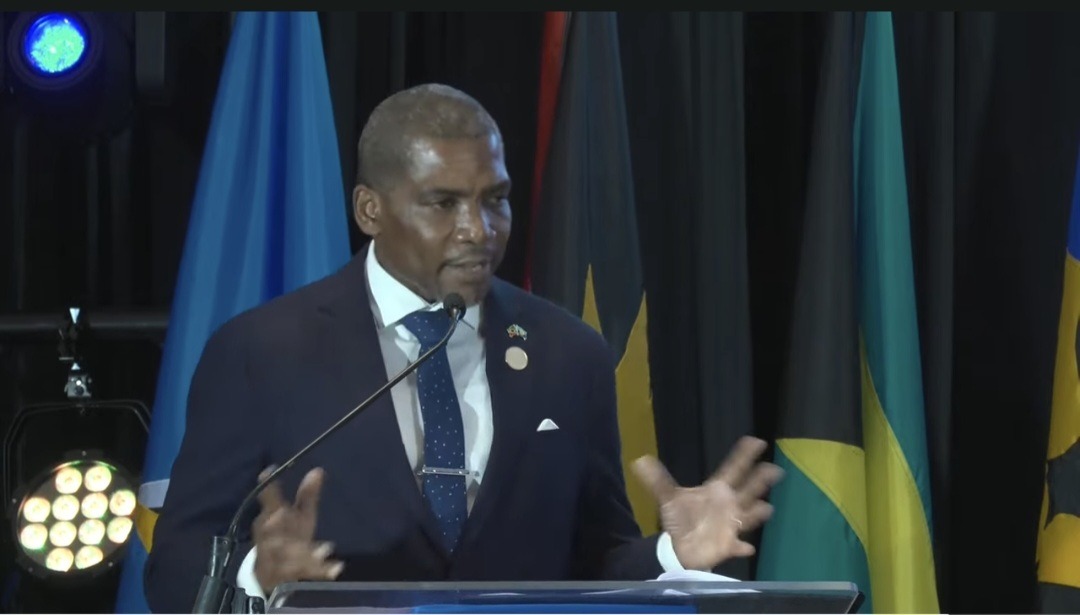
    The 51st regular summit of the 15-nation Caribbean Community (CARICOM) kicked off in St. Lucia Sunday, opening with a stark rebuke from outgoing Chairman Dr. Terrance Drew, who also serves as Prime Minister of St. Kitts and Nevis, targeted at regional leaders who skip critical decision-making gatherings.

    Drew’s opening address came amid a growing regional controversy tied to his role in announcing a second five-year term for incumbent CARICOM Secretary-General Dr. Carla Barnett, set to begin in August. The announcement has drawn fierce pushback from the government of Trinidad and Tobago, whose Prime Minister Kamla Persad-Bissessar has publicly pledged not to recognize Barnett’s tenure after her current term expires on July 31, 2026.

    The dispute over the appointment process stretches back months: Persad-Bissessar walked out of a February CARICOM summit hosted in St. Kitts and Nevis before the vote on Barnett’s re-appointment, delegating her attendance to Foreign Minister Sean Sobers. Reports later confirmed Sobers ultimately did not travel to the summit venue on Nevis, citing safety concerns related to the required ferry crossing. More recently, Persad-Bissessar also missed a virtual CARICOM summit called to address her formal objections to the appointment process, a absence that drew quiet scrutiny ahead of the St. Lucia summit.

    At Sunday’s opening ceremony, Persad-Bissessar arrived at the venue only minutes after CARICOM’s Secretary-General delivered her opening address, aligning with the pattern of partial participation that Drew called out in his speech.

    “Whenever this community faces matters of great significance, let us ensure that every head of government makes every effort to be present,” Drew told assembled delegates. He went on to emphasize that CARICOM’s internal disputes should be resolved through closed, candid dialogue between member leaders, rather than through public posturing that plays out in media headlines.

    “No newspaper headline has solved a disagreement among Caribbean leaders. No public commentary has ever replaced honest dialogue,” Drew said. “But respectful conversation among colleagues committed to a common purpose has repeatedly strengthened this community. Trust is strengthened, misunderstandings are resolved, consensus is built [when we meet in person].”

    Despite the public rift over Barnett’s appointment, Drew struck a conciliatory note in key portions of his address. He publicly praised Barnett for her tenure, highlighting her consistent professionalism, unwavering integrity, and careful commitment to upholding the impartiality of the CARICOM Secretariat while faithfully executing leaders’ policy decisions.

    “Madam Secretary General, thank you for your professionalism, your integrity, and your steadfast commitment to this community throughout my tenure,” Drew said. “Whenever I called, you answered. Whenever support was required, you and your team responded with diligence, competence, and excellence. You have served with distinction, you have understood the importance of preserving the impartiality of the Secretariat while faithfully implementing the decisions of heads of government — that balance has strengthened this community.”

    Drew also reaffirmed CARICOM’s collective commitment to Trinidad and Tobago’s upcoming candidacy for a seat on the United Nations Security Council, noting that the region’s unified backing has been critical to the small island nation’s campaign. He stressed that CARICOM’s collective influence on the global stage is only possible when all member states stand together, even amid internal disagreements.

    “Although Trinidad and Tobago was the candidate, it entered that election carrying the united and public support of the Caribbean community,” Drew said. “That support demonstrated that when CARICOM stands behind one of its own, our collective voice commands respect on the world stage. One could not imagine that Trinidad, a very small country when considered against the rest of the world, would be in a position to compete for a Security Council seat on its own.”

  • WPA calls for nationwide protest against unlimited benefits for former presidents

    WPA calls for nationwide protest against unlimited benefits for former presidents

    On the eve of CARICOM Day, Guyana’s main opposition-aligned Working People’s Alliance (WPA) has issued a nationwide call for peaceful public demonstrations to push back against the Irfaan Ali administration’s proposed legislation that would restore uncapped financial and service benefits to all former Guyanese presidents. The protest, scheduled to kick off at 10 a.m. local time on July 6, will center on a main gathering at Church of God Road in Buxton, with organizers urging civic and community groups across all regions of the country to host parallel peaceful demonstrations in their own localities.

    WPA executive member Kidackie Amsterdam made the announcement during an appearance on the *Politics 101* program hosted by Dr. David Hinds, appealing for cross-sector participation from trade unions, religious institutions, youth organizations, private sector leaders, and other civil society groups to join the demonstration. The core target of the protest is the *Former Presidents’ Facilities and Benefits Bill 2026*, which the current administration has introduced to repeal the 2015 benefits act implemented by the former APNU+AFC government that placed strict caps on all post-presidency benefits.

    Amsterdam laid out the high projected cost of the proposed legislation, estimating that the three living former presidents – Samuel Hinds, Bharrat Jagdeo, and Donald Ramotar – would drain an additional 100 million to 200 million Guyanese dollars annually from public coffers, on top of the existing arrangement that grants former presidents seven-eighths of the sitting president’s 3 million-plus GY$ annual salary. He drew a sharp contrast between this proposed generous spending and the struggles of ordinary Guyanese, noting that the country’s more than 76,000 senior citizens receive just 46,000 GY$ per month in old age pension. Former President David Granger, the fourth living former head of state, currently travels to Cuba for ongoing specialized medical care under existing benefits provisions.

    Joining Amsterdam on the program, former PNCR executive member Annette Ferguson threw her full support behind the protest, rejecting the proposal that the bill be sent to a bipartisan parliamentary select committee for review – a position put forward by PNCR executive and APNU parliamentarian Ganesh Mahipaul. Ferguson argued that the bill is unconscionable and imposes an unfair extra financial burden on Guyanese citizens already grappling with soaring cost of living, underfunded public healthcare, and underresourced education systems. She also recalled that a nearly identical uncapped benefits bill was pushed through by the Jagdeo administration in 2009, despite widespread public outcry from civil society and the then-opposition.

    Notably, the broader A Partnership for National Unity (APNU) coalition, which counts the WPA as a member, has not formally backed public protests against the bill. But the WPA has framed the demonstration as a non-partisan push to scrap legislation it argues would place an unnecessary drain on public finances at a time when most Guyanese are struggling to cover basic living costs.

    Key provisions of the 2026 bill that have sparked outrage would eliminate nearly all restrictions on former presidents’ benefits. Under the proposed law, former presidents would be exempt from all income taxes, just like the sitting head of state. Critically, the legislation would grant unlimited benefits regardless of whether a former president engages in private business, paid employment, or even if they are convicted of a criminal offense that results in a prison sentence.

    The 2015 law currently in effect – which the Ali administration is moving to repeal – puts clear limits on all public spending for former presidents. It caps combined monthly utility costs (water, electricity, telephone) at 25,000 GY$ per former president, limits medical expense reimbursement to 200,000 GY$ annually for the former president, their spouse, and minor children, and restricts reimbursement to care received at domestic public health facilities unless the required treatment is not available locally. The 2015 framework also limits personal security to no more than two full-time personnel, caps state-provided motor vehicles at two, and provides an annual vacation allowance equal to two first-class return airfares, aligned with the terms offered to Supreme Court judges.

    Amsterdam emphasized that the WPA does not oppose treating former presidents with dignity and reasonable respect, but argues any benefits must be balanced against the country’s pressing economic needs and the constraints facing ordinary taxpayers. He warned that the cumulative long-term cost to the national treasury of the uncapped benefits could run into hundreds of millions of Guyanese dollars, diverting critical funds from far more urgent national priorities. Those priorities, he said, should include higher wages and benefits for teachers, nurses, police officers and other public servants, expanded public healthcare access, increased support for pensioners and people living with disabilities, expanded school feeding programs, critical infrastructure upgrades, youth employment programs, and financial support for the agriculture sector and small businesses.

    “This is a question of national priorities,” Amsterdam said. “Public office is a privilege of service, not a pathway to unlimited taxpayer-funded privileges after leaving office. This demonstration is not about personalities or partisan politics – it is about protecting the public purse and demanding responsible governance.”

    He criticized the government for using its parliamentary majority to advance a policy that ordinary Guyanese never asked for and cannot afford, arguing that the proposed legislation is completely out of touch with the daily economic realities facing most citizens. “Every additional dollar committed to generous post-office benefits is a dollar unavailable for urgent national priorities,” he noted.

    Amsterdam closed with an appeal to all Guyanese, regardless of political affiliation, ethnicity, or religious background, to join the peaceful, lawful demonstrations across the country. “Let us demonstrate peacefully, lawfully and respectfully. Let us send a clear message that Guyana’s wealth belongs to all Guyanese and should first be used to improve the quality of life of the people,” he said.

  • Opposition Leader accuses President of “massive corruption” at highway “ranch”

    Opposition Leader accuses President of “massive corruption” at highway “ranch”

    On Sunday, July 5, 2026, a sharp public conflict erupted between Guyana’s top political rivals, as Opposition Leader Azruddin Mohamed leveled explosive GY$2.2 billion corruption allegations against sitting President Irfaan Ali over an agricultural property along the Linden-Soesdyke Highway. Mohamed published a 24-minute exposé video on his Team Mohamed’s Facebook page, complete with on-site imagery of the property, claiming the project involves improper misuse of state resources and presidential influence.

    Mohamed alleged that the 150-acre sprawling agricultural estate, which he refers to as a personal “ranch”, includes a GY$75 million public-funded access road and a GY$55 million electricity transmission line built exclusively for the property. In a pointed critique of inequity, he noted that nearby residents of St. Cuthbert’s Mission have only received four hours of grid electricity daily for decades, while Ali’s livestock – including black-bellied sheep and Brazilian cattle – enjoy 24/7 power access. According to the opposition leader’s estimates, the development also includes large ventilated poultry tunnel houses, dedicated cattle shelters, multi-level sheep enclosures, worker housing, a two-story concrete personal residence, and a recreational complex with a swimming pool, paved deck, gazebo, outdoor cooking area and event spaces, totaling a GY$165 million investment in residential and leisure infrastructure. Mohamed claimed Ali is projected to earn millions of dollars annually from the venture across poultry, cattle, sheep, goat, and fish production, and argued that the president amasses private generational wealth while pressuring business leaders to fund his lavish political fundraisers and galas.

    Notably, the report adds context: Azruddin Mohamed and his father Nazar “Shell” Mohamed are already under United States sanctions and criminal charges for alleged wire fraud, mail fraud, and money laundering connected to their gold trading operations. The U.S. Treasury Department’s Office of Foreign Assets Control claims the pair exported over 10,000 kilograms of gold without reporting it to Guyanese authorities, evading more than US$50 million in required tax payments to the Guyanese government. As of publication, none of Mohamed’s cost or revenue estimates for Ali’s property have been independently verified by third parties.

    President Ali has issued a full, vehement rejection of all allegations, speaking to reporters from Demerara Waves Online News shortly after arriving in St. Lucia for the 51st Caribbean Community (CARICOM) summit running from July 5 to 8. Ali clarified that the property is a pre-existing farm he owned long before his first election as president in 2020, and that all funding for expansions and operations comes from personal bank loans, not state resources. “There is absolutely no State involvement or no State financing for any single thing on my farm. It is in existence long before I am President and all of my assets have been declared to the Integrity Commission,” Ali stated, adding that local banking institutions can confirm all loans and asset declarations. He also rejected claims that he used presidential influence to secure the land or project benefits.

    Guyana’s Integrity Commission, unlike Jamaica’s equivalent body, is not legally required to publicly disclose the asset declarations of senior political officials. Ali further framed the accusations as part of a blackmail campaign by the Mohamed family, with whom he maintained a close personal relationship dating back to his secondary school years before the U.S. imposed sanctions on the pair in June 2024. “This part of a nasty agenda of the Mohameds and now they came out this morning with complete propaganda, lies and deception,” the president said, noting the pair had attempted similar pressure tactics until recently to force him to back down from unspecified actions.

    Ali also confirmed that his farm staff reported unauthorized drone flights over the private property for four consecutive days ahead of the accusations, with some reports of items being dropped from the unmanned aircraft. A formal police report has been filed over the incursion, and authorities are currently investigating the incident.

  • Guyana flatly denies Suriname’s claim Ali was told of new Corentyne bridge financing plan

    Guyana flatly denies Suriname’s claim Ali was told of new Corentyne bridge financing plan

    Diplomatic tensions have emerged between neighboring South American nations Guyana and Suriname over the long-planned cross-border Corentyne River Bridge, after Guyana issued a formal categorical rejection of Suriname’s recent claim that Guyanese President Irfaan Ali was briefed nearly two months ago on Suriname’s plan to take sole responsibility for financing the infrastructure project.

    The public dispute broke into the open after Suriname’s Ministry of Foreign Affairs reiterated Saturday that Ali had been officially notified of Suriname’s intention to fully fund the bridge during a May bilateral meeting. This claim followed an earlier announcement of the unilateral financing plan made in Suriname’s National Assembly the prior week, which Ali had already dismissed as inaccurate.

    In a detailed official statement released late Friday ahead of Suriname’s latest reiteration of its claim, Guyana’s Foreign Minister Hugh Todd clarified the full context of the May 15 meeting between Ali and Surinamese President Jennifer Geerlings-Simons, emphasizing the gathering was convened at Ali’s initiative to coordinate disaster assistance amid severe flooding that hit parts of Suriname. During that meeting, Todd said, Guyana offered immediate support: it deployed a technical team of drainage and irrigation specialists from Guyana’s Ministry of Agriculture, and lent two high-capacity portable pumps to support flood mitigation efforts in affected Surinamese communities. At no point during that meeting, Todd stressed, was financing for the Corentyne River Bridge ever discussed, nor was any indication given that Suriname planned to abandon the long-standing collaborative framework for the project.

    Todd recalled that the Corentyne River Bridge has been framed as a joint bilateral undertaking since the project was formalized via a 2020 memorandum of understanding between the two governments under Suriname’s previous administration. From its inception, both sides have agreed that all aspects of the project – from planning and financing to construction, operation and long-term management – would be decided through mutual consultation and joint agreement. In line with this shared approach, Guyana and Suriname have together worked to court international development partners to secure funding for the bridge, which is viewed as a key regional infrastructure project that will boost cross-border trade and social development for both nations.

    “Contrary to the impression now being conveyed publicly, Guyana has never been informed through the established bilateral mechanisms that the Government of Suriname intended to assume sole responsibility for financing the bridge,” Todd said in the statement, adding that if Suriname had formally proposed a policy shift on the project’s financing structure, Guyana would have reviewed the proposal through established diplomatic and technical channels – a step that never occurred because no formal proposal was ever submitted.

    Todd noted that Suriname’s own recent public statement acknowledges that a joint technical working group for the project remains mandated to discuss financial, technical and operational details – a fact that he says confirms financing has always been understood as a matter for joint deliberation, not unilateral decision-making by either side.

    The Guyanese foreign minister added that if Suriname has chosen to revisit the agreed financing arrangements, the appropriate diplomatic process would be to raise the proposed shift through existing bilateral communication channels first, rather than announcing policy changes via public statements that bypass direct consultation.

    Guyana remains fully committed to moving forward with the Corentyne River Bridge project, Todd affirmed, and continues to hold that the initiative must proceed on the foundational principles of transparency, mutual respect, ongoing consultation, and joint decision-making between the two governments. “The Government of Guyana stands ready to continue discussions in good faith through the agreed bilateral mechanisms with a view to advancing this transformational project for the benefit of the peoples of Guyana and Suriname,” the statement concluded.

  • Strike balance between qualifications, invaluable experience in promoting teachers- APNU

    Strike balance between qualifications, invaluable experience in promoting teachers- APNU

    On a Friday ahead of the July 4, 2026 update, Guyana’s main parliamentary opposition bloc, A Partnership for National Unity (APNU), publicly condemned the Ministry of Education for cutting the Guyana Teachers’ Union (GTU) out of the process of drafting a controversial new teacher promotions framework, arguing the policy unfairly skews rewards toward academic credentials at the expense of on-the-job experience.

    For decades, formal collaboration between the Ministry of Education and the GTU has been the standard practice for setting teacher promotion criteria, a long-standing tradition the government side abandoned when rolling out the updated system, APNU representatives emphasized during a press briefing. APNU is led by the People’s National Congress Reform, one of the country’s major opposition political forces.

    When contacted for comment on Saturday following the opposition’s public criticism, the Ministry of Education had not issued an immediate response to address the claims.

    At the core of the opposition’s objection is the revised scoring structure for promotions. Under the previous system, teachers earned incremental service credit that added up to two points per year of classroom work. The new framework drastically reduces that weight: educators now only receive one point for every five years of service, while assigning far higher point values to different levels of academic qualifications.

    Breaking down the new scoring, APNU notes that a Bachelor’s degree carries 14 points, a Graduate Diploma is worth 6 points, an Advanced Graduate Diploma 10 points, a certification in Education Management 8 points, a Master’s degree 15 points, and a PhD 18 points. By this math, the opposition calculates that a Bachelor’s degree alone carries more weight than 70 years of frontline teaching experience, while a PhD outranks 90 years of in-classroom service.

    While APNU acknowledges that incentivizing teachers to pursue further academic training is a worthwhile goal, the bloc argues the restructured system unfairly erases the value of decades of practical teaching experience. This shift disproportionately harms veteran educators, particularly those who are already nearing the end of their careers, leaving them at a major disadvantage for promotion, APNU says. The opposition adds that the new rules deny well-qualified veteran teachers earned promotion opportunities, creating a deeply inequitable system for the country’s educator workforce.

    “The message being sent by this framework is clear: experience counts for almost nothing,” APNU stated. “That is the unavoidable conclusion when five years of service in front of students earns just one point. But it is through real-world classroom experience that teachers develop the judgment, campus leadership, classroom management abilities, and hands-on practical wisdom that no textbook or degree program can ever teach.”

    The most severe harm falls on educators nearing retirement, the opposition argues. Many of these veteran teachers entered the profession at a time when opportunities for advanced academic training were far more limited than they are today, and penalizing them with rule changes so late in their careers is an unnecessary injustice, APNU says. For these teachers, promotions are not just a matter of professional recognition: they directly impact end-of-career gratuity payments and post-retirement pension benefits, meaning the new rules threaten the long-term financial security of educators who have spent their careers serving Guyana’s education system.

    Responding to the potential counterargument that veteran teachers can simply return to school to earn additional credentials, APNU parliamentarian Ganesh Mahipaul noted that this guidance is meaningless for educators who have already put in 30 to 35 years of service and are only a few years away from retirement.

  • Businessman on attempted abduction charge granted GY$1 million bail

    Businessman on attempted abduction charge granted GY$1 million bail

    On Friday, July 3, 2026, a 36-year-old city businessman from Georgetown, Guyana was granted one million Guyanese dollars in bail after being formally charged with attempted abduction, court documents confirm.

    Avishkar Singh, a resident of 208 Alexander Village in Greater Georgetown, faces an indictable charge connected to an alleged incident that occurred on June 30, 2026. The person identified as the intended target of the alleged plot is Joshua Samaroo.

    Singh’s legal representative, attorney Joel Persid-Edmond, told local outlet Demerara Waves Online News that bail was approved by Chief Magistrate Faith McGusty following more than 60 minutes of legal arguments from both the prosecution and the defense. Persid-Edmond told reporters that he presented a clear case to the court asserting the charge against his client is unfounded, claiming the entire accusation is a failed conspiracy to frame Singh for a crime he did not commit.

    The case is scheduled to return to court for further proceedings on July 29, 2026.

    The incident traces back to a police operation launched by the Guyana Police Force, which initially categorized the event as an attempted kidnapping. According to initial police statements, investigators launched an operation that uncovered allegations Singh had arranged and handed over a sum of cash as partial payment to other parties to carry out the kidnapping of the male victim.

    Following the operation, Singh was taken into police custody, and the sum of cash allegedly involved in the arrangement was seized as evidence for the ongoing case.

  • Guyana pushes for free and fair elections, economic reforms in Cuba

    Guyana pushes for free and fair elections, economic reforms in Cuba

    As of Friday, July 3, 2026, Guyana has joined growing international discourse around Cuba’s political and economic future, issuing an official statement asserting that the Cuban people alone must determine their own path through free and fair elections while calling for diplomatic dialogue to de-escalate ongoing regional tensions. The declaration comes against a backdrop of sustained pressure from the United States pushing for democratic transitions and sweeping economic overhauls in Cuba.

    In its official release, Guyana’s Ministry of Foreign Affairs laid out its core position: any lasting resolution to Cuba’s current challenges must be rooted in the explicit will of the Cuban public, grounded in universal democratic norms, respect for the rule of law, international humanitarian standards, governmental transparency, and accountable governance. The ministry referenced the foundational text of the United Nations Declaration of Human Rights, which enshrines the principle that the authority of governing bodies derives from the will of the people, a will that must be expressed through regular, legitimate elections conducted via universal equal suffrage and secret, free voting processes.

    The Guyanese government emphasized that it stands in solidarity with the Cuban population amid the country’s ongoing economic and humanitarian struggles, and it remains open to supporting any sustainable solution that addresses these issues. The statement comes weeks after Cuba’s national government rolled out broad economic reforms designed to move the country away from its long-standing command-style economic model. The policy shift has unfolded alongside widespread concerns that the U.S. is planning military intervention to remove the current administration led by President Miguel Diaz-Canel from power.

    Against this volatile backdrop, Guyana reaffirmed its belief that inclusive dialogue is the only viable path forward to unlock long-term development for the Cuban people. “We encourage diplomatic dialogue that would promote stability and lead to the prosperity of the Cuban people, and the creation of opportunities that optimise the full potential of the Cuban people in an economic environment that guarantees the freedom of the Cuban people,” the ministry’s statement read.

    This position aligns with comments Guyana’s leader made in May 2026, on the sidelines of the inaugural Shield of the Americas Summit hosted by U.S. President Donald Trump. During an interview with Fox News, the Guyanese head of state called for a political transition that would open access to greater prosperity and democratic governance for Cubans. “There must be dialogue but those changes must lead to the improvement of the people of Cuba. It must lead to better conditions for the people of Cuba, must lead to a society in which the rule of law, in which democracy, in which freedom is celebrated,” he stated at the time.

    In addition to citing the UN Declaration of Human Rights, Guyana’s foreign ministry also referenced provisions from the United Nations Convention on Civil and Political Rights, which guarantees all citizens the right and opportunity to participate in public affairs—either directly or through freely elected representatives—and to vote and stand for office in regular, legitimate elections held via universal equal suffrage and secret ballot that protects the free expression of voters’ will.

    Guyana is not alone among Caribbean U.S. allies in taking this stance. Trinidad and Tobago Prime Minister Kamla Persad-Bissessar, who also attended the Shield of the Americas Summit, has previously issued her own call for democratic reform in Cuba, aligning the two neighboring Caribbean nations’ positions on the ongoing regional debate over Cuba’s future.

  • Ali sees no need to consult new Opposition Leader on Chief Justice, Chancellor

    Ali sees no need to consult new Opposition Leader on Chief Justice, Chancellor

    On July 1, 2026, a high-stakes constitutional dispute emerged in Guyana between President Irfaan Ali and newly sworn-in Opposition Leader Azruddin Mohamed, centered on the legally required consultation process for permanent appointments to the country’s two most senior judicial roles: Chief Justice and Chancellor of the Judiciary.

    When pressed by Demerara Waves Online News for a timeline on initiating formal consultations with Mohamed, President Ali affirmed that his administration’s existing position – first outlined in a letter to former Opposition Leader Aubrey Norton – remains unchanged. The incumbent head of state noted that the government has maintained uninterrupted operation since winning re-election, and the prior recommendation for the substantive appointments of Justice Roxane George-Wiltshire as Chancellor and Justice Navindra Singh as Chief Justice still stands. When asked whether this long-held position had been formally communicated to the new Opposition Leader, Ali acknowledged the situation falls into a constitutional “grey area” that requires careful navigation, stopping short of committing to new talks with Mohamed.

    Mohamed has rejected the President’s stance outright, arguing that a prior consultation with his predecessor cannot be legally transferred to his new post. In blunt remarks, the Opposition Leader emphasized that the Guyanese Constitution explicitly requires consultation with the sitting Opposition Leader, not a former officeholder. “Norton is no longer Opposition Leader. The President needs to reach out to me directly to schedule discussions on these critical appointments – we cannot rely on a years-old letter to a different officeholder,” Mohamed stated. He further revealed that he is currently preparing legal action to compel Ali to fulfill his constitutional obligation to hold new consultations, regardless of any personal or political differences between the two men. “We have a country to govern, and the Guyanese people expect us to put national interest above personal friction. I do not understand why the President is afraid to sit down and talk with me about this,” Mohamed added. When asked whether he personally supported the permanent appointments of the two currently acting judicial officeholders, the Opposition Leader declined to take a public position, saying he would share his stance at a later date.

    The origins of the dispute stretch back to October 2025, less than two months after Guyana’s September 2025 general and regional elections, and three months before Mohamed defeated Norton in a parliamentary opposition leadership vote held on January 26, 2026. At that time, Ali first approached Norton to secure his support for making Roxane George-Wiltshire and Navindra Singh’s acting roles permanent, but Norton never granted his approval to the nominations.

    In other related remarks Wednesday, Ali confirmed that the bipartisan parliamentary appointments committee will move forward with recommending nominees for a new Police Service Commission (PSC) following the recent deaths of PSC Chairman Patrick Findlay and commission member Lloyd Conway. Reaffirming his commitment to constitutional governance, Ali stated: “Wherever my role as President requires the execution of a constitutional function, you can expect me to uphold all requirements of the Constitution, as a leader committed to democracy and the rule of law.”

    The dispute unfolds against a backdrop of broader political tension: the ruling People’s Progressive Party Civic-led administration cut formal ties with Mohamed and his father, Nazar “Shell” Mohamed, shortly after the U.S. Treasury Department’s Office of Foreign Assets Control imposed sanctions on the pair and their business entities. U.S. authorities allege the Mohameds evaded more than $50 million in taxes owed to the Guyanese government on exports of over 10,000 kilograms of gold. The two men have been indicted by a Florida federal court on charges of wire fraud, mail fraud, and money laundering connected to their gold trading operations, and are currently contesting a U.S. extradition request.