分类: society

  • Land Dispute Turns Violent in Lemonal, Woman Shot

    Land Dispute Turns Violent in Lemonal, Woman Shot

    A long-simmering land disagreement in Lemonal Village erupted into shocking violence on the afternoon of Tuesday, May 12, 2026, leaving a 33-year-old woman wounded and a licensed gun owner in custody facing serious criminal charges.

    According to official police statements, 54-year-old Rupert Gentle, a local driver, was operating a bulldozer to clear a plot of land when he was confronted by Stacey Middleton, who demanded he immediately halt his work. Middleton was not alone at the scene; she was accompanied by one other adult and an underage minor, adding another layer of gravity to the confrontation. What began as a verbal dispute escalated into physical danger in a matter of seconds. Investigators working the case confirmed that Gentle first maneuvered the bulldozer directly toward the group of protestors, an action that put Middleton and her companions in immediate danger.

    Startled and fearing for her safety, Middleton threw the contents of a water bottle toward Gentle. In the heat of the moment, Gentle told responding officers he believed the clear liquid was actually corrosive acid, and claimed he felt a burning sensation on his face. Convinced his life was under immediate threat, Gentle drew his legally licensed firearm and fired a single shot that struck Middleton in the body.

    Emergency responders rushed the injured woman to a nearby medical facility for urgent treatment, while law enforcement officers quickly secured the crime scene, recovering the weapon and unused ammunition from the area. Gentle voluntarily surrendered his firearm to authorities shortly after the shooting and was taken into police custody without further incident.

    On the following day, Wednesday, Gentle was provided access to a Justice of the Peace as required by law, and exercised his right to decline making a formal statement to investigators. Police subsequently formally charged him with two severe offenses: use of deadly means of harm and wounding. Due to the severity of the charges against him, Gentle will not be released to home confinement while he awaits trial. Under the provisions of Belize’s Crimes Control and Criminal Justice Act, the courts have no legal authority to grant bail in these circumstances. As a result, Gentle has been remanded to the Belize Central Prison, where he will remain held in custody until his next court appearance, scheduled for July 10, 2026.

  • A Driver’s Evasive Action Still Ends in Child’s Death

    A Driver’s Evasive Action Still Ends in Child’s Death

    A tragic traffic incident in Red Bank Village has claimed the life of 9-year-old Vanessa Cal, leaving local communities in mourning after what initially appeared to be a near-miss ended in sudden, irreversible loss. Two people have been taken into police custody following the collision, which unfolded at a village intersection on May 14, 2026.

    According to official details released by Assistant Superintendent Stacy Smith, a staff officer with the Red Bank Police Department, the pair — a man and a woman — were traveling in a SUV driven by the woman when the crash occurred. As the driver approached the crossing, she spotted young Vanessa moving downhill at high speed on her bicycle. The driver told investigators she intended to hit the brakes to avoid a collision, but mistakenly pressed the accelerator instead, sending the SUV careening into a nearby roadside fence. Seconds later, Vanessa’s bicycle collided with the stationary vehicle.

    In the immediate aftermath of the crash, the situation appeared less severe than it ultimately proved. First responders and witnesses noted that Vanessa showed no obvious external injuries, remained conscious and responsive, and was quickly moved to a nearby residential property for preliminary assessment. Roughly 10 minutes after the collision, however, the child’s health declined sharply: she began foaming at the mouth, prompting bystanders to rush her to a local polyclinic for emergency care. Medical teams were unable to resuscitate her, and she was pronounced dead shortly after arrival.

    Police have taken both the driver and her male passenger into custody as the investigation into the crash proceeds. Cal’s body is currently being held for a mandatory postmortem examination, which will allow forensic pathologists to determine the exact cause of her death and clarify any internal injuries that were not visible at the crash site.

    This report is adapted from a transcribed broadcast of local evening news, with transcribed Kriol language statements standardized for clarity in text formatting.

  • Relatives of Bree Arthurs Say Authorities Have Not Responded

    Relatives of Bree Arthurs Say Authorities Have Not Responded

    Fifty days have passed without a single trace of Deborah “Bree” Arthurs, a 29-year-old call center employee and single mother from Belize, and her family’s mounting impatience with local law enforcement has finally boiled over into a public rebuke.

    In a candid, urgent Facebook post shared last week, a close relative of Arthurs revealed that the family submitted a formal plea for answers to top government officials more than two weeks ago — an email dated April 27 addressed to Belize’s Minister of Home Affairs Oscar Mira and the national Commissioner of Police. To date, that message has gone completely unanswered.

    At the heart of the family’s growing alarm is the only confirmed lead in the case: multiple reports place Arthurs last seen entering a silver Chevrolet Equinox with heavily tinted windows on March 27, the day she vanished. The family is pressing for immediate answers to critical, unresolved questions: Who rented that unmarked vehicle? Who was behind the wheel the day Arthurs disappeared? And where could she have been taken after she got in?

    The criticism goes far beyond this single case, however. The relative’s post also alleges a systemic failure within Belize’s law enforcement and political system, pointing to a widely recognized pattern of organized crime and deep-rooted corruption that allows criminal actors to operate with impunity, confident they will never face consequences for their actions.

    Frustrated by the lack of movement from local authorities, the family has escalated the case to federal and international bodies. They have submitted formal documentation of Arthurs’ disappearance and their allegations of systemic failure to the Washington D.C. headquarters of international law enforcement focused on transnational crime, as well as to a serving U.S. Senator from Texas, in a bid to draw national and global attention to both the missing person case and what the family calls a ongoing crisis of criminals escaping justice while innocent people disappear and die.

    The timeline of Arthurs’ disappearance adds another layer of tragedy to the mystery. On March 27, she traveled from her home in Belmopan, the nation’s capital, to the coastal hub of Belize City to drop her young son off at a water taxi terminal for a trip. After dropping him off, she set off to return to Belmopan — but she never arrived at her destination, and has not been heard from by any family member or friend since.

  • Woman Dragged Back to Court to Face Cyberbullying Charge

    Woman Dragged Back to Court to Face Cyberbullying Charge

    An already-concluded cyberbullying legal case has made an unexpected return to Belize’s judicial system, drawing fresh public attention to a high-profile dispute between a local woman and a former top law enforcement official.

    In late 2025, Nichole McDonald, a resident of Belize City, saw the cyberbullying charge brought against her by ex-Police Commissioner Chester Williams thrown out by the court. The dismissal came after Williams, the complainant in the case, failed to appear at the scheduled original hearing, a procedural misstep that led the court to dismiss the matter without holding a full trial.

    Many observers assumed the case would stay closed after the 2025 ruling. But Williams, who has maintained he is an aggrieved party seeking full judicial resolution, refused to drop the issue, pushing aggressively to have the charge reinstated. Now, months after the initial dismissal, McDonald has been ordered back to court to answer the same accusation she was cleared of months earlier.

    Assistant Superintendent Stacy Smith, a staff officer with the Belize Police Department, clarified the legal framework that allowed the case’s revival in a recent comment on the development. Smith acknowledged that she did not hold specific details of the McDonald case, but explained that legal precedent and procedure in Belize allow for reinstatement of charges that have been dismissed or withdrawn before a full trial concludes.

    “He is an aggrieved person, and he would have made a report with the hope that the matter was ventilated and have justice take its course. Reinstated charges that did not go [the] full length is not something new or unlawful,” Smith said, confirming that the move to bring back the charge follows established legal norms.

    McDonald has entered a not guilty plea to the reinstated cyberbullying charge, and the case is expected to move through the Belize court system in the coming months. This case comes amid growing global scrutiny of how cyberbullying allegations are handled in judicial systems, particularly when complainants hold positions of former public authority.

  • Rising depression an ‘invisible disability deepening here’

    Rising depression an ‘invisible disability deepening here’

    Barbados is facing a growing, long-overlooked public health crisis as rates of depression and anxiety skyrocket, placing unmanageable strain on every sector of society – from workplaces and schools to family units and entire communities. Leading disability advocates and business leaders are now sounding the alarm, arguing that the island nation can no longer afford to relegate mental health challenges to the shadows.

    The World Health Organization already recognizes depression as the single leading cause of disability globally, and the Barbados Council for the Disabled (BCD) frames common mental health conditions such as depression and anxiety as “invisible disabilities” that carry severe, growing social and economic costs for the country. Rosanna Tudor, BCD’s operations manager, drew on decades of disability advocacy work to emphasize that these unseen conditions are far from minor issues; they are core contributors to many of the biggest challenges Barbados faces today.

    “These are the disabilities we do not see: anxiety, depression, trauma, cognitive, and neurological conditions. Yet they are shaping how people function, how they cope, and in some cases, how they break,” Tudor explained. She stressed that this growing crisis carries tangible economic consequences, noting that Barbados’ most valuable asset is its people – and when that population suffers under unaddressed mental health strain, the entire economy feels the impact. Lower workforce productivity, higher rates of absenteeism, widespread employee burnout, and widespread disengagement are just some of the measurable outcomes, she said, adding that workplaces across the country are already absorbing major costs from challenges they lack the training and resources to manage.

    “We cannot build a sustainable economy on a workforce that is silently struggling. We already had to wait years to achieve some success with ‘visible’ disabilities,” Tudor said.

    Tudor’s assessment has received full backing from Sheena Mayers-Granville, executive director of the Barbados Employers Confederation (BEC), who confirmed that local workplaces have already seen a marked jump in reported cases of depression and other mental health conditions among staff. She noted that Barbadian employers have increasingly adopted compassionate, proactive approaches to supporting employees facing these challenges, a shift that reflects broader societal maturation around mental health.

    “I think as a society we’ve matured to the point where we do recognise that mental health is very important and when persons present at work with mental health issues, then it’s treated just as serious as a physical ailment,” Mayers-Granville said. Many employers now leverage employee assistance programmes to connect staff with counselling, adjust work schedules to allow employees to process their challenges, and support gradual reintegration for workers returning after mental health-related leave. Even so, employers often lack the expertise to provide full clinical support, and must balance the needs of struggling employees with the operational demands of running a business that supports all its staff.

    Mayers-Granville acknowledged that unaddressed mental health challenges inevitably drag down workplace productivity: an employee dealing with untreated depression or anxiety cannot perform at their peak, she explained. When a team member is out or working at reduced capacity, remaining staff must pick up the extra workload, creating a secondary strain that employers must carefully navigate to avoid overburdening the rest of the team.

    “It’s navigating that balance, and I think that’s where employers sometimes find themselves in a difficult space because one, you put some guardrails around that one employee, but while still making sure that the remaining team is able to have some balance and manage through,” she said.

    Beyond workplace pressures, Tudor warned that families are carrying the heaviest, most underreported emotional burden of the crisis. “Families are carrying burdens they were never prepared for. Parents are navigating children with emotional and psychological challenges without guidance. Spouses are managing strain. Caregivers are overwhelmed. This is disability advocacy all over again,” she said. Too often, these struggles remain hidden until they escalate into tragedy, she added, and the cumulative effect is eroding family stability across the country.

    Tudor also drew a clear link between unaddressed community trauma and rising violent crime, noting that repeated gun violence incidents leave behind widespread unresolved trauma that rarely receives targeted support. “We cannot ignore the increasing fatalities arising from gun violence and the growing exposure to trauma within our communities. Each incident leaves more than a headline. It leaves fear, grief, and unresolved emotional wounds,” she said. “But when trauma is not addressed, it does not disappear. It is internalised and too often repeated. What we are witnessing is not just violence. It is the consequence of trauma left untreated.”

    Disability advocates argue that delayed action will only deepen the crisis, and the time for systemic change is now. “If we continue to wait for the next crisis before acting, we risk undermining even the strongest legislative intentions,” Tudor said, adding that low-cost, accessible programmes that create safe spaces for open discussion and remove barriers of cost, stigma, and fear can deliver meaningful immediate impact.

    In response to rising mental health needs among young people, Barbados’ Ministry of Education is already taking steps to strengthen its support systems. Senior Ministry Psychologist Dr Juanita Brathwaite-Wharton revealed that the ministry is currently drafting a new national psychosocial support policy in partnership with UNICEF and The University of the West Indies, designed to improve early identification and intervention for students struggling with mental health challenges.

    Dr Brathwaite-Wharton confirmed that the ministry has recorded a sharp increase in anxiety and depression symptoms among students, concentrated at the secondary school level. She attributed this rise in part to the widespread digital engagement of modern young people, who are exposed to a far wider range of stressful global issues – from geopolitical conflict to climate change – than previous generations, and regularly engage in harmful social comparison with curated, unrealistic content on social media.

    “This impacts your self-esteem when what is being put out there looks as though it is perfect,” she explained, noting that children internalize these unrealistic standards, with lasting negative impacts on their self-esteem and overall mental well-being.

    Over the past five to six years, the Ministry of Education has invested heavily in expanding school-based mental health support, increasing the number of on-site psychologists, social workers, safety officers, and guidance counsellors available to students. Students at the secondary level can self-refer for support, while parents, teachers, and administrators can refer students at both primary and secondary levels for evaluation and targeted intervention. The ministry also partners with private mental health agencies to expand access to care beyond what government services can provide.

    One major ongoing concern for the ministry is the rising trend of student self-medication, as young people turn to harmful substances instead of seeking professional mental health treatment. Statistics from the National Council on Substance Abuse show increasing substance use among young people starting as early as primary school, Dr Brathwaite-Wharton said, a trend that exacerbates existing mental health challenges and causes cognitive impairment that interferes with learning and emotional regulation.

    Beyond clinical support, the ministry has identified gaps in young people’s core social and emotional skills, including conflict resolution, anger management, and problem-solving. To address this, the ministry has revamped its positive behaviour management programme as part of broader national education transformation, working in partnership with the Ministry of People’s Empowerment, the Ministry of Youth, the Ministry of Health, and other cross-sector agencies. The updated programme prioritizes social and emotional learning while strengthening systemic processes to identify at-risk students and connect them with support early.


  • San Pedro’s Boom: Progress or Overdevelopment?

    San Pedro’s Boom: Progress or Overdevelopment?

    The Caribbean island of San Pedro, Belize, is experiencing an unprecedented period of exponential growth that has divided local opinion over whether the expansion represents welcome progress or reckless overdevelopment. With construction cranes dotting the skyline, new commercial and residential developments breaking ground regularly, and large-scale dredging projects underway, the northern stretch of the island in particular has seen explosive expansion that shows no immediate signs of slowing. As public debate intensifies over the costs and benefits of this rapid transformation, Area Representative for Belize Rural South Andre Perez has opened up about the government’s approach to managing San Pedro’s boom, addressing concerns ranging from housing affordability to crippling traffic congestion.

    Perez acknowledges that the island’s growth has outstripped many early projections, describing the expansion as moving by leaps and bounds, with exponential gains concentrated in northern areas of the island. He says the government is acutely aware of the growing friction between two opposing camps: tourism stakeholders who warn that unregulated rapid development risks eroding the natural charm that draws millions of visitors to the island each year, and local residents who argue they have a fundamental right to access land to build homes and achieve what Perez calls the Belizean dream of property ownership on the island. Perez concedes that the current pace of growth may require a deliberate pause to assess long-term impacts, saying “it’s going a bit too fast” and that the government is actively working to strike a sustainable balance between development opportunity and livability.

    One of the most contentious claims surrounding San Pedro’s boom is that rising land values are pricing native Belizeans out of the housing market. Perez pushes back against this narrative, while acknowledging that past policy missteps created the current affordability problem. He explains that under the previous administration, land allocation policies prioritized outside investment over local access, leaving a legacy of systemic exclusion that the current government is still working to untangle. To counteract this gap, the current administration has developed more than 1,000 new residential lots specifically designated for first-time local landowners, ensuring that young Belizeans and new generations of residents still have a path to property ownership on the island.

    Beyond land use debates, San Pedro’s exploding population and tourist traffic have created a parallel crisis on the island’s streets: a surplus of golf carts, the primary mode of local transportation for both residents and visitors, that has caused widespread congestion, noise pollution and safety hazards. Perez says officials have implemented targeted reforms to address this crisis, including pausing new approvals for golf cart rental businesses and capping the total number of rental vehicles allowed to operate. Under the new rules, only replacement vehicles are approved for existing rental operations, and priority for new personal golf cart registrations is given to residents in the remote northern stretches of Ambergris Caye, who rely on the vehicles to travel long distances for work and daily needs.

    To address a second major traffic issue – constant heavy construction truck traffic cutting through the heart of San Pedro’s town center that created persistent noise and gridlock – the government has opened two new off-shore ports on the island’s less developed eastern side. Construction materials are now unloaded and transported via these alternate routes, eliminating the need for heavy trucks to pass through residential and commercial districts. Perez notes that the policy has already produced a noticeable improvement in quality of life for town center residents, and traffic conditions are significantly better than they were just six months ago.

    Even with these targeted reforms in place, Perez emphasized that San Pedro’s unrelenting growth requires continuous monitoring and adaptive policy making. The island’s boom shows no signs of stagnating, meaning local officials will need to remain proactive to address emerging challenges and protect the needs of local residents while still supporting sustainable economic expansion.

  • Market Vendors Say Current Regulations Will Affect Their Livelihoods

    Market Vendors Say Current Regulations Will Affect Their Livelihoods

    A simmering dispute over operating day allocations at Belize City’s Michael Finnegan Market continues to unfold, as small retail farmers push back against existing regulations that they say threaten their economic survival. This latest chapter of the conflict comes after multiple retail producers were turned away from the market earlier this week, when enforcement of a longstanding rule that reserves Tuesdays and Fridays exclusively for wholesale operations, leaving only Saturdays for retail vendors, was strictly implemented.

    For many small-scale farmers who rely on the market as their primary source of income, being limited to just one selling day a week is a devastating blow. Many travel from outlying districts to Belize City to sell their produce directly to consumers, and the restriction has cut into their earnings at a time when small agricultural producers already face steep economic headwinds. Multiple vendors have told reporters that the one-day limit makes it impossible to cover their travel and production costs, forcing many to consider exiting the market entirely.

    When pressed by reporters this week on whether the current regulations could be adjusted to address the vendors’ concerns, Delroy Herrera, market manager for the Belize City Council, did not rule out changes. But he made clear that any amendment to the existing rules will follow formal, legal processes rather than being rushed through in response to individual complaints.

    Herrera emphasized that inclusive public consultation is the first and most critical step toward resolving the standoff. “Public consultation is always good because that’s how you get your feedback once you’re in political life,” Herrera said. “I understand we are at capacity inside the market right now, but we want all our people – especially the small farmers who are struggling – to come to the table and lay out the challenges they are facing.”

    He acknowledged that many small producers who travel to Michael Finnegan from other districts already face barriers and unfair treatment in their home regions, driving them to seek more open selling opportunities in Belize City. “They already feel like they are being bamboozled in their districts, so they come here to get a fair shot,” Herrera noted.

    Herrera framed the existing regulatory structure as a necessary framework to keep the market operating orderly, comparing it to household rules that keep daily life running smoothly. “Every house has rules, right? And so it’s simple to understand the rule, to work around the rule, or to amend the rule, but we have to do it respectfully, and we have to do it with the constraint of the law,” he explained.

    Once the consultation process is complete, Herrera said the council will draft a formal proposal outlining potential adjustments to the day allocation rules, with the goal of reaching a solution that works for all stakeholders – the council, wholesale vendors, and small retail producers. “Once we have that done, then from there we can do whatever amendment needs to be done to incorporate everybody so that everybody can move harmoniously,” he said.

    The market manager did, however, set a clear condition for any meaningful progress: rather than submitting scattered, individual complaints, retail vendors must organize and present their shared demands as a unified collective. “The council cannot act on scattered individual complaints,” Herrera stressed. “For any real change to happen, retail vendors will need to unite, bring their concerns to the table as one voice, and give the process a chance to work.”

    As of Thursday, no formal date for the public consultation has been announced, and vendors are still in the early stages of organizing to coordinate their collective demands. The dispute highlights the ongoing tension between regulatory order and the livelihood needs of small, independent producers in Belize’s informal agricultural sector.

  • Police probe Pinelands shooting incident

    Police probe Pinelands shooting incident

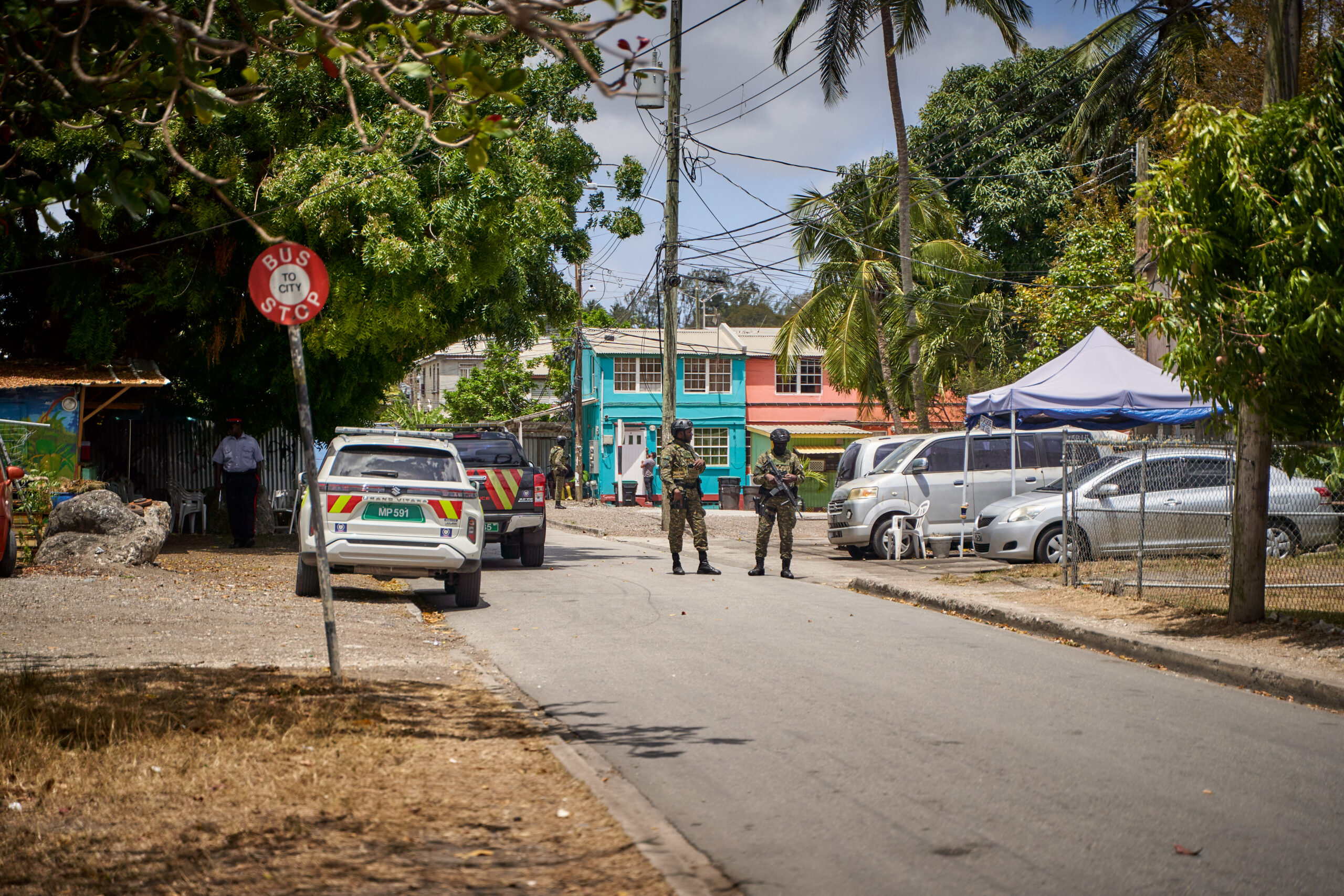
    A major manhunt is ongoing in the parish of St. Michael after a Thursday morning shooting involving law enforcement officers assigned to the regional anti-crime initiative Operation Broken Trident. The incident unfolded along Field Road in the Pinelands neighborhood just after 10:30 a.m., when a combined patrol of police officers and military personnel was conducting routine neighborhood security checks, according to official police statements.

    As the patrol approached a small group of men gathered in an informal gathering near a local commercial venue, one individual in the group immediately fled across the street while pulling a handgun from his clothing. Police officials confirmed that the fleeing suspect then pointed the loaded firearm directly toward the line of responding officers. Fearing an imminent threat to his life and the safety of other personnel on the scene, one officer discharged his service weapon at the suspect.

    Despite the officer’s action, the suspect managed to evade capture and remains at large as of the latest update from law enforcement. No injuries to officers, military personnel, or bystanders have been reported in connection with the incident, and the condition of the suspect remains unknown.

    Authorities have confirmed that the investigation into the encounter is still active and ongoing, with detectives working to identify and locate the suspect. Police are calling on members of the public who may have witnessed the shooting, have information about the suspect’s identity, or know of his current whereabouts to come forward to assist with the case.

    Members of the community with relevant tips can submit information anonymously through Crime Stoppers at 1-800-8477, contact the national police emergency line at 211, or reach out directly to investigators at District ‘A’ Police Station at 430-7242.

  • Two Detained After 9 Y/O Girl Dies in Red Bank Village RTA

    Two Detained After 9 Y/O Girl Dies in Red Bank Village RTA

    A tragic traffic incident in Red Bank Village has ended the young life of 9-year-old Vanessa Cal, leaving local communities in mourning and prompting law enforcement to take two people into custody as the investigation into the crash proceeds. The fatal collision, which occurred on [May 14, 2026], unfolded at a local intersection in circumstances that have been outlined by police in initial briefings.

    Assistant Superintendent of Police Stacy Smith shared details of the incident with reporters this afternoon, confirming that Cal was riding her bicycle near the intersection when the crash occurred. According to Smith’s account, the driver of a sport utility vehicle lost control and struck a perimeter fence at the junction, and the moving vehicle subsequently collided with the young cyclist.

    The female driver, who was behind the wheel at the time of the crash, told responding officers that she had meant to press the brake pedal to slow or stop the vehicle, but mistakenly hit the accelerator instead, leading to the unintended loss of control that caused the crash. After the collision, the driver told investigators she checked the scene immediately, where she found Cal’s bicycle damaged, but the child did not appear to have any obvious outward injuries and remained responsive following the impact.

    Cal was moved to a nearby residential property to receive initial care while waiting for emergency medical support, but her condition declined rapidly despite initial observations that her injuries were not visible. No further details on the timeline of her condition deterioration or the exact cause of death have been released ahead of a scheduled postmortem examination, which will formally document the cause and manner of the young girl’s death.

    Both the female driver and a male passenger who was in the SUV at the time of the incident have been taken into police custody to await further investigation. Law enforcement has not yet filed formal charges against either individual, and the investigation remains active as officers work to piece together the full circumstances of the crash. Cal’s body remains in police custody ahead of the postmortem examination, which is expected to provide critical clarity for the ongoing investigation.

  • Cabinet Bans Hunting of Three Species, Here’s for How Long:

    Cabinet Bans Hunting of Three Species, Here’s for How Long:

    In a developing environmental policy announcement dated May 14, 2026, Belize’s national Cabinet has greenlit a 12-month moratorium on all hunting and capture activities for three native wildlife species, paired with a sweeping update to the country’s outdated wildlife protection legal framework — a move that has drawn both praise and measured criticism from regional conservation leaders. The temporary ban specifically targets three at-risk populations: the white-lipped peccary, the yellow-headed Amazon parrot, and the brown brocket deer, all of which have recorded sustained population declines in recent decades due to unregulated hunting and habitat loss across Belize. Alongside the hunting restriction, Cabinet formally approved the new Wildlife Conservation and Management Bill, a piece of legislation designed to replace the decades-old original Wild Life Protection Act that has guided the country’s conservation rules for generations. Dr. Celso Poot, the long-serving Managing Director of the Belize Zoo and a prominent voice in Central American wildlife conservation, described the policy updates as a long-awaited milestone for the region’s environmental community. In his response to the announcement, Poot emphasized that the revised legislation has been years in development, shaped by extensive cross-stakeholder consultations that address gaps in the country’s original, outdated regulatory framework. “This is something that has been in the works for many years. A lot of consultations have gone into the updating of it… I think that will be welcomed by the conservation community because we have a lot of antiquated laws,” Poot stated. Despite his support for the broader regulatory overhaul, Poot raised pointed questions about whether the one-year timeline for the hunting ban will be sufficient to allow the protected species’ populations to recover to sustainable levels. He noted that the three species included in the ban are just a small fraction of the Belizean wildlife currently facing downward population trends, adding that most vulnerable large mammal and bird species require far longer than 12 months of protection to rebound from decades of overexploitation. Poot further argued that hicatee turtles, a critically endangered freshwater turtle species native to Central America, should have been added to the list of species protected under the new moratorium, given their ongoing population collapse across the country. This developing story will be updated with full additional details in a broadcast airing at 6:00 p.m. local time.