分类: society

  • Catholic Church Defends HPV Vaccine Position

    Catholic Church Defends HPV Vaccine Position

    A public debate over HPV vaccination policy in Belize has intensified in recent days, as the Catholic Diocese of Belize City and Belmopan has issued an official statement clarifying and defending its long-held stance on school-based administration of the vaccine, pushing back against widespread misinterpretation of its position.

    Contrary to circulating rumors that the Church opposes the life-saving immunization itself, the diocese made clear that it fully acknowledges the public health value of HPV vaccines and deems them ethically acceptable for use. The core of the institution’s objection is not to the vaccine, but to the government’s chosen model of delivering doses directly on school campuses, a policy the Belizean Ministry of Health has already implemented across the country.

    Under the ministry’s current nationwide initiative, registered nurses and other qualified medical personnel travel to public and private schools to administer HPV vaccines to eligible students. The diocese argues that this framework is improper for a vaccine that targets a sexually transmitted infection, centering its critique on the critical issue of informed parental consent.

    In its statement, the diocese emphasized that parents must receive full, unfiltered medical information about the vaccine without any external pressure or coercion to consent. The institution maintains that decisions about childhood HPV vaccination should be made exclusively in clinical settings, where parents — who hold the legal and ethical right and responsibility to make medical decisions for their minor children — can weigh the risks and benefits alongside trusted healthcare providers, aligned with their own moral and cultural values.

    The Church also raised a practical note about the limitations of the most widely used HPV vaccine, Gardasil 9. While acknowledging that the shot provides robust protection against multiple high-risk strains of the virus, the diocese pointed out that it does not cover every cancer-causing HPV variant circulating in Belize. This clarification aligns with data from the U.S. Centers for Disease Control and Prevention (CDC), which confirms that more than 200 distinct HPV strains exist globally, and Gardasil 9 only targets the nine strains responsible for the majority of HPV-related cancers and genital warts.

    Despite its public disagreement with the ministry’s rollout model, the diocese stressed that it shares the same core goal as the government: protecting the health and wellbeing of Belizean children. The institution added that it remains open to collaborative dialogue with the Ministry of Health to adjust the policy, though it has no plans to reverse its position on the inappropriate nature of school-based delivery. For its part, the Ministry of Health has stood firm on its current strategy, framing the nationwide HPV vaccination initiative as a critical public health priority.

    The debate comes as global health authorities widely recommend HPV vaccination for pre-adolescent children, as the vaccine provides the strongest immune protection before the onset of sexual activity, when exposure to the virus typically occurs.


  • Suspect at large after shooting at police in Chaussee Road operation

    Suspect at large after shooting at police in Chaussee Road operation

    A targeted anti-crime operation in Saint Lucia ended in a violent armed exchange this Tuesday, after an armed suspect opened fire on serving law enforcement officers along Chaussee Road in Castries. While the alleged attacker managed to evade capture following the confrontation, police have confirmed that one illegal weapon was recovered, and all individuals connected to the incident have already been identified.

    In an official public statement released Thursday, Assistant Commissioner of Police Luke Defreitas — who heads the force’s Central Division — detailed the sequence of events that unfolded. The operation was carried out by the Royal Saint Lucia Police Force’s specialized Gangs, Narcotics and Firearms Unit, with backup support from other departmental units. Its core goal was to crack down on rising violent crime and the proliferation of unregistered illegal firearms across the Central Division.

    According to Defreitas’ account, when officers encountered the armed suspect on Chaussee Road, the individual fired multiple shots directly at the police team, putting every officer present in immediate lethal danger. In response, officers returned fire, acting with what Defreitas praised as “discipline and lawful restraint” that prevented unnecessary escalation. Despite the exchange of gunfire, no officers suffered serious injury or death, a close call that Defreitas credited to the team’s quick thinking and training.

    After the confrontation, law enforcement recovered a Glock 27 pistol from the scene. Defreitas noted that the handgun is engineered for close-range lethality, a characteristic that makes its seizure a critical win for public safety. The recovery, he stressed, highlights just how severe the threat of illegal firearms circulation remains across the island.

    Though the suspect successfully escaped, Defreitas issued a direct warning to the attacker and any accomplices: all involved have been identified, and they are urged to turn themselves in to police custody immediately.

    Defreitas framed the attack on officers as an assault on the nation’s foundational security, stating clearly that the Royal Saint Lucia Police Force will not tolerate such acts of violence against its personnel. He linked the incident to a recently documented sharp rise in gun violence across Saint Lucia, where criminal networks continue to deploy weapons with total reckless disregard for innocent civilian life.

    Pushing back against any perception that the suspect’s escape emboldens criminal elements, Defreitas noted that the outcome reflected the force’s commitment to protecting broader public safety. “While the offenders have escaped, this was in the interest and safety of the wider public. Under different circumstances, the outcome would have been different,” he said.

    He commended the officers involved for their courage and professionalism during the high-stakes confrontation, adding that their conduct stopped what could easily have become a catastrophic mass casualty event. Finally, Defreitas called on the general public to partner with law enforcement in the ongoing fight against gun crime, emphasizing that long-term success requires widespread community vigilance, active cooperation with police, and universal respect for the rule of law.

  • Is Ambergris Caye’s Tourism Driving Belizeans Off Their Own Land?

    Is Ambergris Caye’s Tourism Driving Belizeans Off Their Own Land?

    Nestled in the heart of Belize’s Caribbean coastline, Ambergris Caye has long stood as one of the country’s most popular tourist destinations, drawing thousands of annual visitors with its turquoise waters, coral reefs, and laid-back island culture. But as the tourism sector continues to expand at a breakneck pace, a growing public debate has emerged over who exactly benefits from this boom — and whether long-time local residents are being pushed off the land their communities built.

    As of May 14, 2026, Andre Perez, the area’s elected representative, acknowledged publicly this week that large-scale development across the island has progressed “a bit too fast,” confirming that the national government has been “acutely aware” of the mounting pressures facing local communities. Despite this acknowledgment, construction activity shows no signs of slowing: cranes remain operational across the island, dredging work for new resort and residential projects continues, and new construction sites are still being cleared, particularly in the less developed northern stretches of the caye.

    This unrelenting growth has forced an uncomfortable question into the public spotlight: Is the island’s main town of San Pedro being developed for native Belizeans, or exclusively for the foreign tourists that power its economy?

    Perez pushed back against widespread claims that local residents are being priced out of the land market in an interview with local outlet News 5 on Wednesday. He pointed to a government initiative that has delivered more than 1,000 developed lots to first-time Belizean landowners as evidence that officials are still working to preserve access for locals. He argued that this program directly counters narratives of displacement, noting that young, first-time buyers now have clear pathways to secure property on the island.

    “Everyone here, the new generation, first-time landowners, are getting the opportunity to get a piece of land,” Perez told reporters. “So that is actually counteracting those that are saying [they] are being outpriced.”

    He added: “It remains on them to decide whether they want to sell or not, but they have been delivered in their hands a title that says they have a piece of Ambergris Caye.”

    While the government frames its land initiative as a solution to affordability concerns, local residents argue that rising property values driven by tourism investment are about more than just upfront housing costs. The steady influx of outside capital and tourism-related infrastructure has gradually shifted the island’s cultural and economic identity, reshaping a community that was once built around local fishing and small-scale commerce into a hub catering almost exclusively to international visitors.

    Many locals now worry that the same rapid growth that has boosted the island’s GDP will ultimately displace the intergenerational communities that gave Ambergris Caye its unique character. Perez acknowledged these growing anxieties this week, admitting that calls for a slowdown in development merit serious consideration.

    “I can hear the concerns of certain people, especially in the tourism business,” Perez said. “Perhaps it’s time to look and say, ‘Let’s take a pause in development,’ because it’s going a bit too fast. So as a government, we are aware of it, acutely aware of it.”

  • Unsung Heroes programme opens for 2026 nominations

    Unsung Heroes programme opens for 2026 nominations

    A regional search is now open across 10 Caribbean markets to shine a long-overdue spotlight on ordinary people whose quiet, consistent contributions make extraordinary differences to their communities, as CIBC Caribbean brings back its popular Unsung Heroes programme for 2026. The initiative, which was first relaunched last year, offers thousands of dollars in cash prizes to standout winners, and organizers are now calling on members of the public across Barbados to submit their nominations.

    Speaking at the official launch event held Thursday at Bridgetown’s Michael Mansoor Building, Victor Boyce, CIBC Caribbean’s Barbados Country Head, highlighted the overwhelming success of the 2025 relaunch and reiterated the programme’s core mission: to celebrate unrecognized acts of service, bravery, and compassion that often fly under the public radar.

    Operating across all 10 Caribbean territories where the bank maintains a presence, the Unsung Heroes programme follows a two-stage judging process. First, each participating territory selects its own local winners. Those local champions then advance to a regional judging panel, which picks one overall regional unsung hero and two second-place runners-up.

    When the programme was relaunched in 2025, organizers expanded eligibility to include any individual aged 10 and older, a change that uncovered a wealth of inspiring stories from young community changemakers that would have otherwise gone uncelebrated, Boyce explained. Beyond youth involvement, the programme accepts nominations across three core categories: outstanding community service, acts of bravery or heroism, and extraordinary acts of kindness, all carried out within the past 12 months.

    Boyce noted that a common thread across all past nominees and winners is their humility: most had no idea how much their actions had impacted the people around them. “Almost all of our heroes whom we have identified via this programme have been surprised when they were chosen, and they tell us that they were humbled even to have been nominated,” he said.

    As a standout example of the kind of work the programme celebrates, Boyce pointed to 2025’s Barbados national winner, Carla Daniel, whose grassroots work protecting local sea turtle populations and boosting community environmental awareness captured widespread public admiration. Daniel once even dove into a muddy drainage ditch to rescue a trapped sea turtle, and her efforts have not only helped stabilize local turtle populations but also inspired hundreds of Barbadians to care more about coastal conservation, Boyce added.

    Organizers are encouraging nominations from a broad group of people, including native Barbadians, visitors, and temporary residents who have encountered an unsung champion making a tangible difference in the country. “Do you know of someone who has performed an act of heroism or bravery which has not been recognised?” Boyce asked the public. “Log on to our corporate website, CIBCCaribbean.com, and follow the easy steps to nominating your CIBC Caribbean Unsung Heroes.”

    The prize structure for 2026 offers substantial rewards for honorees. Barbados’ national winner will take home BBD $10,000, with the national runner-up receiving BBD $5,000. At the regional level, the top winner earns US $10,000 (equal to BBD $20,000), while the two regional runners-up receive US $7,000 (BBD $14,000) and US $5,000 (BBD $10,000) respectively. New for 2026, the person who nominates the eventual regional winner will receive a US $1,000 (BBD $2,000) incentive prize for their participation.

  • GAIA bosses reject NUPW wage talks inaction claim

    GAIA bosses reject NUPW wage talks inaction claim

    Two days after airport workers held a public protest over stalled wage negotiations, leadership at Grantley Adams International Airport Inc. (GAIA) has pushed back against allegations from the National Union of Public Workers (NUPW) that company management has refused to engage in collective bargaining.

    In an official statement provided to local outlet Barbados TODAY on Thursday, GAIA spokesperson Sharleen Browne-Jones refuted the union’s claim that airport leadership has ignored multiple outreach attempts to schedule formal negotiations. “That assertion is incorrect,” Browne-Jones stated, pointing to a documented trail of communications between GAIA Inc. and the NUPW spanning several months, with confirmed exchanges on February 10, April 2, April 7, April 14, and May 8.
    Browne-Jones explained that scheduling conflicts rooted in conflicting availability on both sides have been the primary barrier to holding formal talks, rather than deliberate delay from management. “At different points, availability constraints arose on both sides, including instances when NUPW representatives were unavailable and other instances when GAIA Inc. was unavailable,” she said. “It is therefore not accurate to suggest that GAIA Inc. has been unresponsive or that it is delaying the process.”

    Browne-Jones’ comments came in direct response to industrial action held at the Barbados airport on Tuesday, when dozens of workers walked off the job to demonstrate against what union leadership described as months of silence from management in response to a formal wage adjustment proposal. The NUPW, which represents the airport’s frontline and administrative staff, submitted its formal bargaining package nearly five months ago, calling for a 20 percent wage increase for the 2025–2027 period. According to the union, GAIA management has still not tabled a formal counter-proposal to the workers’ request.

    Speaking at Tuesday’s protest, NUPW president Kimberly Agard accused GAIA Inc. of refusing to enter meaningful negotiations despite the union’s repeated requests for a meeting. “The NUPW would have put a position to the management of GAIA Inc. since last year December, and to this date, no response has been given,” Agard told reporters. She emphasized that the union had “continuously reached out to management” in an effort to return to the bargaining table, noting that staff frustration had grown steadily over the months of delay. “The members are frustrated. They work hard, they deserve better,” she added.

    In Thursday’s statement, Browne-Jones pushed back against that narrative, confirming that discussions remain active and that management is fully committed to reaching a resolution through open, constructive dialogue. “The management of GAIA Inc. remains in communication with NUPW. A meeting in June has already been proposed, and GAIA Inc. continues to work toward that date,” she said. Browne-Jones added that if an earlier time slot that works for both parties becomes available, airport management stands ready to convene negotiations ahead of the planned June date.

    “GAIA Inc. values its employees tremendously, respects the role of the union, and remains ready and willing to engage constructively,” Browne-Jones said.

  • Nighttime Detour and Single-Lane Traffic Planned for Section of All Saints Road

    Nighttime Detour and Single-Lane Traffic Planned for Section of All Saints Road

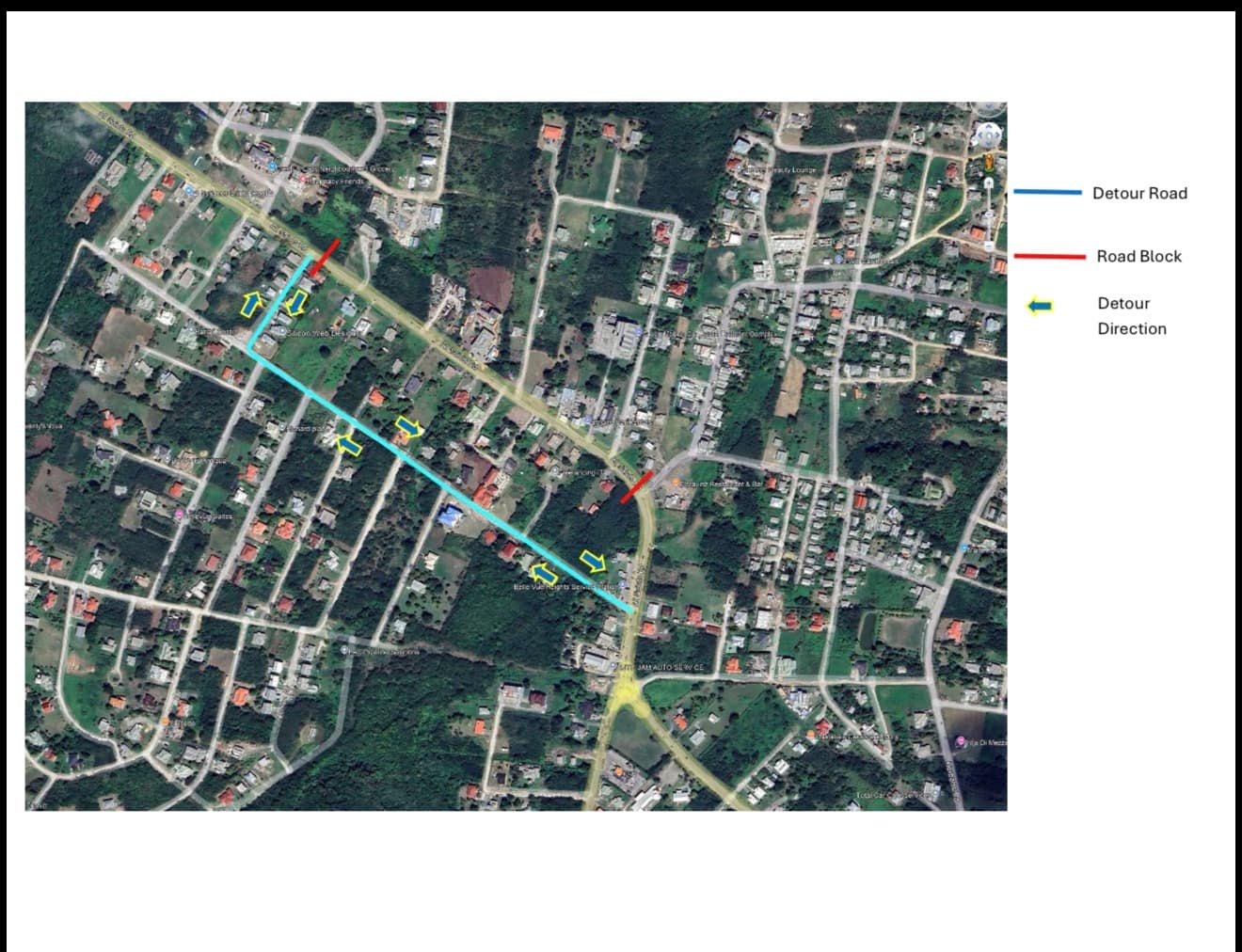
    The Government of Antigua and Barbuda’s Ministry of Works has issued a public advisory announcing major infrastructure upgrades along a key stretch of All Saints Road, set to trigger temporary traffic changes next decade. The works will take place between two prominent local landmarks – FADI Building Supplies and the Fresh and Eazy Supermarket – and follow a period of single-lane traffic operations on the corridor.

    Starting at 7:00 pm on Thursday, 14 May 2026, once single-lane access is suspended for the night, a full temporary detour will remain in effect until 7:00 am the following morning. The Ministry has outlined clear, direction-specific routes to guide motorists through the disruption. For drivers traveling out of town, the detour requires a right turn at Flex Hardware Store, then a return to All Saints Road via the route passing Heritage Preschool. Motorists heading into St. John’s town center will instead turn left at D’Cravinz, regaining access to the capital through the Herberts route.

    To minimize confusion and keep traffic moving, trained flag persons will be stationed at key points along the detour to assist commuters. Motorists are reminded that marked sections of the temporary route operate as one-way traffic zones, with all layout details clearly marked on official project maps. Directional signage has also been installed along the entire detour corridor to guide drivers traveling in both out-of-town and inbound directions.

    Local residents who live in the immediate area of the construction zone will retain limited access to their properties, though the Ministry has urged all road users to exercise extreme caution while traveling through the area. Heavy-duty construction machinery will be active in the work zone throughout the overnight closure, creating potential hazards for unaware passersby.

    Importantly, the advisory confirms that all commercial businesses located along the closed stretch of All Saints Road will remain open for operations during the works, meaning residents and customers can still access local shops and services. This overnight upgrade forms part of the broader, government-led All Saints Road Project, a long-term infrastructure initiative aimed at improving the corridor’s safety, capacity and longevity.

    Public works officials have urged all regular users of All Saints Road and stakeholders in the area to revise their travel plans ahead of the scheduled works, noting that short delays are inevitable during the overnight closure. Any members of the public with questions or concerns about the traffic changes or the project more broadly can contact the Project Implementation Management Unit directly at 562-9173 for further information.

  • WASCO steps up trucking, valving operations as drought continues

    WASCO steps up trucking, valving operations as drought continues

    One of the most intense prolonged dry periods in recorded history has pushed Saint Lucia’s public water system to a breaking point, forcing the national Water and Sewerage Company Inc. (WASCO) to maintain emergency water delivery and distribution protocols across the entire island to mitigate widespread shortages.

    In an official public update released Thursday, WASCO confirmed that months of dramatically below-average rainfall have pushed inflows at the country’s most critical water treatment facilities to dangerously low levels. Two major processing hubs, the Theobalds Water Treatment Plant — which serves populated communities stretching from Millet to Cap Estate — and the Hill 20 Water Treatment Facility, which supplies the Babonneau region, have both been hit particularly hard by the sustained drought conditions.

    The crisis is not isolated to northern and central parts of the island. Southern Saint Lucia’s water networks, which serve communities including Dennery, Beausejour, Patience, Soufrière and Choiseul, are also grappling with steep cuts to available supply. These reductions have forced lower production outputs across the board, adding unplanned strain to the island’s already overstretched distribution infrastructure.

    To address the immediate crisis, WASCO has ramped up emergency potable water trucking operations, prioritizing delivery to essential public services and the communities facing the most severe scarcity. The utility has also continued targeted community valving operations designed to create a more equitable distribution of remaining available water across all affected districts.

    Meteorological data confirms the severity of the dry spell that has gripped the island since June 2025. Speaking at a WASCO press briefing earlier this month, Director of Meteorological Services Vigil Saltibus explained that months of below-average rainfall have evolved into active developing drought conditions. The 2025 wet season finished with a 37% deficit in total rainfall compared to long-term averages, and the shortfall has carried over into the 2026 dry season with no meaningful relief.

    As of April 2026, accumulated rainfall between June 2025 and April 2026 ranks as the third driest such period on record, Saltibus confirmed. Dry, parched soils have absorbed any light scattered rainfall that has occurred, leaving almost no excess to replenish rivers, reservoirs and critical water catchment areas. This means natural water systems have had no opportunity to recover from months of depletion, keeping supply levels under constant pressure.

    Looking ahead, forecasts indicate that below-average rainfall will likely persist into the early stages of the 2026 hurricane season, a trend partially driven by a developing El Niño climate pattern. This extended dry forecast is expected to push demand for water even higher, worsening stress on already depleted reserves.

    Alongside emergency distribution efforts, WASCO has moved quickly to accelerate water quality testing across all affected distribution networks, working to uphold public safety standards even as inflows remain low. The utility is collaborating closely with the Water Resources Management Agency, the Ministry of Environmental Health, and both regional and international partners to ensure all water supplies remain fully compliant with World Health Organization safety protocols.

    In addition to short-term emergency response, WASCO highlighted long-term infrastructure projects aimed at boosting the water system’s resilience to future climate extremes. These include ongoing redevelopment works in the Patience region, designed to strengthen long-term supply reliability for the community.

    WASCO is urging all customers across the island to prioritize water conservation, store water supplies safely, and use existing reserves sparingly for the duration of the dry spell. The utility has also advised residents to monitor its official website and social media channels for the most up-to-date information on water trucking routes and valving schedule changes.

  • Should Retail Vendors Unite to Push for More Selling Days?

    Should Retail Vendors Unite to Push for More Selling Days?

    A growing debate over selling day restrictions at Belize’s Michael Finnegan Market has moved into the spotlight this week, as city authorities confirm they are willing to revise existing rules— but only if retail vendors band together to formally push for change.

    Currently, local retail vendors at the popular public market are only permitted to sell goods on Saturdays, a regulation that has sparked growing frustration among small-scale producers and street vendors who rely on the market for their primary income. The dispute boiled over earlier this week, when a routine regulatory enforcement operation turned away multiple retail vendors who attempted to set up their stalls outside of the allowed single weekend day.

    Delroy Herrera, the manager of Michael Finnegan Market, outlined the city council’s position in an interview with local outlet News 5 on Tuesday. He emphasized that the council does not reject the idea of expanding selling days, but any adjustment to existing policy must follow official legal and procedural channels.

    “Every organization, every public space operates with clear rules, right? It’s straightforward: you can follow the rule, work within the framework of the rule, or push to amend the rule. But that change has to happen respectfully, and it has to stay within the constraints of local law,” Herrera explained.

    For many retail farmers and small vendors, the current one-day restriction has already caused measurable financial harm. Multiple vendors reported that their weekly incomes have dropped significantly under the existing policy. Some producers, who travel multiple hours from outlying districts to reach the Belize City market, added that many of their regular customers only attend the market on Tuesdays and Fridays, forcing them to lose out on consistent sales that they depend on to cover living and production costs.

    Herrera reiterated that the Belize City Council is prepared to hear vendors’ concerns and negotiate potential changes, but collective organization from the vendor community is a non-negotiable prerequisite for moving forward.

    “Once vendors have organized themselves and presented a unified position, we can work through whatever amendments are needed to create a framework that works for all stakeholders: the city council, local farmers, and every person who relies on this market,” he said.

    The next step, Herrera explained, will be for organized vendors to collaborate with market leadership to draft a formal proposal outlining their requested changes, which will then be submitted to the Belize City Council for review and a final vote on whether to amend the existing market day regulations.

  • Rotary Club Donates Renovated Classroom to Police Youth Intervention Unit

    Rotary Club Donates Renovated Classroom to Police Youth Intervention Unit

    On Thursday, May 14, 2026, a landmark community partnership reached its completion in St. John’s, Antigua and Barbuda, as the Rotary Club of Antigua formally transferred a fully renovated classroom space to the Youth Intervention Unit of the Royal Police Force of Antigua and Barbuda. This project marks another milestone in the service organization’s long-standing dedication to nurturing youth growth and driving public good across the twin-island nation, building on a prior renovation of the same space the club completed back in 2016.

    Carrying an estimated total investment of Eastern Caribbean $28,000, the refurbishment covered a comprehensive suite of upgrades to bring the aging facility up to modern standards. Work crews carried out critical structural repairs to the roof and ceiling, installed new energy-efficient lighting systems, completely overhauled the on-site bathroom facilities, applied fresh coats of paint throughout the space, and completed general structural repairs to restore the building’s functionality and safety.

    Everton Jeffers, Commissioner of the Royal Police Force of Antigua and Barbuda, opened the handover ceremony by welcoming the ongoing collaboration between local community groups and law enforcement, and extended sincere praise to the Rotary Club for its targeted investment in the country’s younger generation. Jeffers stressed that modern policing extends far beyond traditional law enforcement activities, placing equal importance on proactive crime prevention, intentional youth mentorship, and creating pathways for vulnerable young people to access positive, constructive opportunities that keep them away from harmful paths.

    Going further, Commissioner Jeffers issued a call for expanded participation from across Antigua and Barbuda’s civil society to support the Youth Intervention Unit’s mission. He highlighted that the unit relies on community contributions ranging from volunteer mentorship and vocational training to professional counseling services to effectively support young people at risk of falling into delinquent behavior.

    Jeffers also took the opportunity to recognize the individual contributions that made the renovation project possible, singling out Inspector Claudina Nathaniel-Morgan, retired Sergeant Randy Christopher, the project’s contracted construction team, all participating Rotary Club members, and every other stakeholder who dedicated time, resources, or labor to bring the project to successful completion.

    The official handover ceremony closed with an opening prayer led by a local faith leader, followed by a guided tour of the newly upgraded facility for all attendees, who got to see firsthand the impact of the community’s collective investment in youth support.

  • Body of murdered man found, missing thumb

    Body of murdered man found, missing thumb

    A homicide investigation is underway in central Trinidad after hikers stumbled across a partially decomposed body matching the description of a 37-year-old man who vanished from his home more than a week ago. Authorities confirmed the grim discovery was made shortly before 11:30 a.m. Wednesday in a remote ravine accessible only by an unmaintained gravel path off Caparo Valley Brasso Road in Longdenville.

    Local law enforcement sources say the initial report of the body came from a Longdenville resident who was checking property lines at the back of his private garden off Palmiste Gravel Road when he made the unsettling find. The man immediately contacted the Longdenville Police Post to alert officers of what he had discovered.

    Two uniformed officers, Corporal Ramdeen and Constable Lewis, responded to the call within minutes, accompanying the reporting witness deep into the wooded area off the main road. After traveling roughly 1.5 kilometers along the rutted gravel track, the first responders located the body in a steep ravine. The corpse was found lying supine, with its feet bound, clad in a dark jersey and red three-quarter length pants. Forensic investigators also noted a distinct trauma: the victim’s left thumb was missing from the scene.

    Following the discovery, cross-checking with missing person reports led investigators to identify the man as Jevon Stewart, a resident of Pecan Crescent in Cashew Gardens, North Chaguanas. Steward had been listed as missing after his mother, Mahalia Stewart, reported him missing to authorities on May 5. Family accounts confirm Mahalia Stewart last saw her son alive at approximately 9 p.m. on May 4, when he was at the family home. When she woke the following morning, he was gone, and repeated attempts to reach him through relatives, friends and coworkers turned up no clues to his whereabouts.

    Police have not yet released a formal cause of death, pending the results of an autopsy scheduled for later this week. Investigators are asking any members of the public who have information about Stewart’s disappearance or the circumstances of his death to contact the Longdenville Police Post or the nearest police station to share details anonymously.