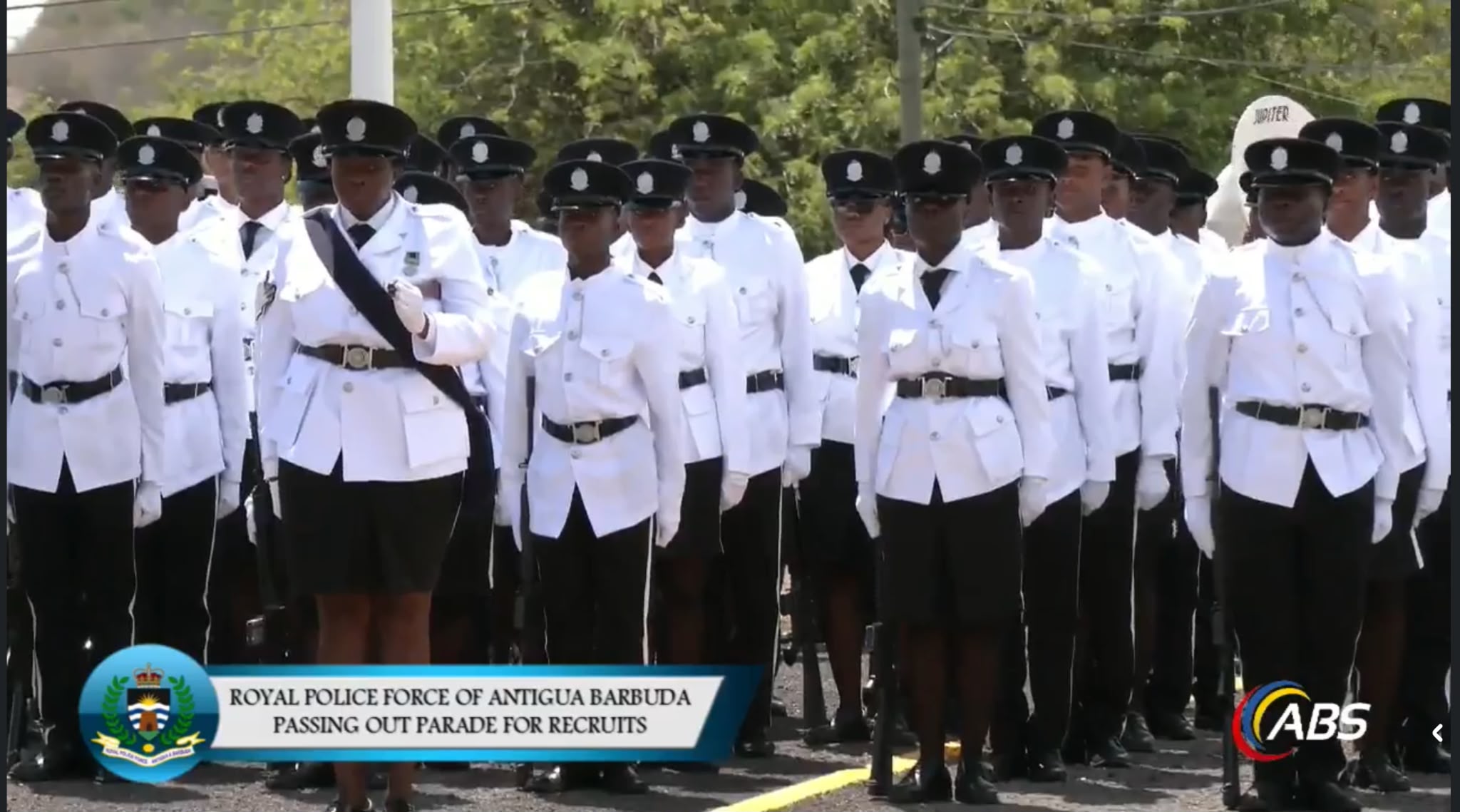
In a landmark ceremony marking a decades-long legacy of law enforcement training, 43 newly minted officers were formally sworn into the Royal Police Force of Antigua and Barbuda this Thursday, following the successful completion of the force’s 50th Recruit Training Course. The graduation, hosted at the Sir Wright F. George Police Academy, carried extraordinary historical weight: it comes 56 years after formal standardized recruit training was first established in the country in 1967, making this cohort a milestone for the institution. “This course is far more than just another annual graduating class,” Police Academy Commandant Superintendent Rodney Ellis emphasized in his official address. “It stands as a defining milestone in the history of recruit training for the Royal Police Force, and symbolizes generations of commitment, sacrifice, discipline, and selfless service to the people of our nation.”
Drawing on a familiar cricket analogy to frame the academy’s 56-year evolution, Ellis noted that Sir Wright F. George, the academy’s namesake, “opened the batting” by laying the foundational framework for professional police training in Antigua and Barbuda, with every subsequent commandant building on that foundation to strengthen the institution over the decades. Ellis also highlighted a notable tradition among the academy’s leadership: the five most recent commandants have all risen to the roles of Commissioner or Deputy Commissioner of Police for the force.
When Ellis was tapped to lead this historic 50th course earlier this year, he said he turned to faith for guidance, adopting the biblical verse Proverbs 22:6 — “Train up a child in the way he should go” — as the core guiding principle for the intensive six-month training program. “When the commissioner called me in late January to tell me I would take charge of this milestone course, I prayed to Almighty God for wisdom, strength, and guidance to lead this training to success,” he explained.
The program began with an incoming cohort of 54 special constables, 32 men and 22 women, all seeking to transition into roles as full-time regular police officers. From their very first day on campus, recruits were pushed to their physical, mental, and emotional limits through a demanding mix of grueling physical fitness training and rigorous classroom instruction. “For many of these recruits, this level of intensity was completely unlike anything they had ever experienced before,” Ellis said. “The first few weeks tested every part of who they are.”
The rigor of the program led to some attrition: one female recruit and one male recruit stepped down for medical reasons, two candidates had their contracts terminated over disciplinary issues, and two others resigned for personal reasons. But those who persisted showcased remarkable resilience and dedication throughout the entire six months, Ellis noted.
Graduating officers completed 11 core training modules covering critical policing topics including departmental administration, general patrol practices, professional and personal development, the national criminal justice system, local and national laws, tactical response skills, traffic management and road safety, crime pattern analysis, criminal investigation procedures, and hands-on field training. In a unique addition tailored to the nation’s tourism-focused economy, the academy also prioritized public customer service training, with specialists from the Ministry of Tourism leading sessions on respectful, effective community and visitor engagement.
In the end, 43 recruits met the program’s required passing threshold of 350 points out of a maximum 500, delivering an impressive overall pass rate of 95.6 percent — a result Ellis calls a testament to both the recruits’ relentless hard work and the unwavering dedication of the academy’s instructional staff. “This graduating class has demonstrated consistent competence across every single training domain, and I have full confidence in their ability to serve and protect this nation,” Ellis said. “I can assure the commissioner, the government, and the people of Antigua and Barbuda that the Royal Police Force is moving in the right direction, preparing capable officers to safeguard our communities.”
Ellis saved special recognition for the academy’s instructors, praising their ability to produce an exceptional cohort even while operating with limited institutional resources. “Despite constrained resources, you stayed committed, professional, and resilient, and your dedication has given our nation an outstanding group of new police officers,” he said. “No amount of praise can match the effort you put in.”
Speaking directly to the graduating officers, Ellis reminded them that their long-term success in policing will not be measured by their exam scores or physical training results, but by the trust and confidence they build with the public they serve. “The public will not remember your examination marks or your physical fitness test results,” he emphasized. “They will remember your integrity. They will remember your professionalism. They will remember how you treat them, every single day you wear the badge.”
The academy has fulfilled its responsibility, Ellis said, by instilling in the new recruits the core values and professional standards the force demands. Now, it falls to the officers to carry forward those principles throughout their entire careers. “We have done our part by training you according to the values and standards of the Royal Police Force of Antigua and Barbuda,” he said. “Now it is your responsibility to uphold those standards, day in and day out.”
Closing his address, Ellis quoted former British Prime Minister Winston Churchill to encourage the new officers to persist through the inevitable challenges of law enforcement work: “‘Success is not final, failure is not fatal; it is the courage to continue that counts.’” He ended by extending his best wishes to every graduate as they embark on their new careers serving the people of Antigua and Barbuda.