分类: politics

  • Ireland announces visa requirements for Nicaragua, St Kitts and Nevis and St Lucia – effective June 15

    Ireland announces visa requirements for Nicaragua, St Kitts and Nevis and St Lucia – effective June 15

    DUBLIN, Ireland – Ireland’s Minister for Migration Colm Brophy has formally announced a major update to the country’s visa policy: starting Monday, June 15, 2026, all nationals of Nicaragua, Saint Kitts and Nevis, and Saint Lucia will be required to secure an entry visa before traveling to Ireland. The new rule extends even to holders of diplomatic and service passports, and will also apply to international travelers transiting through Irish airports on route to third-party destinations.

    In his official remarks on the policy shift, Brophy emphasized that the change follows a lengthy period of careful evaluation, and is designed to bring Ireland’s immigration framework into closer alignment with protocols already adopted by the United Kingdom and most European nations. “This is a carefully considered decision that brings Ireland more closely in line with the approach taken in the United Kingdom and across Europe,” Brophy stated.

    Ireland’s visa regulations are subject to ongoing, regular review, with the core goal of striking a delicate balance between two key priorities: upholding robust immigration controls that protect national borders, and preserving access for legitimate travelers seeking to enter Ireland for tourism, employment, education, or family reunification. Brophy reaffirmed that this balance remains at the center of all adjustments to the country’s migration rules.

    The minister also acknowledged that abrupt policy changes can create disruptions for travelers who have already arranged and booked trips to Ireland ahead of the new rules taking effect. To address this concern, the Irish government will roll out dedicated transitional arrangements to support affected individuals as they adjust their travel plans, with officials advising eligible nationals with existing travel bookings to check the official Immigration Service Delivery website for the latest guidance and support.

    This latest adjustment is part of a broader, ongoing effort by Ireland to align its visa policies with standards across the United Kingdom and the European Schengen Area. The government has already implemented other related changes in recent months: earlier this year, it removed the right of appeal for refusals of certain short-stay, or Type C, visas. In 2025, Ireland also introduced new mandatory visa requirements for nationals of four other countries: Eswatini, Lesotho, Nauru, and Trinidad and Tobago.

  • PSU Says Finance Officers are ‘Accomplices to Corruption’

    PSU Says Finance Officers are ‘Accomplices to Corruption’

    In a sharp rebuke of alleged systemic financial misconduct in Belize’s public sector, the Public Service Union (PSU) has launched a formal legal push for transparency, accusing government finance officials of intentionally structuring large payments to evade mandatory oversight and enabling public funds misappropriation. The union’s action, filed June 12, 2026 under the Freedom of Information Act (FOIA), comes on the heels of explosive reports revealing Jenny Armstrong, sister of incumbent Belmopan Area Representative and Home Affairs Minister Oscar Mira, collected over $1.7 million in government disbursements between 2020 and 2025.

    At the center of the PSU’s allegations is a 2023 transaction that underscores the supposed illicit practice: on September 14 of that year, 12 separate invoices totaling more than $103,000 were approved for Armstrong alone. As the PSU outlines in its official request, breaking a single large payment into a dozen smaller chunks requires manual creation of 12 distinct entries in the government’s SmartStream financial system. The union argues it is extraordinarily improbable that each invoice accurately disclosed that it was just one segment of a larger aggregated payment. If the transaction’s true nature was intentionally omitted from the invoice comment fields, the PSU contends, every entry qualifies as a premeditated false record entered into the government’s official financial infrastructure.

    The alleged scheme is designed to circumvent strict financial controls put in place by the Belize government in 2022. Circular No. 1 of 2022 mandates that any single payment exceeding $10,000 must go through rigorous multi-level oversight, including two separate approval checks by the Treasury Department. By contrast, payments that fall below the $10,000 threshold can be processed entirely internally within individual government ministries and departments, with no external Treasury review. The PSU’s claim is that finance officers are deliberately splitting large payments into sub-$10,000 chunks to skip this mandatory oversight process.

    Notably, the union stops short of placing direct blame on elected ministers, noting that cabinet members do not personally process or approve routine payments. Instead, the full weight of responsibility is placed on the finance officers who enter and sign off on the manipulated invoices. The PSU also notes that department heads and chief executive officers may have ordered finance staff to structure payments in this way, making them complicit in the misconduct.

    In its formal statement, the PSU did not mince words describing the practice: “They are accomplices to corruption. This is not a simple mistake; it is a deliberate and corrupt scheme to steal the public’s money without being caught.”

    Through the FOIA request, the union is seeking a full breadth of records covering a five-year window from April 2021 to March 2026. The requested documents include the identities of all ministries, departments, finance officers, department heads, and CEOs implicated in the payment-splitting practice, as well as the names of all vendors that received these structured disbursements. The PSU has also requested complete copies of all relevant SmartStream invoices, purchase orders, and approval documentation related to the transactions.

    Beyond the information request, the PSU is calling on Belize’s Auditor General to launch a full independent review of government financial records covering the same five-year period, and to publish a complete unredacted report of its findings for the public. In cases where misconduct is confirmed, the union is pushing for immediate suspension or termination of all involved personnel, and referral of the cases to the Belize Police Department and Director of Public Prosecutions to open criminal investigations into potential charges including fraud and abuse of public office.

    The Accountant General, Auditor General, and Contractor General now have 30 days to respond to the FOIA request, with a formal response deadline set for July 10, 2026.

  • Chuck: $608 million in judgment debt against the State settled

    Chuck: $608 million in judgment debt against the State settled

    KINGSTON, Jamaica — In a major update delivered to Jamaica’s House of Representatives on June 10 during the annual Sectoral Debate, Justice Minister Delroy Chuck has announced that the government disbursed a total of $680 million in outstanding judgment debt payments to claimants across the country over the 2025/2026 fiscal year.

    Speaking to lawmakers, Chuck framed the full disbursement of allocated judgment debt funds as a critical step toward reinforcing the country’s justice system. He noted that meeting these court-ordered financial obligations will give judicial officers greater confidence to deliver timely rulings, moving the nation closer to the government’s core goal of accessible, equitable justice for all Jamaican citizens.

    “As part of our unwavering commitment to delivering justice for every Jamaican, we are pleased to confirm that the Attorney General’s Chambers has fully utilized the budget allocated to cover all judgment debts submitted to the Ministry for disbursement,” Chuck told parliament.

    Beyond judgment debt, Chuck outlined significant progress across the Ministry’s Social Justice Division, which oversees three core public initiatives: Restorative Justice, Child Diversion, and Victim Services. Despite widespread damage to parish-level Justice Centres and court facilities from recent extreme weather, including Hurricane Melissa, the division has maintained its full mandate to deliver alternative conflict resolution and support services to vulnerable communities.

    The division has sustained ongoing training and outreach programs in partnership with faith-based organizations, schools, at-risk communities, and families in need across the island. Most notably, restorative justice tools were deployed to de-escalate conflict during a recent surge in violence in Jamaican schools, an effort implemented in close collaboration with the Ministry of Education, Youth, Skills and Information to educate the public on non-violent conflict resolution alternatives.

    Last fiscal year, the program marked Justice Day with special peace education events in four schools across four parishes, reaching thousands of young students with messaging centered on non-violence and community harmony. The Ministry also partnered with the national judiciary to host a three-day targeted sensitization training for sitting judges on key social justice issues, an event that was widely deemed a success by participants.

    In a key modernization push, full digital case management systems are currently being rolled out for both the Child Diversion and Restorative Justice programs. The Child Diversion digitization effort is backed by UNICEF, while the Restorative Justice system upgrade is supported by the Ministry of National Security and Peace through its Citizen Security Secretariat. Chuck explained that the digital overhaul will streamline case tracking, improve the accuracy and reliability of program data, and allow social justice officers to serve clients across a range of settings—from court rooms and office locations to police stations and community outreach sites. To support this shift, the Ministry has also upgraded its core digital infrastructure to enable remote, on-location service delivery.

    Chuck emphasized that even after Hurricane Melissa disrupted operations at justice centers across the island, restorative justice and other social justice programs have continued to strengthen the country’s overall justice framework. Over the past fiscal year, the program’s outreach team trained more than 31,000 Jamaicans on restorative justice principles and hosted 101 hands-on restorative practices workshops, repeated the program’s core public message: “Talk It Out and Not Fight It Out.”

    “ We are proud to report that our restorative justice interventions have resulted in almost 1,700 binding conflict resolution agreements signed by opposing parties, helping to strengthen community cohesion and build sustained peace across the island,” Chuck added.

  • Trump says US-Iran deal to be signed Sunday

    Trump says US-Iran deal to be signed Sunday

    Diplomatic efforts to end the ongoing Middle East war reached a fever pitch Saturday, as conflicting timelines and unresolved core disputes overshadowed growing optimism that weeks of stalled negotiations could soon reach a breakthrough. In a surprise post on his Truth Social platform, former U.S. President Donald Trump announced that a historic peace agreement with Iran would be signed Sunday, with the strategically vital Strait of Hormuz immediately opened to all global maritime traffic following the deal’s signing.

  • Trump’s name removed from Kennedy Center arts venue

    Trump’s name removed from Kennedy Center arts venue

    WASHINGTON, D.C. – In a landmark legal rebuke of former president Donald Trump’s unprecedented efforts to brand iconic federal public spaces with his personal name, construction crews completed the removal of Trump’s name from the facade of the Kennedy Center for the Performing Arts on Saturday, bringing a months-long political and legal battle to a close.

    The saga began shortly after Trump returned to the White House in January 2025, when the newly inaugurated Republican president moved to install himself as chairman of the prestigious performing arts venue and stacked the center’s governing board with hand-picked loyalists. In December of the previous year, the reshaped board voted to rebrand the institution as “The Donald J. Trump and John F. Kennedy Memorial Center for the Performing Arts,” adding large metal lettering of Trump’s name directly above the original dedication to assassinated president John F. Kennedy on the building’s riverfront facade.

    The renaming sparked immediate public backlash. Dozens of scheduled performances were canceled by artists protesting the move, and ticket sales for remaining events plummeted as audiences boycotted the venue. Legal challenges were quickly filed, arguing that the unilateral name change violated federal law, as only Congress holds the authority to alter the official name of federally owned cultural institutions.

    Last month, U.S. District Judge Christopher Cooper sided with challengers, ordering that all branding bearing Trump’s name be removed from the Kennedy Center’s building and grounds by the end of Friday, January 31. In a last-ditch effort to halt the work, center leadership (still dominated by Trump appointees at the time) filed an emergency appeal, arguing that the institution would face “irreparable harm” from the removal process. That appeal was rejected by both the district court and a higher appellate court on Friday, clearing the way for construction to begin.

    Hundreds of anti-Trump activists and local residents gathered at the Kennedy Center on Friday to watch crews erect scaffolding, with dozens staying on site into the evening until severe overnight thunderstorms forced workers to pause construction out of safety concerns. The center’s executive director Matt Floca requested and received a 12-hour extension to the court-ordered deadline, allowing work to resume at dawn Saturday. By midday Saturday, Floca confirmed in a legal filing that all physical signage containing Trump’s name on both the building and surrounding grounds had been fully removed, and the Kennedy Center had already scrubbed all references to Trump’s name from its official website earlier that week. A white protective tarp remained stretched over the facade Saturday afternoon while crews finished touch-up work, drawing curious onlookers including morning joggers who paused to observe the scene.

    Cooper also issued a temporary injunction blocking Trump’s planned two-year closure of the Kennedy Center for renovations, which was scheduled to begin this coming July.

    Local residents who gathered to watch the removal welcomed the outcome as a major victory against Trump’s efforts to reshape Washington’s public landscape. Forty-two-year-old Washington local Elise Serbaroli called the removal “a big win,” noting that she had been heartbroken when Trump’s name was first added to the building she has long counted as one of her favorite local destinations. Sixty-five-year-old Dawn Martin echoed that sentiment, emphasizing that the Kennedy Center’s original name honors a legacy that cannot be displaced for political gain. “Some people may think this is a menial sort of sign. But the truth is, we cannot take away the honor that the Congress bestowed on this beautiful building for John F. Kennedy, a president who deserves this honor and whose name should be protected,” Martin said. Tens of thousands of people also followed the removal process in real time via online livestream, reflecting the national attention the conflict has drawn.

    The Kennedy Center controversy is not an isolated case. Since taking office in 2025, Trump has moved to rename multiple federal institutions across Washington, rebranding the now-defunct U.S. Institute of Peace in his own name and installing massive banners bearing his likeness outside the Department of Justice and Department of Agriculture headquarters.

    The name removal comes as Trump prepares to mark his 80th birthday Sunday with a high-profile $60 million celebrity cage fight event hosted on the White House grounds. The event is also being billed as the kickoff for national celebrations of the 250th anniversary of U.S. independence from Britain, which the Trump administration is marking with a new commemorative $250 bill featuring the president’s image. Trump responded to the court ruling last week by saying he would abandon all oversight and control of the Kennedy Center, in a fit of anger over the decision.

  • Six months and $84 million to get Bogue lands ready for sale

    Six months and $84 million to get Bogue lands ready for sale

    MONTEGO BAY, St James — After nearly two decades of tangled negotiations and political tension over land tenure, a major step forward has been reached to resolve the long-running standoff at Bogue Industrial Estate, one of Montego Bay’s most hotly contested commercial parcels. On Thursday, the St James Municipal Corporation formalized an $84-million construction agreement with local firm Odelallen Construction, clearing the way for long-awaited infrastructure upgrades that will pave the path to regularizing land ownership for the site’s current occupants.

    Scheduled to kick off on July 2, the six-month construction project will lay critical public utilities across the 5-hectare property, which has been occupied by 26 separate commercial operators since roughly 2003. Speaking at the official contract signing ceremony, Montego Bay Mayor Richard Vernon laid out the full scope of the upcoming works, noting that the upgrades align with all regulatory standards for a formal commercial subdivision.

    “We have to deliver all the required core infrastructure, including potable water, electrical service, fire hydrants and other basic utilities, before the development can earn a compliance certificate and move forward,” Vernon explained. He recounted that years of preliminary discussions with the current land occupants had already laid the groundwork for this milestone: when local officials first proposed an amicable settlement for the property claims almost a decade ago, the operators made a clear demand that infrastructure be installed before they would sign any formal sale agreement.

    The site, commonly referred to locally as Bogue Lands, has been a source of political friction spanning multiple Jamaican national administrations. Unlike informal squatters, the current commercial operators have long maintained legitimate claims to the land, arguing that they have poured substantial private investment into developing their businesses on the site over the past 20 years. The St James Municipal Corporation has worked for years to regularize the operators’ status, granting them the first right of refusal to purchase the lots they currently occupy once the site is formally subdivided.

    For Mayor Vernon, Thursday’s contract signing marks an unprecedented turning point for the community. “Today I’m glad that we have not only secured the funding, but also selected a qualified contractor to deliver the full infrastructural upgrade for the entire Bogue Industrial Estate,” he said. “As soon as the upgrades are complete, we will begin finalizing the sale agreements with the current occupiers.” He called the moment a historic milestone for Montego Bay, closing a chapter of uncertainty that has held back development of the site for years.

    Once the upgrade work wraps up, municipal authorities will conduct a new market valuation of the individual lots ahead of sale. Proceeds from the land sales will boost the St James Municipal Corporation’s capital budget, supporting a range of critical local infrastructure projects including the long-planned repairs to the Old Shoe Arcade, a popular local commercial hub in need of renovation.

    Officials have already secured sign-off from Jamaica’s Integrity Commission, the successor body to the former Contractor General’s office, approving the sale of the land at fair market value. While Vernon and municipal leaders do not expect major pushback to the formal sale process, they have emphasized that every step has been carried out in full compliance with Jamaican law to guard against potential legal challenges.

    “We don’t anticipate significant opposition, but we acknowledge it remains a possibility,” Vernon noted. “Our priority has been to follow every legal requirement to the letter, so that if any challenge does arise, we are fully prepared to defend our process in a court of law.”

  • Government advances Passenger Information and Passenger Name Record Bill, 2026

    Government advances Passenger Information and Passenger Name Record Bill, 2026

    According to Grenada’s Ministry of Legal Affairs, the 2026 Advance Passenger Information and Passenger Name Record Bill marks a critical milestone for the country, strengthening border management protocols, expanding national security capabilities, deepening regional security cooperation, and ensuring that all passenger personal data is handled in line with globally recognized data protection principles and international best practices.

  • ‘Take any evidence against me to the police’

    ‘Take any evidence against me to the police’

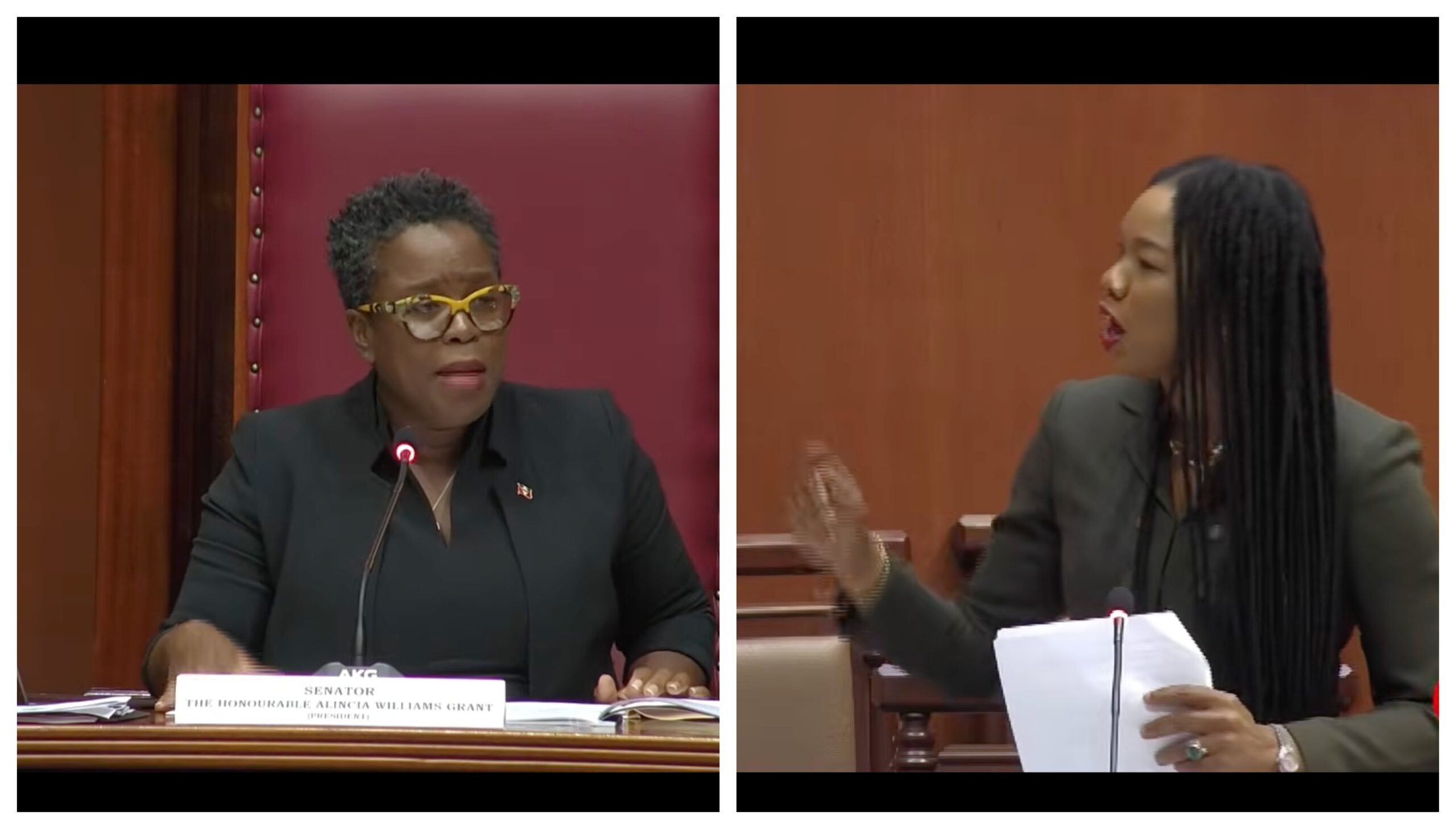
    A sharp political confrontation has erupted in Trinidad and Tobago’s Parliament over unsubstantiated claims of illegal activity linked to the opposition People’s National Movement, after Attorney General John Jeremie dropped a bombshell announcement during a Wednesday debate focused on extending a national state of emergency. Jeremie told the legislative body that the United States government had revoked visas belonging to a group of figures labeled the “1%”, a comment widely interpreted to hint at connections between opposition figures and criminal activity. Now, opposition leader Pennelope Beckles is pushing back forcefully, challenging the ruling government to act on its claims rather than hiding behind parliamentary immunity.

    In a fiery address to government lawmakers, Beckles argued that the governing administration has abused the legal protection of parliamentary privilege to smear the PNM and its members without offering any concrete proof of wrongdoing. “It is one thing to stand on this floor and level accusations against the opposition, but if you actually hold evidence, take it to the police,” Beckles stated, doubling down on her demand that officials stop making unproven claims behind the protection of parliamentary immunity. “Do not hide behind this privilege to spread baseless accusations when you know you lack the evidence to back them up. If you have proof tying me to any illegal activity, take it directly to law enforcement.”

    Beckles went on to accuse the ruling party of being fixated on targeting the so-called “1%” for political gain, rejecting any implication that she or any fellow opposition parliamentarian are involved in unlawful activity. She issued an open challenge to the government to release any formal reports that name opposition members or tie the PNM to criminal networks, stating that the public has a right to see the evidence if it actually exists.

    Noting the context of the debate around the state of emergency, which is tied to public safety and gang violence, Beckles acknowledged the government’s attempt to link its accusations to broader national security concerns. She insisted, however, that if authorities have credible evidence of wrongdoing, they must follow formal legal processes instead of using parliamentary privilege to make unchallenged claims that cannot be legally answered outside the chamber. “If you have the information, act on it properly,” she said. “You cannot keep coming into Parliament to level these smears, when you refuse to repeat them outside these walls where you can be held accountable – and everyone knows why that is.”

  • US hits Cuba with more sanctions, hints at military action again

    US hits Cuba with more sanctions, hints at military action again

    On Thursday, the United States government unveiled a fresh round of economic restrictions targeting Cuba, with the island nation’s state-owned oil and gas conglomerate, Cuba Petróleo (Cupet), bearing the brunt of the new measures. U.S. Secretary of State Marco Rubio made the announcement, claiming the company controls assets that were illegally seized from U.S. property owners decades ago.

    Beyond the sanctions designation, Rubio placed full responsibility for Cuba’s ongoing national energy crisis squarely on the country’s ruling leadership. He argued that while ordinary Cuban citizens have endured crippling fuel shortages and widespread power outages driven by years of underinvestment in critical energy infrastructure, the island’s communist leadership has siphoned off energy resources for personal gain.

    “Cuban officials resell thousands of barrels of this already scarce fuel on unregulated secondary markets, hoard the majority of available energy supplies for the country’s military, intelligence services and repressive state apparatus, and deliberately ration access to power as a tool to enforce social control over the population,” Rubio alleged during the announcement.

    This latest action comes as Cuba continues to grapple with the cumulative economic pressure of a more than 60-year U.S. trade embargo that has gutted the country’s ability to import essential goods, including fuel. Washington has long maintained pressure on Havana to overhaul its existing economic and political systems, and the new sanctions mark a further escalation of that long-running campaign.

    The penalties also arrive alongside a sharp uptick in aggressive military rhetoric from U.S. officials. Just one day before the sanctions announcement, U.S. Secretary of Defence Pete Hegseth conducted an official visit to the U.S. Naval Base at Guantanamo Bay, a facility that has remained a point of contention between the two nations for decades. During his tour of the base, Hegseth did not rule out the possibility of direct U.S. military action against Cuba, issuing a stark warning to Havana against making what he called a “wrong decision” that would create a threat the U.S. would be forced to respond to militarily.

  • Skerrit urges patience as geothermal plant commissioning continues amid power outages

    Skerrit urges patience as geothermal plant commissioning continues amid power outages

    Dominica’s Prime Minister Roosevelt Skerrit has issued a public call for patience from customers of Dominica Electricity Services (DOMLEC), following widespread recent power disruptions tied to the ongoing commissioning of the country’s landmark geothermal power plant.

    Addressing reporters during a Wednesday press conference, Skerrit highlighted that Dominica has made history as the first country in the Caribbean region to integrate geothermal energy into its national power grid. As a trailblazer in this regional energy transition, he emphasized, the nation is navigating uncharted technical and logistical territory that comes with being the first mover.

    “The geothermal facility is still in its commissioning phase, which involves extensive testing, fine-tuning of equipment, and full system integration before it can launch into full commercial operations,” Skerrit explained. “I am not downplaying the disruption and inconvenience these rolling outages have caused for households and businesses across the country. But these growing pains of recent weeks are the necessary price we pay for pioneering a new energy future for our nation.”

    Once all commissioning work is finalized, Skerrit outlined the transformative long-term benefits the project will deliver for Dominica. Consumers will see reduced electricity rates, the national power supply will gain far greater reliability, and the country will cut its heavy dependence on costly imported fossil fuels that have long left its energy market vulnerable to global price volatility.

    Since the plant began initial power generation in March, Skerrit confirmed that temporary service interruptions have stemmed from technical challenges inherent to testing and integrating brand-new energy infrastructure into the existing national grid. Crucially, he added, every issue that has emerged during the testing process has already been identified, targeted, and fully resolved as part of standard commissioning protocols.

    Beyond the main geothermal generation facility, commissioning work is also progressing on a suite of associated critical infrastructure: a new 33-KV underground transmission line, the Fond Cole substation, and an on-site battery energy storage system. All these components must work in perfect synchronization to form a fully functional, integrated national power system, Skerrit noted.

    The Dominican government remains fully confident in the geothermal project and its ability to deliver sustained, long-term benefits to the country, the prime minister reaffirmed. “While we recognize the frustration caused by recent outages, rolling out a project of this scale requires rigorous, meticulous testing to guarantee that when it enters full commercial service, it operates safely, reliably, and efficiently for decades to come,” he said. Skerrit closed by thanking the Dominican public for their ongoing understanding and patience as the project nears completion.