Facing persistent global economic pressures that have driven up living costs for households and businesses across the nation, the Government of Grenada has launched a comprehensive, fiscally responsible 2026 Cost of Living Assistance Programme. Valued at a maximum of EC$18 million, the temporary five-month relief package combines energy-focused tax cuts, expanded household subsidies, and consumer-focused tax exemptions to ease immediate budget strains, curb inflation, and support local economic activity, all while preserving long-term fiscal sustainability.
The first and most broad-reaching measure of the programme is a full temporary removal of Value Added Tax (VAT) on all electricity consumption, effective from 1 August through 31 December 2026. Unlike targeted relief that benefits only specific groups, this cut applies to every category of electricity customer across the country: residential households, small commercial enterprises, large commercial operations, industrial producers, public institutions, and all other energy users. As a core input to every sector of Grenada’s economy, lower electricity costs will reduce expenses across the board—from monthly household budgets to overhead for local businesses and production costs for agriculture and manufacturing. By August, all electricity customers will see a zero charge for VAT in the government charges section of their monthly bill, delivering immediate, transparent savings directly to end users.
The second energy-focused measure complements the VAT cut by eliminating the Customs Service Charge on imported diesel used exclusively for electricity generation, running for the same August to December 2026 period. Because Grenada relies entirely on imported fuel to produce much of its electricity, import taxes directly pass through to end users in the form of higher power tariffs. By removing this charge at the border, the government reduces the underlying input cost of electricity generation, helping to offset upward pressure on power prices driven by volatile global fuel markets. Unlike the immediate VAT cut on retail bills, the benefits of this measure will be passed to consumers gradually, aligned with existing billing cycles and the flow of new duty-free fuel shipments into the national energy supply.
Third, the government is dramatically expanding its existing residential electricity subsidy programme to reach thousands more vulnerable households, while more than quadrupling the monthly benefit amount. Previously, the programme offered just EC$10 per month in relief for households consuming 99 kilowatt-hours (kWh) or less monthly, supporting approximately 22,089 households. The enhanced scheme raises the monthly subsidy to EC$50 and expands eligibility to all households consuming 200 kWh or less per month, pushing the total number of beneficiary households to 38,640 across Grenada, Carriacou, and Petite Martinique. The expanded subsidy will take effect for August 2026 bills, putting extra cash directly back into household pockets to cover groceries, back-to-school supplies, and other essential daily needs. Like all measures in the package, the enhanced subsidy is temporary, targeted, and designed to cushion household disposable incomes from global energy price shocks while the government advances long-term solutions in renewable energy and energy efficiency.
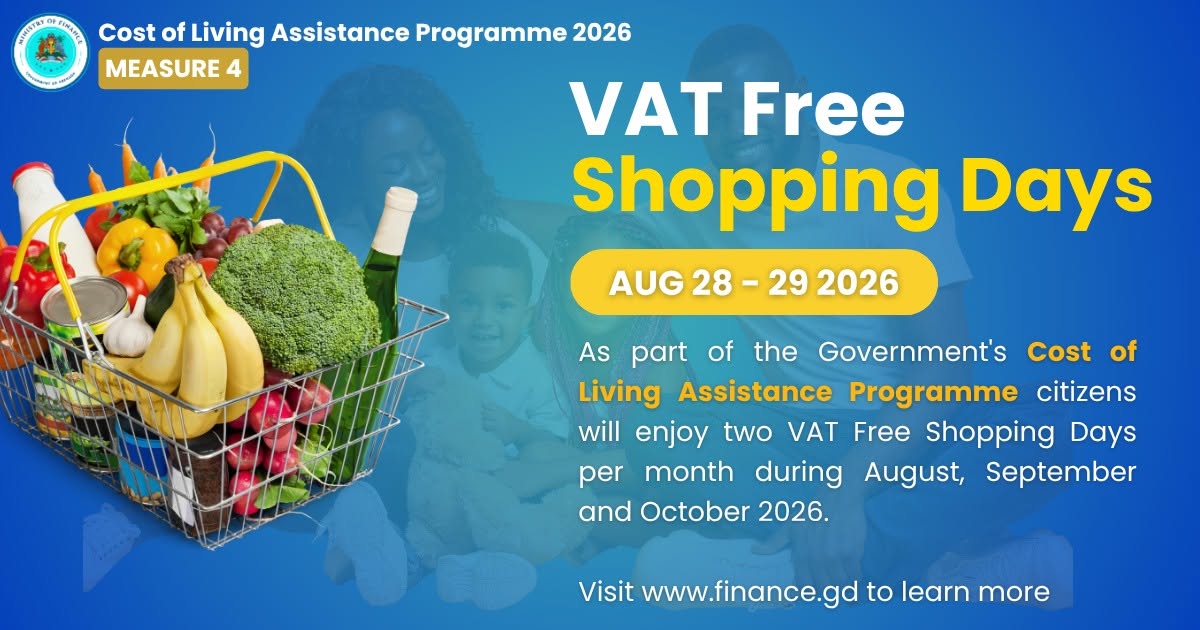
As a fourth measure to support consumers and stimulate local business activity, the cabinet has approved two VAT-free shopping days per month for August, September, and October 2026. The first VAT-free weekend is scheduled for 28–29 August 2026, timed perfectly to help families cover back-to-school costs and stock up on essential household goods. Only approved, VAT-registered, tax-compliant businesses are permitted to participate, and the exemption applies to a wide range of everyday goods: groceries, clothing, school supplies, books and uniforms, household goods, appliances, electronics, and hardware. The initiative has four core goals: deliver direct immediate cost-of-living relief to households, boost consumer spending and retail sales, support compliant local businesses, and encourage broader tax compliance by strengthening public-private collaboration. Clear pricing and compliance rules have been built into the programme design to ensure consumers receive the full benefit of the tax exemption. The Ministry of Finance will launch a full public information campaign in the coming weeks to share details on participating businesses and eligible items with the public.
In addition to these four new measures, the government will extend existing fuel price stabilisation measures through the end of December 2026. These measures include keeping price caps in place for domestic consumption of key fuel products: gasoline, diesel, and kerosene are capped at EC$17 per gallon, 20-pound LPG cylinders are held at EC$40, and 100-pound cylinders are capped at EC$350.
Throughout the announcement, the Ministry of Finance emphasized that the entire relief package has been structured to be fiscally responsible, with an expected maximum total fiscal impact of EC$18 million. Years of prudent public financial management have created the fiscal space to deliver this meaningful immediate relief without putting long-term national fiscal sustainability at risk, officials noted. This targeted investment is designed to protect household budgets, support economic stability, and buffer Grenadians from ongoing external economic uncertainty, representing what the government calls responsible governance that balances short-term relief with long-term national stability.