分类: education

  • Education Ministry Launches 2026 School Uniform Grant Programme

    Education Ministry Launches 2026 School Uniform Grant Programme

    A new initiative aimed at removing financial barriers to equitable education access has been officially announced by Antigua’s Ministry of Education, Science and Technology. Set to roll out for the 2026 academic year, the 2026 School Uniform Grant Programme will deliver targeted financial support to qualifying households struggling to cover the cost of mandatory school uniforms for their children.

    The application window for the grant program is scheduled to open on July 13, 2026, and will remain open through a seven-week period ending on August 28 of the same year. All interested eligible applicants must submit their completed applications in person at the Antigua Multipurpose Center before the final deadline passes, with no late submissions expected to be accepted.

    In a formal statement accompanying the program announcement, ministry officials outlined the dual core goals driving the initiative. First, the program is designed to guarantee that every student across the nation can step into the new academic year with the required basic materials and proper attire. Second, it seeks to ease the growing financial strain that uniform costs place on low- and middle-income households ahead of each back-to-school season.

    “Every child deserves the opportunity to begin the school year with confidence,” the ministry’s statement read. “This initiative reflects our continued commitment to supporting families while investing in the education and future of our nation’s children.”

    Program administrators have reiterated that all eligible applicants should prioritize submitting their applications well in advance of the August 28 closing date to avoid any last-minute processing delays. For additional questions about eligibility requirements, required documentation, or application procedures, community members can contact program staff directly at 727-2427.

  • Improving the Digital Competencies of Literacy Educators

    Improving the Digital Competencies of Literacy Educators

    Literacy educators form the foundational backbone of global efforts to deliver inclusive, quality education for all, but a widespread gap in support leaves countless practitioners facing systemic barriers to success. From limited access to up-to-date professional development opportunities to unstable working conditions and a persistent lack of access to modern digital teaching resources, these challenges directly undermine the ability of educators to serve diverse learner communities. As education systems around the world undergo rapid digital transformation, the urgency to address these gaps has grown exponentially: literacy educators now require robust digital competencies to deliver accessible, effective instruction that meets the changing needs of 21st-century learners.

    To respond to this unmet critical need, the UNESCO Institute for Lifelong Learning (UIL), in partnership with Huawei – an associate member of the Global Alliance for Literacy (GAL) – has launched a groundbreaking, free multilingual online course titled *Improving Digital Competencies for Literacy Educators*. Hosted on the UIL Learning Hub, the self-paced program is currently available in four widely spoken languages: English, French, Arabic, and Spanish, making it accessible to literacy educators across diverse regional and linguistic contexts.

    The course curriculum is carefully aligned with established global education frameworks, including the UNESCO Recommendation on Adult Learning and Education (RALE) and the DELTA digital competency framework, to ensure it meets international quality standards. Its core mission is to equip literacy educators with the practical digital skills needed to confidently integrate technology into their teaching practices, leverage digital tools to enhance learning outcomes, and advance the professionalization of adult literacy education globally. This initiative represents a targeted step toward ensuring educators can adapt to evolving learner needs and advance progress toward United Nations Sustainable Development Goal 4 (SDG 4), the global commitment to inclusive and equitable quality education for all.

    As an open-source, completely free resource, the course removes common financial and access barriers that prevent many educators from accessing professional development. Key benefits of the program include: practical, step-by-step instruction tailored specifically to the unique needs of literacy educators, immediately adaptable teaching resources that can be integrated into diverse educational contexts from rural community programs to urban adult learning centers, and an official certificate of completion co-issued by UIL and Huawei for participants who successfully finish all requirements.

    The course is structured into 11 self-guided learning units, totaling 2.5 hours of instruction that educators can complete on their own schedule to fit around existing work commitments. Core learning objectives include exploring innovative approaches to embedding digital tools into literacy instruction, building capacity to design engaging, inclusive learning materials and accessible learning environments powered by technology, and supporting ongoing professional growth through evidence-based educational technology practices.

    Direct access links for each language version of the course are publicly available: English at https://learninghub.uil.unesco.org/course/view.php?id=78, French at https://learninghub.uil.unesco.org/course/view.php?id=84, Spanish at https://learninghub.uil.unesco.org/enrol/index.php?id=83, and Arabic at https://learninghub.uil.unesco.org/course/view.php?id=81&notifyeditingon=1. Educators with questions about enrollment or course content can reach the program administration at [email protected].

  • Social media for more than ‘posting and being messy,’ SVGCC grads told

    Social media for more than ‘posting and being messy,’ SVGCC grads told

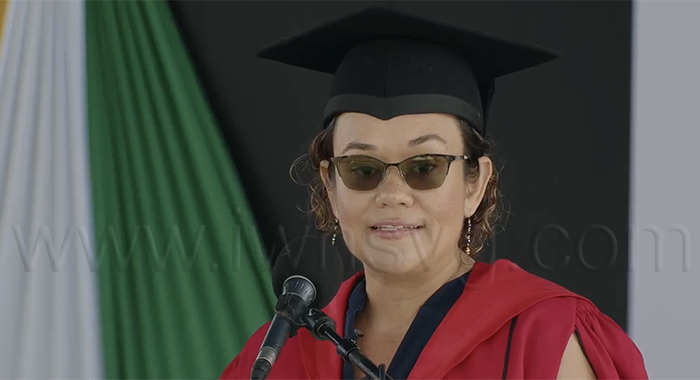
    At the recent commencement ceremony for over 900 graduates of the St. Vincent and the Grenadines Community College (SVGCC), featured speaker Dr. Andrea Veira delivered a compelling call to action, challenging young graduates to rethink how they engage with digital technology and social media. Held under the theme “Tomorrow’s Leaders, Empowered Minds, Limitless Possibilities”, the event became a platform for Veira — a seasoned scholar, educator, researcher and consultant — to reframe digital access not as an entitlement for young people, but as a responsibility tied to collective progress.

    Veira opened by highlighting the unprecedented opportunities that today’s digital landscape offers young Vincentians and Caribbean people, opportunities that previous generations could barely have dreamed of. From massive open online learning platforms and global professional networks to digital entrepreneurship infrastructure, and cutting-edge emerging tools including artificial intelligence, automation, drone technology, robotics, and big data systems, Veira framed these resources as power-building assets for purpose-driven young people. “These are tools for empowered minds,” she told the assembled graduates. “And when used with discipline and purpose, they open limitless possibilities.”

    Against this backdrop of opportunity, Veira pushed back against the trivial, unproductive uses of technology that have become common for many users. She pointed out that far too many people spend their connected time on mindless scrolling, unhealthy social comparison, and spreading online gossip and drama — a habit she described as wasting a once-in-a-generation gift. Rather than accepting passive digital consumption as the norm, Veira urged graduates to regularly pause and reflect on their digital habits, asking the critical question: How am I using these tools to build something meaningful?

    Veira laid out a clear, constructive vision for digital engagement that redefines social media as more than a space for personal display or drama. She encouraged graduates to leverage these platforms to lift up their communities: promoting local small businesses, sharing educational resources with public audiences, celebrating Caribbean culture, and organizing collective action for local issues. This framing positions young internet users not just as passive consumers of online content, but as intentional digital citizens whose online activity can strengthen local economies, build public awareness, and deepen community solidarity.

    Turning to one of the most debated modern technological shifts, Veira addressed the growing integration of artificial intelligence into education and the workforce, urging graduates to approach AI with both ethical awareness and intentionality. She advised that AI should be used to sharpen, not replace, independent critical thinking — a guideline that balances embracing innovation with retaining individual intellectual agency. Beyond AI, Veira encouraged graduates to apply all types of digital technology creatively across key local sectors, from designing climate-resilient agricultural solutions to improving access to healthcare, expanding educational opportunities, boosting sustainable tourism, and supporting community development more broadly.

    Throughout her address, Veira returned to a core principle: digital tools themselves are neutral, but the choices people make about how to use them carry real weight. The key question for young people, she argued, is not whether they engage with the internet, but what purpose that engagement serves. Without a foundation of clear values and purpose, Veira warned, even advanced technical skills can amount to shallow, unproductive output. “The world does not need more qualified people who lack compassion,” she emphasized. “It needs graduates who can combine knowledge with kindness, confidence with humility, and creativity with responsibility.”

    While Veira celebrated the inherent resilience and creativity of Gen Z and millennial generations, she closed by reinforcing that digital tools only deliver true empowerment when they are tied to service, stewardship, and solving real community problems. In her vision, graduates have the power to shape online spaces for good: choosing to move beyond mindless scrolling and comparison, and instead build meaningful, brighter futures for themselves and their entire communities.

  • Genevieve Smith Foundation Awards Four Potters Primary Graduates in Honour of Late Educator Genevieve “Teacher Gen” Smith

    Genevieve Smith Foundation Awards Four Potters Primary Graduates in Honour of Late Educator Genevieve “Teacher Gen” Smith

    On Wednesday, July 8, 2026, the Potters Primary School graduation ceremony held at the Potters Seventh-day Adventist Church became more than a rite of passage for graduating students. It served as a poignant tribute to one of the community’s most revered educators, and a public reaffirmation of the foundation established in her honor to carry forward her life’s work. The Genevieve Smith Foundation, which has supported young scholars at the school for three consecutive years, awarded four standout 2026 graduates with academic scholarships, marking the first round of awards since the passing of the foundation’s namesake and founder, Genevieve Smith – known to generations of students and community members as “Teacher Gen.”

    Teacher Gen passed away on December 11, 2025, leaving behind a 50-year legacy of radical service, compassionate mentorship, and unwavering commitment to educational equity that transformed hundreds of young lives. For decades, she called Potters Primary School her professional home, where she distinguished herself not only as a rigorous and dedicated classroom educator but also as a steady source of love, guidance, and encouragement for every student who crossed her path. Beyond the walls of the school, she opened her home and her heart to scores of vulnerable children in need, fostering, raising, and nurturing dozens of young people throughout her lifetime. Her core belief – that every child, regardless of background, deserves a fair opportunity to pursue their potential – earned her deep respect and enduring affection across the entire community.

    Speaking on behalf of the Smith family and the foundation at the ceremony, J’noure Smith-Kellman, Teacher Gen’s granddaughter, reflected on her grandmother’s extraordinary life and the family’s renewed commitment to advancing her vision of empowering children through accessible, quality education. She emphasized that while the 2026 scholarship cycle carries unique emotional weight as the first held after her grandmother’s passing, it has also strengthened the family’s resolve to protect and grow the work Teacher Gen built.

    “This scholarship programme is our family’s way of ensuring that my grandmother’s legacy lives on,” Smith-Kellman told the gathered crowd of graduates, parents, teachers, and invited guests. “She dedicated her life to serving others, especially children, and she firmly believed that education could transform lives. Although she is no longer with us, her passion for helping young people continues through the work of the Genevieve Smith Foundation.”

    She added, “While this year has been one of tremendous loss for our family, it has also strengthened our resolve to continue what she started. Every scholarship we award is a reminder that her work did not end with her passing. It lives on in every child who is encouraged to pursue excellence.”

    In total, the foundation distributed 2,000 Eastern Caribbean dollars in awards this year, with four individual scholarships of 500 Eastern Caribbean dollars each recognizing students who demonstrated standout achievement aligned with Teacher Gen’s core values. The 2026 recipients included Jerzaria Hamilton, honored as the Top Female Student; Tayzhoni Murrain, named Top Male Student; Zia Roach, recognized as the Most Improved Student; and D’hanna Henry, who received the Exceptional Dedication and Potential Award.

    Smith-Kellman closed her remarks by congratulating all of Potters Primary’s 2026 graduates, urging them to carry the values of hard work and resilience with them as they transition to secondary school. She also extended gratitude and congratulations to the parents, guardians, and school faculty and staff, who work collaboratively to nurture students through their primary education journey.

    Today, the Genevieve Smith Foundation remains fully committed to honoring Teacher Gen’s life and legacy by investing in the educational development of young people at Potters Primary, and celebrating students who embody the values of academic excellence, resilience, kindness, and service that she modeled every day. Through its annual scholarship program, the foundation works to ensure that Teacher Gen’s remarkable, decades-long contribution to local education continues to inspire new generations of young leaders.

  • 40 scholarships offered by Morocco to Haitian high school graduates (2026-2027)

    40 scholarships offered by Morocco to Haitian high school graduates (2026-2027)

    In a tangible gesture of bilateral educational cooperation following a high-level diplomatic visit, the government of Morocco has approved 40 full additional scholarships for recent Haitian high school graduates seeking higher education for the 2026-2027 academic cycle. The opportunity comes directly after Haitian Foreign Minister Raïna Forbin’s official working mission to the Kingdom of Morocco on May 20, 2026, which paved the way for expanded educational partnerships between the two nations.

    Aspiring candidates must meet a clear set of eligibility requirements to be considered for the award. All applicants must be under the age of 23, have completed their secondary education in 2025 with a minimum cumulative grade average of 6.00 out of a 10-point grading scale, and hold a range of official documentation to verify their status. Required documents include an official government-issued birth certificate, a valid high school diploma and official academic transcripts, a final-year report card, a valid passport, and a clean criminal record certificate issued by the Court of First Instance in the applicant’s residential jurisdiction.

    The application window for the scholarships closes on Thursday, July 16, 2026, and interested students can submit their materials through three approved channels. In-person submissions are accepted at two locations across Haiti: the Ministry of Foreign Affairs and Worship office at 15 Rue Mangonès, Pétion-Ville, Port-au-Prince, and the Northern Departmental Office of the Ministry of Foreign Affairs, housed in the Vaudreuil administrative complex in Cap-Haitien. Applications can also be submitted electronically via email to the official dedicated address: bourses.maec@diplomatique.ht.

    Following the close of applications, entrance selection exams will be administered on Saturday, July 18, 2026, with testing centers running simultaneously in three Haitian cities: Port-au-Prince, Cap-Haïtien, and Les Cayes to accommodate applicants from different regions of the country.

  • Belizean Educator Launches AI-Toolkit for Teachers

    Belizean Educator Launches AI-Toolkit for Teachers

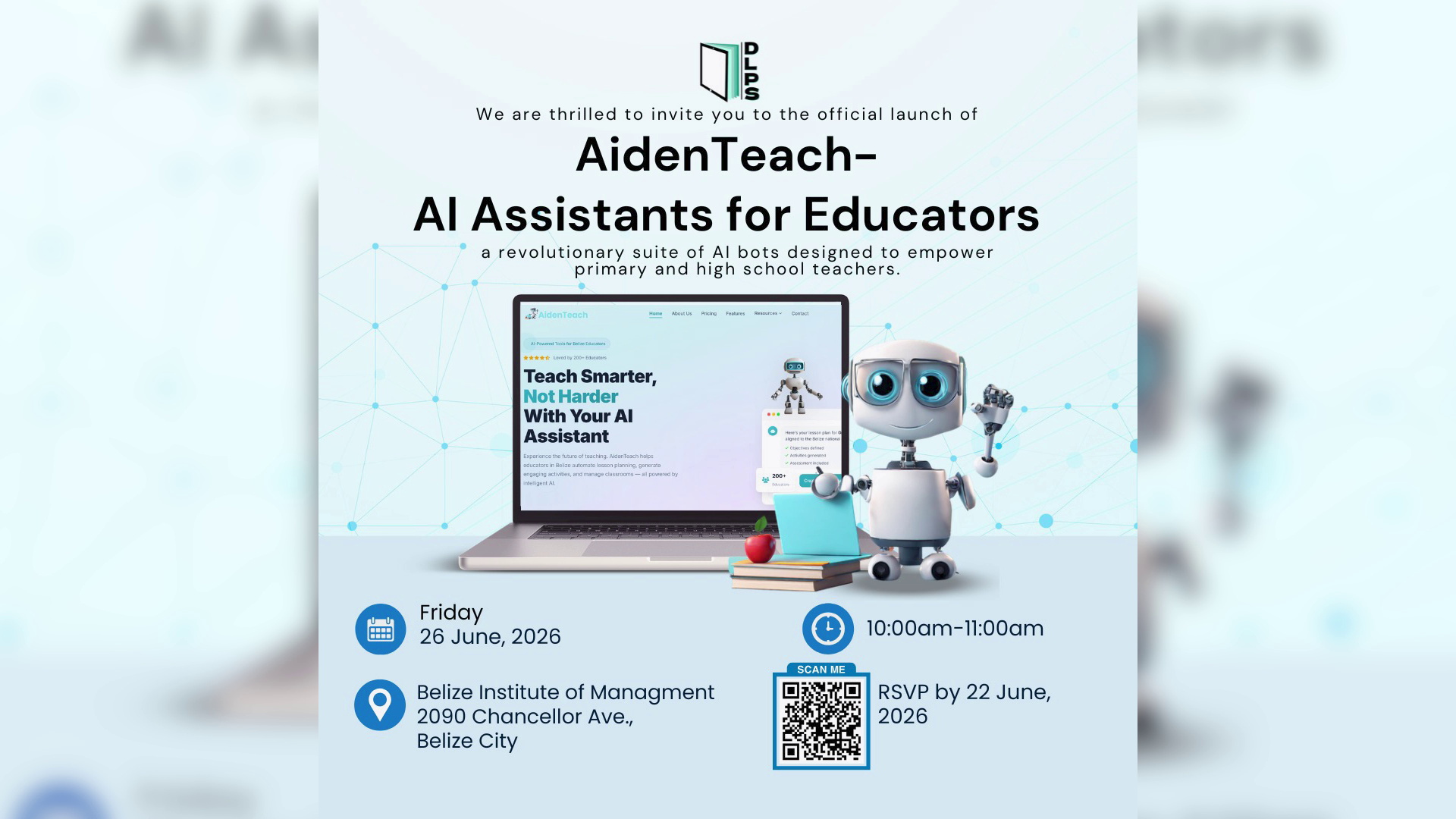
    As artificial intelligence continues to reshape modern educational landscapes across the globe, a pioneering educator from Belize is stepping forward to harness this technology for the benefit of overworked teaching professionals. Dr. Adriani Coleman, founder of the regional educational organization Digital Learning and Pedagogical Solutions Belize, first introduced her AI-powered teaching support platform AidenTeach back in 2023, and the tool has been gaining traction among educators seeking to cut down on non-instructional work.

    The core mission of AidenTeach is straightforward: to streamline the extensive administrative and routine tasks that consume so much of teachers’ time outside of direct instruction. The platform is structured as an affordable monthly subscription service, giving members access to 14 custom-built AI bots tailored to address four of the most time-consuming domains of K-12 and higher education teaching. These four key focus areas are lesson planning, classroom discipline management, project-based learning support, and both formative and summative student assessments.

    In a recent interview, Dr. Coleman explained the personal inspiration that drove her to develop the platform, noting that teaching has long required educators to juggle a dozen competing priorities at once. Beyond designing engaging learning experiences, teachers are saddled with endless paperwork, compliance deadlines, and administrative reporting that pull their focus away from what matters most: connecting with students. “When you’re in the classroom, your mind is somewhere else because you have to meet certain deadlines,” Coleman explained, emphasizing that AidenTeach was built to give teachers back their most valuable resource: time.

    To access the platform, educators simply visit the official website aidenteach.com, where transparent pricing is posted publicly. After selecting a subscription tier that fits their needs and entering payment information, they gain immediate access to the full suite of AI tools.

    Looking ahead, Dr. Coleman has ambitious expansion plans for AidenTeach across the Caribbean region. The platform will officially launch its services in Jamaica in the near future, bringing its AI-powered support to a new cohort of educators looking to reduce their workload and refocus on student engagement.

  • Voorlopig 34,3% geslaagd voor HAVO en 50,2% voor VWO; veel kandidaten naar herexamen

    Voorlopig 34,3% geslaagd voor HAVO en 50,2% voor VWO; veel kandidaten naar herexamen

    On July 8, the Dutch Ministry of Education, Science and Culture (OWC) published preliminary final exam results for the 2025-2026 academic year across two major secondary education tracks: Higher General Secondary Education (HAVO) and Pre-University Education (VWO), revealing mixed outcomes that still show an overall upward trend compared to last year.

    Across all HAVO programs, just 34.3% of 1,946 total candidates passed their final exams immediately on their first attempt. Breaking down the HAVO numbers: 668 students earned an immediate pass, 414 failed outright, 628 have been scheduled for a retake exam, 98 are eligible for a delayed make-up exam, and 138 candidates withdrew from the exam cycle before results were finalized. Two-year HAVO programs posted particularly underwhelming preliminary results: Christelijk HAVO recorded a 31% immediate pass rate, while HAVO-III notched a comparable 35.9% pass rate. Three-year HAVO tracks, by contrast, delivered more consistent, stable performance across the board.

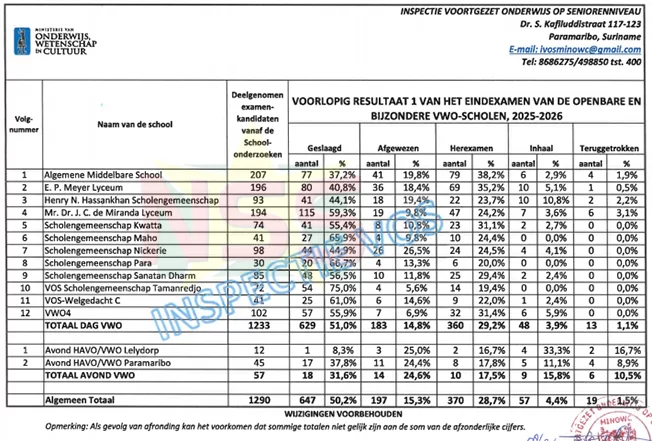
    For VWO, the more rigorous pre-university track, outcomes were far stronger: 50.2% of 1,290 total candidates passed immediately. The VWO breakdown shows 647 immediate passes, 197 outright failures, 370 candidates moving to retakes, 57 eligible for delayed make-ups, and 19 candidate withdrawals. Private VWO institutions boasted standout results this year: Arthur A. Hoogendoorn Atheneum led all schools with a 93.5% preliminary immediate pass rate, with 72 of its 77 candidates passing on the first try. Nassy Brouwer College followed with a strong 69.8% pass rate, while ACI recorded a solid 64.3% immediate pass rate.

    Overall, nearly one-third of all candidates across both education tracks will need to complete a retake exam to earn their diploma.

    The release of this year’s results was delayed by several days after officials discovered errors in two math exam papers, Wiskunde 1 and Wiskunde Q. Education Minister Dirk Currie explained that one question on Wiskunde 1 did not align properly with the curriculum students had prepared for, while two questions on Wiskunde Q were incomplete. In collaboration with subject teachers and school principals, ministry officials implemented grading corrections to ensure no student was unfairly penalized for the exam errors.

    Ministry officials frame the 2025-2026 results as a positive development overall. The Inspectorate for Senior Secondary Education notes that while performance gaps between individual schools remain, preliminary full-year results show a clear upward trajectory compared to the 2024-2025 academic year. Inspectors also project that final pass rates will rise significantly once all retake exams are completed and scored.

  • Education Ministry Congratulates Top 10 Performers in 2026 Grade Six National Assessment

    Education Ministry Congratulates Top 10 Performers in 2026 Grade Six National Assessment

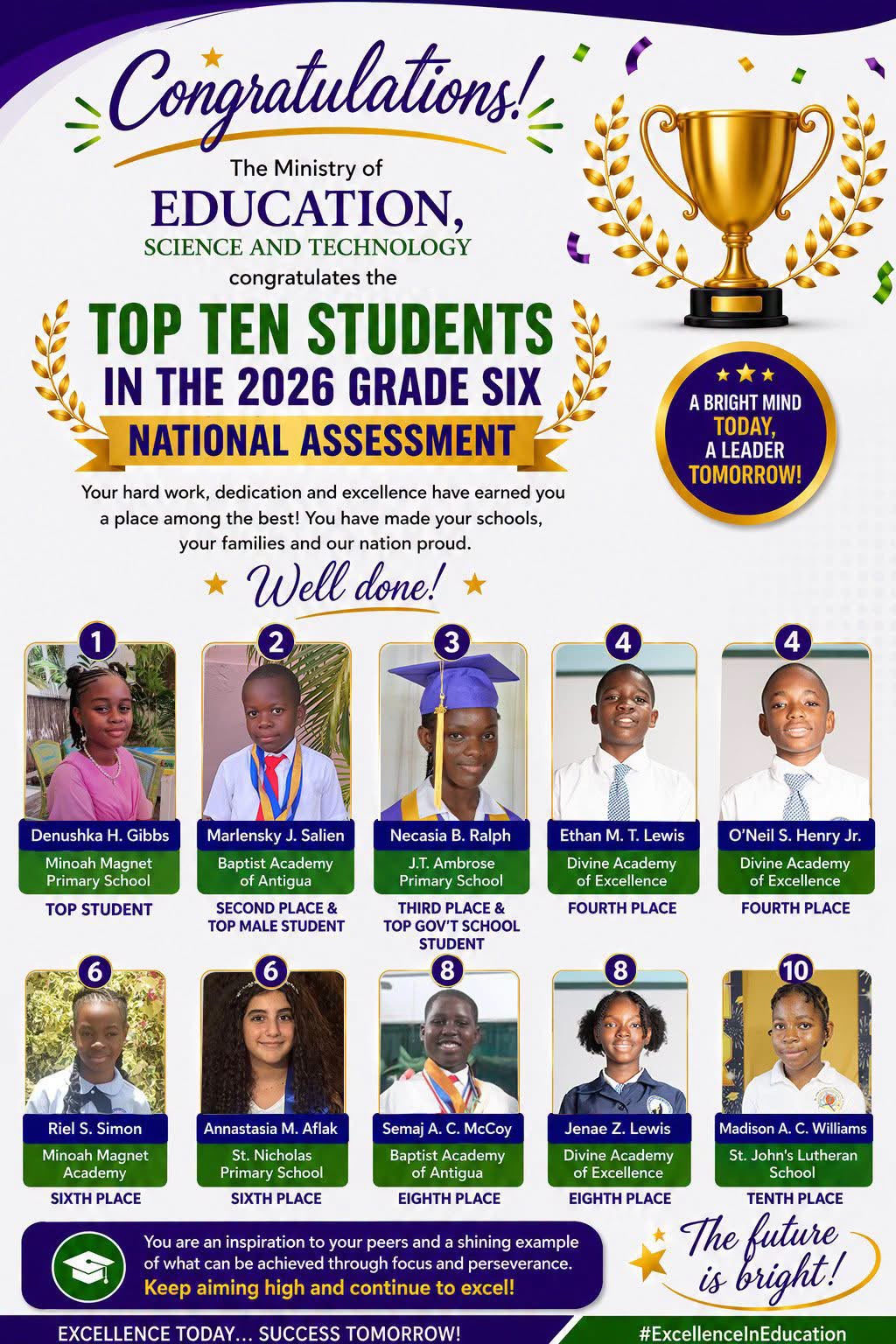
    Officials from the Ministry of Education, Science and Technology have extended formal congratulations to the 10 highest-achieving students across the country following the release of results for the 2026 Grade Six National Assessment, highlighting the outstanding academic rigor and consistent dedication that brought the cohort to their impressive milestones. In an official statement circulated to media and education stakeholders this Wednesday, the ministry emphasized that the standout results posted by these young learners are not accidental, but a direct reflection of months of intentional hard work, steady perseverance, strict personal discipline, and an unwavering commitment to meeting high academic standards. Beyond celebrating the students themselves, the government body also took the opportunity to acknowledge the critical behind-the-scenes support system that helped pave the way for these successes, giving public recognition to school principals, classroom teachers, and the students’ family members and guardians who offered guidance, encouragement, and resources throughout the entire primary school journey. “This outstanding achievement is a testament to your hard work, perseverance, discipline, and commitment to excellence,” the ministry noted in its official message to the honorees. “You have made your families, schools, teachers, and the entire nation proud.” Looking ahead to the next phase of the students’ academic careers, the ministry extended well wishes for continued growth and success as the group prepares to transition from primary education to secondary school, a key milestone that will set the foundation for their future professional and personal pursuits. The full list of top 10 performers, along with their affiliated institutions and special distinctions, has been released to the public alongside the official congratulatory statement. Claiming the overall top spot in the national assessment was Denushka H. Gibbs, a student at Minoah Magnet Primary School. Securing second place and the title of top-performing male student nationwide was Marlenky J. Salien of Baptist Academy of Antigua. Third place went to Necasia B. Ralph from J.T. Ambrose Primary School, who also earned recognition as the highest-scoring student from a government-run primary campus. Fourth place was awarded jointly to Ethan M. T. Lewis and O’Neil S. Henry Jr., both enrolled at Divine Academy of Excellence. Two students tied for sixth place: Riel S. Simon of Minoah Magnet Academy and Annastasia M. Aflak of St. Nicholas Primary School. Eighth place was another tie, claimed by Semaj A. C. McCoy of Baptist Academy of Antigua and Jenae Z. Lewis of Divine Academy of Excellence. Rounding out the top 10 at tenth place is Madison A. C. Williams from St. John’s Lutheran School.

  • Registration Opens for Antigua and Barbuda’s 2026 Agricultural Water and Irrigation Training

    Registration Opens for Antigua and Barbuda’s 2026 Agricultural Water and Irrigation Training

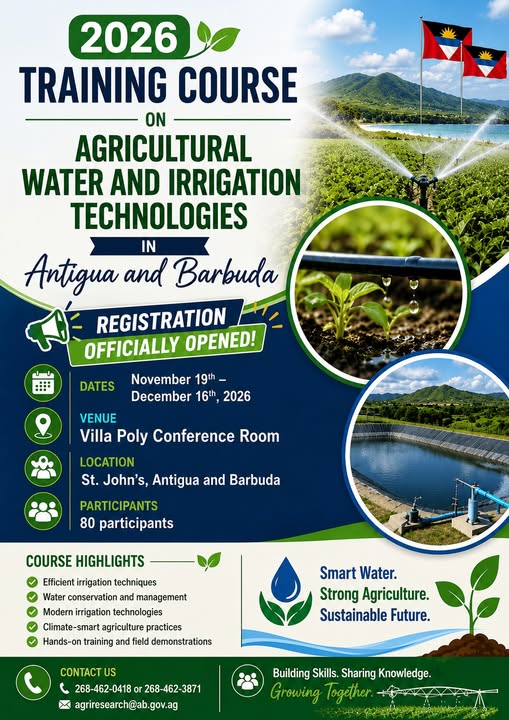
    Aspiring agricultural professionals and industry stakeholders in Antigua and Barbuda have received a new opportunity to advance their expertise, as the nation’s Ministry of Agriculture, Lands, Fisheries and the Blue Economy has officially launched registration for a targeted 2026 training course focused on agricultural water management and cutting-edge irrigation technologies.

    Designed to address growing challenges around water scarcity and climate volatility impacting the Caribbean agricultural sector, the program centers on equipping participants with both foundational knowledge and actionable practical skills in three core areas: modern irrigation system deployment, strategic water conservation, and climate-smart agricultural practices. Unlike traditional classroom-only learning models, the course prioritizes hands-on experience, giving attendees direct access to innovative tools and technologies that are reshaped sustainable agriculture globally. By the end of the program, participants are expected to leave with the capabilities needed to help build a more resilient, productive, and environmentally sustainable agricultural sector across Antigua and Barbuda.

    The 4-week training session is scheduled to run from November 19 through December 16, 2026, and will be hosted at the Villa Poly Conference Room in St. John’s, the nation’s capital. The curriculum is structured to cover a wide range of high-impact topics, including water-efficient irrigation techniques, integrated water resource management, the latest smart irrigation technologies, adaptive climate-smart farming practices, hands-on skill-building workshops, and live field demonstrations of new equipment and methods.

    Aligned with the government’s long-term vision for the sector, the program is rooted in the guiding slogan: “Smart Water. Strong Agriculture. Sustainable Future.” It reflects a broader commitment to capacity building, knowledge sharing, and collaborative growth across the national agricultural community, aiming to uplift smallholder farmers, agricultural extension workers, and industry professionals alike. Interested individuals can access registration via the official link shared by the ministry, and additional inquiries can be directed to the program’s administrative contact for further details.

  • Education secretary urges Dominican teachers to view AI as a learning tool

    Education secretary urges Dominican teachers to view AI as a learning tool

    At the opening ceremony of the annual Dominica Association of Teachers (DAT) Summer Training Institute, held this Monday at Dominica’s Convent High School, a top government education official has called on local educators to reframe their perspective on artificial intelligence, embracing the emerging technology as a supportive tool rather than a disruptive threat to teaching.

    Robert Guiste, Permanent Secretary of Dominica’s Ministry of Education, used his keynote address to push for broader adoption of AI in educational settings, telling attendees, “I want us as teachers to focus on AI. AI should be our friend.”

    Guiste pointed out that even original writing from iconic literary figures would trigger AI detection flags in today’s testing landscape. He explained, “Teachers, no matter what you do, if you were to call William Shakespeare now and you were to write something off his head, you run it through an AI checker, you are going to get 30 percent AI, at least.” His comments highlight a growing recognition that overreliance on AI detection tools can produce misleading results for genuinely original work, as AI systems are trained on vast corpora of existing text that overlap with even new, human-generated content.

    Beyond encouraging responsible AI use among educators and students, Guiste emphasized the value of regional collaborative platforms for upskilling teachers. He noted that the Organization of Eastern Caribbean States (OECS) maintains a dedicated professional development hub that offers educators across the region access to expanding high-quality learning opportunities, curated digital resources, and cross-institutional collaborative networks. This infrastructure is designed to support continuous career growth for teachers at every stage of their careers, Guiste said, adding, “It reflects our shared commitment within the OECS to building teacher capacity and ensuring that educators have access to continuous, relevant, and flexible professional development.”

    Notably, the OECS hub’s built-in AI feature was not developed by outside international consultants. It was created by young tech professionals from across the Eastern Caribbean region, including two expert developers based in Dominica. This homegrown innovation aligns with the regional bloc’s goal of building locally led, context-appropriate educational tools that meet the specific needs of Caribbean educators and students.

    Guiste closed his remarks by stressing the importance of digital literacy around AI, urging teachers to master when and how to leverage the technology, and to pass that critical understanding on to their students. By teaching responsible AI use from an early stage, he argued, schools can prepare the next generation for a workforce where AI literacy will be an essential skill.