
On July 15, Caribbean regional airline LIAT marked a landmark milestone for regional connectivity when its first direct flight from Pointe-à-Pitre, Guadeloupe touched down at Montego Bay’s Sangster International Airport, carrying 33 passengers to open a groundbreaking new air corridor between the two Caribbean islands. The new year-round service will operate on a twice-weekly schedule, with flights landing in Montego Bay every Tuesday and Saturday, creating a permanent, convenient link between the French Caribbean and Jamaica’s top tourism hub.\n\nIndustry and government stakeholders across the region have framed the new route as far more than an expansion of airline service: it is a transformative step toward deeper economic, social and cultural integration across the Caribbean archipelago. For decades, travel between neighboring Caribbean islands often required inconvenient connections through North American hubs or multiple regional airports, adding time, cost and friction to personal, tourism and business trips. The new direct connection eliminates that barrier, unlocking a host of shared opportunities for both destinations.\n\nFor Jamaica, the route aligns with a key strategic priority of the country’s tourism sector: diversifying its source markets beyond traditional core markets of North America and the United Kingdom. By opening a direct gateway to the French Caribbean, the service makes it far easier for French and other European vacationers to reach Jamaica’s world-famous beaches, culture and attractions, while also strengthening Montego Bay’s growing reputation as a regional aviation hub for the broader Caribbean.\n\nGuadeloupe stands to gain equally from the new connection. The direct link opens the door to growing multi-island Caribbean itineraries that combine the distinct cultural experiences of French-speaking and English-speaking island destinations, a product that is increasingly popular with international travelers seeking immersive regional vacations. Beyond tourism, the route is expected to drive growth in business and conference travel, simplify family visits for communities spread across the region, create new opportunities for partnerships between airlines and cruise lines, and expand cultural exchanges across music, cuisine, festivals and sports.\n\nJamaica’s Minister of State in the Ministry of Tourism, Hon. Tova Hamilton, emphasized the transformative potential of the new route during welcoming ceremonies for the inaugural flight. She rejected the idea of Caribbean islands operating in isolation, noting that the region can only unlock its full collective potential through greater connectivity. “Every seat on this aircraft represents opportunity,” Hamilton said. “The Caribbean cannot reach its full potential as a collection of isolated islands. Our strength lies in moving people, goods, and culture more freely across our borders.”\n\nThat vision was echoed by LIAT Air Chief Operating Officer Obiukwu Mbanuzuo, who framed the new route as a symbolic as well as practical milestone for the regional carrier. For LIAT, which has long centered its mission on connecting Caribbean communities, the new service is more than just an addition to the airline’s route network. “It is a connection between two nations, their peoples and their economies,” Mbanuzuo said.
分类: business
-

Dominican Republic reinforces fruit fly controls to maintain mango exports
Santo Domingo, Dominican Republic – The Dominican Ministry of Agriculture has launched a suite of updated phytosanitary protocols designed to solidify the country’s position as a reliable mango exporter to the United States and the European Union, with a core focus on bolstering fruit fly surveillance and aligning with global food safety standards. The new regulatory framework comes in direct response to gaps identified by international agricultural health authorities last year, and is aimed at preserving critical market access for one of the country’s most high-value agricultural export commodities.
Under the new measures, the ministry has appointed agricultural engineer Jeurys Arias to head the national fruit fly monitoring initiative. A key immediate priority for the new program is a full systematic inspection of all 2,089 detection traps deployed across Peravia province, the Dominican Republic’s export mango heartland that accounts for roughly 80% of the nation’s total mango output destined for international markets. Beyond inspections, the initiative also includes upgrades to surveillance infrastructure, georeferencing tracking capabilities, and centralized data management systems to improve transparency and traceability across the pre-export inspection process.
Agriculture Minister Francisco Oliverio Espaillat confirmed that the reinstatement of stricter phytosanitary controls follows recommendations issued in 2023 by the United States Department of Agriculture’s Animal and Plant Health Inspection Service (APHIS), which flagged procedural weaknesses in the country’s pre-export inspection protocols. By addressing these gaps, the Dominican government aims to ensure uninterrupted tariff and market access for Dominican mangoes entering the $2 billion U.S. fresh mango market.
Emidio Gómez, director of the Ministry of Agriculture’s Health and Food Safety division, provided an update on the current harvest season, noting that between 85% and 90% of the country’s yellow-skinned mango crop had already been shipped to the United States before the new measures were implemented, leaving just 10% of the total harvest still pending export. For European markets, Gómez added that exports of green- and red-skinned mango varieties, which launched in early May, are proceeding on their scheduled timeline. He also emphasized that the Dominican Republic remains officially free of the Mediterranean fruit fly (*Ceratitis capitata*), a key pest that would threaten export access if detected.
To support small and large scale mango producers through the transition, the Ministry of Agriculture has pledged ongoing technical assistance and training to help operations adapt to the new protocols. This support is designed to help maintain the Dominican Republic’s price and quality competitiveness in global fresh fruit markets, where demand for Caribbean mangoes continues to grow year over year.
-

Energy Ministry: Larimar exports won’t reduce supply for Dominican artisans
In a public statement released Sunday, the Dominican Republic’s Ministry of Energy and Mines moved to clear up widespread misconceptions surrounding raw larimar exports, emphasizing that shipments of the rare blue gemstone do not come at the expense of local Dominican artisans who rely on the material for their work.
According to ministry officials, current production data shows 60 percent of all larimar extracted from the country’s Barahona region mines remains within Dominican borders, leaving only 40 percent of total output designated for international export. The exported share is explicitly surplus material that the local jewelry manufacturing sector does not need, with the highest quality first- and second-grade larimar — stones celebrated for their vivid, intense blue hue and premium market value — reserved exclusively for domestic artisans and independent jewelry workshops.
Officials also addressed a common point of confusion in national trade data: most export aggregated statistics group raw, semi-processed, and fully finished larimar products under a single tariff heading. This means a large portion of the reported total export value actually comes from high-value finished larimar jewelry, not unprocessed raw stone, countering claims that the country is exporting most of its most valuable raw material.
To further strengthen the entire larimar value chain and connect key domestic stakeholders, the ministry has announced a new initiative: the 2026 Larimar Miners-Artisans Direct Sales Fair, scheduled to take place August 21 at the Larimar Museum Workshop School in Bahoruco, Barahona. The core goal of the event is to cut out unnecessary intermediaries by linking larimar miners directly to the artisans who use the stone, creating more equitable revenue distribution and supporting growth for small businesses across the sector.
In the statement, the ministry warned that imposing arbitrary restrictions on surplus larimar exports would carry severe economic consequences for local mining communities. Such a policy would cut off primary income for small-scale miners, undermine the long-term financial stability of local mining cooperatives, and put hundreds of working positions at risk across the region. Alongside addressing export policy, officials also highlighted ongoing improvements to the larimar mining sector, including upgrades to mine safety regulations and formalization efforts. Recent upgrades include enhanced ventilation systems, improved electrical infrastructure, and overall safer working conditions for mining employees.
New production data from the Dominican Directorate of Mining Promotion confirms that total larimar output reached 188,696 pounds across the first half of 2026, solidifying the country’s position as the only commercial source of the unique gemstone in the global market.
-

The Million-Dollar Meeting that never happens
The Dominican Republic is currently facing a critical, underdiscussed gap in its growing innovation ecosystem: it is not a lack of creative entrepreneurs or promising startup ideas that holds the country back, but a broken, outdated procurement system that fails to turn promising ventures into sustainable, scalable businesses.
Across the country, public and private institutions regularly host glowing startup events: young entrepreneurs present prototypes to crowds of attendees, bank executives hand out awards to competition winners, corporate leaders launch new accelerators, hackathons and innovation challenges, and universities showcase student work to industry partners. These events draw full rooms, are covered widely in local media and shared across professional social platforms, and are rooted in sincere intentions to grow the domestic innovation economy. But once the event ends, the banners come down and attendees return to their daily work, one critical question is almost never asked months later: how many of these participating startups actually received a formal, paid purchase contract from the institutions hosting the events?
Too often, startups leave these events with only a certificate, an invitation to pitch again, a non-binding memorandum of understanding, or an unpaid pilot that promises exposure but no revenue. This silence around the number of actual contracts awarded exposes a deep structural flaw in the Dominican innovation ecosystem. While the country has poured significant time and resources into building a pipeline of new innovators and entrepreneurs, it has largely neglected the work of reforming the public and private institutions that should be the first major buyers of domestic innovation. This disconnect explains why the Dominican Republic can produce a growing number of entrepreneurship programs, competition cohorts and accelerator graduates while still failing to help promising new ventures turn their ideas into durable, job-creating companies. The core challenge is not that startups need more general support; it is that too few domestic institutions have clear, reliable mechanisms to turn an unmet operational need into a funded, paid contract for an innovative new supplier.
Today’s innovation ecosystems have become very skilled at tracking surface-level activity: they count the number of entrepreneurs trained, applications received, workshops hosted, mentors recruited, competitions held and ventures accelerated. These metrics easily prove that programs ran and reached participants, but they do not prove that a functional market for domestic innovation has been created. The far more important, unreported metrics are far more demanding: how many participating startups became approved institutional suppliers? How many paid pilot projects have been commissioned? What share of those pilots turn into recurring, long-term contracts? How much institutional spending actually flows to emerging Dominican companies? And how much revenue, employment and intellectual property has been generated by those transactions?
An innovation program that trains 500 entrepreneurs but generates no commercial demand for their solutions may have some educational merit, but it should not automatically be celebrated as a successful economic development initiative. No industry would accept this flawed measurement: tourism is not judged by the number of hotel management training seminars held, ignoring actual hotel occupancy rates. Export performance is not measured by counting how many companies attend trade workshops, ignoring the actual value of purchase orders received. Yet innovation programs are regularly celebrated without any disclosure of whether anyone actually bought the innovations being developed. This gap has major economic consequences: public procurement accounts for roughly 12% of GDP across OECD economies, 14% to 15% of GDP in the European Union, and an estimated 15% of global GDP overall. At this scale, procurement is far more than routine administrative paperwork; it is core economic strategy, implemented through public and private spending.
The failure to integrate innovation into procurement is often framed as a problem that only hurts startups, but this is an incomplete view. The institutions that refuse to adapt their procurement processes also pay a steep price for this inaction: a bank may continue running a costly, inefficient manual process that a local startup could have automated; a tourism operator may keep paying for imported technology that is not built for the unique needs of the Dominican market; a government ministry may lose hundreds of staff hours to fragmented, outdated legacy systems; a university may see valuable local research sit unused with no path to commercialization; a telecommunications company may hold massive amounts of valuable customer data but have no internal process to partner with a startup to turn that data into a profitable new service. While the startup loses out on a contract, the institution continues paying for the unresolved problem year after year. These costs may appear as higher operating budgets, slower customer service, duplicated labor, increased cybersecurity risk, unused data, overreliance on foreign suppliers, and delayed decision-making. Because these losses are spread across multiple departments, they rarely come with a single invoice explicitly labeled “failure to innovate,” but they are no less real.
The Inter-American Development Bank estimates that inefficiencies in public spending across Latin America and the Caribbean, including weaknesses in procurement systems, add up to roughly 4.4% of the region’s total annual GDP. Not all of this waste can be eliminated by working with new technology startups, but the figure makes clear how much institutional value is lost when spending systems fail to connect public and private budgets to better solutions. The core question for Dominican institutions is not whether they should “support startups” as a form of corporate social responsibility; it is whether they can identify their most costly operational problems, open those problems to capable new suppliers, and purchase better solutions under clear, controlled terms.
It would be a mistake to simply blame procurement departments for this gap. Traditional procurement systems are intentionally designed to acquire well-known goods and services from established suppliers, who can prove their reliability through years of prior contracts, stable financial history, industry certifications and long delivery track records. The core purpose of traditional procurement is to protect institutions from unnecessary risk, maintain fair competition and deliver the best value for money. But innovation represents a fundamentally different kind of transaction: the solution may not have years of proven operating history; the buyer may understand their problem clearly but not know the exact technical specification that will solve it; the supplier may be highly capable but too young to have a long track record; the institution may need to test the solution’s performance before committing to a large-scale rollout.
When institutions use a traditional procurement process for innovative solutions, it creates a paradox: organizations call for new innovation, but their qualification rules only reward solutions that have already been proven elsewhere. The outcome is predictable: large, established incumbents remain eligible for contracts, emerging innovative firms remain “interesting” but unqualified, and official innovation programs operate at a polite distance from the institution’s actual spending machinery. Leading global procurement systems have already recognized this gap and adapted. The OECD and European Commission have created extensive guidance for using public procurement as a demand-side tool to drive innovation, including frameworks for pre-commercial procurement, public procurement of innovative solutions, and innovation partnerships. These frameworks help institutions clearly define their challenges, test competing solutions, and move toward implementation while still protecting competition and managing risk. The World Bank’s modern procurement framework similarly emphasizes that purchasing strategies should be tailored to the specific purpose and evaluated based on overall value delivered, not automatically awarded to the lowest bid that meets minimum compliance rules. These models do not eliminate critical financial controls; they redesign the procurement pathway so that uncertainty can be managed, rather than used as an excuse to avoid working with new suppliers entirely. The Dominican Republic does not need weaker, less rigorous procurement; it needs more sophisticated, adaptive procurement that can accommodate innovative solutions.
Most institutional innovation projects get through the first meeting without issue: a startup founder demonstrates their product, the institution’s innovation team sees clear potential, executives ask thoughtful questions, and everyone agrees the solution deserves further discussion. But the second critical meeting, the one that actually leads to a contract, almost never happens. That meeting needs to bring together the executive who owns the operational problem, the leader who controls the relevant budget, the procurement, finance, legal, risk and compliance teams, and a senior institutional sponsor with enough authority to align all these stakeholders. Without this meeting, the initial conversation generates interest but no clear path to a commercial transaction. The innovation team can advocate for the solution, but they cannot allocate budget from the relevant business unit. Procurement can run a formal process, but they have no approved mandate to move forward. Legal can review the contract terms, but they cannot decide whether solving the problem is a strategic priority for the institution. Every team is involved, but no one is explicitly responsible for converting interest into a contract. This missing ownership is the hidden institutional gap holding back Dominican innovation. The critical question is not just whether an organization has an innovation department; it is whether the organization has created a clear internal pathway for innovation to turn into allocated spending, implemented solutions and measurable returns on investment.
The term “pilot” is often used when institutions want to appear open to innovation without making a real commitment. There is nothing wrong with a well-designed pilot: a disciplined pilot project can reduce technical, operational and financial uncertainty before a full-scale rollout. But a pilot that does not have a clear, pre-defined decision-making process is not innovation procurement; it is just postponed judgment. Before any pilot launches, institutions should be able to answer six core questions: What expensive operational problem is this pilot solving? Which executive owns that problem and is accountable for its resolution? Which budget will pay for the successful solution? What specific evidence will count as successful validation of the solution? What procurement mechanism will be used to award a full contract if the pilot succeeds? Who has the authority to approve scaling the solution if it meets the success criteria? If these questions are left unanswered, the pilot will almost always become an isolated, forgotten experiment. The startup invests time and resources into customizing the product, training the institution’s team, and providing executive attention, while the institution gains knowledge and optional future access to the product. But when the budget cycle changes, the internal sponsor changes roles, or the project gets kicked into an indefinite review, it never moves forward. A paid validation should be designed as a bridge to a final decision, not a substitute for one.
For public and private institutions across the Dominican Republic, the first step to fixing this gap is not announcing another innovation competition. It is identifying the costly operational problems that are already draining money, time and institutional capacity, and deciding which of these problems can be opened to qualified external innovative suppliers. From there, six core elements need to be connected in a clear sequence: Problem → Sponsor → Budget → Validation → Procurement → Scale. The problem must be large enough to be economically meaningful. The sponsor must have enough institutional authority to move the project forward. The budget must be identified before the solution is publicly celebrated. Validation must be paid, time-bound, and governed by pre-agreed success criteria. Procurement must have a legally and operationally clear pathway to a full contract. Scaling must follow a pre-defined decision, not another round of unproductive exploratory meetings.
This structured framework protects both institutions and startups. It prevents innovation teams from promoting solutions that operational business units do not actually need. It prevents startups from investing time and resources into pilots that have no committed buyer. It allows procurement and legal teams to shape the transaction early on, before enthusiasm outpaces institutional guardrails. It gives finance teams a clear basis for measuring operational returns on investment. It allows senior executives to distinguish between surface-level innovation activity and actual commercial implementation. Most importantly, it turns innovation from a public relations exercise into a core management discipline that drives real value.
The world’s strongest innovation economies did not grow from venture capital investment alone. Investment is important, but capital cannot permanently replace the demand from actual customers. Many of the technologies that reshaped global markets benefited from sophisticated institutional demand during their early, formative years. Governments and large corporations did not just cheer on new founders; they became the first major customers, set clear performance requirements, and gave new companies the reference implementations they needed to expand to broader markets. The U.S. Small Business Innovation Research program is a prominent example of public demand being used to develop and test solutions for federal government needs. European governments have built formal innovation procurement tools, while South Korea has integrated public innovation purchasing into a sophisticated digital procurement infrastructure. Today, the European Union is debating how innovation procurement can strengthen its strategic domestic industries and reduce overreliance on foreign suppliers.
The lesson for the Dominican Republic is not that the government should indiscriminately favor young domestic companies or lower quality standards in the name of entrepreneurship. The state should not pick winners, and public and private institutions should never purchase low-quality solutions as a form of charity. The real lesson is that sophisticated, dynamic economies create controlled, fair opportunities for qualified emerging suppliers to prove they can solve important problems. They do not confuse risk management with automatically excluding any new, unproven solution. A demanding, high-standard first customer does more to help a startup grow than a dozen entrepreneurship workshops. It generates immediate revenue, creates a track record of operational performance, builds credibility, and produces a reference case that can help the company expand beyond the Dominican Republic to export markets. For a small economy like the Dominican Republic that wants to export more high-value intellectual property, this shift is decisive.
Today, the Dominican Republic has no shortage of innovation-focused rhetoric, and it already has all the core building blocks of a thriving innovation economy: talented founders, strong universities, healthy corporate balance sheets, well-established public institutions, functional financial infrastructure, and an increasingly ambitious entrepreneurial class. What remains underdeveloped is the commercial procurement machinery that connects these assets together. A mature, honest national innovation report should not just report how many entrepreneurs were reached by programs; it should disclose the total value of innovation contracts awarded, the number of first-time domestic suppliers that were approved, the share of paid pilot validations that converted to full contracts, the institutional cost savings or new revenue generated by these solutions, and the number of Dominican innovations that have subsequently been exported. These metrics will reveal whether the country is building real innovation capability, or just surface-level activity.
The next phase of growth for Dominican innovation will not be determined by how many founders enter startup programs, how many judges attend demo days, or how many institutions add their logo to an event backdrop. It will be determined by whether the country’s leading public and private institutions can allocate budgets to solve their defined problems, and allow qualified domestic companies to compete for the right to deliver those solutions. The Dominican Republic has spent years building the supply side of innovation; now it must focus on building intentional demand for domestic innovation. Innovation does not become lasting economic power when it gets applause; it becomes economic power when someone with the authority signs the purchase order.
-
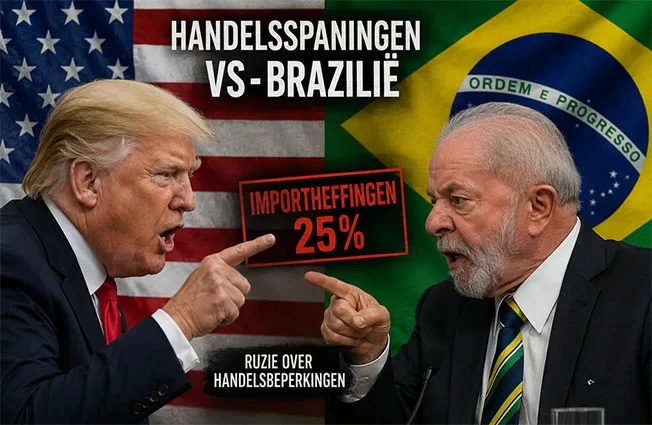
Handelsoorlog tussen VS en Brazilië escaleert na nieuwe importheffingen
On July 19, the United States announced a new round of 25 percent import tariffs targeting a broad range of products exported from Brazil, a trade measure set to enter into force on July 22. This new tariff policy forms the latest escalation of an ongoing trade dispute between the two nations, with Washington justifying the action by claiming Brazil engages in unfair trade practices that disadvantage American businesses. In response, Brazil has issued a sharp rebuke and threatened to enact retaliatory countermeasures against the United States.
The new tariffs cover a wide swathe of Brazil’s key export categories to the US, including furniture, ethanol, industrial machinery, footwear, and dozens of other manufactured and industrial goods. However, the Office of the U.S. Trade Representative carved out a series of exemptions for goods deemed critical to domestic U.S. economic operations or for which the country lacks sufficient domestic production capacity. Key Brazilian exports excluded from the new levies include coffee, beef, oranges, orange juice, select energy products, and aerospace components.
According to U.S. trade officials, the tariffs are the outcome of a 12-month-long investigation into alleged unfair trade barriers maintained by Brazil. Washington specifically highlights the regulatory treatment of U.S. technology and payment firms operating in Brazil, as well as other systemic trade practices that it argues put American companies at a competitive disadvantage in the Brazilian market.
The Brazilian administration has condemned the move in strong terms. President Luiz Inácio Lula da Silva has labeled the new U.S. import tariffs unacceptable, and confirmed that Brazil reserves the full right to implement proportional countermeasures to protect its domestic economy. Brazilian officials note that countermeasures will not be limited to reciprocal import tariffs, and will include a range of additional economic policy tools designed to minimize the negative impact of U.S. tariffs on Brazil’s own economic growth.
Trade analysts warn that the new round of trade tensions between the two largest economies in the Western Hemisphere is likely to have spillover effects on economic growth across South America. As the region’s largest economy and a leading global exporter of agricultural goods, industrial products, and raw materials, a contraction in Brazilian exports to the U.S. will not only put added pressure on Brazil’s domestic industrial sector, but could also ripple through regional trade networks.
For neighboring Suriname, the impacts are expected to be mostly indirect, but still meaningful. Brazil is Suriname’s largest regional trading partner and a core economic engine for South America as a whole. A slowdown in Brazilian economic activity driven by reduced exports could dampen regional investment flows, shift cross-border trade patterns, and lower demand for Suriname’s raw material exports. At the same time, Brazil may redirect export volumes originally bound for the U.S. to other regional markets, increasing competitive pressure on domestic producers in Suriname and other smaller South American economies.
In the coming weeks, global trade observers will closely monitor whether diplomatic channels can lead to a negotiated compromise between Washington and Brasília before the tariffs take effect. If negotiations fail, there is significant risk that trade tensions will escalate further, leading to a tit-for-tat cycle of additional reciprocal trade measures that could disrupt commerce across the entire hemisphere.
-

Telesur moderniseert kernnetwerk om groei dataverkeer op te vangen
Suriname’s leading state-owned telecommunications firm Telesur is embarking on a two-year large-scale initiative to modernize its core IP and transmission network, responding to exponential surges in domestic and international data traffic that have strained existing infrastructure over the past five years.
The official launch of the project took place this Thursday at a Strategic Stakeholder Session and Project Kick-off Ceremony, where Telesur formalized its partnership with three global technology leaders: Openlink, Cisco, and Ciena. At the event, all parties signed a binding Statement of Commitment, cementing their shared responsibilities for delivering the network upgrade on schedule. Armando Guevara, General Manager of Openlink, and Doric Ramlakhan, Chief Executive Officer of Telesur, led the ceremonial signing.
According to official data shared by Telesur, the urgent need for this investment stems from staggering growth in data usage across the country. Between 2020 and 2025, the company recorded a 419% jump in international data traffic on its network, soaring from roughly 35 gigabits per second (Gbps) to 172 Gbps. Domestic data traffic has also expanded rapidly, driven by the ongoing rollout of fiber-optic connections across Suriname and accelerating digital transformation across households, private enterprises, and public government services.
The IP Core and transmission network acts as the digital backbone of all of Telesur’s operations, handling all data routing within Suriname as well as international connectivity to global networks. Completing the modernization will not only boost the network’s ability to accommodate current and future demand but also prepare the infrastructure to support emerging digital applications that are expected to enter the market in coming years.
For end customers, the upgrade will deliver tangible long-term benefits: expanded network capacity, more consistent and stable internet connections, and a flexible infrastructure that can accommodate future technological advances. Most construction and upgrades will be carried out on backend infrastructure, meaning the project will cause minimal direct disruption to everyday user services during implementation.
Telesur CEO Doric Ramlakhan emphasized that the investment is a proactive measure to prevent growing data demand from eroding the quality of the company’s service offerings. More broadly, Ramlakhan noted that the modernization project lays a critical foundational framework for sustained digital advancement, innovation, and inclusive economic growth across Suriname in the years ahead.
-

OP-ED: We’ve called the meeting, now here’s what we bring
When the European Union issued an ultimatum to five Eastern Caribbean nations to shutter their Citizenship by Investment (CBI) programs by 2028, regional leaders gathered in Roseau, Dominica last Friday and made a critical, forward-thinking choice: they will head to Brussels as a unified bloc to negotiate, rather than comply passively. This op-ed from the soon-to-launch Caribbean Outlet, *The Caribbean Ledger*, framed the gathering not as the final step in the process, but the starting line for high-stakes preparation, outlining a clear strategic framework for the Caribbean delegation to reframe the conversation from defense to proactive negotiation.
To enter the talks effectively, regional leaders must first understand the shifting landscape they face. In a June 25 letter from EU Commissioner Magnus Brunner, Brussels made clear that the existence of CBI programs itself, “regardless of how well it is managed,” is now grounds for reviewing Schengen visa-free access for Caribbean nationals. This means compliance reforms – which the Eastern Caribbean Collective Investment Regulatory Authority (ECCIRA), launched this year and headquartered in Grenada, was specifically designed to address – are no longer the core of the discussion. The EU has already moved past administrative concerns to a matter of principle. Any attempt to debate compliance in Brussels will hit an immovable wall, the analysis argues, so the region must shift its approach entirely.
The Caribbean’s strongest negotiating leverage is not a defense of CBI, but a clear exposure of the current asymmetric power dynamic. If the Caribbean shuts down its programs as the EU demands, Brussels and Washington achieve their stated goal of safeguarding global integrity systems – but the entire fiscal cost falls entirely on small island economies. For Dominica, CBI revenue makes up roughly 37% of total GDP. St Kitts and Nevis already saw its 2024 fiscal deficit widen to 11% of GDP after a drop in CBI earnings, and would face an unfillable structural budget gap if the programs are eliminated entirely. Across the region, CBI funding has paid for critical public infrastructure: hospitals, modern airports, climate-resilient housing, and national fiscal buffers that shield economies from external shocks. The current outcome the EU is pushing would leave the EU with all the gains and the Caribbean absorbing all the losses – that is not how an equal partnership works, and the region must state this plainly and calmly from the start of talks.
Instead of begging for compensation, which casts the region as a supplicant, the analysis argues Caribbean leaders should come to the table with a concrete proposal to trade the CBI revenue stream for a permanent, binding EU-Caribbean trade and development compact. Existing frameworks already exist to support this: the CARIFORUM-EU Economic Partnership Agreement, the Samoa Agreement, and the EU’s own Global Gateway development initiative. The Caribbean only needs to turn these loose frameworks into a tangible, enforceable deal that works for both sides: guaranteed long-term market access for Caribbean agricultural and value-added goods, paired with EU investment in the infrastructure needed to scale that trade. This is a negotiation between equal partners, not a surrender to EU demands.
The analysis lays out four core elements that the Caribbean’s formal proposal must include to be taken seriously. First, a phased, negotiated transition instead of an abrupt 2028 hard stop. An immediate end to CBI without alternative revenue would trigger an immediate fiscal crisis across the region. Instead, the Caribbean should propose a 3-5 year structured wind-down, shifting toward residency-focused investment models that meet EU security safeguards while maintaining orderly investment inflows during the transition, with clear public milestones to track progress. Second, a binding commitment for expanded agricultural trade access to EU markets. The region still remembers the collapse of the Windward Islands banana industry after EU trade preferences were withdrawn, when an entire regional economic sector hollowed out almost overnight. This time, the Caribbean should leverage that history to demand a specific, enforceable agreement with set volumes and timelines for expanded access for Caribbean agricultural and agro-processed goods. Third, a dedicated Caribbean Development Partnership facility under the EU’s Global Gateway framework. This facility would be seeded by EU funding, matched with existing capital from the Caribbean Development Bank (CDB) and the Eastern Caribbean Central Bank (ECCB), and targeted at the specific infrastructure needed to expand trade: cold storage networks, packing facilities, port upgrades, and phytosanitary certification systems. Fourth, quantified, binding co-financing commitments for climate resilience. As small island developing states, the Caribbean bears a disproportionate share of climate change costs that it did almost nothing to cause, making this a non-negotiable component of any fair compact.
Beyond substance, the posture of the Caribbean delegation will shape the outcome of the talks. First and most critically, the region must speak with one voice. Divided, separate negotiations will only let Brussels split the bloc and weaken individual nations’ bargaining power. A unified position supported by the Organization of Eastern Caribbean States (OECS) and CARICOM, led jointly by OECS Chairman Prime Minister Gaston Browne and incoming CARICOM Chairman Prime Minister Philip J. Pierre, will signal that this is a region-wide priority, not a narrow sub-regional grievance. Second, the delegation must bring concrete, publicly available numbers for every part of its proposal. Specificity demonstrates seriousness, while vagueness lets the EU agree in principle without delivering any tangible outcomes – a mistake the region has made repeatedly in past negotiations. Every element should be quantified: the fiscal impact of an abrupt phase-out, how much replacement revenue is needed, how much investment the Caribbean will contribute, and what exact volume of market access is being requested. Third, the delegation should reference past patterns of unequal negotiation calmly, not as a list of grievances. Past experiences – the banana trade collapse, 1990s financial services pressure, the more recent correspondent banking crisis – are not random misfortunes, they are patterns that explain why the region is demanding binding commitments rather than vague statements of intent this time around. That request is entirely reasonable for a partner that has seen European interests override regional solidarity in the past.
The window for negotiation is narrow, and preparation is now non-negotiable. Regional development frameworks already lay out clear long-term goals: the CDB estimates the region needs $65 billion in financing by 2033 just to avoid economic stagnation, while the ECCB’s Big Push strategy aims to double the Eastern Caribbean’s total GDP within a decade. An abrupt CBI phase-out would derail both of these critical goals, but a well-negotiated compact would make them achievable. What the region needs right now is not just a joint communiqué or a statement of intent, but a specific, costed, legally grounded transition plan that maps out exactly what revenue needs to be replaced, what new industries will be built, what trade volumes will be negotiated, what infrastructure will be financed, and what timeline all of this will follow. The Caribbean has been forced into economic transitions before, but rarely has it had the chance to prepare a detailed plan in advance, before the crisis hits.
St. Jean & Company, a regional advisory firm that has worked on economic transition strategy since 2020, has already built a transition and diversification roadmap aligned with both the CDB and ECCB frameworks, designed explicitly to support this moment. The firm offers this analysis and existing work to the Caribbean delegation, and stands ready to expand it into a full advisory engagement to support the Brussels mission. The Roseau meeting was the right first step, the analysis concludes, demonstrating that the Caribbean can adapt quickly when global conditions shift. Unlike past transitions, the ground has not yet fallen out from under the region – there is still time to shape a safe, prosperous landing. The window will not stay open forever, so the region must use every moment of preparation wisely.
-

Martí warns that changing the LPG mixture to 90% propane would cause many explosions due to the poor condition of the cylinders.
A controversial proposal to adjust the composition of liquefied petroleum gas (LPG) sold in the Dominican Republic has sparked fierce debate, with top energy industry leaders warning of catastrophic safety risks if the change moves forward, while analysts back the plan as a much-needed solution to sky-high consumer fuel costs.
The debate was ignited by a recent investigation from the Energy Institute of the Autonomous University of Santo Domingo (IEUASD), which found that the weekly Import Parity Price (PPI) calculation conducted by the Ministry of Industry, Commerce and MSMEs (MICM) has left LPG overpriced by roughly 30 Dominican pesos (RD$) per unit for local consumers. As one of its core reform recommendations, the institute has proposed shifting the standard LPG mixture from its current 70% propane and 30% butane blend to a 90% propane composition, a change that industry analysts confirm would cut end-consumer prices, since propane trades at a lower cost than butane on global markets.
However, senior energy sector executives have pushed back hard against the suggestion, highlighting that the vast majority of residential LPG storage cylinders in the country are not equipped to handle the increased pressure that comes with a higher propane blend. To understand the risk, industry leaders note that pure propane sits at a storage pressure of 250 pounds per square inch (PSI), while pure butane holds at just 100 PSI. The existing 70/30 blend lowers overall pressure to a range that is manageable for most tanks, drastically reducing the risk of catastrophic failure.
Carlos José Martí, CEO of the Martí Group, explained that the country’s existing fleet of 25 to 50-pound residential LPG cylinders is already in dangerously poor condition. Many of these aging tanks are repaired informally in unregulated neighborhood yards, with no formal safety inspections to confirm they can hold standard pressure. If pressure is increased by raising the propane share, Martí warned, the country could see a wave of deadly, preventable explosions.
Francisco Camino, technical services director for major local LPG supplier Tropigas, echoed these urgent safety warnings. Camino added that a common unregulated practice among homeowners makes the risk even higher: many residents paint their old gas cylinders to hide visible signs of deterioration, leaving structural flaws and corrosion undetected by both users and distributors. “If tanks can fail at current pressure levels… imagine what could happen if that pressure rises,” Camino explained, emphasizing that higher pressure inherently translates to greater public safety risk. He also noted that Tropigas maintains stricter filling protocols that keep its incident risk near zero, but most other operators across the country do not have the same safeguards. Beyond tank condition, Camino added that ambient temperature also interacts with pressure to amplify risk, a factor that cannot be ignored in the Dominican climate.
Supporters of the proposal, however, argue that the cost savings for consumers are too significant to dismiss outright. Analysts confirmed this Wednesday that the IEUASD recommendation is economically viable, and would immediately bring down monthly energy costs for millions of households that rely on LPG for cooking and other daily needs. Currently, LPG is only subject to a 16% advalorem tax under tax reform 495-06, plus an environmental levy and the Bonogas subsidy charge, but the IEUASD’s investigation confirms that current pricing leaves the fuel 30% more expensive than it should be under the official PPI formula.
Industry experts also note that existing Dominican regulations already allow a propane share of up to 90%, so the change would not require immediate legislative overhauls. They do acknowledge that the higher propane blend has a lower caloric output, leading to slightly different performance: for residential use, the flame burns blue, so experts say a public awareness campaign would be needed to prevent consumers from thinking they are receiving lower-quality fuel. For vehicular use, the blend causes a minor loss of engine power, making it best suited for the small cars that dominate urban public transport in the country, where the power reduction would be unnoticeable.
If the government approves the change, industry insiders say it would take roughly 45 days to implement, to allow importers to close existing supply contracts and build up sufficient propane storage. As of this week, the MICM set the official retail price of LPG at RD$135.20 per gallon, which includes RD$0.80 for the Bonogas subsidy, RD$13.54 for tax reform contributions, RD$11.71 for distribution margins, RD$17.90 for retailer margins, and RD$6.68 for transportation costs. In total, taxes and fees make up RD$50.63 of the final per-gallon price.
The IEUASD investigation also highlighted broader systemic issues with Dominican fuel pricing, stating that current policy creates significant distortions that harm consumers and generate hidden tax revenue for the national government. Efforts to reform the country’s 2000 Hydrocarbons and Fossil Fuel Derivatives Law have stalled for years: a 2022 bill that would have revised the PPI calculation was never even sent to congressional committee for debate, leaving the status quo in place for consumers.
-

Global Ports Holding Calls for Closer Links Between Cruise and Land Tourism
The Caribbean tourism industry is currently entering a transformative era of growth, where regional destinations are reframing their strategic approaches to maximize the long-term benefits of tourism for local communities. This new outlook prioritizes five core pillars: boosting visitor arrivals, upgrading critical infrastructure, empowering small and medium-sized local businesses, preserving irreplaceable cultural and natural heritage, and ensuring tourism profits circulate meaningfully within regional communities.
Cruise tourism stands as a cornerstone of the Caribbean’s travel economy, but industry leaders argue that its full potential can only be unlocked when integrated into a broader, destination-wide economic strategy. Top-performing regional destinations are already aligning cruise operators and land-based tourism stakeholders around a shared set of objectives: elevating the overall visitor experience, expanding opportunities for local ownership and participation, driving sustainable industry growth, and building long-term global competitiveness.
As the world’s largest independent cruise port operator, Global Ports Holding (GPH) is spearheading a new approach to port management that reimagines cruise terminals not just as points of arrival and departure, but as strategic gateways that connect millions of annual cruise visitors to the broader Caribbean experience. Across its portfolio of regional ports, including Antigua Cruise Port, Saint Lucia Cruise Port, San Juan Cruise Port, and Nassau Cruise Port Ltd., GPH is working to weave port operations into the fabric of local economies, linking disembarking passengers directly with local tour operators, family-owned restaurants, independent retailers, cultural heritage sites, local transportation services, and community-led immersive experiences.
A key part of this strategy focuses on reaching passengers before they even disembark, using cutting-edge digital tools to shape their travel plans and encourage local engagement. GPH leverages conversational artificial intelligence, customized digital destination guides, interactive itinerary planning platforms, and targeted marketing campaigns to match passengers with experiences aligned to their unique interests. The platform covers every niche of Caribbean tourism, from traditional cuisine and cultural heritage tours to high-adventure expeditions, wellness retreats, local handicraft shopping, annual cultural festivals, accessible travel options, and guided eco-tourism experiences in protected natural areas.
As an Allied Member of the Caribbean Tourism Organization (CTO), GPH has anchored its work in the region to a commitment of building a more connected, inclusive, and sustainable future for Caribbean cruise tourism. By breaking down the traditional silos between cruise and land-based tourism, the organization is helping regional destinations build stronger, more resilient tourism ecosystems that deliver better experiences for visitors and greater shared value for the local communities that make the Caribbean one of the world’s most sought-after travel destinations.
-

Liberty Business unveiled in St Kitts and Nevis
A major shift in the Caribbean business technology landscape has officially arrived in St. Kitts and Nevis, as long-standing regional provider C&W Business completes its rebranding to Liberty Business. The launch marks a key milestone in the company’s regional transformation strategy, while cementing its decades-long dedication to driving enterprise expansion, digital innovation, and national progress across the Federation.
The rebranding was unveiled at an exclusive stakeholder gathering, drawing senior government representatives, C-suite business leaders, key industry partners, existing enterprise clients, and national media outlets. The event doubled as a celebration of the organization’s centuries-long legacy of serving communities and businesses across St. Kitts and Nevis, kicking off what company leaders call a new era of digital enablement for the region.
“This is far more than a simple name change,” explained Susanna O’Sullivan, Vice President of North Caribbean for Liberty Caribbean. “This evolution reflects our deliberate shift from a connectivity provider to a trusted digital advisor, a strategic technology partner, and a core enabler of long-term sustainable growth for businesses navigating an increasingly interconnected global digital economy.”
Liberty Caribbean, the parent entity that manages popular regional brands including Flow and BTC, currently serves customers across more than 20 Caribbean markets. O’Sullivan emphasized that the launch of Liberty Business builds on the deep, century-spanning legacy left by Cable & Wireless Communications, which first established a presence in St. Kitts and Nevis more than 100 years ago. Throughout its history in the Federation, the organization has been a foundational player in connecting people, businesses, and local communities, while actively contributing to the country’s economic and social advancement.
That legacy has expanded dramatically since the company joined the Liberty Latin America network in 2016. Over the past eight years, the group has poured significant capital into regional network modernization, expanded digital infrastructure, and rolled out next-generation communications technologies across the Caribbean. Today, Liberty Caribbean manages one of the most expansive communications networks in the entire region, backed by nearly 50,000 kilometers of combined subsea and terrestrial fiber infrastructure that connects more than 30 markets. This extensive network delivers reliable, secure, high-performance connectivity across every corner of the Caribbean.
“For modern enterprises in St. Kitts and Nevis, connectivity is no longer just a utility to stay online,” O’Sullivan added. “It is the backbone that drives higher productivity, protects sensitive critical business data, supports distributed hybrid work models, enables seamless adoption of cloud technologies, and builds the operational resilience that businesses need to compete in the 21st century digital economy.”
Lorraine Mitchell, Country Manager for Flow St. Kitts and Nevis, also spoke at the launch event, noting that the launch of Liberty Business aligns with the company’s core mission of helping local organizations navigate digital transformation with confidence. The new brand will deliver customized technology solutions built specifically to address the unique challenges and needs of Caribbean businesses, Mitchell explained.
“Today’s organizations need far more than basic internet access,” Mitchell said. “They require a partner that understands their growth ambitions, helps them proactively manage evolving cyber and operational risks, and delivers technology solutions that drive tangible, meaningful business results. Whether we are serving public sector government agencies, the critical tourism sector, financial services institutions, education and healthcare providers, or small and medium-sized enterprises, our core goal remains the same: to deliver the expertise, infrastructure, and innovation that help organizations grow, operate more efficiently, and maintain resilience in an increasingly competitive regional and global market.”
Under the unified Liberty Business brand, the company now offers an integrated, end-to-end portfolio of enterprise-specific solutions. This includes cutting-edge advanced connectivity, enterprise-grade cybersecurity, flexible cloud services, secure data center hosting, fully managed technology services, enterprise mobility solutions, and unified communications tools — all designed to meet the rapidly changing needs of modern business customers across the region.
Shelton Flash, Director of B2B for North Caribbean at Liberty Caribbean, highlighted that the rebranding and launch reflects the company’s long-term confidence in the economic and digital future of St. Kitts and Nevis. “This launch is a testament to our commitment to being a reliable long-term partner in the country’s digital development journey,” Flash said. “As local businesses continue to adopt new technologies to grow and compete, Liberty Business will be there to listen to client needs, offer strategic advice, build fit-for-purpose infrastructure, protect critical assets, and keep organizations connected. Together with our customers and local partners, we are excited to help build a smarter, stronger, and more connected future for the Federation of St. Kitts and Nevis.”