作者: admin

  • Beazer Says Barbudans ‘Tired of Division’ as He Outlines Development Agenda

    Beazer Says Barbudans ‘Tired of Division’ as He Outlines Development Agenda

    As general election campaigning gains momentum across Antigua and Barbuda, opposition candidate Beazer has laid out his people-centered development vision for Barbuda, arguing that local residents have grown weary of political division and stalled progress that has held the island back. In an in-depth campaign interview, Beazer emphasized that the Barbuda community is eager for tangible, forward momentum after years of stagnation and delayed public projects. “Persons are tired of division, they’re tired of stagnation, they’re tired of delay. They want to see progress. They want to see development,” he stated.

    At the core of Beazer’s policy platform sits expanded access to education, which he frames as a non-negotiable foundation for both individual upward mobility and sustained national growth. He described education as an irreplaceable catalyst for better life outcomes, noting that foundational learning is critical for everything from small business management to personal financial literacy. “Education is your passport towards a better future,” Beazer explained. “Without education, you’re nothing. You don’t know how to run your business. You don’t know how to manage your finances.”

    Beazer urged all Barbuda residents to prioritize lifelong learning, regardless of what form their education takes. He encouraged people to push past self-imposed limits on their potential, pushing for a culture of continuous skill development across the island. “Anybody that is thinking about pursuing education… go for it. Don’t limit yourself, don’t limit your capacity, continue to learn,” he said.

    Beyond encouraging individual pursuit of learning, Beazer outlined concrete plans to expand on-island educational infrastructure if elected. His team has already held early discussions about bringing more permanent physical campuses of training providers and higher education institutions to Barbuda, a move designed to ensure local residents can fully participate in Antigua and Barbuda’s national education ecosystem. “For the future, what we would like to see is for more physical entities to be in Barbuda, so that Barbudans can be included as much as possible into our overall educational system,” he added.

    Beazer’s policy outline comes as all major political parties ramp up their campaigning ahead of the upcoming general election, with each group putting forward competing plans to drive economic and social development across both islands of the Antigua and Barbuda nation.

  • ABLP Leader Frames Election as Choice Between ‘Progress and Regression’

    ABLP Leader Frames Election as Choice Between ‘Progress and Regression’

    As the Caribbean nation of Antigua and Barbuda counts down to its April 30 general election, incumbent Prime Minister Gaston Browne has positioned the upcoming vote as a make-or-break crossroads for the country’s economic and social trajectory. Speaking to a throng of energized supporters at the official campaign kickoff for the Antigua and Barbuda Labour Party (ABLP) held at People’s Place, Browne laid out a stark contrast for voters: stick with the current government’s path of forward momentum, or roll back years of gains and revisit the economic turmoil of the past.

    Browne characterized the election as nothing less than a defining moment for the small island nation, arguing that steady, proven leadership is an indispensable asset at a time of widespread global economic and geopolitical uncertainty. In a sharp rebuke of the opposition’s record and governing credibility, Browne drew a clear line between the performance of his administration and the period before the ABLP returned to power in 2014. He recalled that the preceding years were marked by deep economic contraction and widespread workplace cuts, with approximately 10,000 jobs lost across the country during that period. Browne warned that a victory for the opposition would amount to a return to what he called a “failed experiment” in governance that inflicted lasting harm on Antigua and Barbuda’s working people.

    For the prime minister, the choice facing voters on election day extends far beyond routine partisan politics. “This election is not about retrogression. It is about progress… continued progress,” Browne told the gathered crowd, emphasizing that the outcome will reshape the nation’s development trajectory for decades to come.

    Beyond criticizing the opposition’s past record, Browne also questioned whether the challengers are prepared to take on the responsibilities of national office. He pointed to well-documented internal rifts within the opposition bloc as evidence of their inability to lead cohesively, reiterating that stable, effective governance is non-negotiable amid ongoing global volatility. “This is not a time for experimentation… this is a time for stability, this is a time for competent leadership,” he added.

    Browne closed his remarks by urging party faithful to stay active in the campaign cycle, make sure their voter registration is in order, and turn out in force on election day, stressing that broad voter participation is the foundation of a healthy democracy. He reiterated his core message one final time: the April 30 vote offers voters a clear selection between preserving the current era of sustained economic growth and national development, or risking unforced disruption to the gains Antigua and Barbuda has fought to secure over the past decade.

    Alongside the election date of April 30, official nomination of candidates is scheduled to take place on April 13, marking the formal start of candidates’ official campaign periods.

  • Cultural Ambassador Masicka to Host Youth Talk on Success and Discipline in Antigua

    Cultural Ambassador Masicka to Host Youth Talk on Success and Discipline in Antigua

    Renowned Jamaican Dancehall performer Masicka is set to connect with young people across Antigua and Barbuda this Wednesday for an interactive motivational gathering focused on three core pillars: personal development, self-discipline, and resilience in the face of hardship.

    Held under the theme “Manifesting Greatness: From the Streets to the Stage,” the event is slated to kick off at 5 p.m. local time at the Villa Polyclinic. This engagement forms one of the key public commitments for Masicka in his role as Cultural Ambassador, bringing his personal story directly to the next generation of Caribbean creators and leaders.

    Event organizers have outlined that the session will center on Masicka’s own winding journey to international acclaim in the music industry. Unlike a typical performance, the gathering will give young attendees exclusive, firsthand insight into the unspoken challenges, career setbacks, and high-stakes decisions that have defined his rise to stardom. Through open, honest storytelling, the discussion is designed to push participants to pause and reflect on their own personal and professional paths, highlighting the consistent hard work and dedication required to turn long-term goals into reality.

    Beyond the artiste’s sharing, the event is structured as a two-way conversation. Attendees will have ample space to ask questions, share their own experiences, and engage directly with Masicka on a range of topics relevant to young people today—from building long-term perseverance and maintaining focus amid distraction to navigating the unexpected obstacles that often arise when chasing big dreams.

  • UPP Ratifies 2026 Candidates

    UPP Ratifies 2026 Candidates

    The United Progressive Party (UPP), one of the major political organizations in the country, has completed its internal nomination and approval process for candidates running in the 2026 general election, locking in a full roster of contenders for parliamentary seats across all contested districts.

    The ratification vote, held during the party’s annual national convention over the weekend, saw 89% of registered delegates back the finalized candidate list compiled by the party’s nomination committee. The selection process spanned three months, featuring public town halls, regional primary votes and background screenings to pick contenders that align with the party’s core policy platforms of economic reform, infrastructure expansion and accessible healthcare.

    Party chairperson Sarah Morrison welcomed the outcome of the ratification in a post-convention press address, emphasizing that the selected candidates bring a diverse mix of experienced incumbent lawmakers and first-time political contenders from a wide range of professional and community backgrounds. “This slate reflects what our party stands for: representation that comes from the communities it will serve,” Morrison noted, adding that the approval paves the way for the UPP to launch its official 2026 campaign trail early next year.

    Political analysts point out that the early finalization of candidates gives the UPP a key strategic advantage heading into the election cycle, allowing the party more time to build voter outreach and refine policy messaging ahead of the 2026 polling date. The move also comes as the main opposition party continues to resolve internal disputes over candidate selection, which has delayed their own nomination process by more than a month.

  • Nigeria trip shows Agriculture Minister snail problem could generate cash

    Nigeria trip shows Agriculture Minister snail problem could generate cash

    For months, officials in St. Vincent and the Grenadines (SVG) have framed the invasive Giant African Snail as an existential threat to the nation’s agricultural sector, with a three-year, EC$7 million eradication plan already drawn up to counter the pest. But a recent work trip to Nigeria has upended that approach, after SVG’s Agriculture Minister Israel Bruce discovered that the very species destroying local crops is celebrated as a high-value delicacy in West Africa — and he is now calling for the country to pivot from extermination to commercial harvesting.

    Bruce laid out his unexpected proposal during a press briefing held in Kingstown on April 7, 2026, opening his remarks by acknowledging the idea would sound unconventional to many. He first reminded attendees that during January’s national budget debate, he had publicly warned of the Giant African Snail’s ability to decimate local agricultural output, a threat that remains active today. After the debate concluded, Bruce presented a formal plan to the SVG Cabinet requesting roughly EC$7 million in taxpayer funding to roll out a three-year eradication campaign, a proposal that has since moved into early implementation.

    It was during a visit to Nigeria’s capital Abuja that Bruce stumbled on a radical alternative to culling the snails. Staying at a local hotel, he noticed snails listed on the restaurant menu and grew curious: could this be the same Giant African Snail plaguing his home country? When he asked kitchen staff, their answer confirmed his hunch. Still skeptical, Bruce pulled up a recent photo of a Giant African Snail spotted right on the grounds of SVG’s Ministry of Agriculture, Forest, and Rural Transformation in Kingstown, which he had received that same morning, and asked cooks to verify the match. They confirmed the two were the same species.

    On the spot, Bruce ordered a serving of the grilled snail to test it for himself. More than a week after sampling the dish, the minister told reporters he remains in good health, and has drawn a bombshell conclusion from the experience: instead of spending $7 million in public funds to wipe out the snail, SVG could instead turn the invasive population into a profitable commercial industry.

    “This is not about me trying snail — it is about what this could mean for our country,” Bruce explained. “Nigerians already consider this meat an expensive delicacy, so why waste millions on baits and eradication when we could harvest these snails, process them following all food safety protocols, and export them to meet existing demand?”

    Bruce pointed to existing demographic ties that could lower barriers to entering the market: SVG is already home to a large Nigerian community, and there is an even massive Nigerian consumer base in the United States that could be a target market. Local Vincentian producers, or even Nigerian residents already living in SVG, could build businesses around harvesting, cleaning, packaging and shipping the snails to consumers overseas, he argued.

    Acknowledging that some members of the public have reacted with discomfort to footage of him eating the invasive snail, Bruce pushed back on the hesitation, noting that the meat tasted similar to popular local conch when properly prepared. “As long as it is cleaned correctly, processed properly and de-poisoned following safety standards, it is perfectly good for consumption,” he said. “I have been back for a week and I am perfectly healthy, which proves this delicacy could be the key to saving our country millions while generating new income for our people.”

  • ESFN Encourages Youth Career Development at Antigua Girls’ High School Career Day

    ESFN Encourages Youth Career Development at Antigua Girls’ High School Career Day

    On April 1, 2026, St. John’s, Antigua and Barbuda played host to a meaningful outreach effort as the EcoShores Sustainable Futures Network (ESFN), a regional non-profit focused on sustainability and youth empowerment, joined the annual Career Day at Antigua Girls’ High School (AGHS). The organization’s team, which included several AGHS alumnae, led interactive sessions designed to broaden students’ perspectives on career pathways, highlight the value of diverse skill sets, and encourage young women to pursue their passions across every professional field.

    The visit carried unique emotional and symbolic weight, as the returning former students illustrated the powerful impact of mentorship. By sharing their own post-graduation journeys, team members showed current students how local young people can grow to contribute meaningfully to national, regional, and global development. The energy on campus was palpable: many attendees arrived wearing career-themed uniforms aligned with their current interests, spanning everything from healthcare and construction to business, and came prepared with thoughtful, probing questions for the ESFN team.

    A core focus of the day’s discussions was breaking down barriers for women and girls entering male-dominated professional spaces. Britney McDonald, ESFN Portfolio Manager, walked attendees through her own dynamic career trajectory, which spans infrastructure development, technology, finance, and international relations. Her story helped reframe students’ perceptions of their own capabilities, encouraging them to see themselves as capable leaders in both social and technical fields, while emphasizing the importance of creativity and community-focused work in any career.

    Students raised a wide range of practical questions, from navigating the early stages of building a business to reflecting on the lessons that come from both career regrets and wins. Their curiosity underscored the deep need for targeted guidance as the next generation maps out their professional futures. In response, ESFN highlighted two of its flagship initiatives—the Explorer and Expeditioner programmes—which offer structured apprenticeships and internships that let young people test out different career paths hands-on. These opportunities give participants first-hand insight into various industries, helping them align their professional choices with their genuine passions.

    “It was rewarding to speak with the students on career considerations and that networking with continued education can open doors across different fields,” McDonald shared during the event. “We want them to see that careers evolve in many directions and to be empowered to pursue diverse interests while staying true to their ambitions. It was especially meaningful to remind young women and girls that they belong in every space, including those where they may not always see themselves represented.”

    Beyond career exploration, the event integrated a hands-on interactive activity focused on foundational money management, developed as part of ESFN’s Financial Literacy Programme. Launched just six months prior in September 2025, the programme equips young people with practical skills for budgeting, long-term planning, consistent saving, and building long-term financial independence. The activity reinforced a key takeaway for attendees: meaningful career growth extends far beyond mastering job-specific skills, and confidence in managing personal finances is critical to weathering the inevitable shifts of both professional and personal life.

    This outreach effort aligns with ESFN’s long-standing organizational mission to advance gender equity, empower young people, and expand accessible educational opportunities across the regions it serves. The non-profit is a registered entity focused on advancing sustainability, environmental conservation, and community empowerment across Small Island Developing States (SIDS) and the Southern United States. Its work spans a broad range of critical issue areas, including climate justice, biodiversity protection, youth development, technological innovation, and public education. Through core initiatives such as the ESFN Volunteer Explorer Program, annual World Wetlands Day awareness campaigns, the Build Your Future initiative, Community Swim Program, and the Endeavour Publication, the organization cultivates innovative local solutions to environmental and social challenges, while inspiring action to protect fragile marine and coastal ecosystems. ESFN also prioritizes supporting creative media and cultural expression from vulnerable communities, with a specific focus on uplifting youth voices, as it works to build a more resilient, sustainable future for all.

  • Rekenkamer: Aanbevelingen blijven liggen, toezicht op overheidsprojecten schiet tekort

    Rekenkamer: Aanbevelingen blijven liggen, toezicht op overheidsprojecten schiet tekort

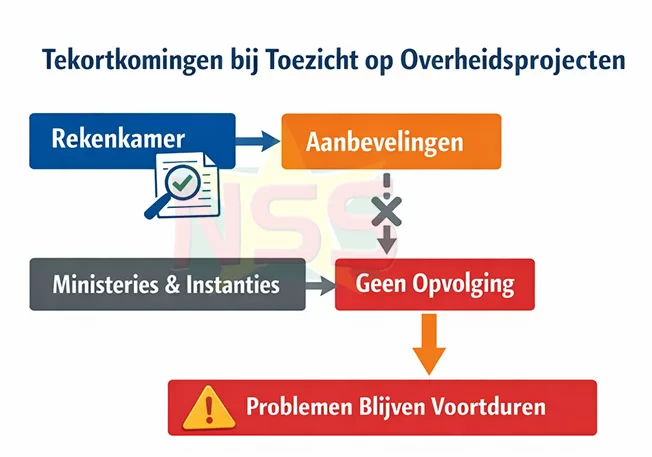
    On April 8, the Netherlands Court of Audit released a damning annual audit report highlighting long-standing structural flaws in government oversight and follow-up processes that continue to erode the effectiveness of public administration across the country. The core finding of the report is that corrective recommendations issued after previous audits have rarely been fully implemented, with most either ignored entirely or only partially acted upon by responsible bodies. The audit institution found that national ministries and executive agencies consistently fail to prioritize addressing documented governance weaknesses, creating a cycle where identical problems reemerge across departments time and again. These recurring issues include incomplete financial record-keeping, unclear accountability frameworks for public spending, and inadequate oversight of major government projects. Further investigation into internal governance systems revealed that internal control mechanisms are non-functional or underperforming in multiple agencies. Project monitoring protocols are poorly designed and inconsistently enforced, while required progress and financial reports are often delayed or submitted with critical omissions. This lack of consistent, timely data prevents public officials from making necessary mid-course corrections to failing projects, and significantly increases the risk of wasteful or inefficient use of taxpayer money. One of the most critical bottlenecks identified by the Court of Audit is the limited translation of audit findings into actual policy and operational change. While auditors regularly formulate clear, actionable recommendations to address gaps, most agencies lack formal structures to implement these changes or track progress over time. Without dedicated follow-up systems, meaningful, lasting improvements to governance never materialize. This breakdown in oversight also puts increasing pressure on parliamentary checks and balances. When the executive branch fails to provide complete, timely information about public spending, lawmakers cannot effectively exercise their constitutional responsibility to oversee how state funds are allocated and used, weakening democratic accountability. The Court of Audit emphasized that urgent action is needed to strengthen internal control systems, clarify lines of accountability across all government bodies, and establish formal, systematic processes for following through on audit recommendations. Without these foundational changes, the institution warned, the risk of repeated inefficiencies and structural governance failures will remain embedded in the public administration. To break this cycle of recurring problems, the Court is calling for a fundamental shift toward a results-focused approach to public governance. Under this new framework, auditors and government bodies alike would not only identify existing weaknesses, but also be required to demonstrate tangible progress on structural improvements across the entire government apparatus.

  • Investigation concludes Calliaqua Police Station fire ‘not nefarious’

    Investigation concludes Calliaqua Police Station fire ‘not nefarious’

    A devastating blaze that levelled the Calliaqua Police Station in Saint Vincent and the Grenadines on March 13 was not an act of arson or deliberate sabotage, initial findings from police and state investigative authorities have confirmed. National Security Minister St. Clair Leacock shared updated details of the ongoing probe during an interview with local outlet Boom FM this Tuesday, laying to rest widespread public speculation that the fire was intentionally set.

    Leacock told radio listeners that early investigation results trace the origin of the fire to a faulty piece of electrical equipment installed on the ground floor of the two-story structure. “I have a formal report from the police as to the cause of the fire, and it is not nefarious as some people are speculating,” the minister stated. Dispelling conspiracies that officers themselves set the building ablaze, he joked with the host, “It started somewhere downstairs, possibly with a malfunctioned piece of item. It’s not deliberate, and the police didn’t run out and set the place afire and leave it alone. That’s not the case, your mischievous self.”

    The minister also noted that the decades-old police station was already in severe disrepair before the fire, with flammable pitch pine paneling lining its interior. This construction material allowed the blaze to spread rapidly once ignited, he explained. While preliminary assessments point to an electrical malfunction as the source of the fire, Leacock emphasized that authorities are still conducting a granular, full review of all evidence. Even with submissions of initial reports from the national power company, police investigators, and official electrical inspectors, the government is combing through every detail of the case to avoid missing any critical information.

    “Even though the power company has given their report, the police have given theirs, and the electrical inspector has given those, we are still doing the evaluation with a fine-teeth comb, so we have to be absolutely sure that we didn’t overlook any part of the investigation,” Leacock said, adding that he would not release full granular details of the cause until the review is finalized.

    Following the destruction of the building, displaced officers have been temporarily relocated to the Calliaqua Town Hall, which sits on the same street in the popular south coast town. Long-term plans for a permanent new facility have already been in the works for some time, and the fire has accelerated discussions over the site of the new station.

    Leacock confirmed that the government is not expected to reconstruct the police station at its original prime main-road location, which the ministry had already targeted for redevelopment before the blaze. Officials had previously identified a vacant plot of land further up Glen Road, below local food outlets, as the intended site for a new police station. Now, the government is considering a swap: officers will remain in the temporary town hall accommodation long-term, and a new municipal town hall will be constructed at the previously planned Glen Road police station site, while the original waterfront police station lot will be repurposed.

    Minister Leacock stressed that any final decision will depend on engineering assessments, architect input, and public consultations, but guaranteed that whatever plan moves forward, officers will end up working in far better facilities than the dilapidated original building. He acknowledged that the original plot, which sits along the town’s main thoroughfare, is prime government-owned real estate, and noted that if a decision rested solely with ministry project staff, the fire-damaged building shell would already be scheduled for demolition within the next two weeks.

    Still, Leacock noted that the timing and funding for demolition require careful budget consideration. Authorities must weigh whether allocating funds to demolish the structure is the most effective use of public money at this time, compared to directing those resources to other pressing infrastructure upgrades across the country. While the burnt-out shell remains an eyesore for the community, the minister commended relevant state agencies for their rapid and thorough cleanup work in the wake of the fire, which has mitigated much of the immediate public disruption.

  • Face the pressure

    Face the pressure

    As Trinidad and Tobago navigates a fragile, transitional economic period marked by rising business failures and persistent systemic headwinds, two leading regional chamber of commerce presidents are calling on local enterprises to hold out through 2026, framing 2027’s incoming gas sector monetization as the likely turning point for broader economic recovery.

    Kiran Singh, president of the Greater San Fernando Chamber of Commerce, laid out this rallying cry in comments this week, pointing to upcoming large-scale gas projects — including Shell’s Dragon and Manatee fields and other regional energy initiatives led by major international energy firms — as the catalyst that will unlock broader growth once they begin production and revenue generation.

    “Our members are excited about the projected increase in gas supply in the coming years and its vital role in stimulating economic recovery. Developments such as the Dragon and Manatee fields and other regional gas initiatives by Shell and other international energy corporations are essential to economic recovery,” Singh stated.

    Singh’s remarks come on the heels of a recent *Express* report documenting a rising wave of business branch closures and operational restructurings across the country, driven by a broadly contracting domestic economy. Acknowledging that the benefits of new gas development are still 18 months out, Singh stressed that the immediate priority for local private sector operators is simply to endure ongoing economic pressures to reach that turning point. “The responsibility of the private sector is to survive 2026, knowing that next year we will start to benefit from the monetisation of said gas fields,” he said.

    He outlined the multiple overlapping challenges currently squeezing local businesses: growing competition from digital online retailers, depressed consumer spending amid broader economic weakness, and a persistent shortage of foreign exchange that has crippled import-reliant sectors. “The shortage of foreign exchange continues to severely impact import-dependent businesses, limiting their ability to restock inventory and maintain operations. Additionally, increases in taxes and regulatory burdens have compounded these difficulties, particularly for sectors such as retail, hospitality and manufacturing,” Singh explained.

    To prevent further unnecessary business failures before the gas sector gains materialize, Singh called on the government to roll out targeted, immediate support measures in the upcoming mid-year fiscal review. These include expanded, more equitable access to foreign exchange for small and medium-sized enterprises (SMEs), targeted fiscal relief for the ecotourism sector, and broad regulatory reforms to cut red tape and simplify doing business. “The Minister of Finance can use the upcoming mid-year review to devise fiscal measures to address these concerns,” he said. “The SME sector should have more equitable access to foreign exchange. There is a need for targeted fiscal relief in the ecotourism sector, particularly for small and medium enterprises, including temporary tax adjustments or incentives to encourage business continuity and investment.”

    Singh emphasized that while long-term macroeconomic recovery plans are important, short-term support is critical to stopping further business collapse. He called for cross-stakeholder collaboration between government, the private sector, and civil society to build practical, timely solutions that respond to on-the-ground economic realities. “Economic recovery must be inclusive and responsive to the realities on the ground,” he noted.

    Baldath Maharaj, president of the Chaguanas Chamber of Industry and Commerce, offered a complementary perspective, framing the current period as a complex, delicate economic transition rather than a single solvable crisis. Maharaj noted that Finance Minister has to navigate overlapping challenges, including post-pandemic global supply chain volatility, unstable global energy markets, and a structural foreign exchange gap where the country only generates roughly 70% of the foreign currency it needs annually.

    Maharaj pointed out that the wave of traditional business closures is being partially offset by the emergence of new enterprises, mostly in the fast-growing digital economy. But he added that these new small digital firms have not yet grown large enough to replace the tax revenue and jobs lost from shrinking traditional enterprises, creating a near-term gap that policymakers must address. “These new openings often represent a shift toward the digital economy. The challenge for the State is that these new, smaller entities do not yet have the tax base or employment capacity of the larger, older firms that are reducing their operations,” he explained.

    Acknowledging that the government is working to balance fiscal sustainability with private sector growth amid competing pressures, Maharaj said policy responses must be carefully tailored to fit the country’s constrained fiscal and currency context. He argued that non-cash interventions, particularly cutting bureaucratic red tape that slows both business openings and closures, offer a low-cost way to speed up the transition to a more diversified economy. “If we can reduce the time and cost it takes for a new business to become fully compliant and operational, we can accelerate the rate at which these new openings begin to meaningfully contribute to the GDP,” he said.

    Looking ahead, Maharaj echoed Singh’s view that upcoming gas developments are critical to medium-term growth, but stressed that these projects face significant geopolitical and technical hurdles that complicate timely market entry. He framed the current wave of business closures as a painful but inevitable part of the country’s shift away from overreliance on traditional economic models toward a more diversified future. “The financial state of the economy is one of staged recovery. We are moving away from total dependence on historical models and toward a more diversified future. The closures we see today are, in many ways, the painful friction of that transition,” he said.


  • Kesar: Borough Day on despite funding dispute

    Kesar: Borough Day on despite funding dispute

    A public dispute over financing has broken out ahead of the 2026 Point Fortin Borough Day celebrations, pitting the borough’s sitting Member of Parliament against local council leaders over who is to blame for ongoing budget shortfalls. Despite the conflict, the ruling national government has confirmed the iconic festival will move forward as scheduled, with its official launch kicking off this Saturday.

    In a social media video released Monday, Point Fortin MP Ernesto Kesar stated that the central government, which he represents, maintains full backing for the successful execution of the 2026 Borough Day. He extended an open invitation to Mayor Clyde James and the Borough Council to set aside political differences and collaborate to deliver a memorable event for local residents and visitors.

    The festival’s administrative status shifted in 2025, when last year’s celebration was designated a national festival, moving oversight from the local borough corporation to the central government. Prior to that, planning and funding responsibilities rested entirely with local authorities.

    Last week, Mayor James went public with the council’s financial woes in his own social media statement. He revealed that the 2026 budget allocation for festivals from the national government only totals $75,000, an amount he says is far too small to cover the event’s basic costs. Compounding the shortfall is the loss of long-time private sponsor Heritage Petroleum, which has left the Borough Council carrying an accumulated $300,000 debt from past events, much of which remains unpaid. James added that he had reached out to multiple national government ministries for emergency assistance but had not received any response, accusing the government and local MP of only offering empty “lip service” instead of tangible support.

    Deputy Mayor Kwesi Thomas echoed these concerns, noting that while the full calendar of 2026 events has already been printed, it has not been distributed to the public due to the ongoing financial crisis. Thomas added that the council has yet to receive confirmation of funding from most national agencies, with the only exception being Atlantic LNG, which has stepped in to sponsor the popular Pan on the Move segment of the festival.

    Kesar pushed back against these claims in his Monday address, pushing back the timeline of the council’s funding request as the root of the current shortfall. According to Kesar, the council submitted its funding proposal for 2026 in February 2026, when the required deadline for submissions was August 2025. This late submission left little time for processing and securing additional budget allocation, Kesar explained. He added that the time for budget negotiations was last year, when allocations were being finalized, not weeks ahead of the scheduled event.

    Addressing the unresolved $300,000 debt from 2025, Kesar acknowledged he was not in office when the debt was incurred, but has already offered to work with the mayor to resolve the outstanding obligations. He claimed there are political actors who do not want the festival to succeed, solely for the purpose of shifting blame to the national government. Kesar confirmed he spoke as recently as Sunday morning with Minister of Culture and Community Development, who plans to release an official statement on the government’s commitment to the festival before the end of the week.

    For Kesar, the top priority is supporting the people of Point Fortin, who rely on the annual festival to generate significant local income for small businesses, vendors and hospitality operators. He thanked the mayor and his council team for their work in planning the event, and reiterated that he remains open to collaboration, even after what he implied was a rejection of his outreach. “I offered my hand and it seems like they slapping away my hand. I will continue to offer my hand because my interest has always been the development of Point Fortin,” Kesar said.

    Kesar also pushed for the immediate distribution of the printed event calendar, noting that independent promoters have already reported that most festival events are completely sold out. With Pan on the Move confirmed and thousands of attendees already booked to travel to Point Fortin, Kesar insisted there is no deception surrounding the 2026 celebration: “Borough Day is going to happen…Borough Day 2026—it eh no tricks, come down and get in the mix. It will be excellent.”

    As of Tuesday, James has declined to issue any further public comment in response to Kesar’s social media address. Local media outlet The Express has confirmed that Minister of Rural Development and Local Government Khadijah Ameen is scheduled to meet on Wednesday with Point Fortin’s Mayor James and the leaders of all 14 regional corporations at the San Fernando City Corporation, where the Borough Day funding dispute is expected to be a top agenda item.