作者: admin

  • Fuel Prices Jump Again, Third Hike This Month

    Fuel Prices Jump Again, Third Hike This Month

    On Monday morning, motorists across Belize faced yet another unwelcome surprise at fuel stations, after a midnight price adjustment that marked the third increase in fuel costs in just over a month. Effective immediately, premium gasoline rose by 84 cents per gallon, while regular gasoline increased by 80 cents, adding to a cascade of rising costs that have already stretched household budgets thin. For ordinary Belizeans already navigating steep increases in grocery bills, utility rates, and baseline transportation expenses, this latest jump in fuel prices has pushed financial strain to new heights.

    Government officials have pinned the recurring increases on widespread volatility in the global crude oil market, which has been roiled by the ongoing armed conflict in Iran. International supply disruptions tied to regional instability have driven up crude prices worldwide, and those costs are being passed directly to consumers at the pump in Belize.

    But for residents grappling with daily budget challenges, the global explanation does little to ease immediate hardship. Many are now questioning how much more prices will climb, and when consumers can expect any measurable relief from the upward trend.

    As fuel costs act as a core driver of broader inflation across Belize’s economy—pushing up fares for public transit, raising delivery costs for consumer goods, and increasing prices across nearly every sector—public attention has shifted to the national government’s tax policy on fuel. Many residents are now calling on policymakers to consider temporary tax adjustments that could reduce the final cost for consumers and ease the broader economic burden on working households.

    Local outlet News Five has confirmed it will continue monitoring developments in fuel prices, tracking how changes at the pump impact the cost of living for ordinary Belizeans across the country.

  • Belize–Taiwan Partnership Expands Beyond Diplomacy

    Belize–Taiwan Partnership Expands Beyond Diplomacy

    On April 7, 2026, bilateral diplomatic engagement between Belize and Taiwan took a tangible step forward, as senior officials from both sides gathered in Belmopan to advance new cooperation projects focused on practical, on-the-ground outcomes rather than formal diplomatic gestures alone. The meeting brought together Henry Usher, Belize’s Minister of the Public Service and Disaster Risk Management, and Amino C.Y. Chi, Taiwan’s recently appointed ambassador to the Central American nation, to map out joint initiatives across two high-priority areas: public sector modernization and climate and disaster resilience.

    Talks centered on plans to upgrade Belize’s public service ecosystem through structured technical training programs, cross-sector knowledge exchange, and targeted capacity building efforts. These initiatives are designed to streamline administrative processes, improve service delivery to Belizean communities, and bring the country’s public sector in line with modern governance standards. On the disaster preparedness front, both sides explored how Taiwan can expand support for Belize’s national emergency response framework. One prominent proposal under discussion leverages advanced drone technology to strengthen the capabilities of Belize’s National Emergency Management Organization (NEMO). Equipped with drones, NEMO would be able to conduct faster, more accurate post-disaster damage assessments, monitor active emergency situations in real time, and cut response times when hurricanes, floods, or other natural disasters strike – a critical upgrade for a small Caribbean nation highly vulnerable to climate-driven extreme weather.

    Throughout the discussions, both sides reaffirmed the deep, long-standing friendship that underpins their bilateral relationship. Officials emphasized that the partnership continues to be grounded in principles of mutual respect, with a shared strategic focus on building national resilience and advancing inclusive, long-term sustainable development for both peoples.

  • Easter Visitors Up, But How They Arrived Has Changed

    Easter Visitors Up, But How They Arrived Has Changed

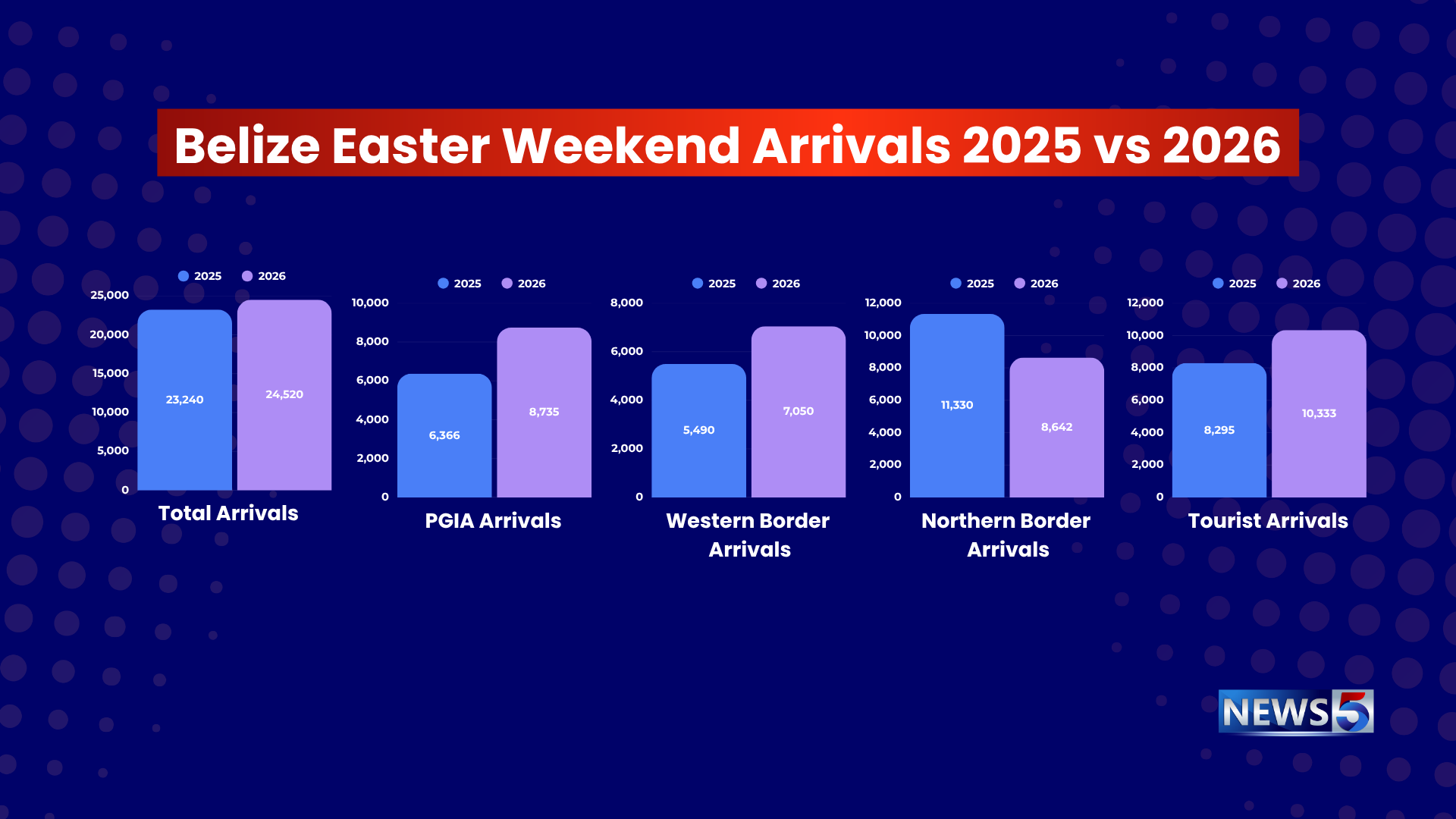
    As one of the peak travel periods of the year, the 2026 Easter holiday brought incremental but notable growth to Belize’s tourism sector, alongside striking changes in how visitors enter the country, new official data reveals. Figures compiled by Belize’s Ministry of Immigration, Governance and Labor show that total arrivals over the Easter weekend hit 24,520, marking a 5.5% increase compared to the same holiday period in 2025. Beyond the top-line growth, however, the data documents clear evolving travel patterns that signal shifting preferences among holidaymakers visiting the Central American nation.

    The most dramatic shift has been a growing preference for air travel over land entry. Arrivals at Philip Goldson International Airport, Belize’s main air gateway, saw a 37% year-over-year jump, rising from just over 6,300 visitors in 2025 to nearly 8,800 this Easter. This double-digit surge points to strengthening consumer demand for international travel to Belize, as more tourists opt to fly directly into the country for peak holiday getaways rather than crossing overland from neighboring countries.

    When it comes to land border crossings, the data tells a divergent story across Belize’s two main entry points. The western border with Guatemala at Benque Viejo del Carmen recorded a strong 28% rebound in arrivals, reversing previous declines and drawing far more overland travelers this year. In sharp contrast, the northern border crossing at Corozal, which connects Belize to Mexico, saw a steep 24% drop in holiday traffic. When combining figures from both border posts, total land crossings dipped slightly overall, revealing two key trends: a general decline in overland travel to Belize for Easter, and a clear shift in overland routes away from Mexico and toward Guatemala during the holiday travel rush.

    Breaking down arrivals by traveler type also highlights the tourism sector’s solid performance this year. While returning residents still account for the largest share of total entries into Belize, their numbers declined marginally year-over-year. The biggest gain came from international leisure tourists, who arrived in far greater numbers: tourist entries jumped nearly 25%, adding more than 2,000 additional visitors to the 2026 Easter tally, a clear indicator of a robust holiday season for Belize’s tourism industry. Smaller travel segments, including business trips, employment-related travel and official government travel, also saw slight incremental gains that contributed to the overall growth in total entries.

    Taken together, the latest arrival figures confirm that Easter travel to Belize is undergoing a quiet transformation. More visitors are choosing to fly in rather than cross by land, overland travelers are shifting between border crossings based on origin and route preferences, and overall visitor numbers continue a steady upward climb. These changes offer key insights for Belize’s tourism stakeholders as they adapt to evolving travel habits during one of the busiest travel windows of the year.

  • USA : A Haitian savagely kills an innocent mother with a hammer

    USA : A Haitian savagely kills an innocent mother with a hammer

    A shocking broad-day murder at a Florida gas station has reignited fierce debate over U.S. immigration policy, after authorities announced the arrest of an irregular Haitian migrant who had been ordered deported years before the killing. On August 4, 2026, the U.S. Department of Homeland Security confirmed that Immigration and Customs Enforcement agents partnered with the Fort Myers Police Department to take 38-year-old Rolbert Joachim into custody at a residence on Fort Myers’ Mango Street, just four days after the fatal attack.

    The incident unfolded on April 3, when local first responders rushed to a 911 emergency call at a neighborhood gas station in Fort Myers. Surveillance footage from the location captured the unprovoked attack: Joachim first shattered the windshield of the victim’s parked vehicle, then approached the woman — identified locally as a 32-year-old mother of two — and struck her repeatedly in the head with a claw hammer in full view of other civilians at the station. First responders pronounced the victim dead at the scene, marking the end of an innocent life in what investigators have called a senseless, unprovoked homicide.

    Once the FMPD identified Joachim as the primary suspect, the department requested operational support from ICE to track down the fugitive. The joint operation led to his arrest without incident on Mango Street, and a subsequent review of his immigration history uncovered a years-long paper trail that has drawn sharp criticism from top Homeland Security officials.

    Records show Joachim first entered the United States at a southern border port of entry in August 2022, and was granted admission into the country under border policies implemented by the Biden administration. By the end of that same year, a federal immigration judge issued a final, enforceable deportation order requiring Joachim to leave U.S. territory immediately. However, the administration granted him Temporary Protected Status (TPS), a designation that allows eligible migrants from crisis-affected countries to remain and work in the U.S., that extended his stay until 2024. TPS had expired nearly two full years before the 2026 killing, yet Joachim remained in the country unlawfully.

    Acting Assistant Secretary of Homeland Security Lauren Bis, who has been a vocal critic of the administration’s border policies, framed the killing as a direct consequence of lax enforcement. “This illegal alien barbarically hit this woman in the head multiple times with a hammer. This heinous murderer was released into the country by the Biden administration. Not only did the Biden administration release him into the country, but they then gave him Temporary Protected Status. Their reckless immigration policies cost this woman her life,” Bis said in a statement following the arrest.

    ICE officials confirmed that a formal detainer has been placed on Joachim, who is currently held at the Lee County Jail awaiting trial on first-degree murder charges. Agency spokespersons added that regardless of the outcome of his criminal trial, Joachim will be processed for deportation to Haiti immediately after his criminal case is concluded. The killing has already prompted renewed calls from congressional Republicans for sweeping reforms to TPS and border entry policies, with many arguing that long-standing enforcement backlogs and discretionary protections put dangerous criminals in positions to harm innocent U.S. residents.

  • Riders Chase Glory in 96th Cross Country Classic

    Riders Chase Glory in 96th Cross Country Classic

    As dawn had yet to break over Belize on April 7, 2026, hundreds of cycling enthusiasts and elite riders gathered along the George Price Highway, ready for the kickoff of the nation’s most iconic and longest-running endurance cycling event: the 96th Holy Saturday Cross Country Classic. Held annually on Holy Saturday, this storied race blends decades of local tradition with world-class competitive spirit, drawing domestic athletes and international contenders alike to test their stamina, strategy, and mental grit across a grueling 70-plus mile route stretching from the George Price Highway to the nation’s capital Belmopan and ultimately finishing in Belize City.

    When the starting gun fired, the dense peloton surged forward, settling immediately into a steady, blistering pace that would hold for the race’s opening stretches. Veteran riders knew all too well that early speed would mean nothing if they burned through their energy reserves before the final push, setting the tone for a race defined by tactical pacing as much as raw speed. The first major break came early, when Ignacio Prado, a Mexican rider competing for Team Canel’s Java, pulled away from the main group, snatching 12 intermediate station prizes before reaching the 16-mile mark. Prado’s lead would not hold, however, as Costa Rican contender Sebastian Calderon and Mexican rider Heriberto Gutierrez reeled him in, then pushed ahead of the pack together. The pair held the front through the stretch leading into the town of San Ignacio, collecting a combined 40 intermediate station prizes along their breakaway.

    Shortly after entering San Ignacio, Calderon dropped Gutierrez, launching a solo effort that carried him all the way to the 46-mile mark just outside Belmopan, where he picked up an additional 30 station prizes alone. By the time the lead group rolled into the final stretch toward the finish line in Belize City, attrition had whittled the front pack down to just eight riders. The final mile unfolded at a measured, tense pace, with every rider conserving energy for the final sprint—until defending champion Jim Brown of Great Britain pulled away from the group, launching a late sprint that left the other seven contenders trailing in his wake. When he crossed the finish line, Brown secured his second consecutive victory at the classic, cementing his status as one of the race’s most successful recent international competitors. Prado crossed second to claim the runner-up spot, while Belize’s own Jyven Gonzalez rounded out the top three, finishing as the fastest domestic rider in the 2026 edition.

    This year’s race made history for its speed: 11 riders, three of whom hail from Belize, finished within eight minutes of the event’s all-time course record, marking an unprecedented showing of high-level competition. In post-race interviews, Brown spoke to the grueling conditions, noting that the tropical heat pushed his body to its limit. “Absolutely cooked, absolutely cooked. The heat just gets to me, but apart from that I am good,” he said. Brown added that he actually saw the strong headwind on the return leg of the race as an advantage. “Actually I did not mind it. I think the wind in the face cools you down a bit. And it made the race harder. If you made a bit of a gap people are less willing to chase,” he explained. When asked about his game plan for the final mile, Brown shared that while he has always trusted his sprint, he entered the final push uncertain of the outcome. “I am always confident in my sprint but I do feel like guys out here are fast. I was not super confident but I was by myself and it worked out,” he said. Echoing the longstanding passion that surrounds the event, Brown added that the energy of local spectators made the second win just as meaningful as his first. “Just as good as last time. The people are passionate here. It makes you feel good how passionate everyone is and how everyone loves the race. I am just proud to be here and proud to win again,” he said.

    For third-place finisher Jyven Gonzalez, the race was a testament to persistence in the face of adversity. The Belizean rider overcame not one but two tire punctures mid-race to secure a spot on the podium. “I love it because the country really take this race serious. This race just hard. It is super unpredictable. Anything could happen in the race. This is my fifth time riding the cross country and five out of five times I never ride this race and it goes smooth. But I signed up for this and it is cycling. Today was really tough for me and I never felt good at all,” he said. Gonzalez detailed his mid-race misfortunes: “I had a rear wheel puncture at mile thirty-five and as I caught back the field my front wheel puncture. I nuh wah like I blew my top for a while and I have to apologize with my service crew. I got frustrated with myself. But it is cycling and sometimes it is tough. Cycling wont be on your side all the time.”

    From the pre-dawn starting line to the dramatic final sprint, the 96th iteration of the Holy Saturday Cross Country Classic once again lived up to its reputation as Belize’s most anticipated annual sporting event. This report was filed by Paul Lopez for News Five.

  • Two shot dead, three hurt in holiday gun attacks

    Two shot dead, three hurt in holiday gun attacks

    A string of unconnected gun violence incidents across Barbados on Easter Monday has left two men dead, including a 22-year-old father of two, and three other people injured, pushing local communities to demand immediate, decisive action from law enforcement to curb rising violent crime.

    The youngest fatality, Raul Clarke from Gall Hill, Christ Church, was enjoying the final hours of the popular annual Oistins Fish Festival with a group of people around 10:05 p.m. when a sudden conflict erupted. Shots rang out into the crowd, striking Clarke, an unidentified second man, and a woman. Clarke was rushed to the island’s main Queen Elizabeth Hospital by private vehicle, but he succumbed to his wounds shortly after arrival. The other two injured victims were transported by emergency paramedics and are currently receiving care for non-life-threatening injuries.

    When reporters from Barbados TODAY visited Clarke’s tight-knit Gall Hill neighborhood this week, neighbors remembered the young father, whose second child is only a newborn, as a polite, helpful member of the community. “He didn’t deserve that; nobody deserves that,” shared one long-time neighbor, a mother who previously lost two of her own children to gun violence eight years apart. “I know how his mother must feel right now. It’s very sad.” Clarke’s immediate family was too overwhelmed by grief to speak to reporters during the visit.

    Hundreds of kilometers north in the parish of St Michael, two more separate shooting incidents unfolded during the island’s public Easter beach celebrations. First, just before 7 p.m., officers from the Hastings/Worthing police division responded to reports of gunfire near Brownes Beach. Upon arrival, they discovered the body of an unidentified man lying close to a local commercial establishment. Roughly two hours later, at St Stephen’s Hill – a neighborhood long labeled as a known crime hotspot – a car pulled up alongside a group of people gathered outside a private residence. A passenger exited the vehicle and fired multiple shots, wounding one man before fleeing the scene.

    Acror the affected areas, residents and local business owners have voiced growing frustration and exhaustion with the persistent cycle of gun violence that has upended daily life on the Caribbean island. Many business leaders warned that the escalating crime wave is already hurting local commerce and risks damaging Barbados’ reputation as a safe tourist destination, the backbone of the national economy.

    “It’s about time that this foolishness stops, because it doesn’t help anyone,” one long-time St Michael resident told reporters. “It’s just leaving a trail of fatherless children behind from all this senseless killing. It ain’t worth any of it.”

    Jojo, a small business owner operating near the St Stephen’s Hill area, said while she refuses to live in fear, the constant proximity to violence has left her weary. “This happened pretty close to my shop, and I work right out by the road. If something went wrong here, there’s nowhere for me to run,” she explained. “I’d feel safer having another person with me, but it shouldn’t have to be a requirement just to run a business.”

    Another nearby business owner, who asked to remain anonymous out of safety concerns, shared that even though he does not reside in the neighborhood, his family has grown increasingly worried for his well-being. “I try not to think about it too much, because the truth is you can’t be safe anywhere, no matter what you do,” he said. “Whether you’re inside, outside, at work – you can’t control when and where violence will hit.” He added that the ongoing crime wave already threatens his customer base: “You don’t know how your customers feel about coming here. We still have to wait and see what the long-term impact on business will be, beyond the personal stress.”

    Arkay, a 10-plus year business owner who operates and lives near the Montgomery playing field in Cave Hill, has joined the growing chorus calling for a far more aggressive police crackdown on violent crime, even suggesting combining national police resources with the Barbados Defence Force to root out criminal networks. “The police have got to do their work,” he stressed. “If they need to lock down high-crime areas, get the criminals off the streets, even if they bring in the Defence Force to help – they just need to get the job done.”

    A former taxi driver, Arkay recalled that he once proudly boasted to visiting tourists about Barbados’ historically low crime rate, but said that reputation is now a thing of the past. Today, the violence has reshaped daily life and hurt local business: “By seven o’clock at night, everybody is off the streets. Before, people would come down to the bars, have a drink, then head home. Now nobody wants to come out at all.”

    He warned that if the crisis is not addressed quickly, it will eventually deter international travelers from visiting the island, with devastating consequences for the entire national economy. “If it’s affecting Barbadian citizens, of course it’s going to affect visitors too. The government and police need to do something about this now,” he said.

    Arkay also highlighted a worrying shift in the demographics of those involved in violent crime, noting that perpetrators are getting younger every year. “The age group getting pulled into these criminal acts is exactly the working-age population that’s supposed to be the next generation pushing Barbados forward,” he explained. “If that generation is destroyed by violence and incarceration, what is going to happen to our country?”


  • 96th Cross Country Classic Under Anti‑Doping Watch

    96th Cross Country Classic Under Anti‑Doping Watch

    As one of the most anticipated annual sporting events in Belize, the 96th edition of the iconic Holy Saturday Cross Country Cycling Classic wrapped up in 2026 with stunning new course records and unexpected attention on anti-doping efforts designed to protect the sport’s integrity.

    This year’s competition delivered historic results: after a dominant wire-to-wire victory in the women’s division, Bermuda’s Gabriella Arnold claimed the top spot on the podium. Reflecting on her win, Arnold shared that the race was one of the most challenging she had ever competed in, particularly the brutal headwind that plagued the final 20 miles as she rode alone at the front. This marked only Arnold’s second race in Belize, following a second-place finish at the Caribbean Championships hosted in the country last October, and she confirmed she plans to return to compete again in the future.

    In the men’s race, eight cyclists broke the previous course record in an action-packed contest that came down to a final sprint. United Kingdom rider Jim Brown outpaced all seven of his rivals in the closing stretch to cross the finish line first. After the race, Brown spoke about the extreme heat that tested his endurance, though he noted the consistent headwind actually worked in his favor: any gap he opened up was harder for chasing riders to close, making his late surge more effective.

    While the dramatic on-course action and broken records have drawn widespread excitement across Belize’s cycling community, they have also sparked questions about performance integrity. That is why Belize’s National Anti-Doping Organization (NADO) implemented a comprehensive, structured testing program for this year’s classic, stepping up oversight to guarantee every victory is earned fairly.

    Charlie Slusher, director of Belize NADO, explained the organization’s testing protocol for top-tier events like the Cross Country Classic. NADO typically tests at least five riders per competition, using a mixed selection approach that includes top finishers, riders who turned in unexpectedly exceptional performances regardless of their final placement, and randomly selected competitors to ensure broad coverage. “It is about fairness. Everybody has an equal chance of winning,” Slusher emphasized. “Doping and using performance-enhancing substances is plain cheating, and it is unfair to sponsors who invest significant prize money and to fans who put their faith in clean competition.”

    Beyond upholding competitive fairness, NADO’s work centers on protecting the long-term health of participating athletes. Slusher noted that many athletes who use banned substances take unsafe, excessive doses that can lead to chronic health complications later in life, including kidney and heart damage, even after they retire from competitive cycling. The organization also runs educational programs to help athletes understand the ever-evolving list of banned substances, ensuring they avoid accidental violations that would cost them their eligibility for international competition.

    All samples collected at this year’s race are shipped to a World Anti-Doping Agency (WADA)-accredited laboratory in the United States for analysis, a process that takes up to 14 working days to complete. To enforce full transparency, all prize money is being held by event organizers until all test results are finalized and released publicly. Slusher stressed that the open, WADA-supervised process eliminates any opportunity to hide or alter results, reinforcing the race’s commitment to clean sport.

    For Belize’s most prestigious cycling event, maintaining integrity is key to attracting future participants and growing the sport across the region. NADO’s expanded oversight positions the organization as both a watchdog for fairness and a safeguard for athlete health, ensuring that the Cross Country Classic remains a event where speed, not cheating, takes the spotlight. This report was presented by Shane Williams for News Five.

  • BREAKING: Antigua and Barbuda Will Go To The Polls On April 30

    BREAKING: Antigua and Barbuda Will Go To The Polls On April 30

    On a charged Tuesday night that kicked off the island nation’s next electoral cycle, Prime Minister Gaston Browne stood before thousands of cheering supporters at the Antigua and Barbuda Labour Party (ABLP) headquarters, known locally as People’s Place, and formally announced the timeline for the country’s upcoming general election. Voting is scheduled to take place across Antigua and Barbuda on April 30, 2026, with official candidate nomination proceedings set for April 13, and a national public holiday scheduled for May 1 to accommodate post-election civic adjustments.

    The launch event was a sea of the ABLP’s signature red, as crowds of loyal backers packed the venue’s grounds to capacity. Energizing chants, upbeat music, and roaring cheers filled the air, turning the gathering into a dramatic declaration of the ruling party’s bid to make history by securing a fourth consecutive term in national government.

    Addressing the assembled crowd, Browne framed the 2026 poll as nothing less than a defining crossroads for the small Caribbean nation. He urged registered voters to throw their support behind his administration, pointing to what he characterized as a proven track record of delivering on campaign promises and providing consistent, steady leadership for the country.

    Browne emphasized that his government’s core mission is centered on lifting up and empowering every Antigua and Barbuda citizen, noting that the country has undergone sweeping, widespread transformation since the ABLP first took office in 2014. He reminded the crowd that when his party assumed power, it inherited an economy crippled by steep job losses from the previous United Progressive Party (UPP) administration. Since that time, he argued, the ABLP has methodically rebuilt the national economy, forging a stronger, more resilient nation better equipped to weather external shocks.

    In outlining the administration’s achievements, Browne highlighted ongoing large-scale investments in critical public infrastructure, including extensive road improvement projects and expanded access to clean drinking water across both islands. He also called attention to social policies designed to directly boost working and middle-class living standards, such as nationwide wage increases and targeted support programs that provide financial relief to vulnerable households. Browne stressed that the ABLP has consistently followed through on its past electoral pledges, and all ongoing policy initiatives are designed to continue improving citizen welfare and expanding economic strength.

    He told the energized crowd that the 2026 election presents voters with a clear, straightforward choice between the progressive progress of “Team Labour” and a return to the policies that stalled the country’s growth decades ago. With national progress already underway, Browne argued, voters should not risk undoing the tangible gains the country has made under ABLP leadership.

    As the official electoral timeline gets underway, political activity across Antigua and Barbuda is already ramping up, with all parties set to finalize their candidate slates ahead of the April 13 nomination deadline. The April 30 vote will ultimately decide whether the ABLP holds onto power to extend its 12-year run of governance, or if the opposition will unseat the ruling party to lead the nation into its next chapter.

  • Statement of facts CCCCI construction

    Statement of facts CCCCI construction

    A major construction materials supplier and contractor in Grenada has issued a formal public statement pushing back against recent claims made by the country’s Prime Minister regarding its contractual performance and operational competence. Consolidated Contractors Company Caribbean Inc (CCCCI), a locally based firm that holds a monopoly on key construction materials for Grenada’s infrastructure projects, has released a full breakdown of facts to correct what it frames as misinformation about its work.

    As the exclusive provider of asphalt across the island nation, and the sole supplier of road construction aggregate sourced from its own Mount Hartman Quarry, CCCCI emphasized that it has consistently met all contractual requirements for delivery timelines, volume of materials, and pricing for every client—including the Government of Grenada, third-party subcontractors, and independent contractors.

    Turning to one high-profile unfinished project, the Moliniere Road upgrade, CCCCI clarified the circumstances behind the incomplete road work. The company was contracted by lead contractor Rayneau to lay two layers of asphalt on the approaches to the new concrete segment of the road, over a base that Rayneau was responsible for preparing. Under the terms of the agreement, advance payment was required for each asphalt layer before work would commence. CCCCI confirmed it never installed the second layer because the required advance payment was never received. The firm also noted that the substandard condition of the current road surface stems from two factors beyond its control: the missing second asphalt layer due to non-payment, and an improperly prepared base layer delivered by main contractor Rayneau.

    CCCCl went on to detail significant unresolved payment arrears owed to it by the Government of Grenada across multiple active and completed infrastructure projects. On the ongoing Cliff Road Project, the company has completed 90 percent of the required work, but has only received roughly 25 percent of the total contracted sum—equaling just $4 million of the project’s full $16.5 million price tag. Despite this major breach of payment terms, CCCCI says it has continued work on the project in good faith, prioritizing the best interests of the Grenadian public over enforcing contractual payment requirements.

    For the True Blue Road Project, which CCCCI fully completed in compliance with all contract terms in 2024, the government still owes approximately 30 percent of the total agreed payment, equal to around $1.5 million. Additional unpaid balances for hot mix asphalt supplied by CCCCI to government projects in 2025 add another estimated $3.5 million to the government’s outstanding debt to the firm.

    The statement also addressed a separate prior agreement between CCCCI and the government. As part of a deal to secure three new contracts—two for River Road and one for the Cliff Road Project—the government requested a discount on the Cliff Road project, which CCCCI approved under the expectation that the two River Road contracts would be awarded to the company as agreed. CCCCI followed through on its end of the deal, reducing the Cliff Road project price by roughly $3 million, but the government has not yet awarded the promised River Road contracts to the firm.

    This formal statement from CCCCI marks a rare public break between a major private contractor and the Grenadian government, bringing long-running unresolved contract and payment disputes into the public eye following critical comments from the Prime Minister about CCCCI’s performance. Contact information for CCCCI is listed at the end of the statement for further inquiry: Queen’s Park, St George, Grenada, West Indies, email: [email protected], telephone: +1 (473) 444-3522/403-3522.

  • Government Orders Remote Work for Public Sector Amid Severe Weather

    Government Orders Remote Work for Public Sector Amid Severe Weather

    Amid ongoing adverse weather conditions that have put much of the Dominican Republic on alert, the country’s Ministry of Public Administration (MAP) has issued a formal directive ordering all government agencies to transition to a reduced in-person work scheme, with a strong push toward remote work arrangements for eligible roles.

    The official circular, signed by MAP Minister Sigmund Freund, lays out targeted accommodations for at-risk employees, prioritizing remote work for staff residing in flood-prone or otherwise vulnerable zones, as well as for those who commute into Greater Santo Domingo from outlying areas. Freund’s order emphasizes that these workers should be permitted to carry out their duties off-site whenever their job responsibilities allow, to reduce exposure to dangerous travel and flood-related hazards.

    Under the new policy, government institutions must maintain only the minimum on-site staffing required to keep core operations running safely and consistently. All essential in-person citizen services must remain open and fully functional, with agencies required to pre-arrange personnel rosters to deliver continuous, efficient support to members of the public who rely on in-person assistance.

    The circular specifically underscores that critical frontline services cannot afford any disruption. Sectors including public health, law enforcement and public safety, emergency response, and disaster relief operations are required to maintain full operational capacity to respond to any weather-related emergencies that may arise.

    The policy was rolled out in direct response to official hazard alerts issued by national civil protection bodies, most prominently the country’s Emergency Operations Center (COE). In addition to implementing the reduced work scheme, Freund has directed all institutional heads to maintain constant monitoring of changing weather conditions, and to stand ready to implement stricter adjustments if conditions deteriorate. These further measures could include deeper cuts to in-person work hours or a full temporary suspension of on-site government operations if the adverse weather worsens.