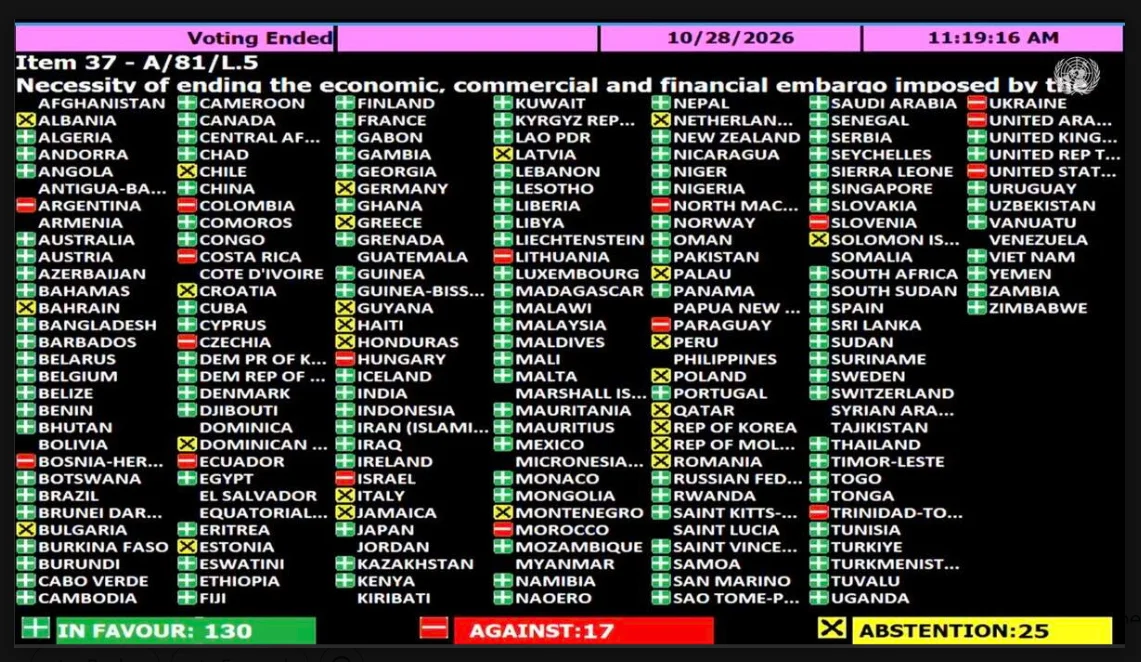
BRIDGETOWN, Barbados – In a landmark shift for Caribbean regional diplomacy, Trinidad and Tobago has become the first Caribbean Community (CARICOM) member state in decades to cast a direct vote against a long-running United Nations resolution demanding an end to the United States’ decades-old trade, economic and commercial embargo on Cuba, as regional governments showed unprecedented division on the longstanding global advocacy issue during the October 28, 2026 General Assembly vote. The final tally marked a sharp reversal of recent years’ overwhelming support for the anti-embargo measure: the resolution passed by 130 votes in favor, 17 opposed, and 25 abstentions, a steep decline from the 2025 outcome that saw 165 supporting votes, just 7 opposing ballots, and only 12 abstentions. Beyond the Caribbean, Havana lost significant traditional backing across both Western Hemisphere and European nations in the latest procedural round. Of the CARICOM delegations present for the preceding Wednesday’s assembly debate, Jamaica, Haiti and Guyana opted to abstain, while The Bahamas, Belize, Barbados, Grenada, St. Vincent and the Grenadines, St. Kitts and Nevis, and Suriname maintained their traditional supportive stance for the resolution. Three CARICOM states – Antigua and Barbuda, Dominica, and St. Lucia – were recorded as absent when the vote was called. Jamaica’s Minister of Foreign Affairs and Foreign Trade Kamina Johnson-Smith laid out Kingston’s rationale for its historic abstention during a post-vote press briefing, framing the decision as a deliberate, months-long policy shift rather than an impulsive break from regional norms. Johnson-Smith noted that Prime Minister Andrew Holness first flagged deepening regional concern over Cuba’s worsening humanitarian crisis during a CARICOM summit hosted in St. Kitts and Nevis earlier in 2026, where he reaffirmed Jamaica’s enduring solidarity with the Cuban people but called for structured U.S.-Cuba dialogue to de-escalate tensions and improve living conditions for ordinary citizens, and suggested CARICOM could play a neutral, constructive mediating role to advance that goal. The foreign minister added that she formally articulated this revised national position during her address to the 2026 UN General Assembly in New York, restating that Jamaica remained deeply troubled by widespread Cuban shortages of food, life-saving medications, energy and other critical essentials, but that the annual UN resolution’s narrow framing no longer aligned with Kingston’s broader policy priorities. She explained that the Jamaican parliament had formally tabled a bipartisan motion just one day prior to the UN vote, which moved beyond the longstanding regional demand for a simple end to the embargo to explicitly call for accelerated Cuban domestic economic and institutional reform, full respect for fundamental universal human rights, and structured, mutually respectful bilateral engagement between Havana and Washington to reduce trade and financial barriers and facilitate Cuba’s gradual, supported integration into the global economic system. Johnson-Smith emphasized that the existing text of the UN resolution did not incorporate any of these additional priority elements, and that no amendments to the document were permitted ahead of the vote. “We did not vote against the measure, because we remain opposed to all unilateral coercive measures that violate the UN Charter, but we also could not vote in favor of a resolution that we now recognize has been reintroduced year after year with zero meaningful progress to ease Cuban suffering, and in fact has coincided with a deepening humanitarian crisis for ordinary Cubans,” she told reporters. The minister added that the revised stance also aligned with Jamaica’s broader commitment to advancing meaningful reform of global multilateral institutions, to ensure existing frameworks can deliver on the 2030 Sustainable Development Agenda for all nations rather than remaining stuck in repetitive, ineffective procedural cycles. She reaffirmed that Jamaica’s longstanding warm bilateral ties with Cuba, rooted in geographic proximity, shared historical heritage and mutual respect for national sovereignty, remained fully intact, and that Kingston would continue to advocate for balanced solutions that address both the harms of the U.S. embargo and domestic structural constraints that have limited Cuban productivity, foreign investment and broad-based economic opportunity for its population.